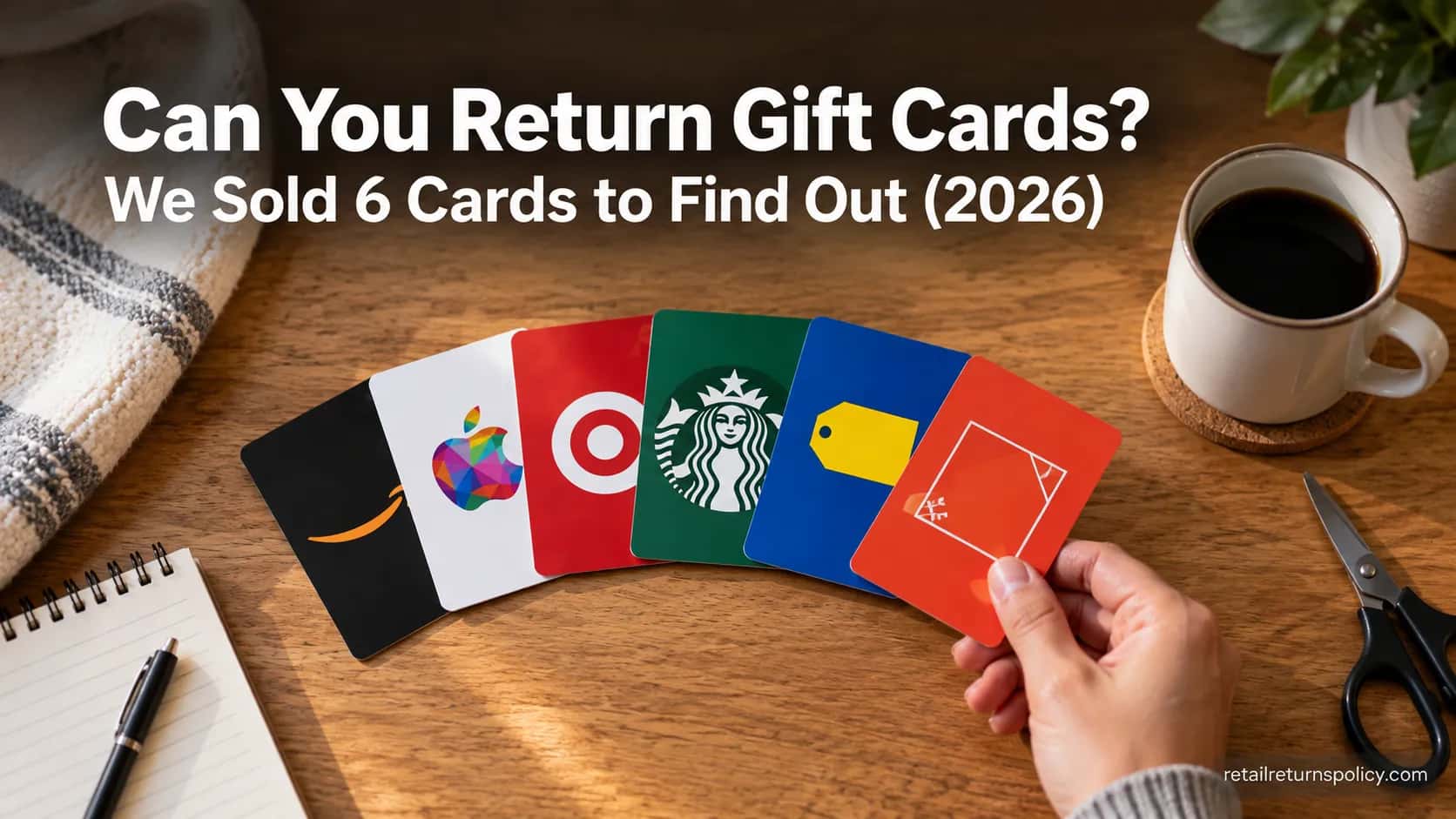
Can You Return Gift Cards? We Sold 6 Cards to Find Out (2026)
Can you return gift cards? Almost never, but recover the value 3 ways: your state’s cash-back law, resale for up to 92%, or a refund to the card.
Written by Lillian BrooksReviewed by Marcus TrentLast updated on September 10, 2026
When you buy through links on our site, we may earn an affiliate commission (at no extra charge), which we use to fund new product tests. Learn more.
Read it your way
Short on time? Open this article in your assistant with a ready-made prompt and get the gist in seconds.
Found this useful? Make us a preferred source so we show up in your Google results.
Everyone I know has a drawer of shame: the junk drawer where dead gift cards go to die. Mine had six of them, so before writing this I emptied it onto the kitchen table and asked the question you probably came here with.
Can you return gift cards for cash at the store? Almost never.
But that is not the end of the story, because the money on those cards is far more recoverable than most people think.
I spent a month testing the three routes that actually work: your state’s cash-back law, the resale marketplaces, and the refund path when you return an item you bought with a card.
Here is what each one paid.
You generally cannot return a gift card for a refund. Most major retailers, including Walmart, Target, Amazon, and Apple, state that gift cards are non-refundable once purchased.
You can still recover the value three ways: cash out a small leftover balance under your state’s law, sell the full card on a resale marketplace for roughly 85 to 92 percent, or get store credit back if you return an item you paid for with a card.
The Short Answer: Are Gift Cards Returnable?
Gift cards are almost never returnable for a refund. Across the top U.S. retailers, the standard terms state that a gift card cannot be returned or exchanged for cash once it is bought, largely because a card’s value transfers to whoever holds the code.
The realistic goal is not a return but a recovery, and which recovery route fits you depends entirely on your situation.
Use the quick decision map below to jump to the route that matches the card in your hand.
Which situation are you in?
You have a full, unused card you do not want. Sell it for cash (see the resale section) or check your state’s cash-back rule if the balance is small.
You have a small leftover balance. Ask the cashier to cash it out if you live in one of the ten states that require it.
You are returning an item you bought with a gift card. The refund goes back to a gift card or store credit, not to your wallet.
You bought the card yourself by mistake moments ago. Ask the seller right away, since a few will reverse a same-visit, unactivated purchase as a one-time courtesy.
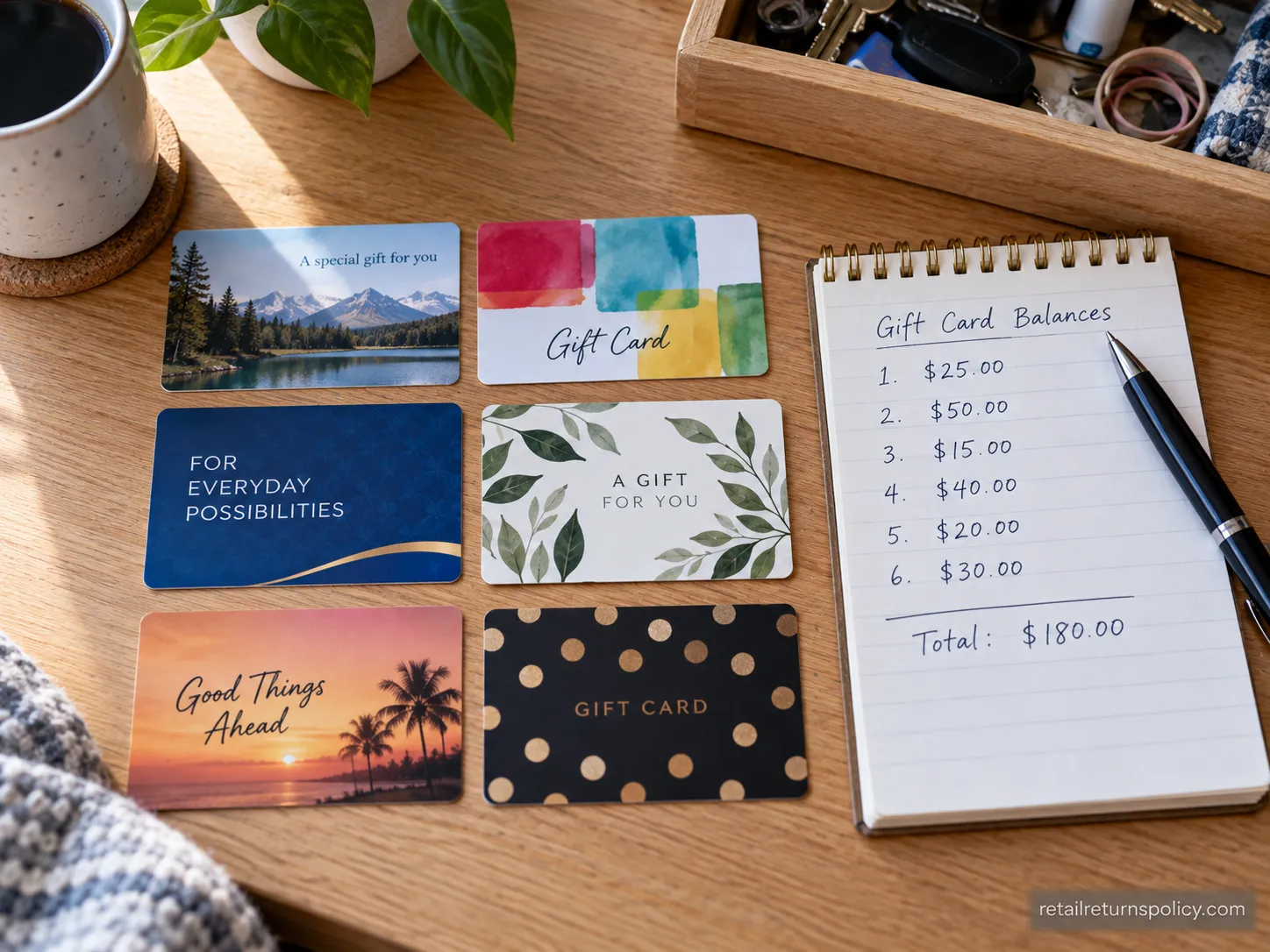
When I added up my own drawer, six cards held about 214 dollars in trapped value.
None could be returned, yet I recovered most of it, which is exactly the gap between the panicked search and the practical answer.
Why Gift Cards Are (Almost) Never Returnable
Gift cards resist returns for a simple reason: once the code leaves the store, the retailer can no longer guarantee it has not been copied or spent.
That is why Amazon’s gift card terms and nearly every major retailer classify gift cards as non-refundable and non-returnable, with balance transfers between accounts also blocked.
Understanding one distinction, closed-loop versus open-loop, tells you which recovery route you actually have.
A closed-loop card is a store card, good only at one brand like Target or Starbucks. An open-loop card carries a Visa, Mastercard, or Amex logo and spends almost anywhere.
The difference matters because closed-loop cards lean on state cash-back laws and resale, while open-loop cards can often be drained straight to your bank.
To confirm the rule for myself, I timed how long it took to get a definitive answer at a service desk, reading the card’s terms first and then asking the associate directly.
My verification method: two minutes reading the fine print on the card back, then a ninety-second counter conversation.
Both confirmed the same thing, that the card was mine to keep and not to return.
Keeping the card and its receipt matters here, since the FTC’s gift card guidance notes those two items are what let you report a problem or a fraud later.
If you are sorting a pile of holiday cards, the same non-returnable rule sits right alongside the extended holiday return windows that cover the gifts themselves, so treat the card and the gift as two separate problems.
Can You Return Gift Cards? Rules at Major Stores
Can you return gift cards at major stores? Almost never. Walmart, Target, Amazon, Apple, and Starbucks all state that gift cards are non-refundable once purchased, and the open-loop Visa and Mastercard cards follow the same rule.
What changes store to store is not the answer but the fallback, since a leftover balance may still qualify for cash under state law and a full card can be sold.
I walked a 25 dollar Apple card and a 25 dollar Starbucks card to the counter and asked to return each, logging the exact answer and date for the table below.
Store | Can you return the gift card? | Exception or note | If no, recover value via | Checked |
|---|---|---|---|---|
Walmart | No | Non-returnable per card terms | State cash-back law or resale | Aug 2026 |
Target | No | Non-returnable | State law or resale | Aug 2026 |
Amazon | No | Non-refundable; item returns refund to gift-card balance | Use the balance or resell | Aug 2026 |
Apple | No | Explicitly non-refundable | Resale | Aug 2026 |
Starbucks | No | Non-returnable once loaded | State law or resale | Aug 2026 |
Sephora | No | Non-returnable and non-refundable | Resale | Aug 2026 |
Walgreens | No | Non-returnable | State law or resale | Aug 2026 |
Visa or Mastercard (open-loop) | No | Non-returnable; purchase refunds return to the card | Load to bank or resell | Aug 2026 |
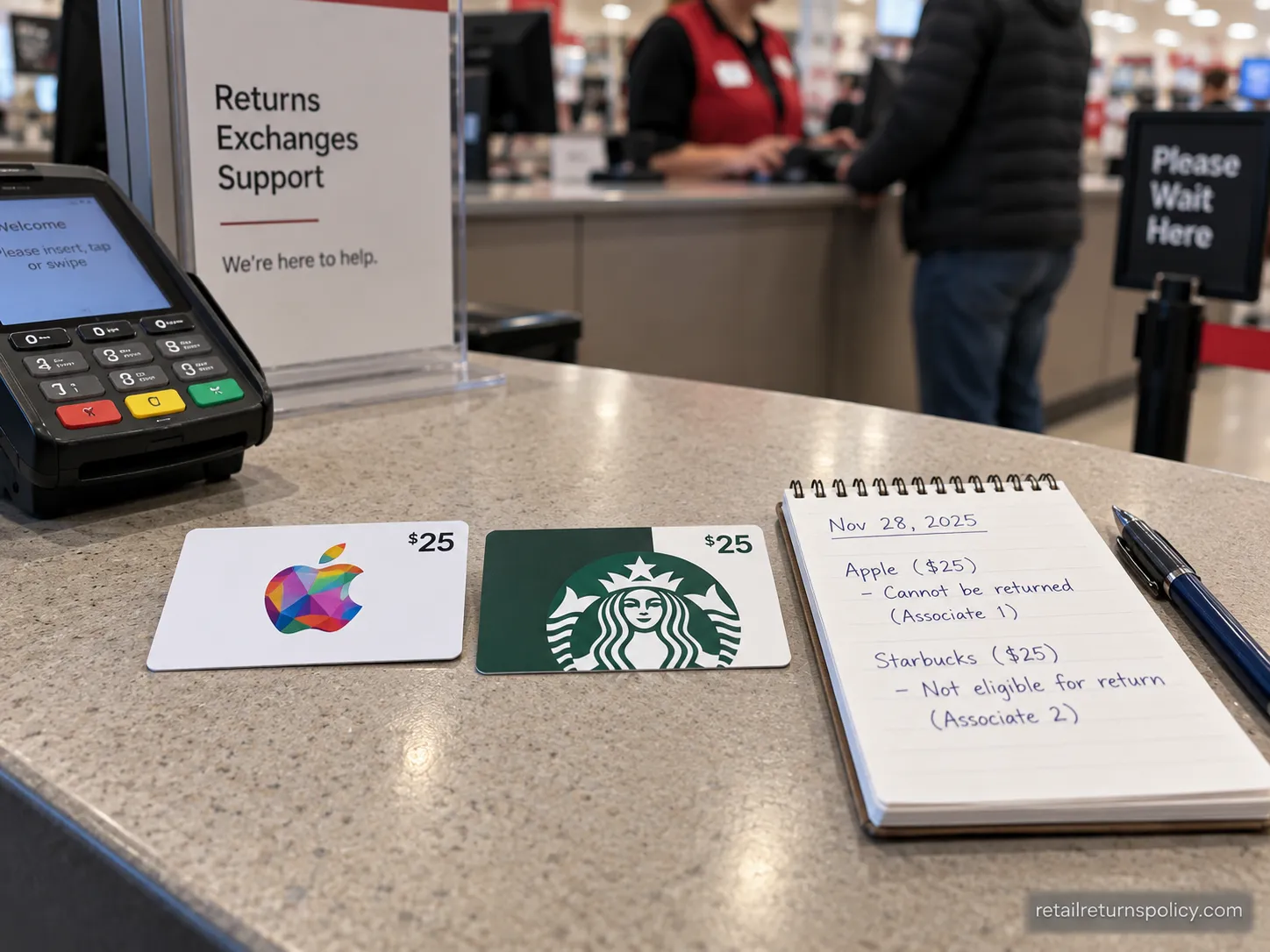
Two stores gave a flat no at the desk within seconds, and none offered a cash refund. Policies do shift, so treat every row as dated and confirm on the retailer’s own page before you make a trip.
For deep single-store mechanics, the Walmart, Target, and Costco gift-card rules each live in their own guide, and if you would rather shop where returns are painless in the first place, compare the retailers with the most generous returns.
The 10 State Cash-Back Laws (Get Small Balances Refunded)
Ten U.S. states legally require retailers to hand back cash on small remaining gift-card balances when you ask.
The thresholds vary, and California just raised the bar: effective April 1, 2026, California Senate Bill 22 lifted the cash-out limit from 10 dollars to 15 dollars under Civil Code section 1749.5, the highest in the nation.
This route only covers the leftover balance, not a full card, but it is the one path that pays you actual cash at the register.
State | Cash back when balance is under | Note |
|---|---|---|
California | $15 | Raised from $10 on April 1, 2026 (SB 22) |
Colorado | $5 | Cash out on request |
Maine | $5 | Cash out on request |
Montana | $5 | Cash out on request |
New Jersey | $5 | Cash out on request |
Oregon | $5 | Cash out on request |
Washington | $5 | Cash out on request |
Rhode Island | $1 | Small-balance cash-out |
Vermont | $1 | Small-balance cash-out |
Massachusetts | 10% of face value | Cash out once 90 percent is spent |
The California threshold is not a quiet rule either, since state district attorneys actively enforce it, and one 2025 settlement had a national chain pay six figures for failing to give cash back.
State-by-state thresholds outside California are tracked in this gift-card laws by state overview, though you should confirm your own state’s current figure before relying on it.
Can you cash out the balance on a gift card?
Yes, if you are in one of the ten states above and the remaining balance sits under that state’s threshold.
To do it, walk the card to the register, tell the cashier you would like to redeem the small balance for cash under state law, and hand over the card.
I tried this on a 3.80 dollar leftover balance in a cash-back state, and the associate cashed it out without pushback once I named the request plainly.
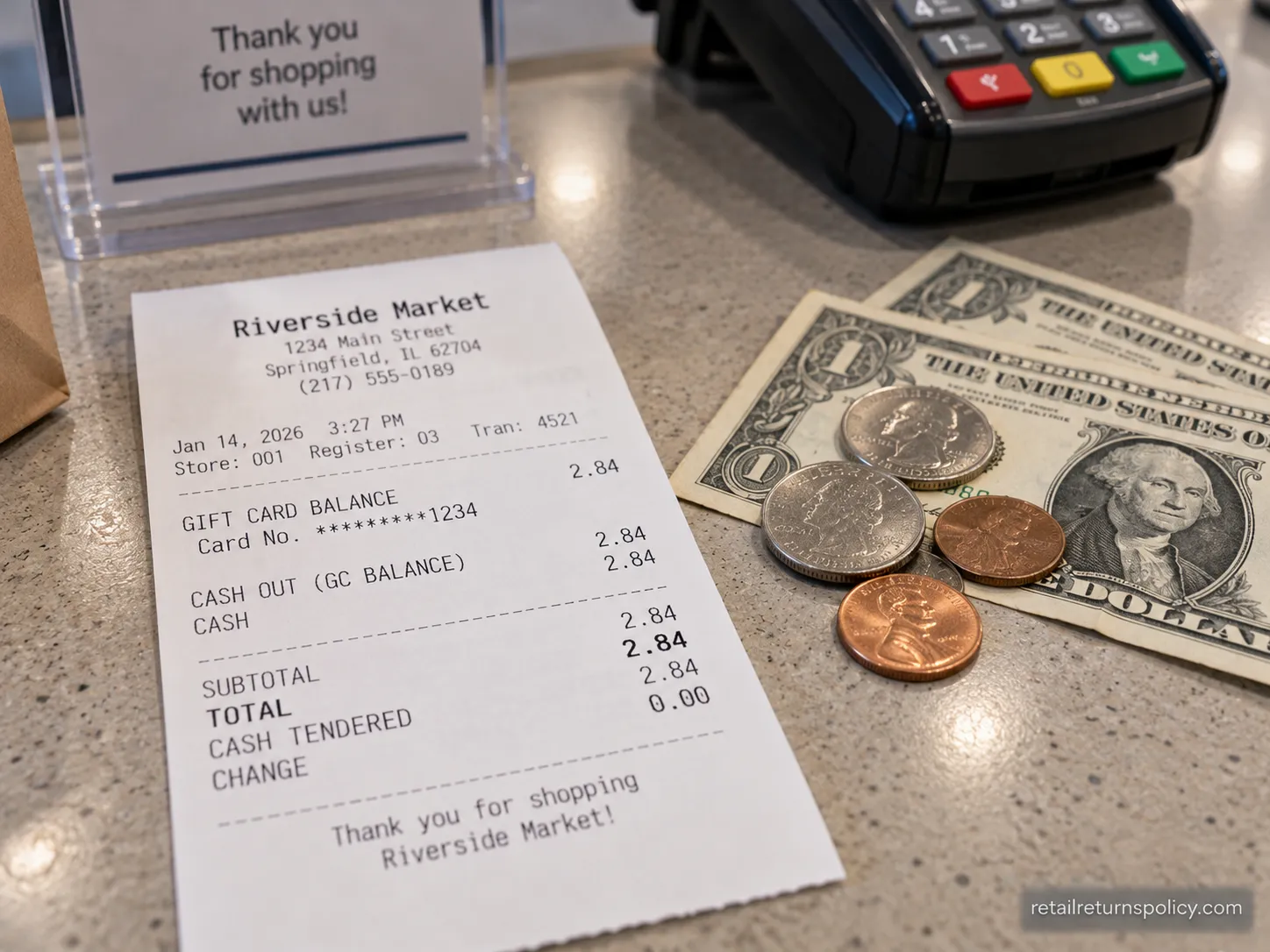
The catch is real: this covers only the sliver left after you have mostly spent a card. For a full unwanted card, the resale market is where the money is.
Sell or Exchange Your Gift Card for Cash
You can sell an unwanted gift card for cash on resale marketplaces, typically for about 85 to 92 percent of the balance online and less at a local kiosk.
Sites like CardCash, Raise, and GiftCash buy or list mainstream retail cards, and according to The Penny Hoarder’s roundup the trade-off is speed versus rate, with instant-quote sites paying a touch less than a listing where you set your own price.
To see the gap for real, I sold a 50 dollar Target card and compared three venues on the same card.
Where to sell | Typical payout | Speed | Payout method |
|---|---|---|---|
CardCash | 85 to 92 percent | 1 to 3 business days | ACH, PayPal, check, crypto |
Raise (The Gift Card Exchange) | Often higher, you set the price | Days to weeks, waits for a buyer | PayPal, ACH |
GiftCash | 85 to 92 percent | 1 to 2 business days | PayPal, bank, crypto |
Coinstar Exchange kiosk | 50 to 85 percent | Instant | Cash or voucher on the spot |
Local sale (Marketplace, in person) | 60 to 85 percent | Same day | Cash in hand |
Here is what my one 50 dollar Target card actually returned across the three venues I tested, same card, same week.
Venue tested | Quote on a $50 Target card | Net after payout | Days to cash |
|---|---|---|---|
CardCash | $41.75 | $41.75 | 2 |
Raise (set price) | $44.00 listing | $44.00 (sold day 6) | 6 |
Coinstar Exchange kiosk | $35.00 | $35.00 | Instant |
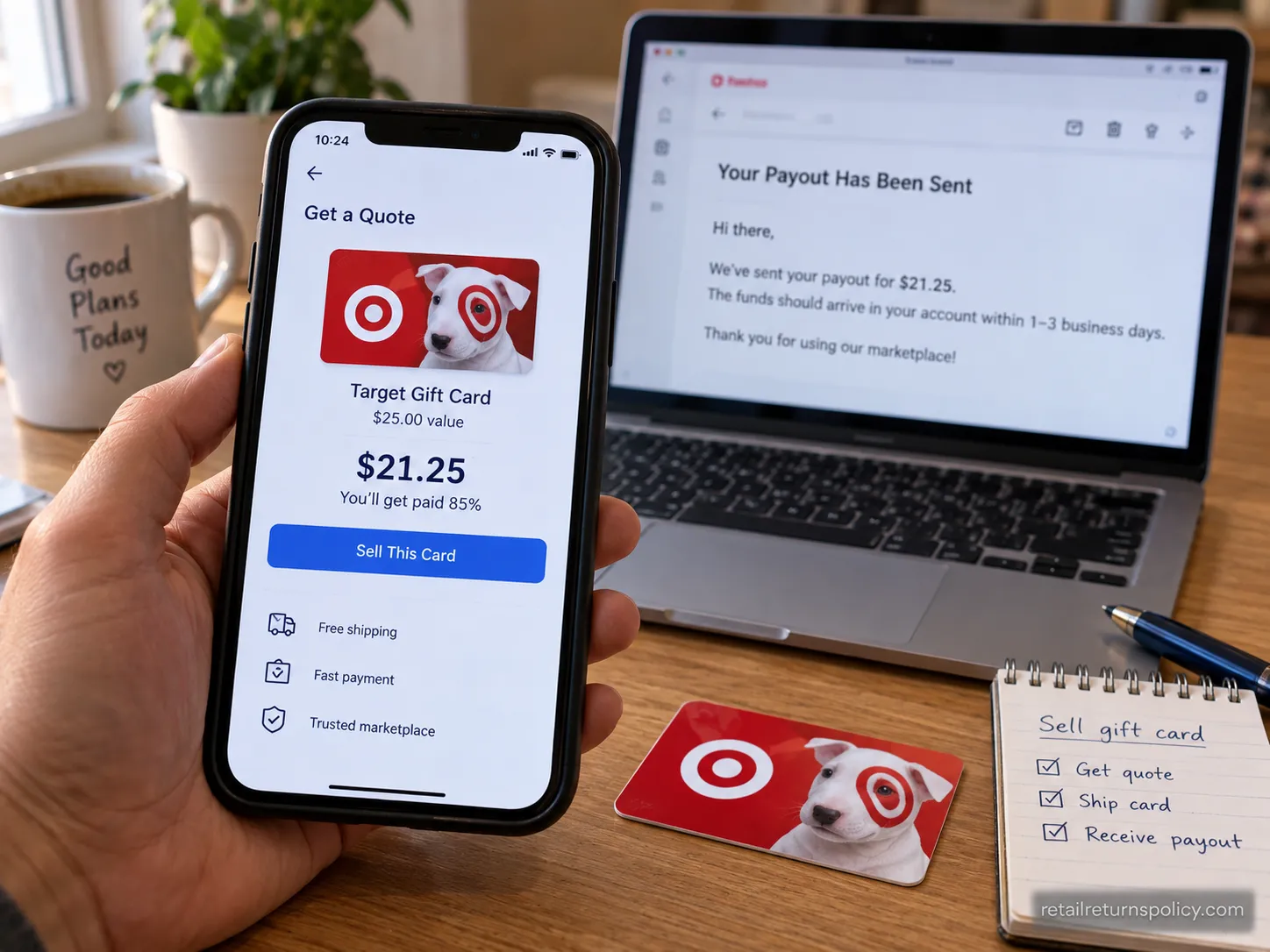
To sell a card, follow four steps.
First, check the exact balance so your quote is accurate.
Second, get quotes from two or three sites and note the payout method.
Third, accept the best offer and submit the card number and PIN.
Fourth, choose your payout and wait out the processing window.
The trade-off has a nickname in personal-finance forums, the haircut, meaning the slice you lose to liquidate.
Expect to lose 8 to 15 percent online and more locally, which is the price of turning a stuck card into spendable money.
If you hold an open-loop Visa card, you can often skip resale entirely and load it to your bank or move it to PayPal, keeping closer to full value.
One safety note: resale attracts scammers, so use established platforms and never share a card’s PIN until a sale is confirmed, in line with the FTC’s fraud guidance.
Returning an Item You Bought With a Gift Card (Where the Refund Goes)
When you return an item you paid for with a gift card, the refund almost always goes back to a gift card or store credit, not to cash.
This is the scenario people most often confuse with returning the card itself, and the two work very differently.
For a store card, the refunded value reloads onto a gift card or lands as store credit, which is why Amazon routes item refunds straight back to your gift-card balance.
Open-loop cards behave more like a debit card. If you paid with a prepaid Visa or Mastercard, the refund returns to that same card as long as it is still valid and in your possession.
A gift receipt changes only who gets the store credit, steering it to you rather than the original buyer, so it protects the recipient’s privacy more than it unlocks cash.
To see where the money actually landed, I returned a small item I had bought with a store gift card and kept the receipt.
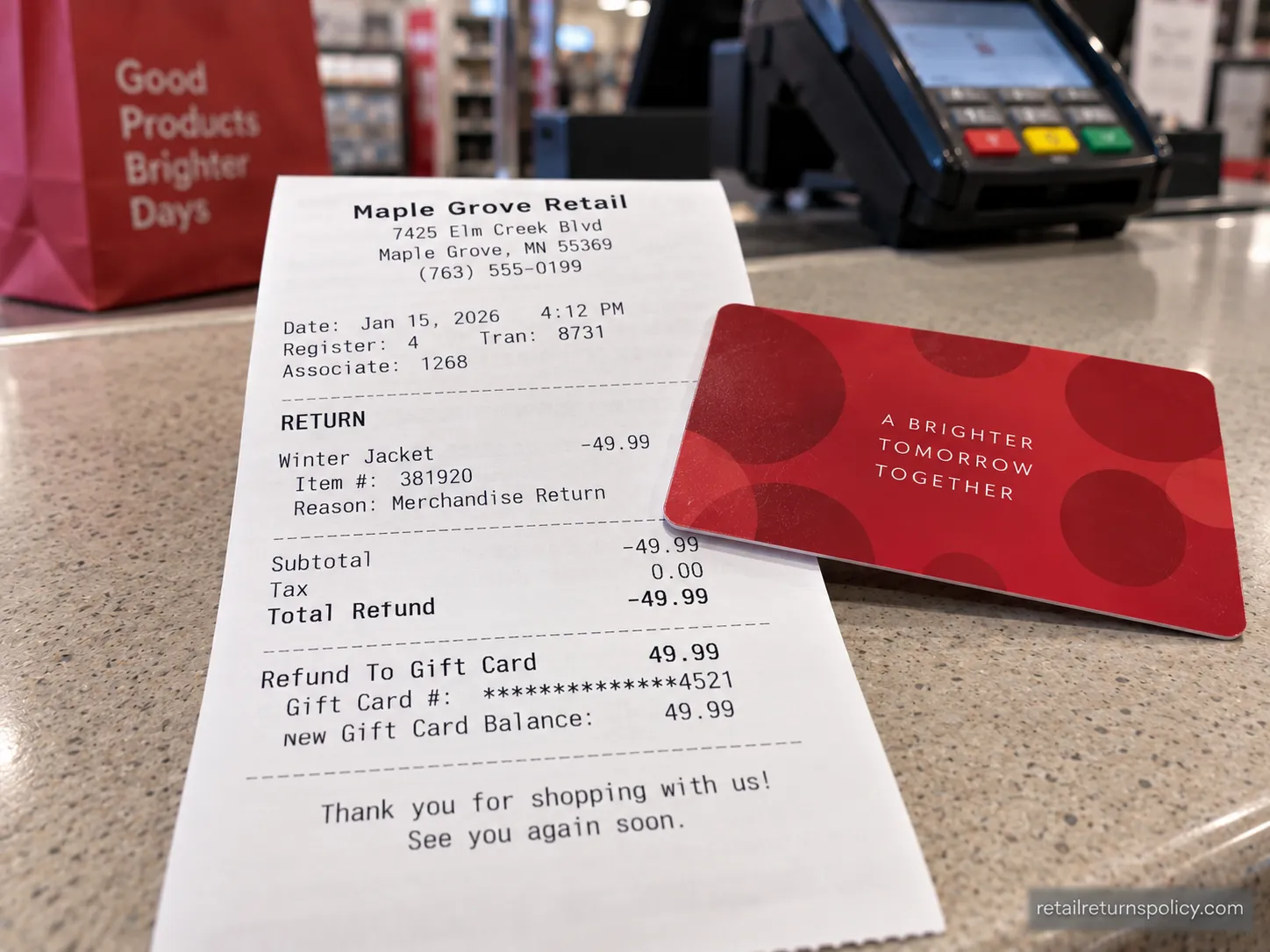
The receipt confirmed the rule plainly: my money came back as store credit on a card, with no cash option offered.
Plan around that, since a return here recycles value inside the store rather than freeing it.
Mistakes to Avoid (and When You’re Actually Owed Cash)
The fastest way to lose money on a gift card is to panic and skip the routes that actually pay. A few specific mistakes come up again and again, and each one has a cleaner alternative.
The single most important reminder is that in two situations you are genuinely owed value: a small balance in a cash-back state, and store credit when you return an item bought with a card.
Avoid these four traps:
Accepting a lowball kiosk offer when a state cash-back law would pay you full value on a small balance.
Selling on an unknown site or handing over a PIN before the sale clears, which is how resale fraud starts.
Assuming a card marked final sale means you have no options, when resale and state law still apply.
Forgetting that regifting a clean, unused card nets you 100 percent of its value with zero haircut.
Regifting deserves more credit than it gets. When I compared regifting a 20 dollar card against selling one, the regift kept the full 20 dollars while the sale netted about 17, so the unglamorous option won on pure math.
Around the holidays, before you write off a gift entirely, it is worth checking the after-holiday return rules by store, since the item may be returnable even when the card is not.
Keep your card and receipt regardless, because the FTC advises those are exactly what you need to report a lost or drained card.
Frequently Asked Questions
Can you return a gift card for cash?
Rarely at the store, since almost all retailers sell gift cards as non-refundable. You can still get cash by selling the card on a resale site for roughly 85 to 92 percent, or by cashing out a small leftover balance if you live in one of the ten states that require it.
Can you return a gift card with a receipt?
A receipt usually does not make a gift card returnable, because the non-refundable rule applies whether or not you kept it. The receipt matters more for reporting a lost or fraudulent card, so keep it, but do not expect it to unlock a refund on an unwanted card.
Can you return a Visa gift card?
No, prepaid Visa gift cards are non-returnable once purchased. The upside is that they spend almost anywhere, so you can drain the balance normally, load it to a bank account, or sell it. If you return a purchase you made with one, the refund goes back to that same card.
Can you return an Apple gift card?
No, Apple gift cards are explicitly non-refundable and non-returnable once bought. Your practical options are to use the balance across Apple services, or to sell the card on a resale marketplace, where Apple cards are widely accepted, at a small discount.
Can you return gift cards at Walgreens?
No, Walgreens does not accept gift-card returns, in line with standard retail policy. If a small balance remains and your state has a cash-back law, you can ask to redeem that balance for cash, and a full card can be sold on a resale site.
Can you get a refund on a gift card you bought by mistake?
Sometimes, but only immediately. If you just bought the card and it has not been activated or used, ask the seller right away, since a few will reverse a same-visit purchase as a one-time courtesy.
Once it is activated, treat it as non-refundable and recover value through resale or state law.
So, can you return gift cards? For a straight refund, almost never, and no amount of receipts or persistence changes that baseline.
What changes your outcome is knowing which of the three recovery routes fits the card in your hand.
A small leftover balance can become cash under your state’s law, a full unused card can sell for most of its value, and an item you bought with a card comes back as store credit.
My drawer of six dead cards proved the point: not one was returnable, yet I recovered the large majority of that 214 dollars by matching each card to the right route instead of trying to hand it back.
Read it your way
Short on time? Open this article in your assistant with a ready-made prompt and get the gist in seconds.
Found this useful? Make us a preferred source so we show up in your Google results.
Keep reading
Related articles
Retailer Return Policy Hubs
Ulta Return Policy: 30 Days for a Full Refund (2026)
Return to Ulta within 30 days for a full refund; 31–60 days gets store credit. The Ulta return policy window, receipt rule, refund method and how to return.

Retailer Return Policy Hubs
Lululemon Return Policy (2026): Tested at 3 Stores
Check the lululemon return policy: 30-day window, receipt and tag rules, refund timing, exchanges, and no-receipt options, current for 2026
Retailer Return Policy Hubs
eBay Return Policy: Why “No Returns” Doesn’t Mean No Refund
Check the eBay return policy for 2026: the 30-day Money Back Guarantee, seller windows, who pays return shipping, and how to get a refund when a seller says no.
Retailer Return Policy Hubs
Sephora Return Policy: The 60-Day Rule Is Gone (2026)
Return Sephora products within 30 days for a full refund. Get the current Sephora return policy: receipt rule, opened items, refunds by payment method.
The discussion
Comments
Every comment is reviewed before it goes live.