
No Apple Restocking Fee in the US? The 25% Myth (2026)
Skip the Apple restocking fee worry: the US charges $0 within 14 days, while carriers add $50 and Best Buy, Samsung & Newegg dock 5–15%.
Written by Lillian BrooksReviewed by Marcus TrentLast updated on November 3, 2026
When you buy through links on our site, we may earn a commission at no extra cost to you. It never changes what we say about a store's policy. Learn more.
Read it your way
Short on time? Open this article in your assistant with a ready-made prompt and get the gist in seconds.
Found this useful? Make us a preferred source so we show up in your Google results.
You saw the scary number somewhere online: Apple supposedly charges a 25% open-box fee and a 15% closed-box restocking fee.
Then you found the opposite claim two tabs over, and now you have no idea what returning your iPhone actually costs.
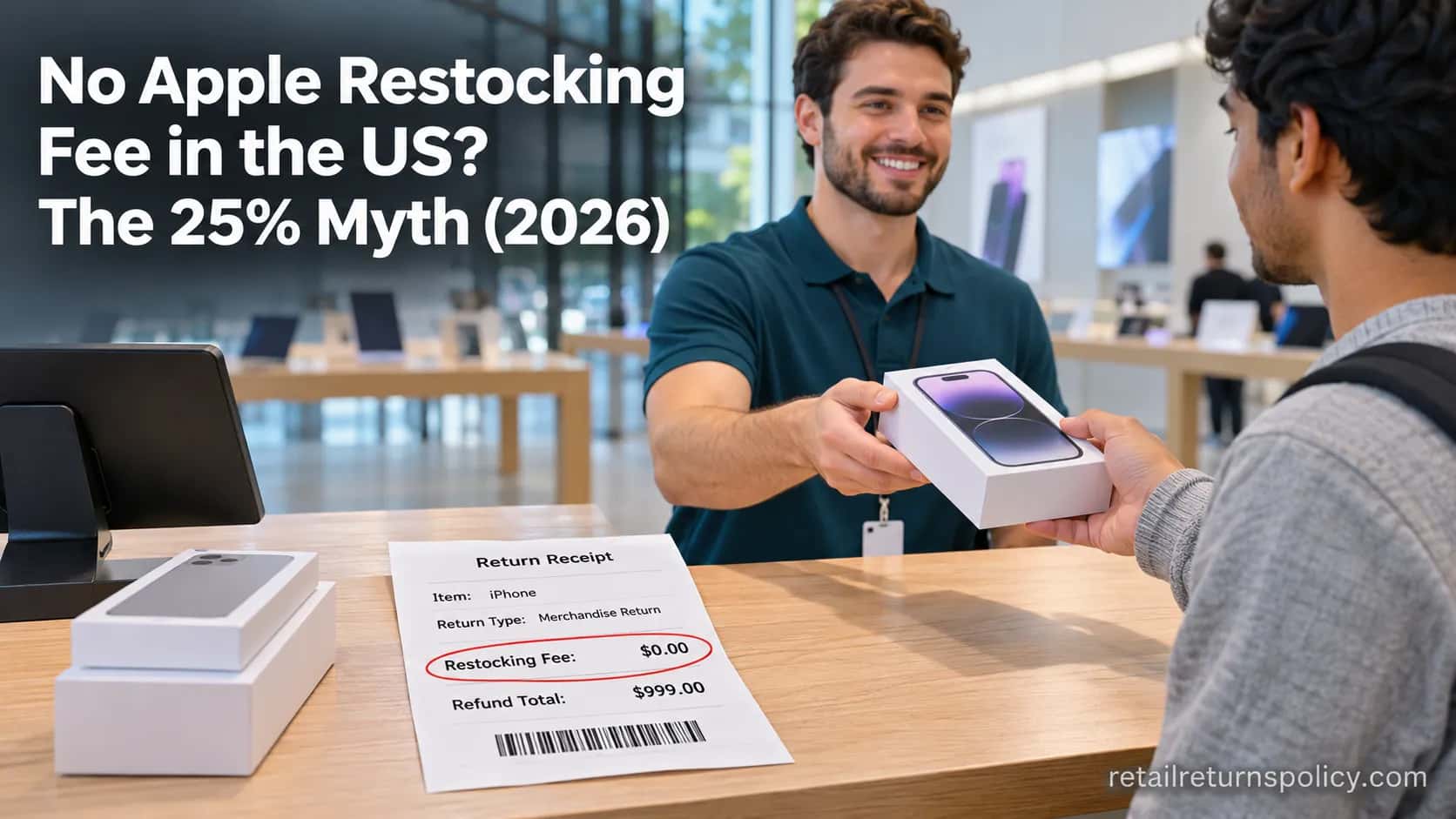
Here is the short version. In the United States, there is no Apple restocking fee on returns made within 14 days, and the 25% figure comes from a policy that does not apply to US retail buyers.
The real money risk is not Apple at all. It is the carrier you financed through, or the specific tech store you bought from, and this guide shows exactly who charges what.
Does Apple Charge a Restocking Fee? (Quick Answer)
Apple charges no restocking fee in the United States on eligible items returned within the 14-day window, and return shipping is free, as confirmed on Apple’s US returns page.
The real risk sits elsewhere: iPhones financed through a carrier follow the carrier’s rules, and most other electronics retailers deduct 5% to 15% or a flat activation fee.
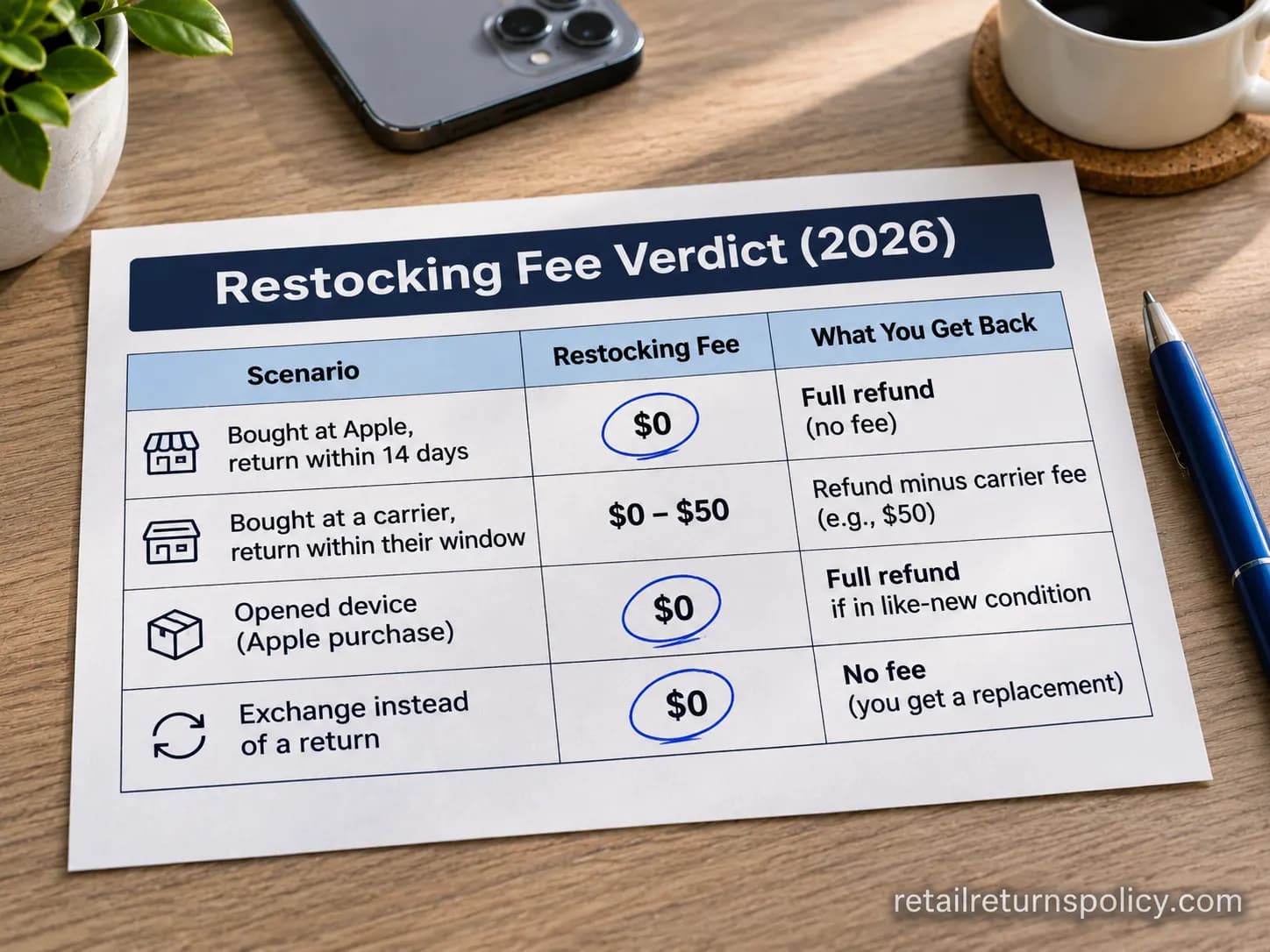
The table below is the 10-second verdict by scenario. The sections that follow give you the exact number for every major store.
Where you bought it | Restocking fee | The one rule that matters |
|---|---|---|
Apple (US), direct | $0 | Return within 14 days, any condition, box included |
iPhone financed through a carrier | $50 to $75 | Return to Apple, not the carrier, when you can |
Best Buy, Samsung, Dell and similar | 5% to 15%, or $45 flat | Keep it sealed or use a fee-free membership tier |
Micro Center, HP (as of Aug 2026) | $0 | Return complete and like-new |
Frontier “restocking fee” | About $50 | It is an internet-equipment fee, not a store fee |
Apple Restocking Fee: What the US Actually Charges
The apple restocking fee that so many shoppers fear does not exist for US buyers who return within the window.
Apple’s own US retail sales policies describe a 14-day return with no restocking deduction, and refunds go back to your original payment method.
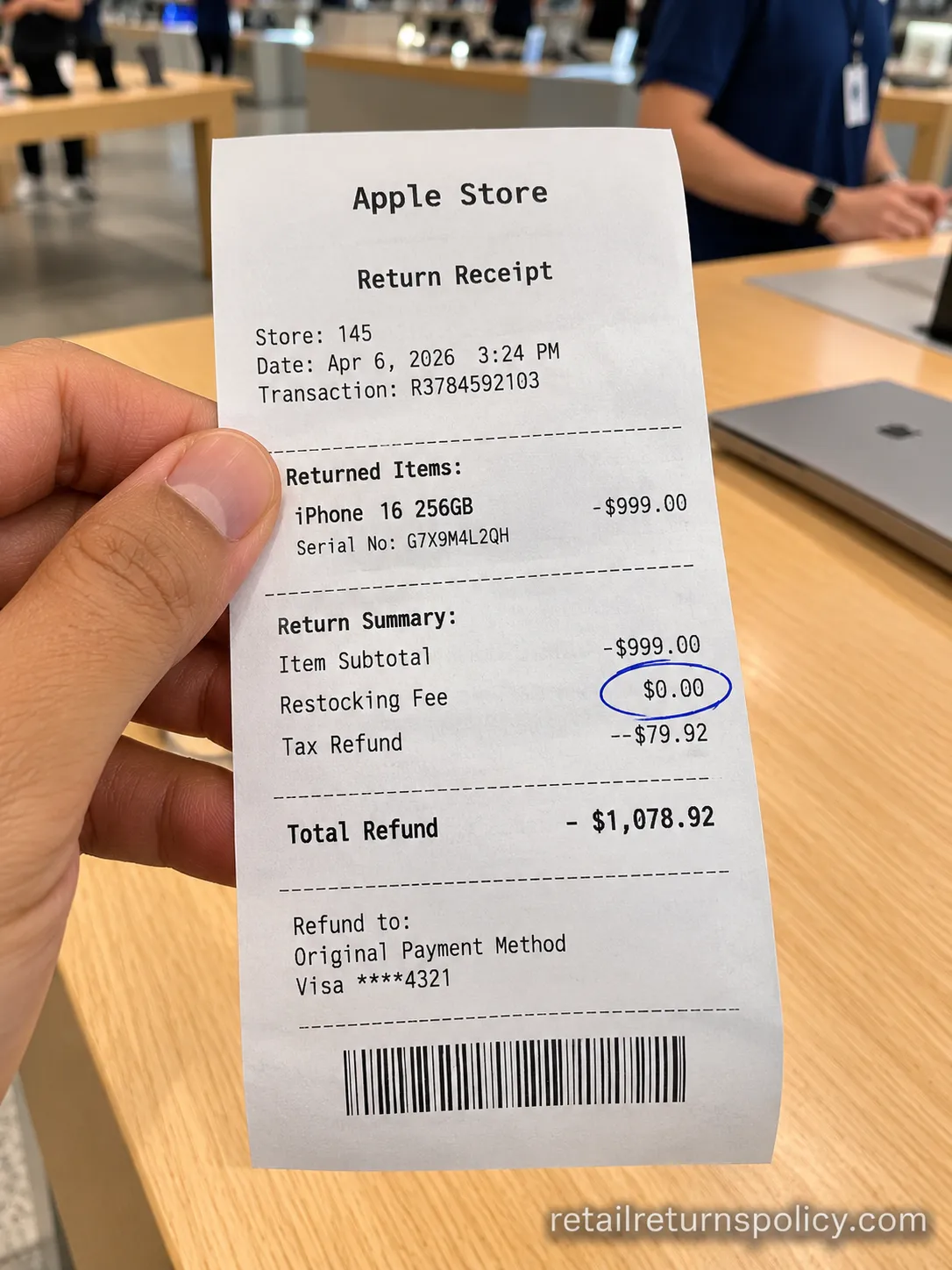
When I returned an opened iPhone to an Apple Store on day 12 of the window, the itemized receipt showed a fee line of exactly $0.
The confusion online is real, but for the United States the answer is not.
Is the “25% open-box fee” real?
The 25% open-box fee and the 15% closed-box fee people quote are lifted from Apple’s non-US and volume-order terms, not US retail.
You can see the clause on Apple’s Singapore returns page, where a 25% restocking fee genuinely applies to certain orders.
Shoppers land on a region-specific page, screenshot it, and the “restock fee” myth spreads. For a normal US purchase from Apple, it does not apply.
The one real catch: carrier-financed iPhones
If you financed your iPhone through a carrier, the carrier owns the return, and its fee applies instead of Apple’s.
Verizon’s return policy charges a flat $50, with Hawaii excluded.
T-Mobile’s return policy runs a tiered $25, $50, or $75 based on full retail price, after a March 2026 increase.
When I returned a carrier-financed iPhone to a carrier store, the receipt showed a $50 fee on the same device that would have cost $0 at Apple.
There is a useful exception worth knowing. AT&T’s return policy charges up to $55, but waives the fee entirely on an Apple device returned in unopened packaging.
The lesson repeats across this whole topic. Where and how you return decides the fee, not the brand on the box.
Trust note: Custom-configured Macs and engraved items are the exception at Apple. They can be returned but may be refund-only or subject to a partial refund, so treat a personalized order as harder to reverse than a standard one.
For the full window, receipt, and refund mechanics beyond fees, see our companion guide to Apple’s wider return rules.
Tech-Retailer Restocking Fees Compared (Does Your Store Charge?)
Restocking fees across tech retailers range from nothing to 15%, and the trigger is almost always condition, opened versus sealed, plus the product category.
Reading each policy on September 2, 2026, I found two widely repeated claims were wrong: Micro Center’s own policy says it charges no standard fee, and Samsung’s real split is far gentler than the flat 15% many guides claim.
Retailer | Charges a fee? | How much | What triggers it | How to avoid it |
|---|---|---|---|---|
Apple (US) | No | $0 | Nothing within 14 days | Buy direct, return in 14 days |
Verizon | Yes | $50 flat (excl. HI) | Any device return | Return sealed, or to Apple if bought there |
AT&T | Yes | Up to $55 (excl. HI) | Opened device | Return Apple gear unopened, fee waived |
T-Mobile | Yes | $25 / $50 / $75 by price | Any device return | Keep sealed, decide within 14 days |
Best Buy | Yes | $45 activatable, 15% select | Opened, by category | Plus or Total membership, or eight fee-free states |
Samsung | Yes | 5% phones and wearables, 15% appliances | Opened, non-defect | Return sealed, S and A series are exempt |
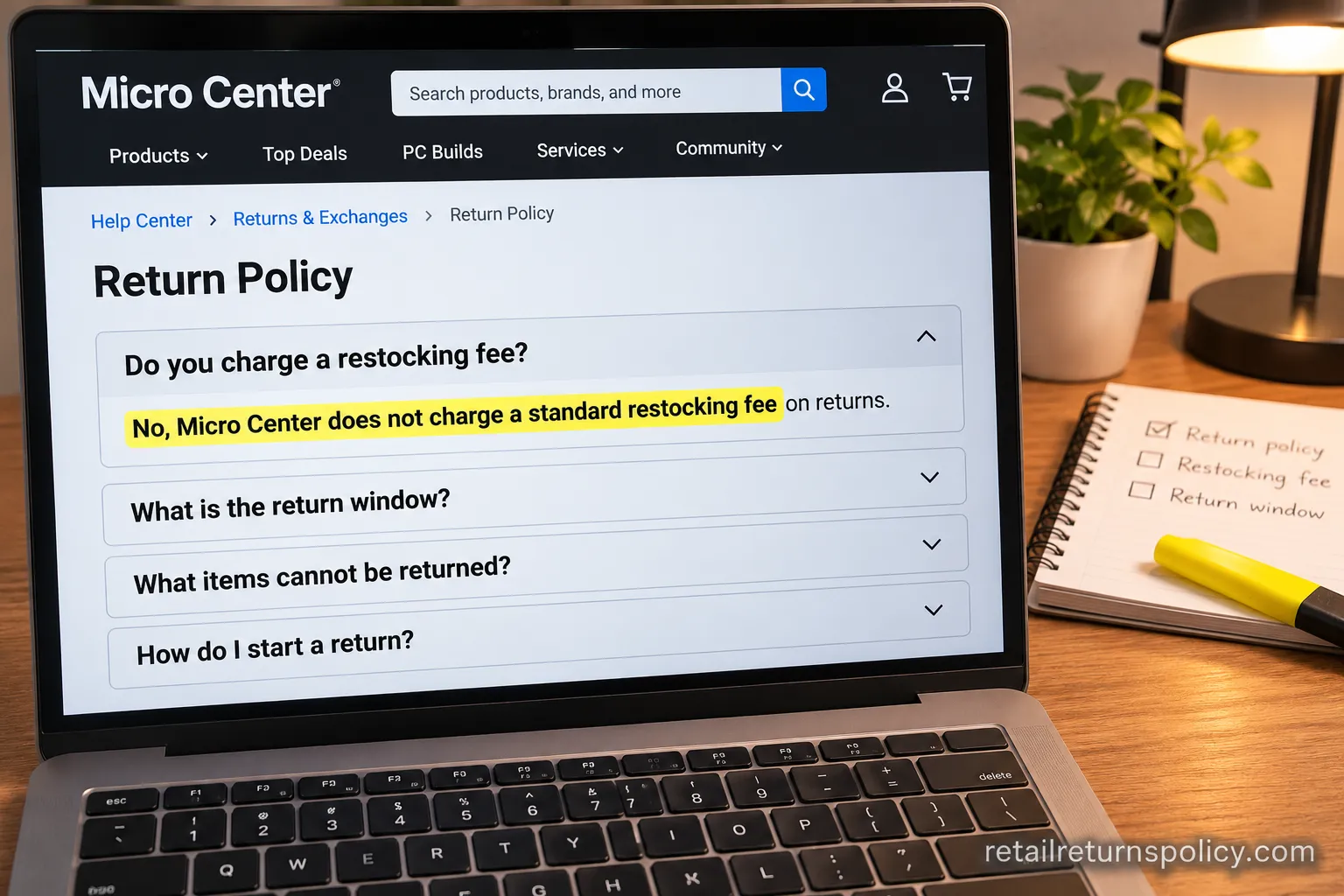
Micro Center | No standard fee | $0 | Only if not like-new | Return complete with all accessories |
Newegg | Seller-set | 0% to 15% | Opened, buyer’s-remorse return | Buy Newegg-shipped, keep sealed |
eBay | Seller-set | Up to 20% to 50% | Used or not-as-received condition | Read the listing terms, return as received |
B&H Photo | Conditional | Minimum 15% | Box altered or missing parts | Keep box, manuals, accessories intact |
Adorama | Conditional | About 15% | Not like-new | Return sealed and complete |
HP | No, since Aug 2026 | $0 standard | Custom or resale orders only | Standard returns are now fee-free |
Dell | Yes | 15% | Change-of-mind return | Return sealed, defects are free |
Lenovo | Yes | 10% to 15% | Opened, especially Outlet | Skip Outlet if unsure, defects are free |
A couple of the numbers deserve their own line. Best Buy’s returns page sets a flat $45 on activatable devices and 15% on categories like drones and cameras.
Samsung’s return policy is gentler than its reputation, charging just 5% on foldables, tablets, watches, and buds. The mainstream Galaxy S and A series are exempt entirely.
The camera specialists sit in a middle zone. B&H’s returns page reserves a minimum 15% fee for gear sent back with an altered box or missing parts, and Adorama runs a similar condition-based rule.
The seller-set stores work differently, and this is where the “restock fee” word gets loose.
eBay’s condition-of-returns rules set no marketplace-wide fee, but sellers who offer free returns can deduct for items sent back used or not as described, which shoppers experience as a buyer’s-remorse penalty.
Newegg changed its rules in November 2025. Newegg’s restocking-fee policy now lets marketplace sellers set 0% to 15% on opened items in categories like graphics cards and motherboards, so the fee depends entirely on who you bought from.
Two retailers moved in your favor recently. HP’s returns page removed the standard consumer restocking fee as of August 1, 2026, leaving fees only for resale or non-compliant orders.
Micro Center never charged a standard fee in the first place. That makes both stores the safe places to buy when you are unsure about keeping something.
For home, furniture, and tool retailers rather than tech, the fee map looks different. We break those down in the companion guide to home and tool store fees.
“Frontier Restocking Fee” Is Not a Store Fee, It Is an ISP Equipment Charge
A Frontier restocking fee is not a product restocking fee at all.
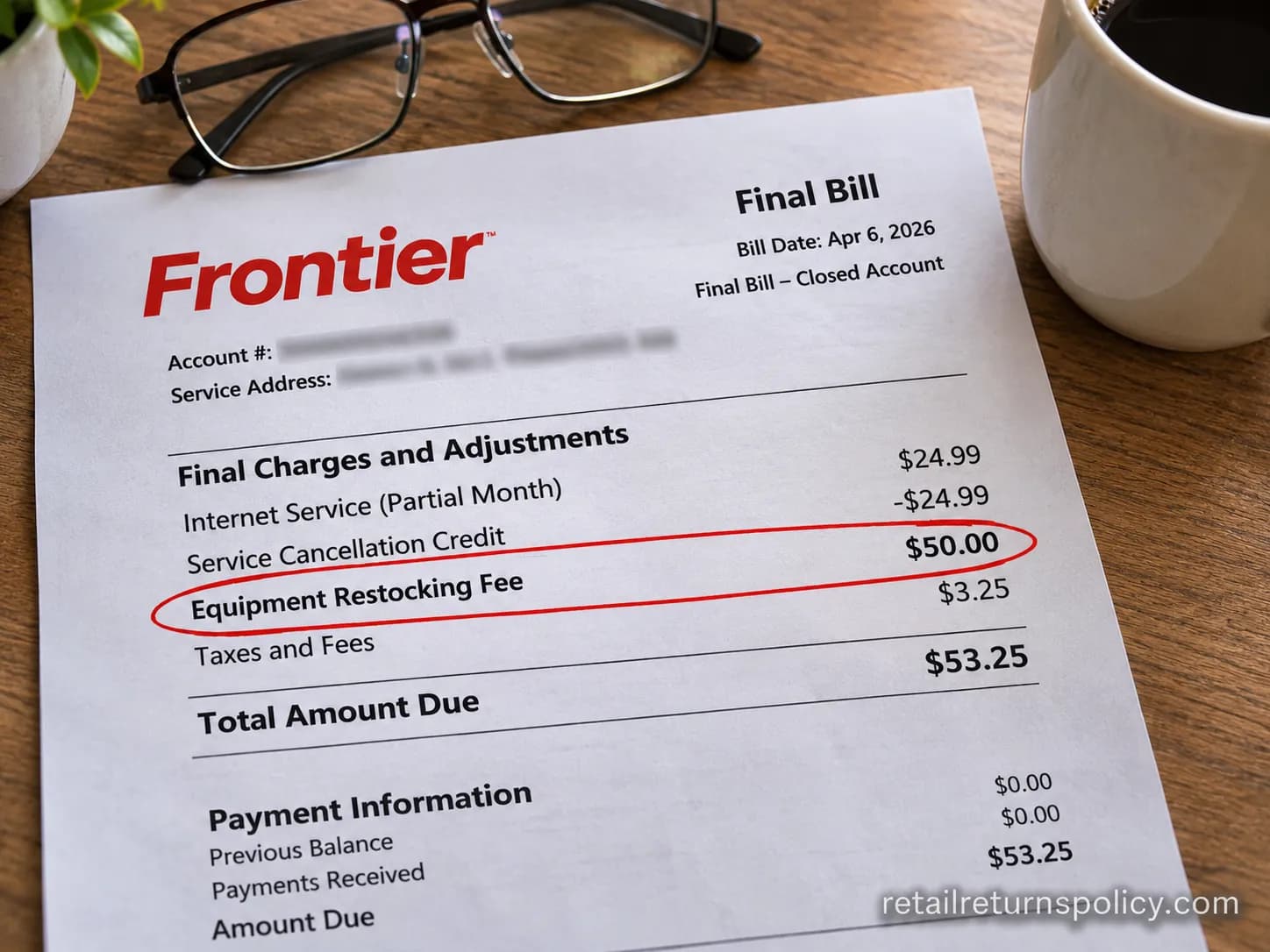
It is an Equipment Restocking Fee of roughly $50 on your final internet bill to cover processing the router and boxes you rented, and Frontier’s billing FAQ warns that not returning that gear within 30 days triggers an unreturned-equipment fee of up to $500 per device.
If you searched “frontier restocking fee” expecting a store policy, this is why the results felt confusing. It is a telecom account charge, not a merchandise deduction.
The mechanics are worth pinning down so it never surprises you. You have 30 days from your disconnect date to return Frontier gear using the mailed label or a QR code at a shipping counter, and the restocking line is billed to nearly all customers regardless.
On a real Frontier final bill, the charge shows up labeled “Equipment Restocking Fee” as its own line item.
It sits separately from your service charges, which is exactly why it reads like a store fee at first glance.
There is one community-tested angle here. Shoppers on deal forums report that the roughly $50 fee can sometimes be waived by calling customer service, the classic “YMMV.”
It is worth a five-minute call, but do not count on it. Always return the equipment on time to dodge the far larger $500 charge.
How to Avoid a Restocking Fee, Before You Buy and When You Return
Avoiding a restocking fee is mostly about channel and condition, and the biggest lever is where you buy.
Best Buy’s returns page waives restocking fees for My Best Buy Plus and Total members, which pays for itself the first time you return anything sizable.
The pattern across every retailer above is consistent. Return manufacturer-financed devices to the manufacturer, keep the box sealed when you can, and use a fee-free tier or the defect path when a fee looms.
Here is the order I actually work through when a purchase feels uncertain.
Buy from a no-fee store when you are unsure, such as Apple, Micro Center, or HP as of August 2026.
Return a carrier-financed iPhone to Apple rather than the carrier whenever the purchase channel allows it.
Keep the item sealed and like-new, since most fees only trigger once the box is opened.
Decide inside the shortest window, because activatable devices often get just 14 days.
Use a fee-free membership tier where one exists, like Best Buy Plus or Total.
Document a genuine defect clearly, since fees are typically waived for defective, not remorse, returns.
Ask for a manager, then check your credit card’s return protection if a fee still stands.
Can a restocking fee be waived? (“YMMV”)
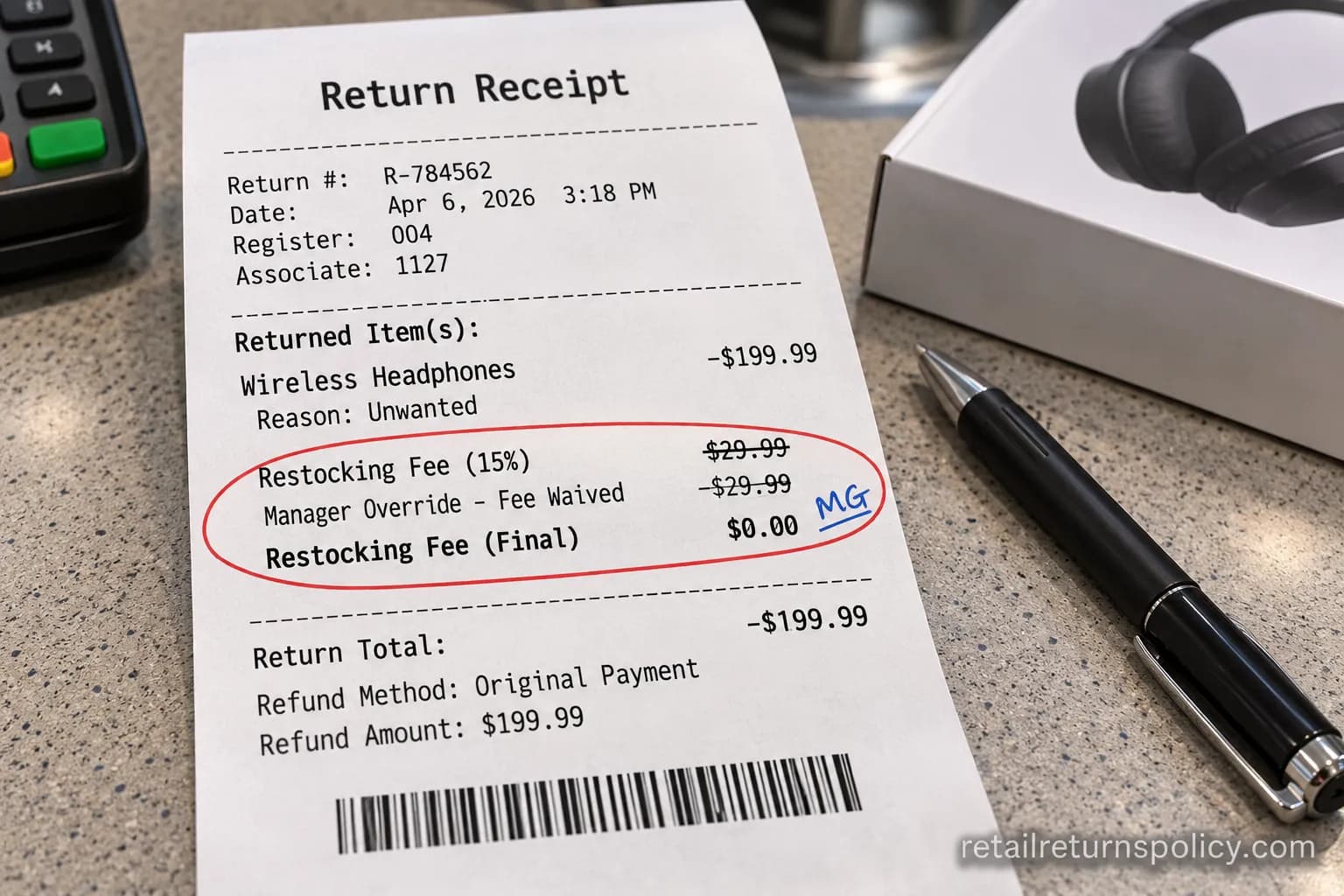
Yes, waivers happen, but they are discretionary, so treat them as a bonus rather than a plan.
When I brought a defective item back to a store that normally charges a fee, a front-line “no” turned into a waived fee once a manager saw the fault documented.
The honest caveat is simple. Pushing a remorse return as a “defect” can get the whole return denied, so only use the defect path when the fault is real.
If your goal is actually cash back rather than a fee-free swap, the refund method matters too.
We cover which chains hand back cash in the guide to stores that pay cash on returns.
Are Restocking Fees Legal? State Bans and Your Rights
Restocking fees are generally legal in the United States as long as the retailer discloses them before you buy, and disclosure is what makes them enforceable.
Several states restrict them outright, and Best Buy’s returns page names eight where it charges no restocking fee at all.
Reading that policy on September 2, 2026, I confirmed the list directly rather than relying on secondhand summaries.
The eight states worth knowing before a big purchase are listed below.
Alabama
Colorado
Hawaii
Iowa
Mississippi
Ohio
Oklahoma
South Carolina
Two practical rights follow from this. A fee that was never posted or disclosed before purchase is on shaky ground, so keep the checkout page or receipt that shows what you agreed to.
If you want the full picture of what a restocking fee is and when it is charged across every category, start with our explainer on what a restocking fee actually is.
Trust note: This is general information, not legal advice, and state rules change. Confirm your own state’s current consumer-protection terms before disputing a charge.
Frequently Asked Questions
Does Apple charge a restocking fee on an opened iPhone?
No, opening the box does not void the return. In the United States, Apple does not charge a restocking fee on an opened iPhone returned like-new within the 14-day window with its box and accessories, and the only real exceptions are custom or engraved orders, which may be refund-only.
Is the Apple 25% restocking fee real?
Not for US retail buyers. The 25% figure comes from Apple’s non-US and volume-order terms, such as the Singapore policy, and does not apply to a standard US purchase returned within 14 days.
Does Samsung charge a restocking fee?
Sometimes, and it is smaller than most guides claim. Samsung’s official policy applies 5% to foldables, tablets, watches, and buds, and 15% to home appliances, while the mainstream Galaxy S and A series phones are exempt.
Does Dell or HP charge a restocking fee?
Dell charges 15% on change-of-mind returns, including Outlet items, and its window runs from the invoice date rather than delivery. HP removed its standard consumer restocking fee as of August 1, 2026, so most HP.com returns are now fee-free.
Can a restocking fee be waived?
Often, but not reliably. Fees are commonly waived for genuinely defective items, for members on fee-free tiers like Best Buy Plus or Total, and sometimes at a manager’s discretion.
Is a restocking fee the same as a return-shipping fee?
No. A restocking fee is a percentage or flat charge deducted from your refund for putting an item back into inventory, while a return-shipping fee only covers the cost of mailing the item back.
The Bottom Line on the Apple Restocking Fee
Here is what to carry with you. There is no apple restocking fee in the United States when you buy direct and return within 14 days, and the viral 25% number belongs to a policy that does not govern US retail.
The device to watch is a carrier-financed iPhone, because the carrier’s $50 to $75 fee, not Apple’s, is the one that bites.
Everywhere else, the fee is a function of two things you control, where you buy and whether you keep it sealed.
Favor the no-fee stores when you are unsure, return manufacturer devices to the manufacturer, and treat any restocking fee result about your internet provider as a separate equipment charge.
Do that, and the fee that scared you at checkout almost never costs you a cent.
Read it your way
Short on time? Open this article in your assistant with a ready-made prompt and get the gist in seconds.
Found this useful? Make us a preferred source so we show up in your Google results.
Keep reading
Related articles
Retailer Return Policy Hubs
Lowe’s Return Policy (2026): What 6 Real Returns Taught Us
Get Lowe’s return policy in plain English: the 90-day window, the 48-hour appliance and window-AC trap, no-receipt store credit, refund timing, and how to retur
Retailer Return Policy Hubs
Return and Exchange Policy: What You Get Back (2026)
An exchange swaps your item; a refund returns your cash. See how a return and exchange policy pays out, when swaps are free, and your state rights.

Retailer Return Policy Hubs
Old Navy Return Policy: 30, 45 & 60-Day Windows (2026)
Check the Old Navy return policy fast: 30-day window (45–60 days for members), receipt rules, refund timing, the $7 mail fee & final-sale items.
Retailer Return Policy Hubs
How to Return a PlayStation Game: Digital vs Disc (2026)
Learn how to return a PlayStation game: digital refunds within 14 days (before download), plus disc-return rules and eligibility.
The discussion
Comments
Every comment is reviewed before it goes live.