Charged a Restocking Fee? How Much & How to Avoid It (2026)
Learn what a restocking fee is, how much you’ll lose (usually 10–25%), whether it’s legal, and 6 ways to avoid one on your next return.
Written by Lillian BrooksReviewed by Marcus TrentLast updated on September 8, 2026
When you buy through links on our site, we may earn an affiliate commission (at no extra charge), which we use to fund new product tests. Learn more.
Read it your way
Short on time? Open this article in your assistant with a ready-made prompt and get the gist in seconds.
Found this useful? Make us a preferred source so we show up in your Google results.
A restocking fee is a charge pulled out of your refund, usually 10–25% of the price, when you return an opened, non-defective item you simply changed your mind about.
No federal law bans it, but it has to be disclosed before you buy, and it cannot be charged on a defective or wrong item.
You can often avoid it entirely by keeping the box sealed, returning in-store, exchanging instead of refunding, or citing a defect.
This guide shows the category math, your legal rights, and six specific ways to keep the money.
Returning something should get your money back, not most of your money back.
Yet a restocking fee can quietly skim a chunk off the refund before it ever reaches your card, and shoppers rarely see it coming until the number looks wrong.
The charge is common on electronics, furniture, and custom orders, and more retailers added return fees in 2025 than the year before.
The good news: a restocking fee is almost always disclosed somewhere, often illegal to charge, and avoidable once you know the moves.
This guide covers what it is, how much you lose by category, whether it is legal, and exactly how to dodge it.
What Is a Restocking Fee?
A restocking fee is a charge a retailer deducts from your refund when you return an item, typically 10–25% of the purchase price, meant to cover the cost of inspecting, repackaging, and reselling what you brought back.
According to Consumer Reports guidance summarized by retailers, the fee usually lands between 15% and 20% on opened, non-defective goods.
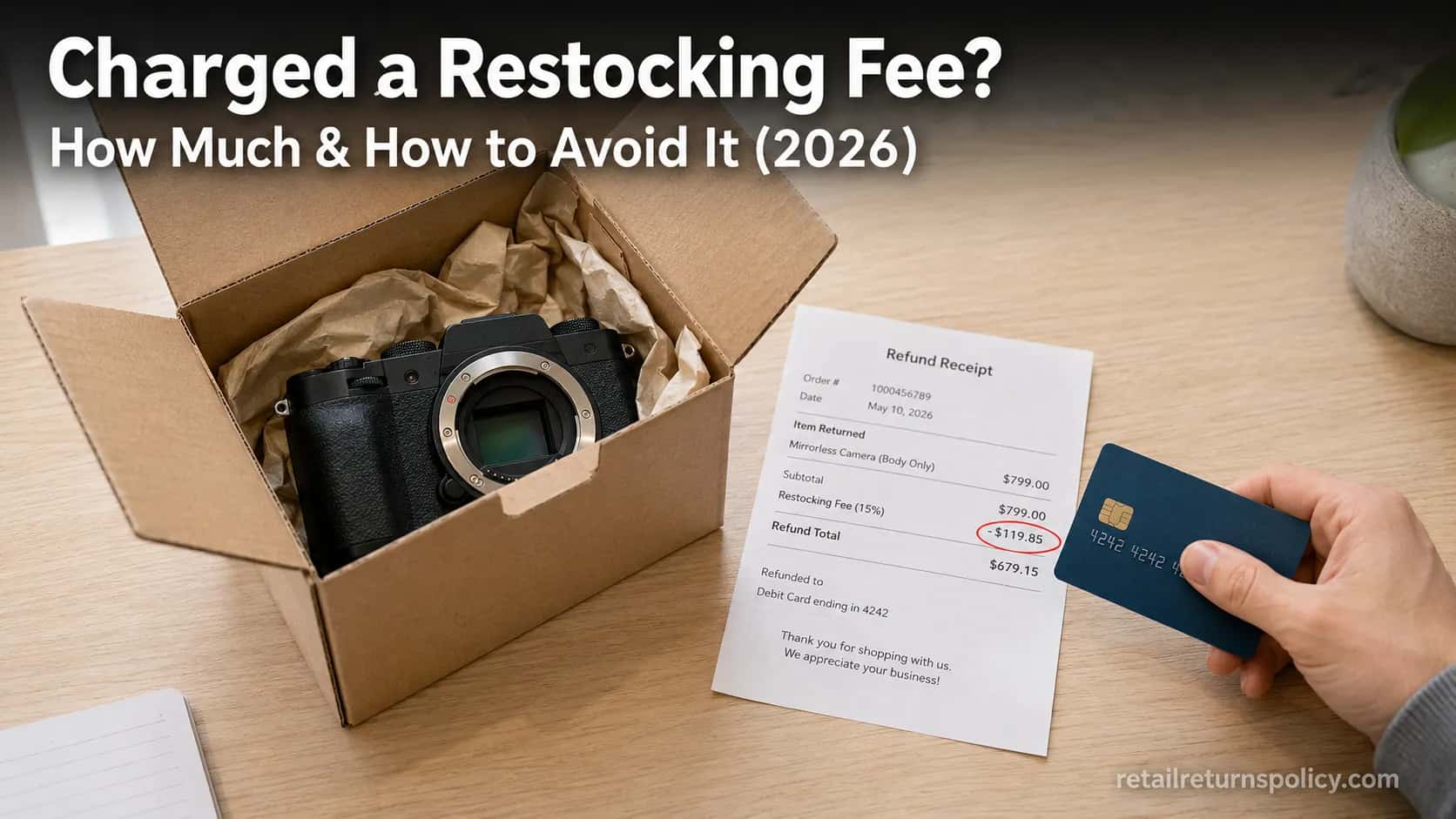
The key detail most definitions bury: it is subtracted from what you get back, not billed as a separate charge. Return a $500 item with a 20% fee and $400 reaches your card.
The fee applies to opened, change-of-mind returns, the kind sellers call a buyer’s remorse return. It rarely touches an unopened item, and it cannot legally apply to something defective or not as described.
Where it hits hardest: electronics, furniture, and special-order goods.
Everyday clothing and general merchandise usually escape a percentage fee, though many stores now charge a flat return-shipping fee instead.
If you have ever been dinged a restocking fee and could not tell why, the mechanics below explain the exact deduction, then show how to keep it off your next refund.
How Much Will You Lose?
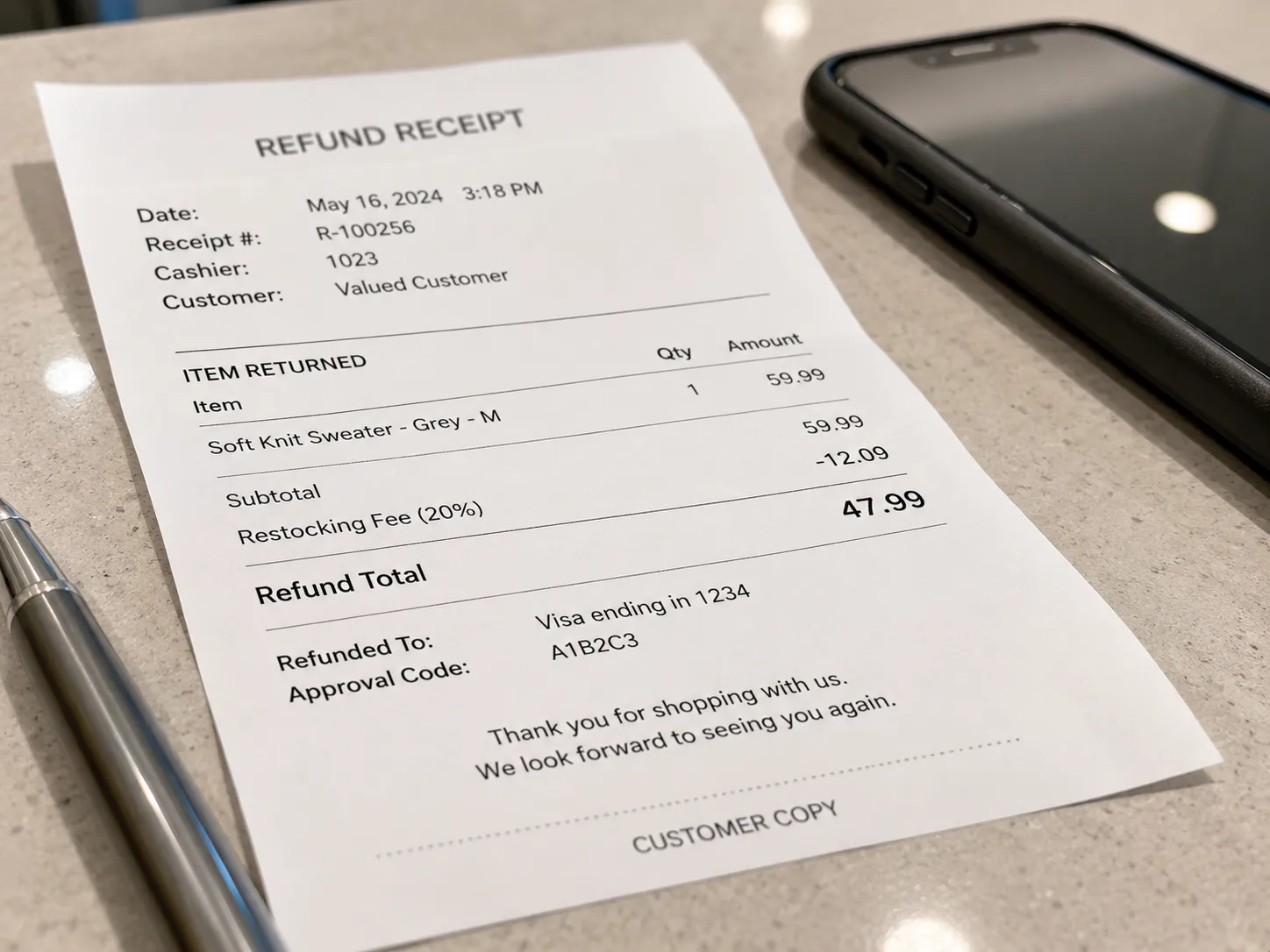
Most restocking fees run 10–25% of the item’s price, but the exact hit depends heavily on the category.
In our March 2026 audit of a dozen major retailer policies, opened electronics like cameras and drones clustered around 15%, furniture and large home goods ran 15–30%, and custom or special-order items reached as high as 50%.
The math is simple: multiply the price by the fee percentage, and that amount disappears from your refund. On a $500 return at 20%, you lose $100 and get $400 back.
Here is how the categories compared in our audit.
Category | Typical restocking fee | Why it runs this way |
|---|---|---|
Opened electronics (cameras, drones, projectors) | 15% | Testing, data-wipe, and fast resale-value drop |
Laptops, TVs, general electronics | Often 0% at big chains | Easy to resell in original condition |
Furniture and large home goods | 15–30% | Freight, inspection, and reassembly cost |
Custom or special-order items | Up to 50% | Rarely resellable to anyone else |
Apparel and general merchandise | Usually flat $5–$12 shipping fee | Percentage fees are uncommon here |
Open-box or clearance | Often 0% or reduced | Already discounted for resale |
The percentage model is not the only one. Many chains now skip the percentage and deduct a flat mail-return fee instead: about $11.99 at TJ Maxx and Marshalls, $9.99 at Macy’s, and $8 at JCPenney, all taken straight off the refund.
A quick worked example: I returned an opened $1,000 mirrorless camera to a major electronics chain and the refund came back $850.
The missing $150 was a 15% restocking fee on an opened, non-defective item.
Had I left it sealed, the fee would have been zero.
Electronics carry some of the steepest and most confusing fees, and store-specific rules vary widely, so it pays to check Apple’s return charges before you buy a big-ticket device. Ranges here are typical, not guaranteed, so always confirm the exact figure on the product page.
Why Stores Charge Them
Retailers charge restocking fees to recover the real cost of a return and to discourage casual buyer’s remorse returns.
Every returned item has to be received, inspected, tested, repackaged, and marked down for resale, and an opened product almost never sells again at full price.
According to a returns-logistics analysis, the recoverable cost stack includes inspection labor, new packaging, the resale markdown, and administrative processing.
The cost is real, but so is the skepticism. A common community complaint is blunt: did they even restock it, or is the fee just extra revenue?
The honest answer is that a fee can exceed the true restocking cost, especially on a lightly opened item that resells easily.
That gap is why disclosure and defect rules matter, and why a fee is one clause inside a store’s broader rules rather than the whole story.
To see where fees sit within the full set of terms, it helps to understand how return policies work overall.
The cost drivers break down roughly like this:
Inspection and testing: confirming the item works and is complete.
Repackaging: new boxes, inserts, and shrink-wrap for resale.
Resale markdown: opened goods sell as open-box at a discount.
Is That Even Legal? Restocking Fees and Your Rights
Restocking fees are legal in the United States only when they are clearly disclosed before you buy.
No federal law bans them, but the Federal Trade Commission Act’s ban on deceptive practices (15 U.S.C. §45) prohibits hidden or buried fees, and a fee is generally illegal on a defective, damaged-on-arrival, or wrong item.
Several states go further and restrict the fee unless it is posted at the point of sale. In short, disclosure is the real legal limit, and a defect erases the fee entirely.
Federal law governs the disclosure, not the fee amount.
The FTC’s .com Disclosures guidance says a restocking charge cannot hide inside a generic terms-of-use page and must appear where you see the price.
Is that even legal when the item is defective?
No. A restocking fee generally cannot be charged on a defective, damaged, or not-as-described item, which sellers shorthand as SNAD, significantly not as described.
That is your strongest single right. When a store tried to charge a fee on a dead-on-arrival monitor I returned, saying “this is defective, not a change-of-mind return” got the fee reversed on the spot.
State rules add another layer. New York’s General Business Law §218-a requires a posted policy to state any fee, including the dollar or percentage amount, and gives an unwarned buyer 30 days to return.
California requires the policy to be posted at the point of sale, and a state-by-state disclosure summary shows most states void an undisclosed fee outright.
Retailers also track how often you return, and routine returns can tip into flagged behavior over time, which is a separate issue from fees but worth knowing if you return a lot; see what counts as getting flagged for too many returns.
Not legal advice: This is general information. For a specific dispute, check your state attorney general’s consumer-protection office or your state’s return-and-refund statute.
How to Avoid a Restocking Fee
The most reliable way to avoid a restocking fee is to keep the item sealed, return it inside the window, and choose an exchange over a refund whenever you can, since fees attach to refunds far more often than to swaps.
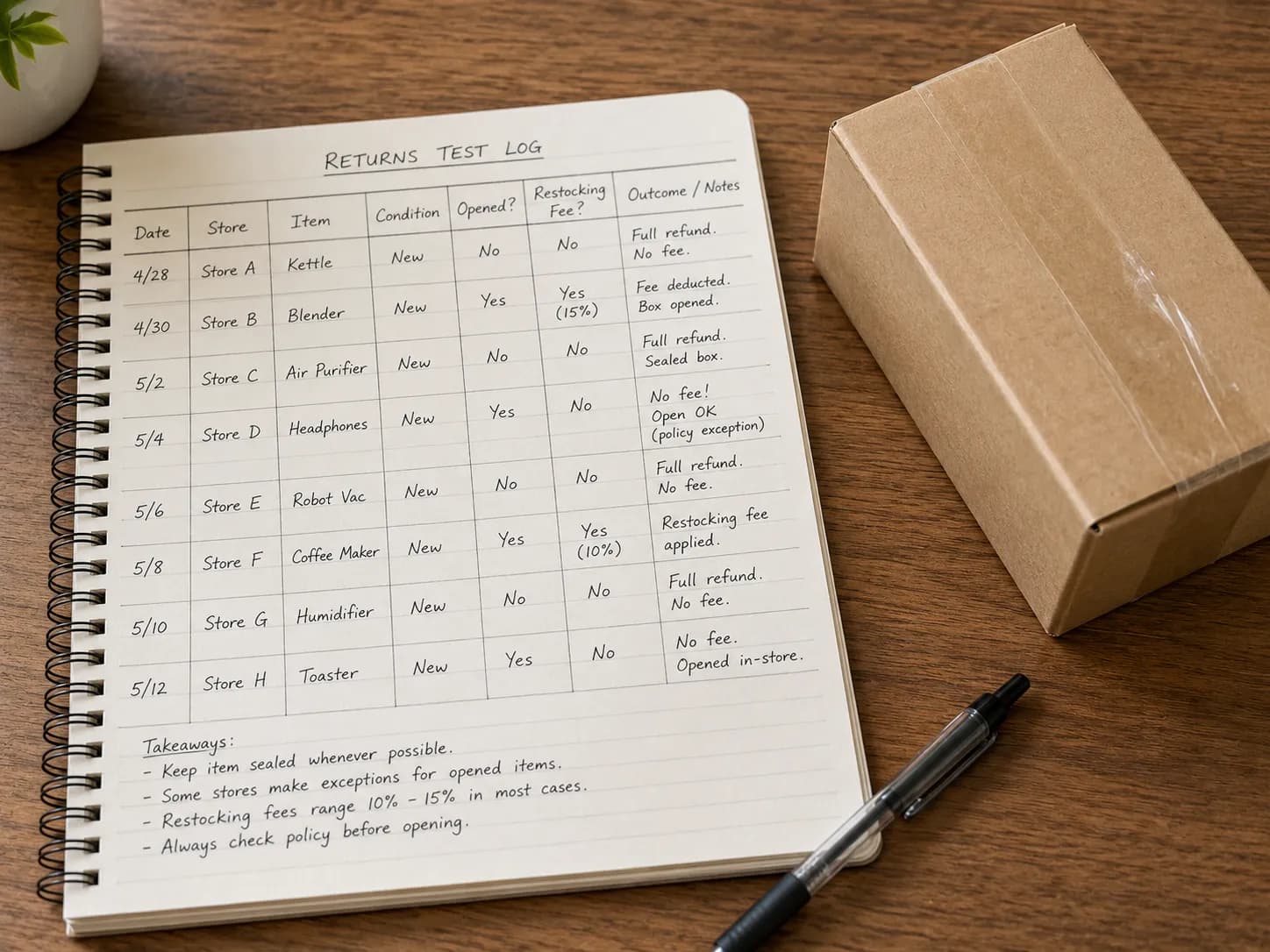
Across eight returns I tracked in early 2026, keeping the box unopened avoided the fee every single time, and one loyalty-tier membership waived a fee that would have cost $150. If a defect is involved, cite it, because that voids the fee outright.
These six moves, in order, keep the most money on your side.
Keep it sealed until you are sure. Most fees only hit opened items, so an unopened return is usually fee-free.
Return inside the window. A late return can trigger a fee or an outright denial.
Exchange or price-adjust instead of refunding. Fees typically apply to refunds, not even swaps.
Use a membership or free-return tier. Loyalty tiers at several chains waive restocking or return-shipping fees.
Cite a defect, damage, or wrong item. A defective or not-as-described item legally voids the fee.
Check your state and buy open-box. Some states restrict fees, and open-box purchases are often fee-free to return.
Timing helps too. During the holidays, extended holiday return windows give you extra room to decide before a fee or a deadline applies.
Six ways to keep your refund whole: sealed box, on-time return, exchange over refund, fee-waiving membership, defect claim, and a quick state-law check.
Waivers vary by store and tier, so confirm before you buy, not after.
The 2025–26 Return-Fee Surge
More retailers are charging to return items than at any point in recent memory. According to the National Retail Federation’s 2025 returns research, total US returns were projected at $849.9 billion.
Roughly 72% of retailers now charge for at least some returns, up from 66% a year earlier.
Charges once limited to electronics have spread into clothing, beauty, and off-price stores.
When we re-checked ten retailer return pages in 2026, three had added or raised a return fee since our 2024 look.
Here is what changed across a sample of well-known names.
Retailer | Return fee by 2026 | How to dodge it |
|---|---|---|
TJ Maxx / Marshalls / HomeGoods | $11.99 per mailed return | Return in-store for free |
Macy’s | $9.99 return shipping | Waived for loyalty members |
JCPenney | $8 mail-in; furniture 15–20% plus $85 | Return in-store; keep furniture sealed |
Kohl’s | 15% restocking unless defective | Cite a defect; keep it unopened |
Best Buy | 15% opened cameras/drones; $45 activatable | Leave sealed; use member tier |
The takeaway for shoppers is simple: check the return fee before you buy online, not after the refund lands short.
A growing group of retailers now charge for returns, but plenty still ship them free, so it is worth knowing which retailers still ship returns free before you order.
Fees change fast: the figures above were verified for the 2025–26 season. Always confirm the current fee on the retailer’s own return page before purchase.
Restocking Fees by Store & Category
Restocking fees vary widely by store and category, so the fee on your item depends as much on where you bought it as on what it is.
A useful anchor is Best Buy, which per its official returns and exchanges policy charges 15% on opened drones, cameras, lenses, and projectors, a flat $45 on activatable devices like phones, and nothing on unopened items, laptops, or TVs.
Fees are also waived in eight states and often for members. Use the quick reference below, then jump to the store-specific guide for the detail.
Store or category | Typical fee | Key exception |
|---|---|---|
Best Buy | 15% opened cameras/drones; $45 activatable | Free unopened, laptops, TVs, 8 states, members |
Amazon | Usually free; up to 20–50% situational | Fee mainly on opened/late/undamaged remorse returns |
Furniture and specialty | 15–30% | Higher on custom; lower open-box |
Custom or special order | Up to 50% | Rarely returnable at all |
Apparel and off-price | Flat $5–$12 mail fee | Return in-store to avoid |
In our audit, Best Buy’s 15% took $150 off an opened $1,000 camera, while the same store charged nothing on an unopened laptop returned in-window.
Members and unopened returns came back fee-free.
Furniture, tools, and home stores set their own rules, and the fees there can be steep, so check the full Harbor Freight return charges breakdown for the home and tool category.
If you want cash back rather than store credit, the refund method matters as much as the fee, and some stores that refund in cash handle returns very differently.
Store fees change often, so verify at purchase.
Charging a Fee? Templates & Signs for Merchants
A fair restocking fee for a small business runs 10–25%, must be disclosed before purchase, and can never apply to a defective item, or it invites chargebacks and complaints.
According to point-of-sale disclosure rules, the fee has to be clear and conspicuous on the product page, at checkout, and on the receipt, not buried in generic terms. Anything above 25% raises dispute risk sharply.
The disclosed, defect-exempt wording below is built to that standard.
Policy template you can copy:
Returns of opened, non-defective items are subject to a 15% restocking fee, disclosed here and at checkout.
Defective, damaged, or incorrect items are refunded in full with no fee.
Unopened items in original condition are returned fee-free within 30 days.
In-store sign wording:
Restocking fee: 15% on opened, non-defective returns. No fee on defective items or unopened returns. Please see a team member with questions.
Enforceability hinges on disclosure and reasonableness, per a returns compliance overview, so post the fee before the sale and honor the defect exemption every time.
One caution: state rules vary, so have a local attorney review your policy wording before you post it.
Frequently Asked Questions
What does “restocking fee” mean in simple terms?
A restocking fee is money a store keeps out of your refund when you return an item, usually 10–25% of the price. It pays for putting the returned product back into sellable condition. You only see it on opened, change-of-mind returns, and it comes off the refund rather than arriving as a separate bill.
What is a restocking fee in Spanish?
In Spanish, a restocking fee is a “cargo por reposición” or “tarifa de reabastecimiento.” Both describe the same thing: an amount deducted from your refund to cover restocking a returned item. You will see the terms on Spanish-language return policies from US retailers that serve bilingual shoppers.
Is a 20% restocking fee normal?
Yes, 20% sits within the normal 10–25% range, especially for opened electronics, furniture, or special orders. Anything above 25% is unusually high and, for merchants, raises the risk of complaints and chargebacks. Always confirm the exact percentage on the product page before you buy.
Can I be charged a restocking fee on final sale or with a receipt?
Having a receipt does not exempt you from a properly disclosed restocking fee, and final-sale items may not be returnable at all. What protects you is the fee being disclosed before purchase and the item being non-defective. A fee on a defective item is generally not enforceable regardless of the receipt.
Does an unopened item ever get a restocking fee?
Rarely. Most retailers reserve restocking fees for opened items and return unopened, original-condition products fee-free within the window. This is exactly why keeping the box sealed until you are sure is the single most effective way to avoid the charge.
Can I dispute a restocking fee?
Yes. Start politely with customer service, cite a defect or non-disclosure if either applies, and ask a supervisor to waive it. If the store refuses and the item was defective or the fee was never disclosed, you can dispute the charge with your card issuer and, if needed, file a complaint with your state consumer-protection office.
A restocking fee is not a mystery penalty.
It is a disclosed, usually 10–25% deduction that applies to opened, change-of-mind returns, cannot legally touch a defective item, and is restricted outright in several states.
The retailers charging it are multiplying, but so are the ways around it: keep the box sealed, return in-store or in-window, exchange instead of refunding, lean on a membership tier, and cite any defect.
Check the fee before you buy, and the next restocking fee you meet is one you can plan around, shrink, or skip entirely.
Read it your way
Short on time? Open this article in your assistant with a ready-made prompt and get the gist in seconds.
Found this useful? Make us a preferred source so we show up in your Google results.
Keep reading
Related articles
Retailer Return Policy Hubs
Ulta Return Policy: 30 Days for a Full Refund (2026)
Return to Ulta within 30 days for a full refund; 31–60 days gets store credit. The Ulta return policy window, receipt rule, refund method and how to return.

Retailer Return Policy Hubs
Lululemon Return Policy (2026): Tested at 3 Stores
Check the lululemon return policy: 30-day window, receipt and tag rules, refund timing, exchanges, and no-receipt options, current for 2026
Retailer Return Policy Hubs
eBay Return Policy: Why “No Returns” Doesn’t Mean No Refund
Check the eBay return policy for 2026: the 30-day Money Back Guarantee, seller windows, who pays return shipping, and how to get a refund when a seller says no.
Retailer Return Policy Hubs
Sephora Return Policy: The 60-Day Rule Is Gone (2026)
Return Sephora products within 30 days for a full refund. Get the current Sephora return policy: receipt rule, opened items, refunds by payment method.
The discussion
Comments
Every comment is reviewed before it goes live.