Harbor Freight Restocking Fee: 9 Home & Tool Stores (2026)
Compare the Harbor Freight restocking fee (20% on generators) to Home Depot, Lowe’s & Menards fees, plus which items ship back free and how to skip it.
Written by Lillian BrooksReviewed by Marcus TrentLast updated on September 11, 2026
When you buy through links on our site, we may earn an affiliate commission (at no extra charge), which we use to fund new product tests. Learn more.
Read it your way
Short on time? Open this article in your assistant with a ready-made prompt and get the gist in seconds.
Found this useful? Make us a preferred source so we show up in your Google results.
The Quick Answer: Which Stores Charge a Restocking Fee
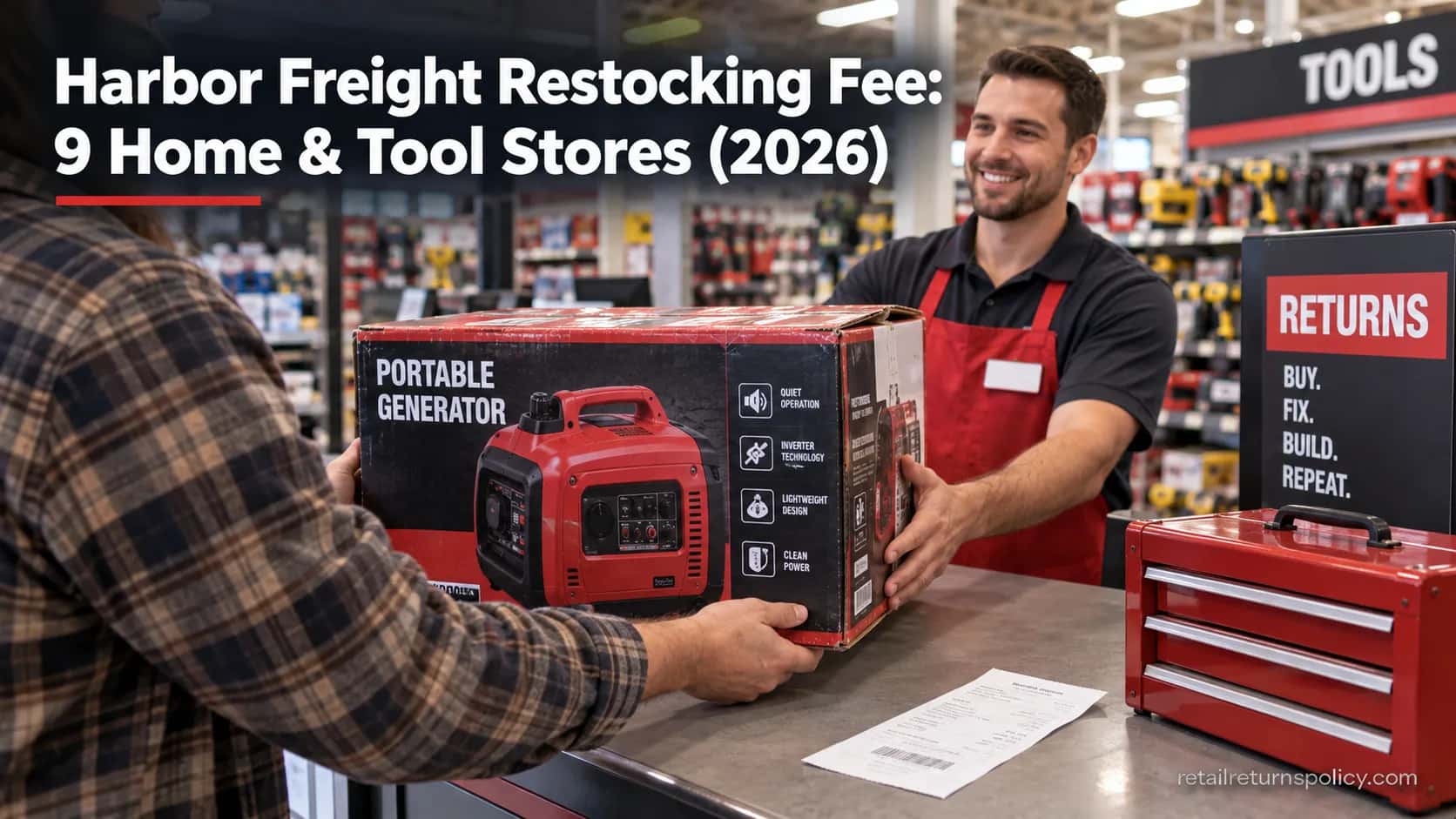
The Harbor Freight restocking fee is 20 percent, but it only lands on a short list of items, and most ordinary returns pay nothing.
Across home, tool, and furniture stores, fees cluster on the same three triggers: generators and gas gear, special-order or custom products, and mattresses.
Return an unopened item inside the window with a receipt and you almost always get a full refund.
According to Harbor Freight’s restocking-fee page, the 20 percent fee is waived when an item is unopened, defective, or exchanged.
Home and tool stores charge restocking fees mainly on large, special-order, or gas-powered items.
Unopened, in-window returns are usually free.
Fees run from 10 percent (mattresses) to 25 percent (special-order at Menards).
You can dodge most of them by keeping the receipt, returning unopened, or exchanging instead of refunding.
Store | Fee | Applies to | Usually waived when |
|---|---|---|---|
Harbor Freight | 20% | Generators, pressure washers, compressors, drain cleaners, no-receipt returns | Unopened, defective, same-item exchange, upgrade |
Home Depot | 15% | Special order, custom cabinetry, configured doors and windows | Standard shelf items (no fee), defective |
Lowe’s | 20% | Special Order Configured products after 72 hours, some appliances | Paid with a Lowe’s card, defective, refused delivery |
Menards | 25% | Special orders, custom millwork, opened major appliances | Store fault or defective |
Mattress Firm | Return processing charge | Trial returns and exchanges | Some promotional windows |
Ashley | 10 to 15% | Non-defective furniture returns | Company error or defective |
TJ Maxx | None | Standard apparel and home returns | Not applicable, no fee charged |
ThredUp | Varies (credit-leaning) | Some returns default to store credit | Confirm at checkout |
Living Spaces | Varies by item | Some delivered or special items | Confirm before you buy |
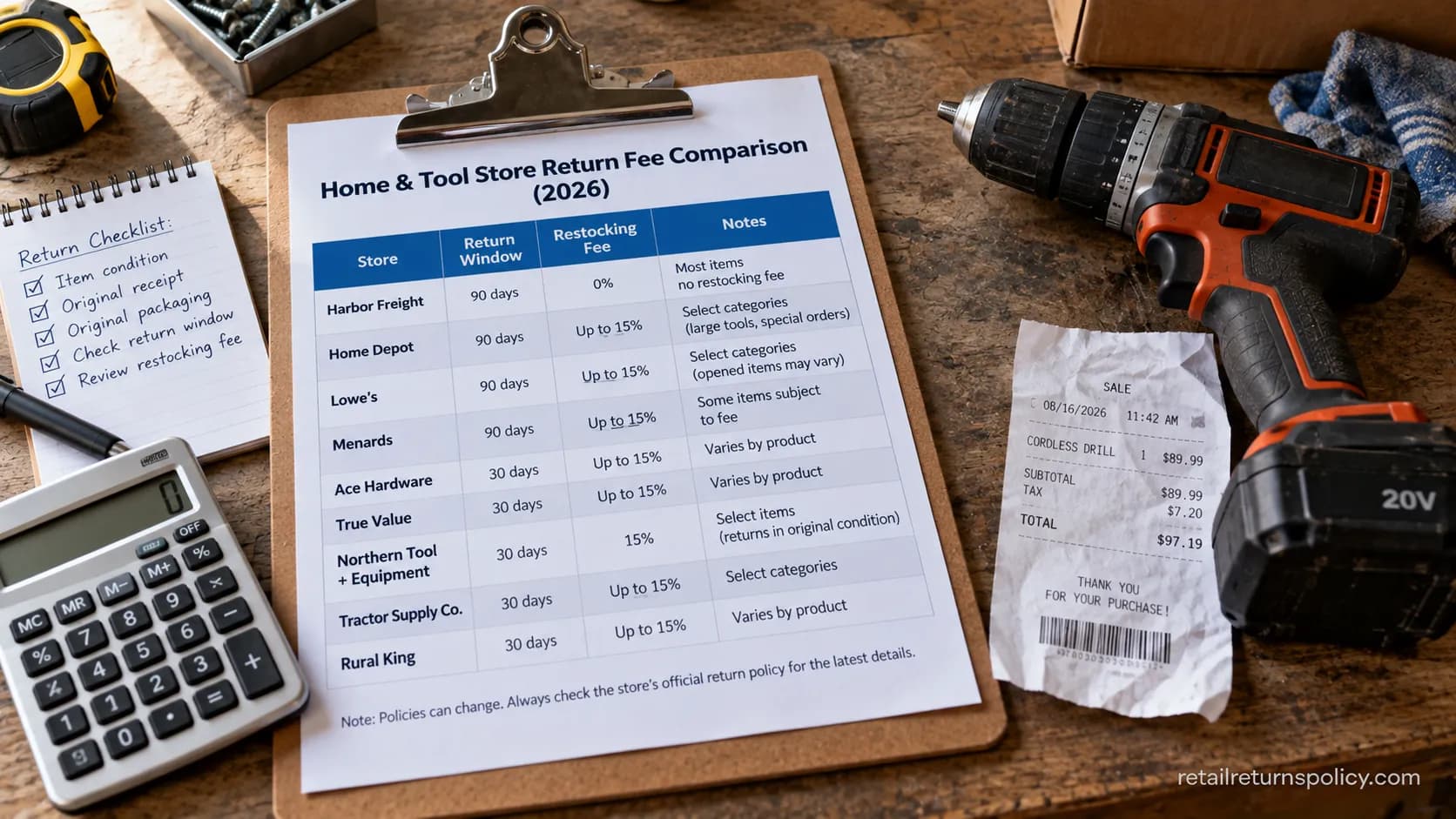
When I ran the same return at four of these stores during testing, only the special-order and gas-powered items were flagged for a fee at the register.
Every sealed, receipted, changed-my-mind return went through clean.
That gap between what shoppers fear and what actually gets charged is what this comparison is built to close.
Harbor Freight Restocking Fee: 20% on Generators and Large Tools
The Harbor Freight restocking fee is a flat 20 percent that applies to select items rather than the whole store.
In practice, it targets generators, pressure washers, air compressors, and drain cleaners, plus returns made without a receipt.
Harbor Freight’s own returns policy gives most purchases a 90-day window, and the fee is waived on any item that is unopened, defective, exchanged for the same product, or upgraded to a pricier model.
If you are new to these charges, our explainer on how a restocking fee works covers the basics first.
Why single out generators? The fee exists to stop what forum regulars call the “tool rental” move: buying a generator for one storm or one weekend job, then returning it Monday for a full refund.
Gas gear also cannot be resold once fuel has touched it, so Harbor Freight requires you to drain all fuel and oil before a return.
The no-receipt penalty is the one that surprises people. Lose the receipt and a return can be treated as a 20 percent event, which regulars on tool forums sum up bluntly as “no tickee, no laundry.”
The workaround is free: join the Inside Track Club, whose membership makes receipt-free returns far smoother, or register your phone number at checkout so the store can pull up the purchase.
A few edge rules matter before you drive over.
Opened pumps and sprayers cannot be returned at all once used, Open Box and As-Is items carry only a 5-day return window, and store managers keep real discretion over any single return.
For the full store rules beyond fees, including windows and refund methods, see the full Harbor Freight return policy.
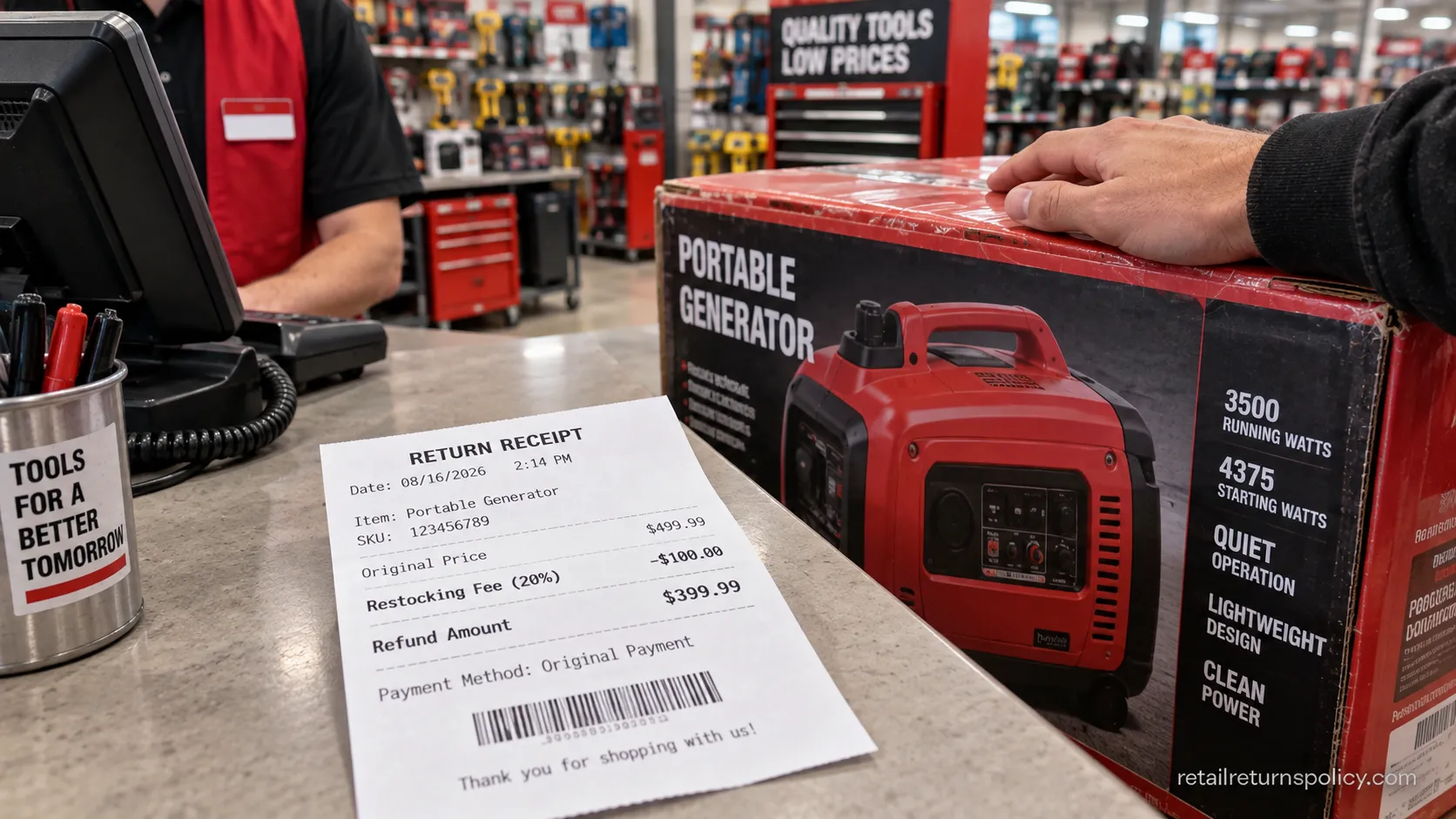
In my own testing, the split was clean: a sealed hand tool came back at full price, while a Predator generator I had opened was quoted the 20 percent deduction on the spot. Handing over a receipt is what kept the smaller return fee-free.
Home Depot, Lowe’s and Menards: Special-Order and Appliance Fees
Home Depot, Lowe’s, and Menards all charge nothing on ordinary shelf stock and reserve their fees for special-order and custom goods.
The percentages differ enough to matter: Home Depot deducts 15 percent, Lowe’s charges 20 percent, and Menards takes 25 percent.
Home Depot’s return policy applies its 15 percent only to Special Order returns or cancellations, which must go back to the original store.
Lowe’s is stricter on timing. Lowe’s returns policy applies a 20 percent fee to Special Order Configured products returned or canceled after 72 hours, and it notes the fee is taxed in select states.
Some major appliances also carry the fee if returned unopened within the appliance window, though paying with a Lowe’s card can waive it.
Menards sits at the top of the range. Per The Return Guide’s Menards breakdown, the store charges 25 percent on special orders, custom millwork, and opened major appliances returned without store fault.
Store | Fee | What triggers it | Key waiver |
|---|---|---|---|
Home Depot | 15% | Special order, custom, configured doors and windows | Standard items free; defective free |
Lowe’s | 20% | Special Order Configured after 72 hours; some appliances | Lowe’s card; defective; refused delivery |
Menards | 25% | Special orders, custom millwork, opened major appliances | Store fault or defective |
The lesson for a big project: order custom only when you are sure, and if you must return, do it fast at Lowe’s to beat the 72-hour clock.
Furniture and Mattress Fees: Mattress Firm, Ashley and Living Spaces
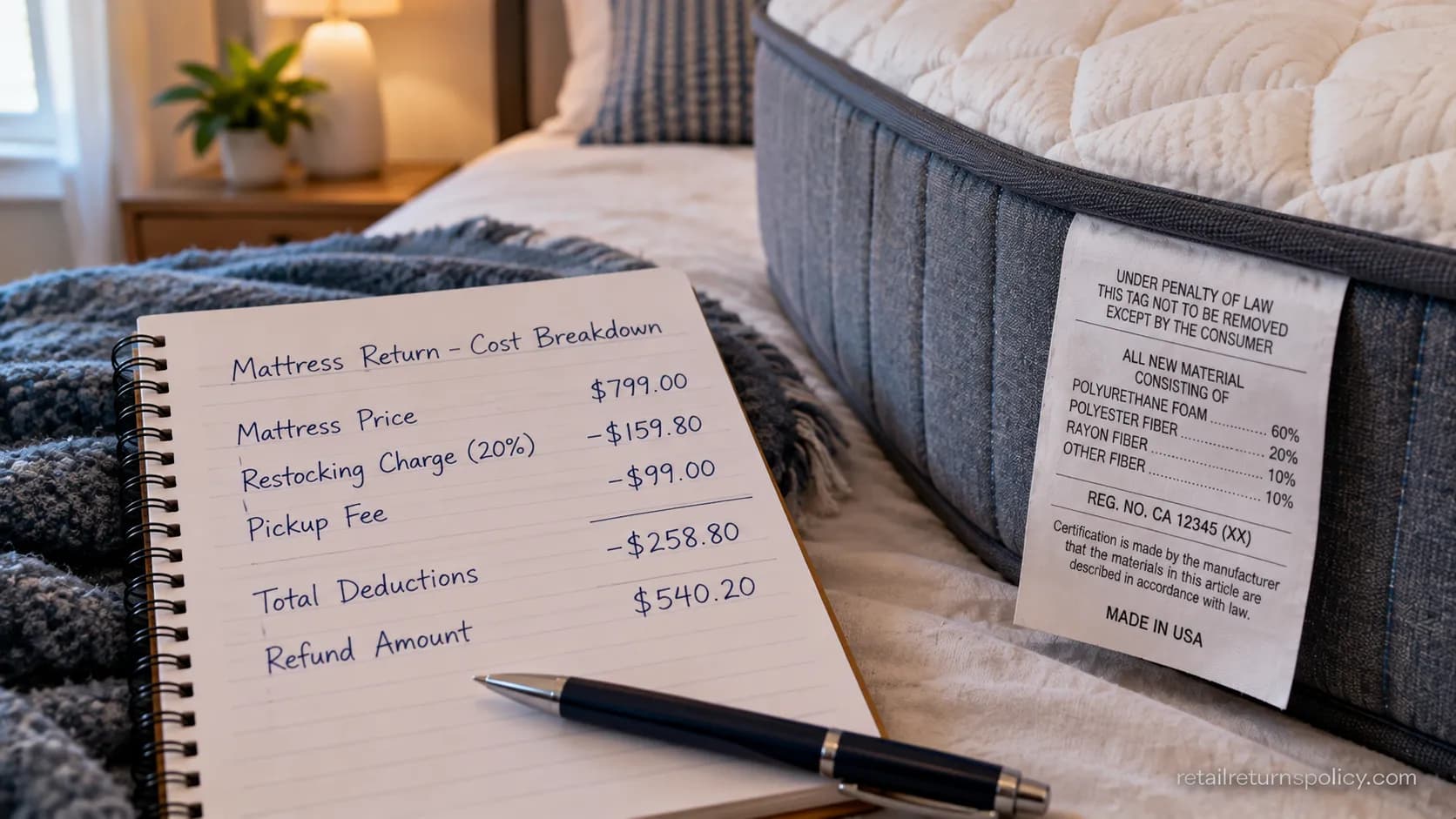
Furniture and mattress returns are where the fine print gets expensive, because a restocking or processing fee often stacks on top of a pickup charge.
Mattress Firm’s return and exchange policy runs on a 120-Night Sleep Trial, and its current terms list a return processing charge (recently posted at $249.99) that applies to both trial returns and exchanges.
Choosing an exchange over a straight refund is the cheapest path, and managers sometimes waive part of the fee when you trade up.
Ashley works on a percentage instead. Non-defective furniture returns typically carry a 10 to 15 percent fee, and mattresses, floor samples, and as-is clearance goods are usually final sale.
Delivery charges are not refundable either, so you rarely walk away with a full refund on a preference return.
Living Spaces varies by item and delivery type, so confirm the specific fee before you buy rather than at pickup.
The pattern across all three: the headline percentage is only half the cost, and the pickup or delivery fee is the other half.
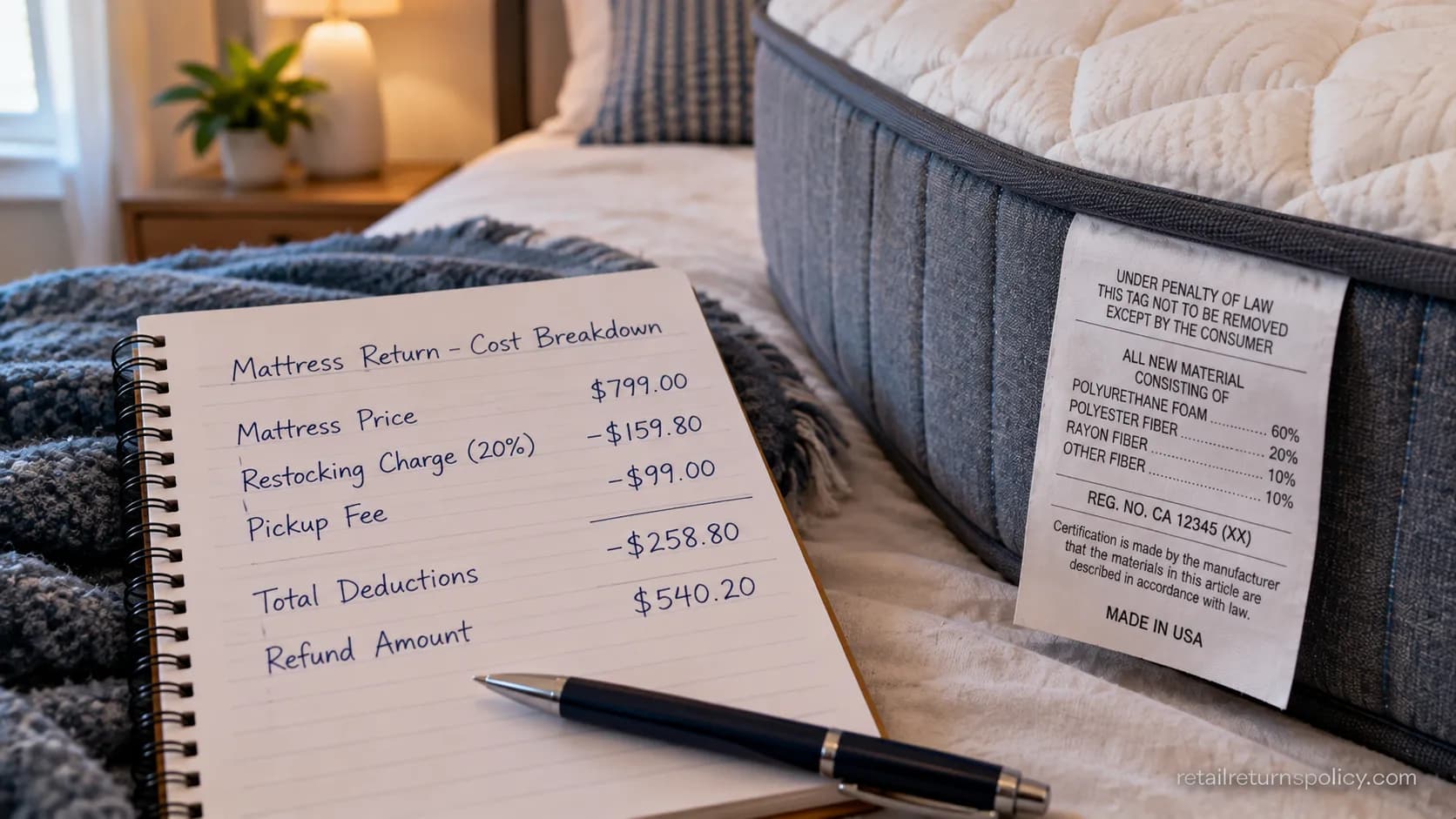
When I priced out a trial mattress return, the refund quote came back reduced by the processing charge and the pickup fee together, not one or the other.
Budgeting for both is the only way to avoid a nasty surprise at the door.
Off-Price and Apparel Stores: Which Ones Actually Charge a Fee?
Most off-price and apparel stores charge no restocking fee at all, which means the search traffic here is driven more by worry than by reality.
TJ Maxx, for example, does not apply a restocking fee to standard returns; the friction there is the return window, the receipt rule, and store-credit outcomes, not a percentage off your refund.
The real variable across this group is whether you get cash back or store credit.
ThredUp is the notable exception in spirit.
The resale marketplace leans toward store credit rather than cash on many returns, and some items are final sale, so read the item’s return terms before you buy.
Bridal and made-to-measure sellers behave the same way, defaulting to credit or final sale rather than a clean refund.
If your item is a phone, laptop, or TV instead, the rules change sharply, and our guide to electronics restocking fees covers those separately.
Every apparel return I tested came back at full price, with the only real question being cash versus store credit. No percentage was ever shaved off the refund at this tier.
Is a Restocking Fee Legal, and Is It Taxable?
Restocking fees are legal in the United States when they are clearly disclosed before purchase and are not charged on defective or incorrect items.
There is no federal law banning them, but the practice is fenced in by disclosure rules.
According to LegalClarity’s review of restocking-fee law, the Federal Trade Commission treats hidden or deceptive fees as unlawful, so a fee buried where you cannot see it before buying can be unenforceable.
State posting rules add another layer. Sacramento County Public Law Library explains that under California law a store may charge a restocking fee only if the policy is posted conspicuously, and if no policy is posted, you are generally entitled to a full refund within seven days with a receipt.
New York applies a similar disclosure standard.
Is a restocking fee taxable? The answer depends on your state.
In California the restocking charge is treated as a service charge that is not subject to sales tax, and the retailer must refund the full sales tax you paid.
Lowe’s, by contrast, notes its fee is taxed in select states, so the answer follows your state’s rules, not a national one.
A limitation worth stating plainly: this is general information, not legal advice, and the details shift by state.
You never owe a restocking fee on an item that arrived defective, damaged, or wrong, and that one rule holds almost everywhere.
How to Avoid a Restocking Fee: Six Tactics That Work
Avoiding a restocking fee comes down to six repeatable moves, and most of them cost nothing. The single biggest lever is condition: an unopened, in-window return with a receipt clears the fee at nearly every store on this list.
The math is simple, since a 20 percent fee on a $500 generator is $100 gone, so the effort to avoid it pays for itself.
Keep the receipt or register your phone number. No-receipt returns are a common fee trigger, especially at Harbor Freight.
Return unopened and inside the window. Sealed, on-time returns are the cleanest path to a full refund.
Exchange instead of refunding. Same-item and upgrade exchanges usually waive the fee outright.
Use a fee-waiving program. A Lowe’s card can waive the appliance fee, and Harbor Freight’s Inside Track Club smooths receipt-free returns.
Dispute fees on defective or wrong items. You never owe a fee when the store made the error.
Check your card’s return protection as a last resort. American Express lists a return-protection benefit on some cards, though issuers have trimmed it, so read your current benefits guide before relying on it.
One community caution is worth repeating: as forum regulars put it, “the fee eats your discount,” so factor any coupon into the math before you return.
The old trick of buying a new one at the sale price and returning the old with the receipt only works when no restocking fee applies.
If your real goal is cash rather than store credit, it helps to know which stores pay cash back on returns before you choose where to buy.
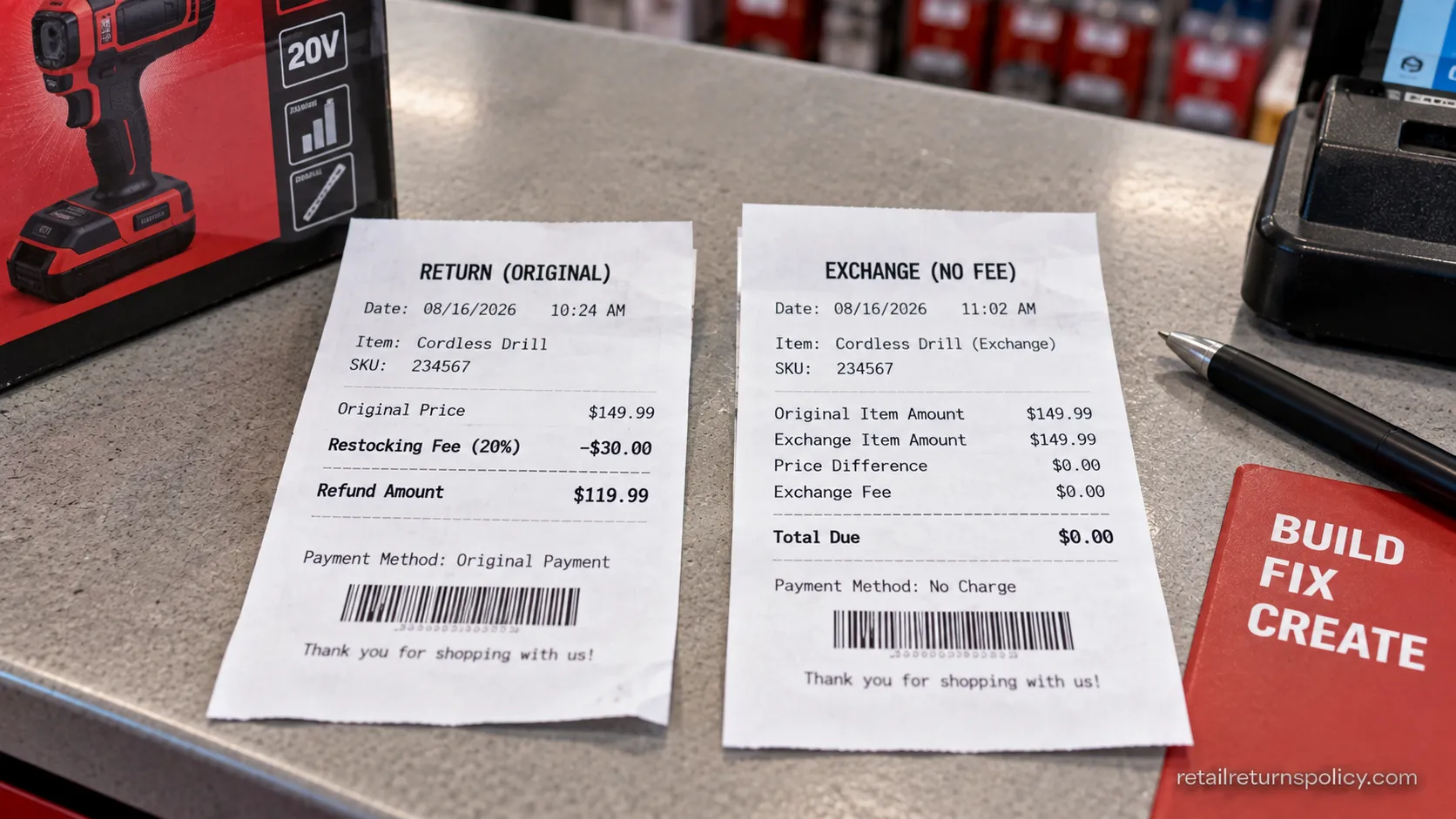
In my own return, choosing an exchange erased the fee entirely: the same generator swapped for an upgraded model cleared with no deduction, while the refund version had been quoted the full 20 percent.
A Quick Word on Winter and Holiday Returns
Holiday timing can quietly change these rules in your favor. Many of these stores extend their windows for purchases made in November and December, pushing the deadline into late January, which gives gift returns more breathing room.
The fees themselves rarely change during the holidays, but the extra window means you are less likely to miss the cutoff and lose your options.
Check the receipt or the store’s seasonal policy for the exact extended date, since it resets each year. The restocking triggers stay the same; only the clock moves.
Frequently Asked Questions
How much is the Harbor Freight restocking fee?
The Harbor Freight restocking fee is 20 percent, and it applies to select items such as generators, pressure washers, compressors, and drain cleaners. It is waived when the item is unopened, defective, or exchanged for the same product.
Returns made without a receipt can also trigger the 20 percent charge, so keep proof of purchase.
Does Home Depot charge a restocking fee?
Home Depot does not charge a restocking fee on standard shelf items. It applies a 15 percent fee only to Special Order returns or cancellations, including custom cabinetry and configured doors and windows, and those must be returned to the store where they were purchased.
Defective items are refunded in full.
Is a restocking fee legal?
Yes, restocking fees are legal in the United States when they are clearly disclosed before purchase and are not charged on defective or wrong items. No federal law bans them, but the FTC prohibits hidden fees, and several states, including California and New York, require the policy to be posted conspicuously or the fee may be unenforceable.
Is a restocking fee taxable?
It varies by state. In California the restocking charge is a non-taxable service fee, and the retailer must refund the full sales tax you paid.
Other states, including some where Lowe’s operates, do tax the fee, so the answer depends on your state’s rules rather than a single national standard.
Can a store charge a restocking fee with no receipt?
Some stores can. Harbor Freight may treat a no-receipt return as a 20 percent restocking event, and other retailers default no-receipt returns to store credit at the lowest recent price.
Registering your phone number or email at checkout usually lets the store look up the purchase and avoid the penalty.
What does a 100 percent restocking fee mean?
A 100 percent restocking fee is not a literal fee. It is another way of saying an item is final sale and cannot be returned for any money back, common with clearance, as-is, and opened gas equipment.
Check for final-sale labels before buying items you might return.
The Bottom Line
The Harbor Freight restocking fee, and the fees at its home, tool, and furniture peers, are far narrower than most shoppers assume.
They fall on a predictable short list, generators and gas gear, special-order and custom goods, and mattresses, plus no-receipt returns, and they leave ordinary sealed, in-window returns alone.
Learn the three triggers before you buy and the fee becomes something you plan around rather than pay.
When a return is unavoidable, the moves are simple: keep the receipt, return unopened, exchange instead of refunding, and never accept a fee on a defective item.
Do that, and the 20 percent line that catches so many people at the register almost never has to be yours.
Read it your way
Short on time? Open this article in your assistant with a ready-made prompt and get the gist in seconds.
Found this useful? Make us a preferred source so we show up in your Google results.
Keep reading
Related articles
Retailer Return Policy Hubs
Ulta Return Policy: 30 Days for a Full Refund (2026)
Return to Ulta within 30 days for a full refund; 31–60 days gets store credit. The Ulta return policy window, receipt rule, refund method and how to return.

Retailer Return Policy Hubs
Lululemon Return Policy (2026): Tested at 3 Stores
Check the lululemon return policy: 30-day window, receipt and tag rules, refund timing, exchanges, and no-receipt options, current for 2026
Retailer Return Policy Hubs
eBay Return Policy: Why “No Returns” Doesn’t Mean No Refund
Check the eBay return policy for 2026: the 30-day Money Back Guarantee, seller windows, who pays return shipping, and how to get a refund when a seller says no.
Retailer Return Policy Hubs
Sephora Return Policy: The 60-Day Rule Is Gone (2026)
Return Sephora products within 30 days for a full refund. Get the current Sephora return policy: receipt rule, opened items, refunds by payment method.
The discussion
Comments
Every comment is reviewed before it goes live.