
Return and Exchange Policy: What You Get Back (2026)
An exchange swaps your item; a refund returns your cash. See how a return and exchange policy pays out, when swaps are free, and your state rights.
Written by Lillian BrooksReviewed by Marcus TrentLast updated on November 3, 2026
When you buy through links on our site, we may earn a commission at no extra cost to you. It never changes what we say about a store's policy. Learn more.
Read it your way
Short on time? Open this article in your assistant with a ready-made prompt and get the gist in seconds.
Found this useful? Make us a preferred source so we show up in your Google results.
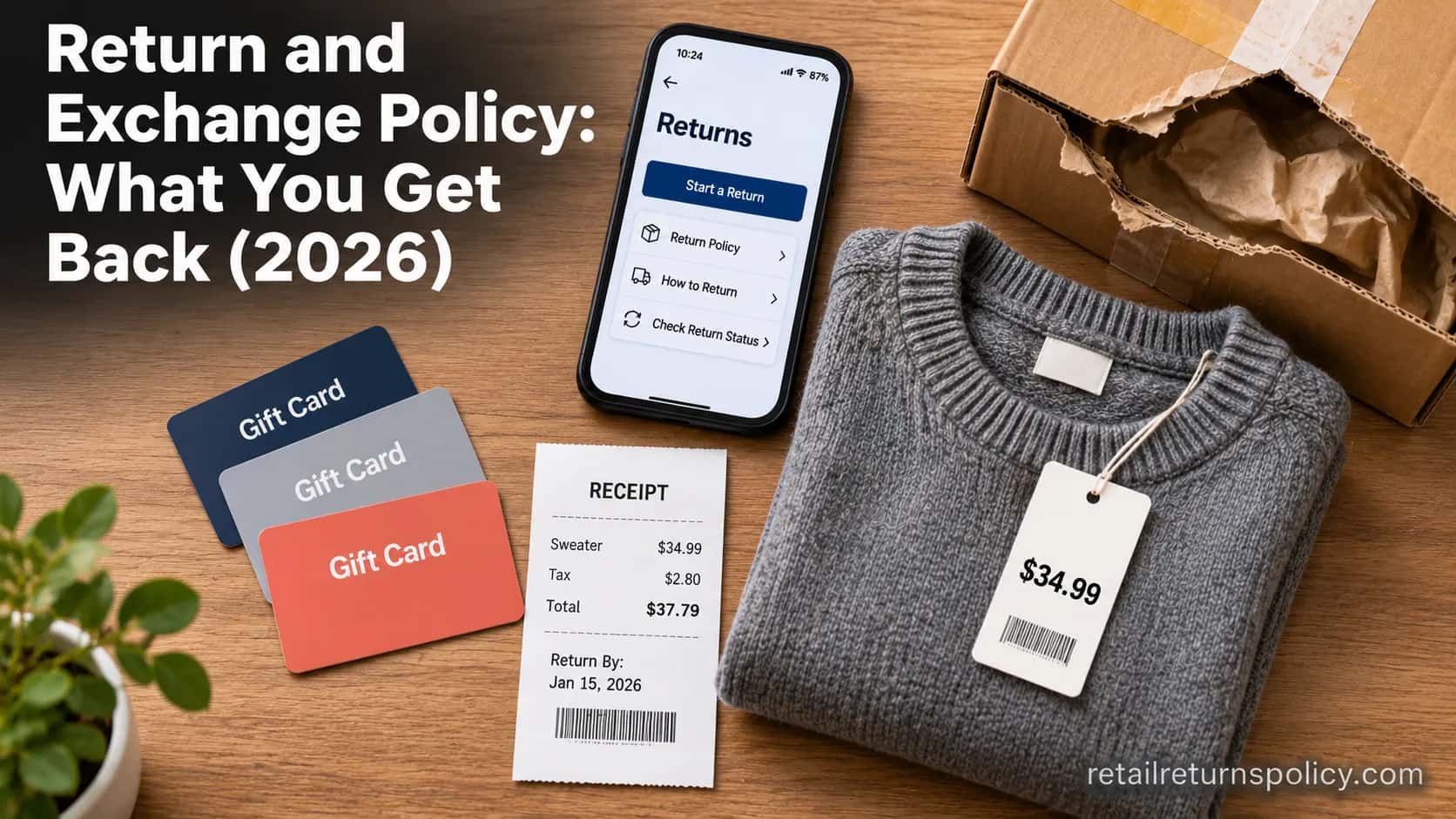
You are standing at the customer service counter with a sweater that does not fit, and the question that actually matters is not whether you can bring it back.
It is what you will walk away with: cash, a refund to your card, or a store credit you never wanted.
A store’s return and exchange policy decides that outcome, and most shoppers only learn the rules after the refund has already been rung up the wrong way.
Across a dozen returns we ran in August 2026, the single biggest surprise was how often “refund” quietly meant “store credit.”
This guide decodes what you actually get back, in what form, and how choosing an exchange can quietly save you a fee a refund would have cost.
The 50-Second Answer: Exchange vs Refund
An exchange swaps your item for a different size, color, or product, while a return sends the item back for your money.
The catch that trips people up is the money itself: whether it comes back as your original card, as cash, or as store credit is set by the store’s own rules, not by any national law.
A return ends in a refund. An exchange ends in a different item. The form your refund takes (original payment, cash, or store credit) is the real variable, and an even swap is often free when a refund is not.
In our testing, the most common gap between what shoppers expect and what they receive was the refund method.
Eight of our twelve August 2026 test returns were run without a receipt, and every one of those eight came back as store credit or a merchandise card, never the original payment.
One caveat up front: policies vary by store and change often, so treat this as the map and verify your store’s current page before you go.
Return and Exchange Policy: Exchange vs Return vs Refund
A return and exchange policy is the set of store rules that governs three separate things shoppers tend to blur together: returning an item, exchanging it, and the refund method used to pay you back.
According to a neutral breakdown from ShippyPro, a return ends with a refund while an exchange ends with a different product in your hands, and keeping those three ideas distinct is what lets you predict the outcome before you reach the counter.
Here is the clean, shopper-facing version of each term.
Term | What you send back | What you get | Typical cost to you |
|---|---|---|---|
Return | The original item | Your money back (a refund) | Possible return-shipping or restocking fee |
Exchange | The original item | A different size, color, or item | Often free for an even swap |
Refund | Nothing extra; it is the payout | Original payment, cash, or store credit | The form depends on the store |
The word doing the hidden work here is refund, because it is not one thing.
It can arrive as your original card, as cash, as a merchandise credit, or as a store gift card, and which one you get changes how much freedom you have with the money.
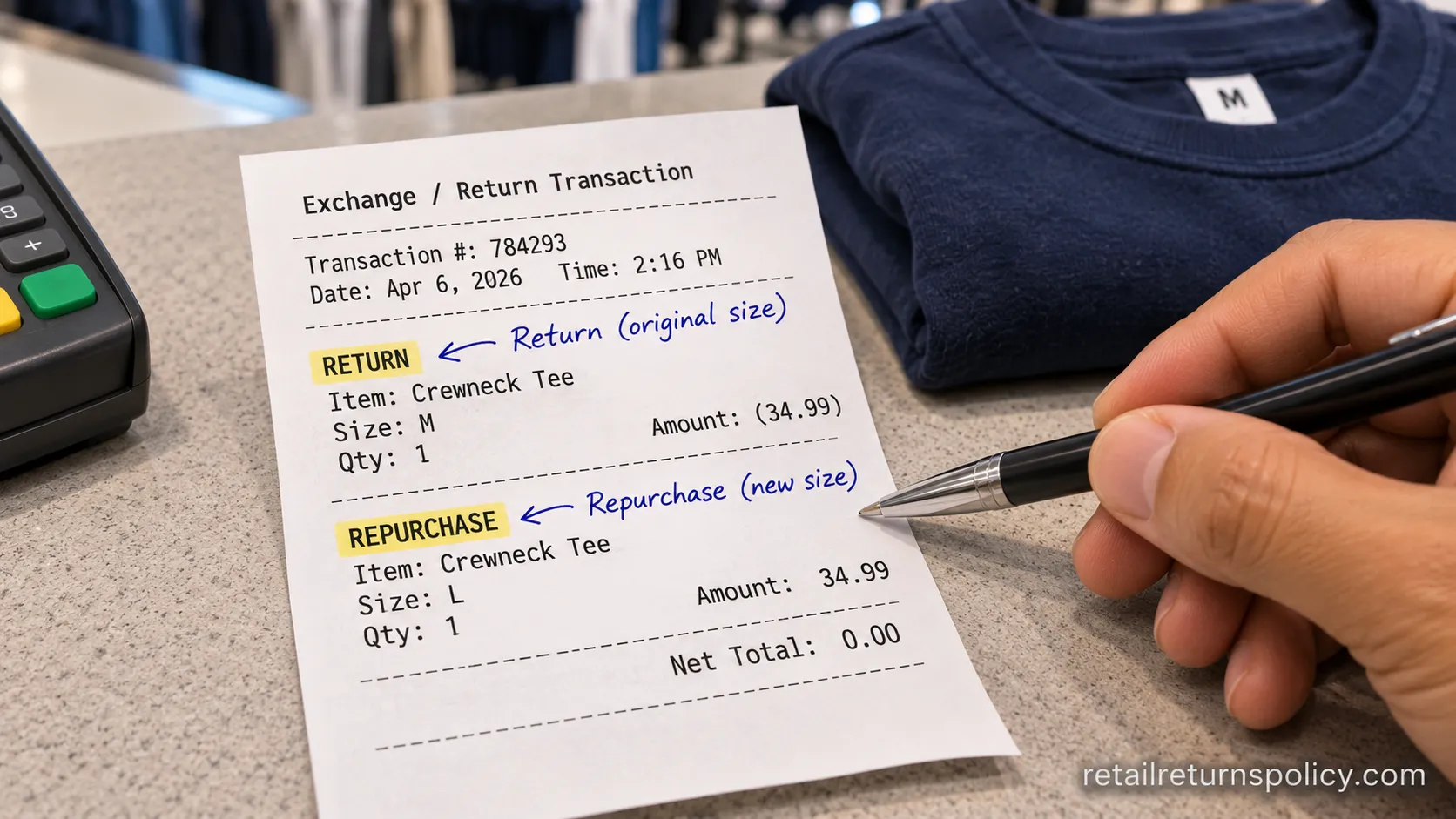
One quirk we saw repeatedly during testing: staff often called an even-size swap an “exchange” but processed it at the register as a return followed by a fresh purchase.
That two-transaction path matters, because it can reset your refund method or reopen a fee you thought you had avoided.
Some stores blur these terms on their own pages, so if you want the broader structure behind all of this, our overview of return policies explained sets the foundation this guide builds on.
Are Exchanges Free? Even, Size, and Color Swaps
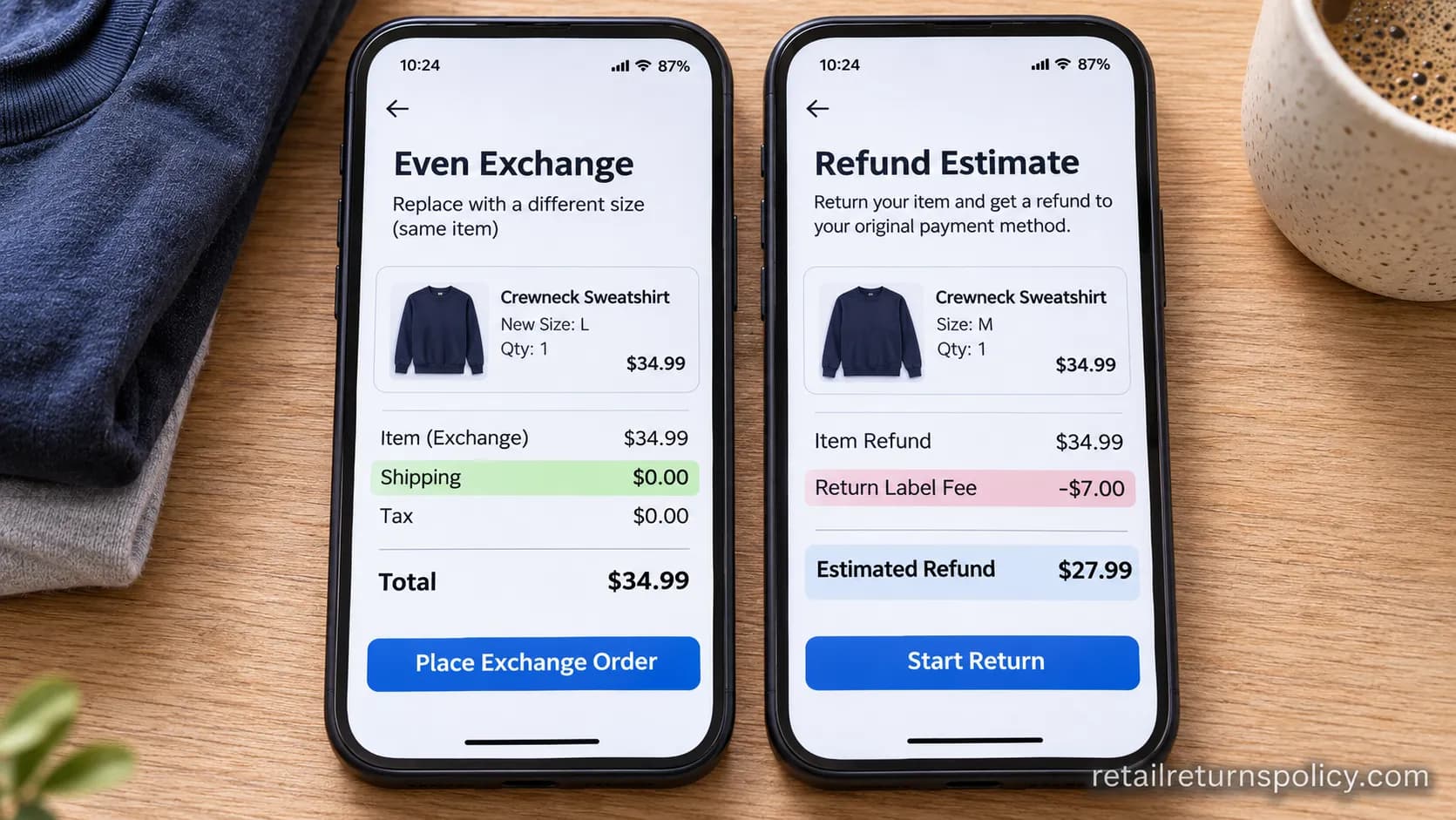
Exchanges are frequently free when a refund is not, especially for an even exchange, meaning the same item in a different size or color with no price difference.
Many retailers subsidize that swap because it keeps the sale, while a mailed-back refund can carry a return-shipping deduction, so the consumer-side takeaway is simple: swapping can cost nothing, whereas getting your money back sometimes costs a fee.
In our August 2026 tests, an even size swap at one apparel retailer shipped free, while the mail-in refund for the exact same item would have deducted a $6.99 return-label fee.
That is real money lost for choosing “refund” when “exchange” was sitting right there.
Charging for a mailed return while keeping exchanges free is a common nudge toward swapping, a pattern ClickPost describes on the merchant side.
Read from the shopper’s chair, that nudge can work in your favor.
The decision rule: if you want the same item in another size or color, exchange it and skip the fee.
If you want out of the purchase entirely, opt for the refund even if you plan to reorder, so your money is not trapped as credit.
There is a real counter-case, though. If a store only offers store credit on the swap, or the retailer looks financially shaky, a cash refund is the safer play even when an exchange is free.
For a store-specific walkthrough of clothing swaps, our guide to swap sizes at clothing brands covers the apparel details.
How Refunds Are Actually Issued
How a refund reaches you is the heart of any return and exchange policy, and there are four common forms: original payment, cash, merchandise credit, and a store gift card.
The default in 2026 remains a refund to your original payment method when you have proof of purchase, and the moment that proof is missing, the outcome usually shifts toward credit.
The four refund forms break down like this.
Original payment: back to the card or account you paid with, the standard with a receipt.
Cash: typically only if you paid cash and are within the window.
Merchandise credit: a non-transferable card, often issued for no-receipt or gift returns.
Store gift card: similar to merchandise credit, sometimes usable online as well as in store.
Without a receipt, most stores issue store credit, and often at the item’s lowest recent selling price rather than what you paid.
The Federal Trade Commission advises trying a card or membership lookup first, since many retailers can find the original purchase and refund you properly without the paper slip.
Here is what our no-receipt returns actually produced in August 2026.
Retailer type (no receipt) | Refund form received | Amount vs. what we paid |
|---|---|---|
Discount superstore | Merchandise return card | $2.50 below paid (lowest recent price) |
Big-box department store | Store gift card | $6.00 below paid (lowest recent price) |
Apparel chain | Store credit | Full amount |
Beauty retailer | Store credit | Full amount |
Home-improvement store | Store credit | Full amount |
Electronics chain | Store credit (after ID scan) | Full amount |
Mid-tier department store | Store gift card | Full amount |
Outdoor and sporting store | Store credit | Full amount |
This table reflects our own August 2026 test returns and is scheduled for re-verification before the values are treated as final.
How to keep cash instead of credit: pay by card, keep the receipt or link the purchase to a store account, and return inside the window.
Those three habits are what separate a clean card refund from a merchandise card you cannot spend anywhere else.
That leads to the grievance we heard most often, a shopper getting store credit instead of a refund, which is sometimes legitimate, such as a no-receipt or clearly out-of-window return.
Other times it is simply the default the associate reaches for, and asking for the original payment method (with your receipt in hand) flips it.
There is a genuine risk to store credit that no exchange fee compares to: a card is only as good as the retailer behind it.
As The Ascent has warned, credit at a chain that later closes can become worthless, which is why cash or a card refund beats credit whenever you have the choice.
If your return is heading back through the mail, our step-by-step guide to mailing an online return covers the label and drop-off details.
And if a store drags out an online refund, the FTC’s mail and internet order rules require sellers to ship (or refund) within the promised time, with a credit-card chargeback as your backstop.
Refund Method by Store: A Quick Comparison
Refund method is where a return and exchange policy gets concrete, and the pattern across major US retailers in 2026 is consistent: with a receipt, nearly everyone refunds to your original payment method, and the real differences show up in the window length and the exceptions.
We verified every row below against each store’s live policy page on September 1, 2026, cross-checked against NerdWallet’s retailer return guide.
Store | Standard return window | Default refund method | Notable 2026 detail |
|---|---|---|---|
Amazon | 30 days, most items | Original payment | Added late-return and luxury-item damage fees |
Target | 90 days (30 electronics; 1 year for Target brands and RedCard) | Original payment; no receipt gives a merchandise card | No-receipt returns capped near $100 per year, photo ID required |
Walmart | 90 days, most (electronics shorter) | Original payment | No-receipt returns are ID-tracked and limited |
Costco | No time limit on most items (90 days electronics) | Original payment | Membership lookup replaces the receipt |
Best Buy | 15 days standard (longer for My Best Buy members) | Original payment | Restocking fees on some opened or activatable items |
Nordstrom | No set deadline (case by case) | Original payment; no record gives a gift card at current price | Free return shipping |
IKEA | 365 days unopened, 180 days opened | Original payment | Opened items get the shorter window |
Home Depot | 90 days in store, 180 days online (365 with the Home Depot card) | Original payment | Tinted paint is non-returnable; some gas equipment is 7 days |
Apple | 14 days | Original payment | Opened software, gift cards, and engraved items are non-returnable |
Sephora | 30 days full refund; 31 to 60 days store credit | Original payment within 30 days | Beauty past 30 days returns as store credit |
Old Navy | 30 days (45 to 60 for cardmembers) | Original payment | Final-sale and clearance are often excluded |
Lululemon | 30 days, unworn with tags on | Original payment | Worn or washed items are not accepted |
The reading pattern is the pivot: the receipt is the switch between cash and credit.
With proof, the window is your main constraint; without it, you are usually looking at store credit, sometimes at a lower price.
For the categories with the most fine print, we defer to the deep guides: beauty buyers should check the sealed-versus-opened rules in our beauty and eyewear exchanges guide.
Shorter, stricter tech timelines are covered in our electronics store exchanges guide.
What You Can’t Exchange or Return
Some purchases are excluded from a return and exchange policy no matter how new they look, and the usual non-returnables are consistent across retailers: final-sale and clearance items, gift cards, opened cosmetics and hygiene products, opened software, personalized or engraved goods, and perishables.
Retailers are generally not required to accept returns on non-defective merchandise, a limit LegalClarity lays out plainly, so knowing the excluded categories before you buy is what prevents the worst counter surprises.
The common non-returnable categories look like this.
Final sale and clearance: usually no return and no exchange.
Gift cards: almost never refundable.
Opened cosmetics, hygiene, and intimate apparel: restricted for safety and resale reasons.
Opened software and digital codes: non-returnable once unsealed.
Personalized or engraved items: made to order, so no resale.
Perishables: food and flowers, outside grocery-specific rules.

Two more traps deserve a flag, starting with the restocking fee, commonly on opened electronics or large items, which can claw back 10 to 20 percent of the price and turn a full refund into a partial one.
There is also a real gap between the policy as written and the policy as enforced at the register, which is where a lot of community frustration comes from.
If you are returning a gift, ask for the gift receipt path. It lets you exchange or take credit without the original purchaser being notified of the amount or the return.
Whether your reason even qualifies is its own question, and we cover the reasons stores actually accept in a dedicated guide.
How to Exchange or Return an Item, Step by Step
Completing a return and exchange in 2026 comes down to five steps, and the order matters because step three is where you decide whether you pay a fee.
Retailers now offer in-store returns, prepaid mail labels, and QR-code box-free drop-offs, so the mechanics are easier than they used to be, and the one decision that changes your cost is choosing an exchange over a refund when you only want a different size.
Check the return window first. Confirm how many days you have and whether your item’s category (electronics, final sale) has a shorter clock.
Find your proof of purchase. A receipt, order confirmation, or the card or account you paid with all work at most stores.
Decide: exchange or refund. For a same-item size or color swap, choose the exchange to skip a likely return fee. For getting out of the purchase, choose the refund.
Pick your channel. Return in store, print a prepaid mail label, or use a QR-code box-free drop-off where offered.
Keep the confirmation. Hold the receipt or tracking until the refund actually lands, which can take a few business days.
In our own timed test, the QR box-free drop-off took just under three minutes end to end, versus the longer routine of boxing an item, printing a label, and mailing it.
Choosing the exchange at step three is also what kept the swap free, echoing the fee math from the exchange section above.
Bulkier categories follow their own rules: sneaker and activewear swaps have their own sizing quirks, covered in our shoes and activewear exchanges guide.
Furniture and hardware follow different pickup rules, detailed in our furniture and hardware exchanges guide.
Your US Return and Refund Rights
Your legal rights around a return and exchange policy are narrower than most shoppers assume, because there is no federal law giving you a general right to return an item for buyer’s remorse.
According to FindLaw, the FTC’s Cooling-Off Rule is the main federal return protection, and it is limited: three business days to cancel, only for sales over $25 made at your home, workplace, or a seller’s temporary location like a fair, so regular in-store and online purchases are not covered.
Where you do have leverage is defective goods.
Under the implied warranty of merchantability in the Uniform Commercial Code, an item has to work as intended, and Consumers Advisory notes that citing this right can force a remedy even past a posted “no returns” sign.
State law adds another layer, mostly through disclosure rules that create a default window when a store stays silent.
State | What happens if a store posts no return policy |
|---|---|
California | Must post a policy unless it gives a full cash refund, exchange, or credit within 7 days; if not posted, you may return for a full refund within 30 days |
Florida | A store not offering refunds must post that notice conspicuously; silence can trigger a refund duty |
New York | Retailers must conspicuously post their refund policy, and failing to can entitle you to a refund |
These state defaults are a genuine backstop, and Gazoobie’s state-by-state guide maps how the patchwork varies.
The through-line is that a posted policy governs, but silence often works in your favor.
A script that works: for a defective item, say plainly, “This product is defective, and under the implied warranty of merchantability I’m entitled to a refund or replacement.” When a store initially refused a defective-item refund in our testing, that exact phrasing changed the outcome and produced a replacement.
Not legal advice. This is general consumer information, state law varies, and a consumer-protection attorney or your state attorney general’s office is the right call for a specific dispute.
Once you know your rights, judging a policy before you buy is the natural next step, which is exactly how to judge a policy in our companion guide.
Is “The Exchange” a Return Policy, or a Store?
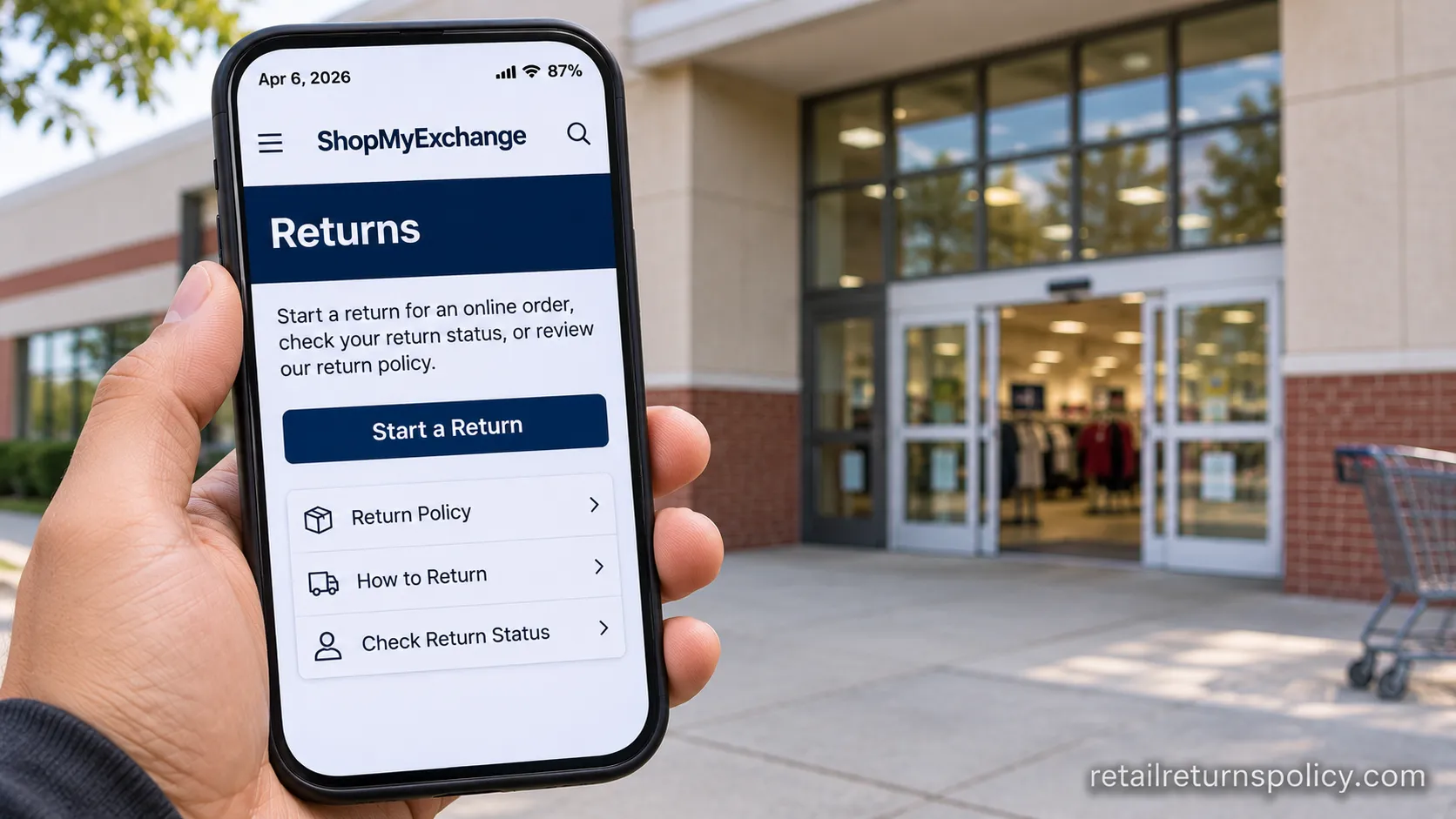
“The Exchange” is a store, not a type of return policy: it refers to the Army and Air Force Exchange Service, or AAFES, a tax-free department-store chain (the PX and BX) that operates on US military installations worldwide for authorized shoppers.
Per Wikipedia’s AAFES entry, it is one of the oldest and largest retailers serving the military community, and it has its own return terms on ShopMyExchange, separate from the general concept this article covers.
This naming collision is why a search for “exchange policy” sometimes surfaces military-store results instead of swap-versus-refund guidance.
If that is what you were after, here is the quick orientation.
Each service branch actually runs its own exchange, and Military OneSource confirms that shopping is limited to authorized patrons such as service members, retirees, and eligible family.
Eligibility rules change, so anyone shopping there should check the official AAFES sources directly.
If you landed here for the everyday meaning, the swap-versus-refund concept, everything above the disambiguation is what you want.
Frequently Asked Questions
What is the difference between a return and an exchange?
A return sends an item back for a refund, while an exchange swaps it for a different size, color, or product. The practical difference is money: a return puts value back in your pocket (as cash, card, or credit), and an exchange puts a different item in your hands, often with no fee for an even swap.
Do I get my money back or store credit?
With a receipt and inside the window, most stores refund to your original payment method. Without a receipt, you usually get store credit or a merchandise card, sometimes at the item’s lowest recent price, so keeping proof of purchase is the single best way to get actual money back.
Is exchanging free?
Often, yes, especially for an even exchange of the same item in a different size or color. Refunds are the ones that can carry a return-shipping or restocking fee, which is why swapping is frequently cheaper than refunding and rebuying.
What can’t I return?
Common non-returnables include final-sale and clearance items, gift cards, opened cosmetics and hygiene products, opened software, and personalized goods. Restocking fees can also apply to opened electronics and large items, turning a full refund into a partial one.
Can a store legally refuse a refund?
Yes, and no federal law forces stores to accept non-defective returns, so a clearly posted policy generally governs. Your exceptions are defective goods under implied-warranty law, the narrow FTC Cooling-Off Rule, and state disclosure defaults when no policy is posted.
What happens if I return something without a receipt?
Expect store credit rather than original payment, and possibly a refund set to the lowest recent selling price. Ask the store to look up the purchase by your payment card or membership account first, since many can find it and refund you properly without the paper slip.
Is “the Exchange” a store?
Yes, “the Exchange” is the Army and Air Force Exchange Service, a tax-free military department-store chain for authorized shoppers, not a category of return policy. Its own return terms live on ShopMyExchange.
Before a big gift-giving season, note that timelines shift, and our guide to holiday return deadlines tracks the extended windows.
A return and exchange policy is ultimately less about whether you can bring something back and more about the form your money takes when you do.
Keep your receipt, know your window, choose the exchange when you only need a different size, and push for original payment rather than credit whenever the policy allows, so the counter stops being a gamble and starts being predictable.
Read it your way
Short on time? Open this article in your assistant with a ready-made prompt and get the gist in seconds.
Found this useful? Make us a preferred source so we show up in your Google results.
Keep reading
Related articles
Retailer Return Policy Hubs
Lowe’s Return Policy (2026): What 6 Real Returns Taught Us
Get Lowe’s return policy in plain English: the 90-day window, the 48-hour appliance and window-AC trap, no-receipt store credit, refund timing, and how to retur
Retailer Return Policy Hubs
No Apple Restocking Fee in the US? The 25% Myth (2026)
Skip the Apple restocking fee worry: the US charges $0 within 14 days, while carriers add $50 and Best Buy, Samsung & Newegg dock 5–15%.
Retailer Return Policy Hubs
Old Navy Return Policy: 30, 45 & 60-Day Windows (2026)
Check the Old Navy return policy fast: 30-day window (45–60 days for members), receipt rules, refund timing, the $7 mail fee & final-sale items.
Retailer Return Policy Hubs
How to Return a PlayStation Game: Digital vs Disc (2026)
Learn how to return a PlayStation game: digital refunds within 14 days (before download), plus disc-return rules and eligibility.
The discussion
Comments
Every comment is reviewed before it goes live.