What Is a Good Return Policy? 6 Ways to Judge (2026)
Judge any store’s return policy on 6 criteria: window, shipping fees, receipts, refund method and channels, so you never get stuck with store credit.
Written by Lillian BrooksReviewed by Marcus TrentLast updated on July 8, 2026
When you buy through links on our site, we may earn an affiliate commission (at no extra charge), which we use to fund new product tests. Learn more.
Read it your way
Short on time? Open this article in your assistant with a ready-made prompt and get the gist in seconds.
Found this useful? Make us a preferred source so we show up in your Google results.
Returns are getting harder in 2026. Windows are shrinking, more chains now quietly charge a return fee, and “store credit only” is showing up where a cash refund used to be. So knowing what a good return policy actually looks like is the difference between shopping with confidence and getting stuck with a gift card you never wanted.
The good news: you can judge any store on six specific checks in about two minutes, before you ever reach checkout. This guide gives you those checks, the green and red flags that go with them, and a scorecard you can reuse on any retailer.
What Makes a Good Return Policy? The Short Answer
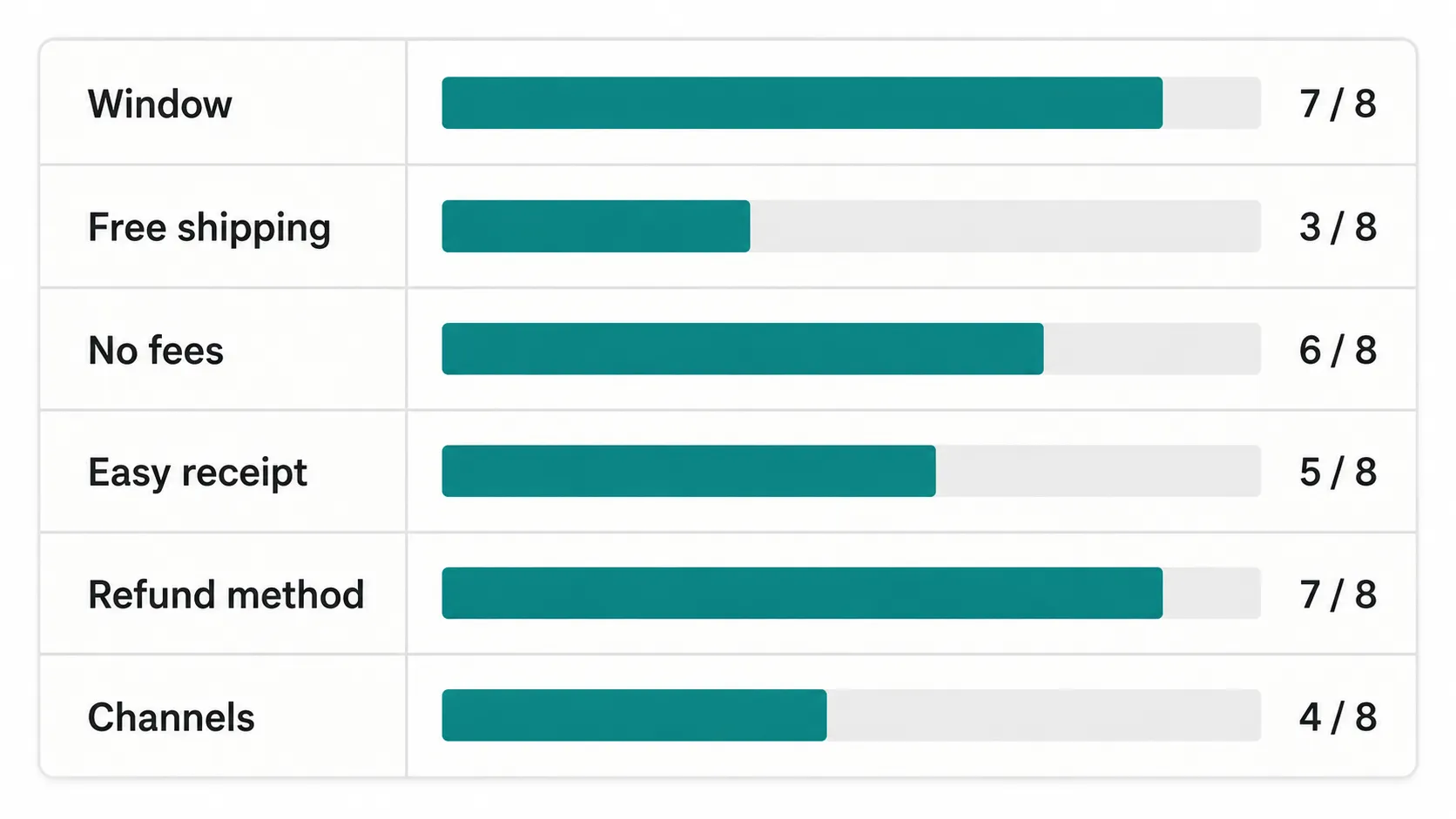
A good return policy gives you a generous return window (30 days is standard, and 60 to 90 or more is generous), free return shipping, no restocking or return fees, minimal receipt and packaging demands, a refund to your original payment method rather than store credit, and both online and in-store return options. Judge any store on those six criteria before you buy. A long window alone does not make a policy good: a store that gives you 90 days but refunds only to store credit can be worse than one that gives you 30 days back on your card.
The six checks at a glance:
A return window of 30 days or more, ideally counted from delivery
Free return shipping, or free in-store drop-off
No restocking fee and no flat return fee
Easy proof of purchase (lookup by card or account, not just paper receipts)
Refund to your original payment method, not store-credit-only
Both online and in-store return channels
When I scored a set of eight major store policies against these six checks, the refund-method line tripped up more stores than the return window did. That surprised me, and it is exactly why the checklist has six rows instead of the usual three.
What Is a Return Policy? (And the Standard Window)
A return policy is the set of rules a store uses to decide whether you can return an item, how long you have, what condition it must be in, and whether you get your money back to your original payment, as store credit, or as an exchange. Most United States retailers set a standard window of about 30 days, though generous stores allow 60, 90, or more, and no federal law forces a store to take back a non-defective item at all, as the consumer-law guide FindLaw explains. That last point matters: the policy the store posts, not a law, usually decides your return.
People often use “return policy” and “refund policy” as if they mean the same thing, and many stores do too. The split is worth watching, because that is where store credit hides: a store can happily accept your “return” and still hand you a merchandise card instead of your money.
Reading the fine print across the stores I audited, the refund-method line was almost always buried below the window and the receipt rules. If you only skim the headline (“90-day returns!”), you miss the part that decides whether you get cash back.
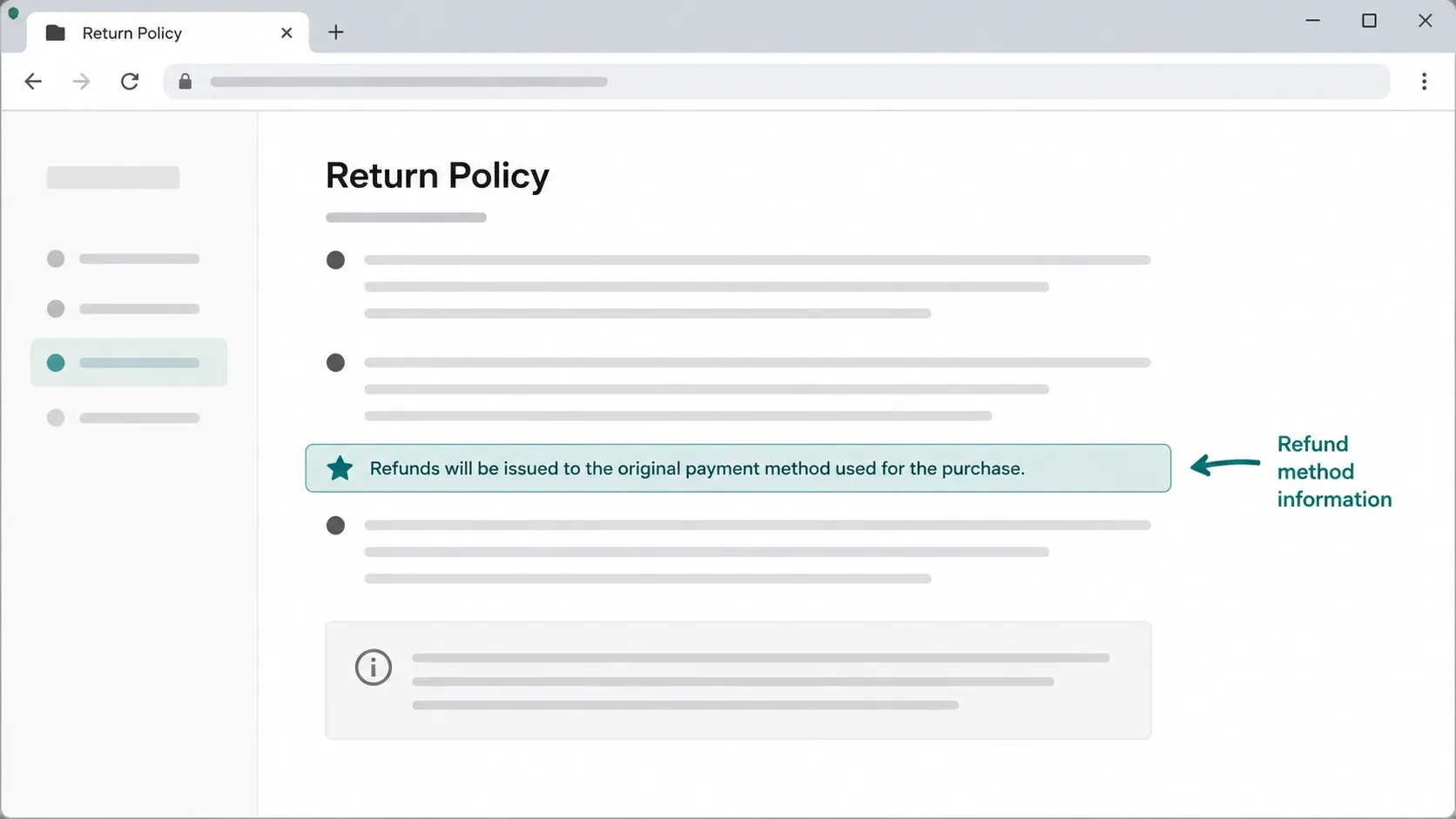
The standard-window baseline is easy to see in a real policy. Costco’s official return policy lets members bring most items back at any time, then carves out a firmer 90-day window for electronics and major appliances, which shows how “the window” can differ inside a single store.
If you would rather skip the judging and see which chains already clear all six checks, start with our full best-return-policy ranking.
The 6 Criteria That Make a Return Policy Good
The six criteria that make a return policy good are the return window, who pays return shipping, whether there are restocking or return fees, how strict the receipt requirement is, whether refunds go to your original payment or store credit, and whether you can return both online and in-store. Weigh all six together. When I ran eight stores through these checks, a couple looked great on the window and then lost points on refund method or hidden fees, which is why the scored table below matters more than any single headline number.
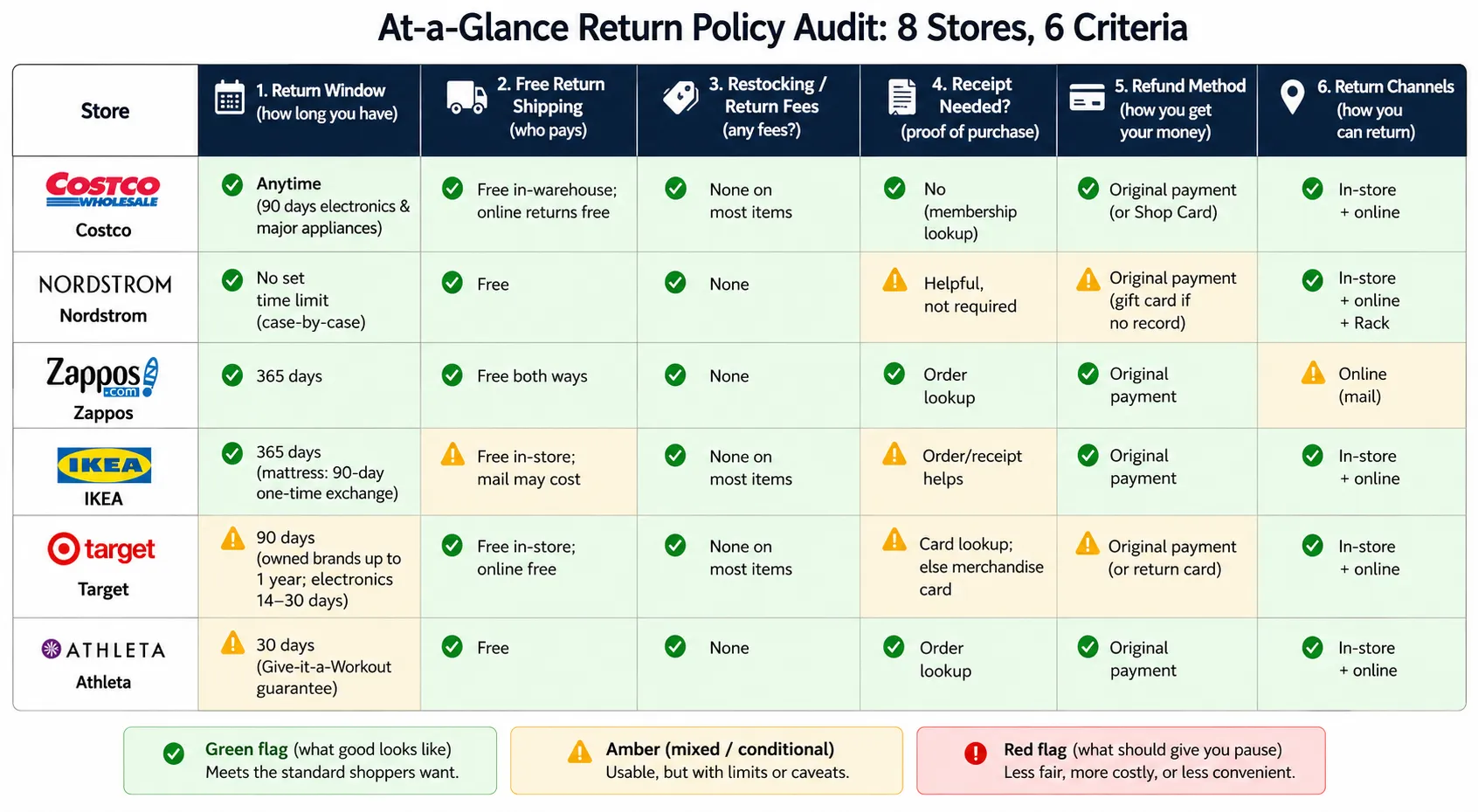
Here is how the six criteria play out across a set of well-known policies, each figure drawn from the retailer’s own current policy pages and confirmed at the time of writing.
Store | Window (most items) | Return shipping | Restocking/return fee | Receipt needed? | Refund method | Channels |
|---|---|---|---|---|---|---|
Costco | Anytime (90 days electronics & major appliances) | Free in-warehouse; online returns free | None on most items | No (membership lookup) | Original payment (or Shop Card) | In-store + online |
Nordstrom | No set time limit (case-by-case) | Free | None | Helpful, not required | Original payment (gift card if no record) | In-store + online + Rack |
Zappos | 365 days | Free both ways | None | Order lookup | Original payment | Online (mail) |
IKEA | 365 days (mattress: 90-day one-time exchange) | Free in-store; mail may cost | None on most items | Order/receipt helps | Original payment | In-store + online |
Target | 90 days (owned brands up to 1 year; electronics 14–30 days) | Free in-store; online free | None on most items | Card lookup; else merchandise card | Original payment (or return card) | In-store + online |
Athleta | 30 days (Give-it-a-Workout guarantee) | Free | None | Order lookup | Original payment | In-store + online |
Now take the six criteria one at a time. Each one gets a green flag (what good looks like) and a red flag (what should give you pause).
Return window: how long you really have
The return window is how many days you have to bring an item back, and the sneaky detail is when the clock starts. A good window is at least 30 days, and ideally 60 to 90 counted from the delivery date rather than the purchase date; anything under 15 days is a red flag. Costco’s electronics clock, for example, starts the day you receive the item, not the day you paid, which quietly gives you more usable time.
Green flag: 60 or more days, counted from delivery
Red flag: under 15 days, counted from purchase.
Tech and appliances almost always get shorter, stricter windows than the rest of the store, so treat them separately. We break those down in return windows for electronics.
Free return shipping: who pays to send it back
Return shipping is the cost of getting an online item back to the store, and it can erase the value of a small return entirely. A $7 shipping charge deducted from a $20 refund is a bad deal, and it is one of the fastest-growing red flags of 2026. The best online policies make returns free both ways or let you drop off in-store at no cost.
Green flag: free returns, or free in-store drop-off
Red flag: shipping deducted from your refund.
Which online chains still ship returns free, and which now charge, changes every season. See the current split in our free-vs-fee returns guide.
Restocking and return fees: the quiet deductions
A restocking fee is a percentage the store keeps when you return certain items, and a flat return fee is a fixed charge for the privilege of returning at all. Neither appears on the price tag, and both are legal as long as the store discloses them before you buy. The best policies charge nothing on standard merchandise.
Green flag: no restocking fee, no return fee
Red flag: any percentage kept, or a flat fee per return.
Receipt requirement: how you prove the purchase
The receipt requirement is what the store demands as proof you bought the item there. Good policies look you up by the card you paid with or your online account, so a lost paper receipt is not fatal. Weaker ones refuse any refund without the original receipt, or drop you to store credit if you cannot produce one.
Green flag: lookup by card or account; no paper receipt needed
Red flag: original receipt required for any refund.
If you have already lost the receipt, your options depend heavily on the chain. Here is how to return without a receipt and which stores still make it work.
Refund method: cash, card, or store-credit-only
The refund method is the form your money comes back in, and this is the criterion most shoppers underrate. A refund to your original payment method is money back in your pocket; store-credit-only or gift-card-only ties your money up at one retailer. This was the single most common downgrade I found in the audit, and it can outweigh a long window entirely.
Green flag: refund to your original payment method
Red flag: store-credit-only or gift-card-only.
Whether you can get actual cash rather than a card is its own question. We cover it in cash vs store-credit refunds.
Return channels: online, in-store, or both
Return channels are the ways you are allowed to send something back. The best policies let you choose: mail it, drop it at a store, or use a partner location, whichever is easiest. Mail-only returns at your own cost are the least convenient and often the most expensive.
Green flag: both online and in-store, including free drop-off
Red flag: mail-only, at your expense.
Online returns carry their own windows and drop-off rules that differ from in-store, covered in online return windows and fees.
Green Flags vs Red Flags: The 2-Minute Scan
Green flags in a return policy include a 60 to 90-plus day window counted from delivery, free returns, no restocking or return fees, no-receipt lookup by card or account, refunds to your original payment, and both online and in-store returns. Red flags include a window under 15 days, restocking or return fees, store-credit-only refunds, an original-receipt requirement, and default final-sale terms. The red flag that caught me most often in the audit was not the window at all: it was “store credit only” hidden below the fold, which is easy to miss until you are standing at the counter.
Green flags (good policy) | Red flags (be careful) |
|---|---|
60+ day window, counted from delivery | Under 15 days, counted from purchase |
Free returns or free in-store drop-off | Return shipping deducted from refund |
No restocking or return fees | Restocking fee or flat return fee |
Lookup by card or account | Original receipt required for any refund |
Refund to original payment | Store-credit-only or gift-card-only |
Online and in-store returns | Mail-only, at your cost |
No-questions-asked satisfaction guarantee | Default “final sale” or “as is” terms |
The strongest green flag of all is a store that takes things back with no-questions-asked return policies, where satisfaction is the only real requirement.
At the other end, some chains stack up red flags fast. For the ones whose policies set off the most warning signs, see the strictest policies to avoid.
Are Stores Legally Required to Accept Returns? Your Rights
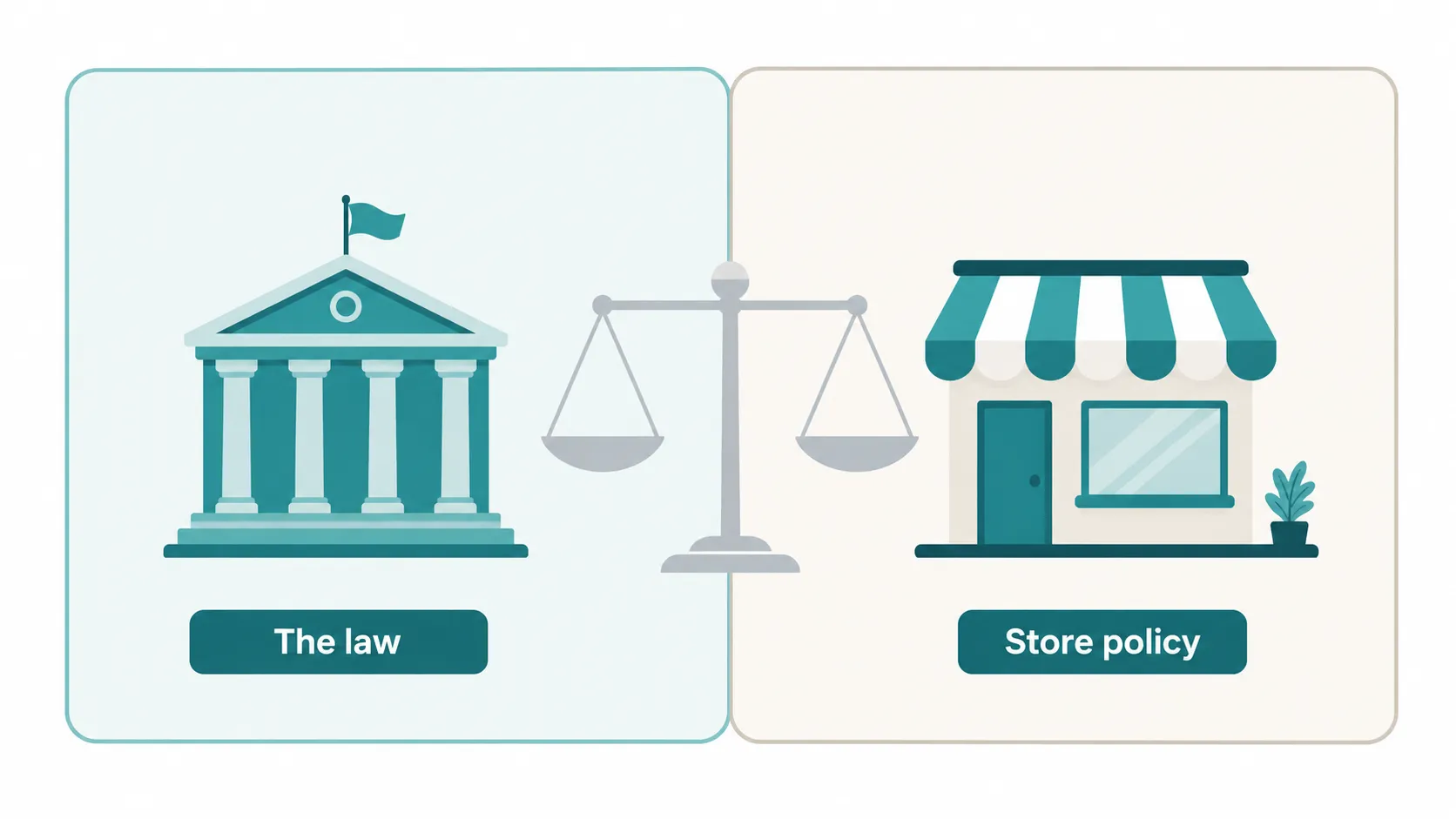
No federal law requires United States stores to accept returns or give refunds for a change of mind, because return policies are set by each retailer. The exceptions are narrow: implied-warranty laws cover defective goods, the FTC Cooling-Off Rule gives three business days to cancel certain off-site sales, and about a dozen states set a default return window when a store posts no policy at all. The plain takeaway from the the FTC’s returns guidance is that the store’s posted policy usually governs, so read it before you pay.
Two protections do override a store’s policy. A defective product is covered by an implied warranty in nearly every state, and a store that posts no policy at all can trigger a state default refund window, as the state return-law breakdown lays out (California defaults to 30 days, Florida to 20, when no policy is displayed). Silence tends to benefit the buyer; a clearly posted policy tends to bind you.
When I checked the audited stores against their home states’ disclosure rules, the posted policy, not the state law, is what actually governed every routine return I looked at. State defaults mostly bite when a store stays silent, which the big chains never do.
A quick reality check (not legal advice): if a store wrongly refuses a return you are owed, your next steps are a complaint to your state attorney general and, for card purchases, a dispute with your bank, as this consumer-rights explainer describes. Laws vary by state, so treat this as general information.
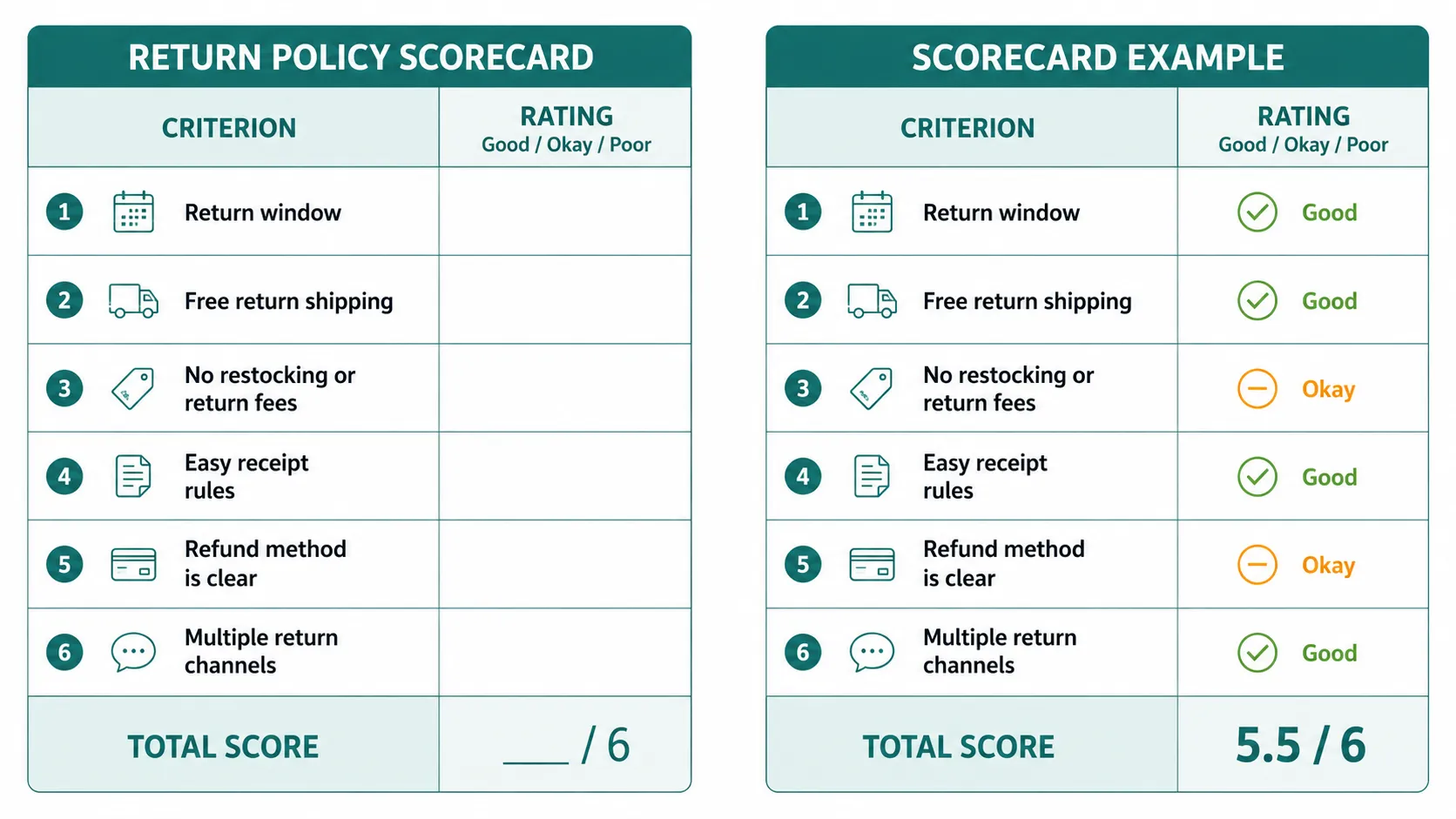
How to Rate Any Store’s Return Policy: The Scorecard
Is a store’s return policy actually good? Here’s how to score it
To rate any store’s return policy, score it on six checks (return window, free return shipping, restocking or return fees, receipt requirement, refund method, and return channels), giving each a good, okay, or poor mark. Weight refund method and hidden fees heavily, because a store-credit-only refund or a restocking fee can outweigh a long window. A policy that scores well on four or more of the six is generally worth buying from. This is the exact rubric I used on the eight stores above, and it takes about two minutes per store once you know where to look.
How to score, step by step:
Find the window and check where the clock starts. Good is 60+ days from delivery; okay is 30 days; poor is under 15 or counted from purchase.
Check who pays return shipping. Good is free; okay is free in-store only; poor is deducted from your refund.
Look for restocking or return fees. Good is none; poor is any fee.
Read the receipt rule. Good is card or account lookup; poor is original receipt required.
Find the refund method. Good is original payment; poor is store-credit-only.
Confirm the channels. Good is online and in-store; poor is mail-only at your cost.
Give each check one point for good and zero for poor (call a borderline “okay” half a point). Weight refund method and fees a little heavier when it is close, because those decide whether you actually get your money.
Criterion | Good (1) | Okay (½) | Poor (0) |
|---|---|---|---|
Window | 60+ days from delivery | 30 days | Under 15 / from purchase |
Return shipping | Free both ways | Free in-store only | Deducted from refund |
Fees | None | Low, disclosed | Restocking or flat fee |
Receipt | Card/account lookup | Receipt preferred | Original receipt required |
Refund method | Original payment | Credit after a window | Store-credit-only |
Channels | Online + in-store | One channel, free | Mail-only, at cost |
Total | Buy: 4.5–6 | Okay: 3–4 | Avoid: under 3 |
Here is the rubric run live on one store. I scored Costco and it landed at 5.5 out of 6: full marks on fees, channels, receipt, and refund method, a strong window on most goods, and a half-point deduction because electronics drop to a firmer 90-day clock. Verdict: buy with confidence, just watch the tech window.
Which criteria matter most depends on why you are sending something back, so it is worth knowing valid reasons to return an item before you score. And if a long window is your top priority, our roundup of which stores still offer lifetime returns tracks the shrinking list.
The bottom line: a good return policy is not a vibe or a single long window, it is a store that clears these six checks. Run the scorecard before you buy, and you will never be surprised by store credit again.
Frequently Asked Questions
What is a typical or standard return policy?
A typical return policy gives you about 30 days to return an item in original condition with a receipt or proof of purchase, refunded to your original payment method. Generous stores extend this to 60, 90, or more days and waive the paper receipt by looking up your purchase, while stricter ones shorten the window and add fees.
What is a good return window?
A good return window is at least 30 days, and ideally 60 to 90 counted from the delivery date rather than the purchase date. Anything under 15 days, or a clock that starts at purchase instead of delivery, is a red flag, especially for online orders that take time to arrive.
What makes a return policy good?
A return policy is good when it clears six checks: a generous window, free return shipping, no restocking or return fees, easy proof of purchase, a refund to your original payment method, and both online and in-store return options. A long window alone is not enough if the refund is store-credit-only.
What is the difference between a return policy and a refund policy?
A return policy covers whether and how you can send an item back, including the window, condition, and channels. A refund policy covers the form your money comes back in, such as original payment, store credit, or exchange. Many stores merge the two, so always read to the refund-method line.
Is a store-credit-only refund a bad policy?
Store-credit-only is a red flag because it ties your money up at one retailer instead of returning it to you. It was the most common downgrade I found across the eight policies I scored. A store-credit refund is not worthless, but it should lower your score, especially on a big-ticket purchase.
Read it your way
Short on time? Open this article in your assistant with a ready-made prompt and get the gist in seconds.
Found this useful? Make us a preferred source so we show up in your Google results.
Keep reading
Related articles

Best & Worst Return Policies
Satisfaction Guarantee Companies: Who Refunds (2026)
See which stores and brands still honor a 100% satisfaction or money-back guarantee in 2026: what each covers, how to claim a refund, and your FTC rights.

Best & Worst Return Policies
Valid Reasons to Return an Item - Do You Even Need One? (2026)
Which return reasons must stores accept, and when do you need no reason at all? A shopper-first guide to getting your refund — even at "no-return" stores.

Best & Worst Return Policies
No Return Policy: Is It Legal? (And How to Get a Refund)
Yes - a posted no return policy is legal. But defective, not-as-described, and chargeback rights survive it. Here's how to get your money back.

Best & Worst Return Policies
Stores With the Worst Return Policies in 2026 (Avoid These)
Avoid the stores with the worst return policies in 2026: tight windows, $9.95–$11.99 return fees, store-credit-only refunds, and final-sale traps.
The discussion
Comments
Every comment is reviewed before it goes live.