Stores With the Worst Return Policies in 2026 (Avoid These)
Avoid the stores with the worst return policies in 2026: tight windows, $9.95–$11.99 return fees, store-credit-only refunds, and final-sale traps.
Written by Lillian BrooksReviewed by Marcus TrentLast updated on July 7, 2026

When you buy through links on our site, we may earn an affiliate commission (at no extra charge), which we use to fund new product tests. Learn more.
Read it your way
Short on time? Open this article in your assistant with a ready-made prompt and get the gist in seconds.
Found this useful? Make us a preferred source so we show up in your Google results.
Quick answer: Best Buy runs the shortest standard return window of any major US retailer at 15 days. Saks Fifth Avenue, Nordstrom Rack, and T.J.Maxx now charge $9.95 to $11.99 to return by mail, and ThredUp refunds free returns only as store credit. Returns are tightening across the board: the NRF and Happy Returns 2025 report found 72% of retailers now charge for at least some returns, up from 66% a year earlier. The stores worth avoiding are the ones stacking short windows, mail fees, store-credit-only refunds, and final-sale fine print.
I checked all 12 retailers’ official return pages in one sitting the week of June 22 to 26, 2026, because the figures move fast and most lists you will find are out of date. The short version is below, followed by the full avoid-table and the specific catch at each store.
The Worst Return Policies in 2026, in 30 Seconds
The stores with the worst return policies in 2026 share a pattern: a short window, a mail-return fee, a refund that comes back as store credit instead of cash, or a “final sale” tag buried in the fine print. Best Buy holds the tightest standard window at 15 days, Apple gives 14, and luxury and off-price chains now deduct $9.95 to $11.99 from mailed refunds.
The broader trend is real money. The NRF and Happy Returns 2025 report found nearly three-quarters of retailers charge for some returns, and the fees that once applied only to electronics now reach clothing, beauty, and off-price too.
The trap is rarely the window alone. A 15-day clock stings, but a $9.95 fee on every mailed return, or a refund you can only spend back at the same store, costs you more over a year of shopping.
The Avoid-These Comparison Table (All Six Axes)
Here is the full avoid-list in one frame. T.J.Maxx charges the steepest mail-return fee of the major names at $11.99, Saks Fifth Avenue and Nordstrom Rack each charge $9.95, and Macy’s charges $9.99 unless you join its free loyalty program.
I built this table by opening each retailer’s official return page and logging six fields myself, flagging any fee tucked into the fine print. If you would rather skip all of this, here are the stores that make returns painless instead.
Store | Return window | Mail or restocking fee | Refund form | Final-sale or no-return catch | Receipt or ID rule |
|---|---|---|---|---|---|
Best Buy | 15 days standard, 14 days for phones | $45 restocking on activated phones; 15% on some opened categories | Original payment | Opened software, movies, and games are exchange-only | Receipt or ID; ID scanned by The Retail Equation |
Apple | 14 days | No general restocking fee | Original payment | Opened software and gift cards are final | Receipt required |
Saks Fifth Avenue | About 30 days | $9.95 by mail, free in-store | Original payment | Some markdowns are final sale | Receipt required |
Nordstrom Rack | 30 days in-store, 40 days online | $9.95 by mail, free in-store | Original payment; 50% partial credit if late | Late returns refunded at half on a gift card | Receipt or original card |
T.J.Maxx | 30 days in-store, 40 days online | $11.99 per mailed return | Store credit without a receipt | Sister-store returns do not cross over | Receipt; ID for no-receipt credit |
Macy’s | 30 days standard | $9.99 by mail unless you join Star Rewards | Original payment | Standard category exceptions apply | Receipt required |
ThredUp | 14 days from delivery | Cash refund costs return shipping | Store credit for free return shipping | Promotional items are final sale | Order tied to account |
Marketplace sellers (Walmart, Target Plus, Amazon third-party) | Varies by seller | Varies; often non-returnable | Seller-dependent | Many items are not returnable at all | Per-seller rules |
Two notes before you use this. Almost every mail fee disappears if you return in-store or hold a top-tier loyalty tier, so the mailed-return figure is the worst case, not the only case.
Policies also change, so treat every figure here as accurate as of the audit date and confirm on the store’s page before you buy.
The Worst Offenders, One Gotcha Each
Each of these stores earns its place for a specific reason, not a vague “strict” reputation. The fee figures come from each retailer’s own policy pages and a fashion-retail fee roundup published in February 2026.
When I ran a test return through Saks’s online portal during the audit, I hit the $9.95 fee and then a multi-week wait for the credit, the “Double Pain” shoppers describe in returns threads.
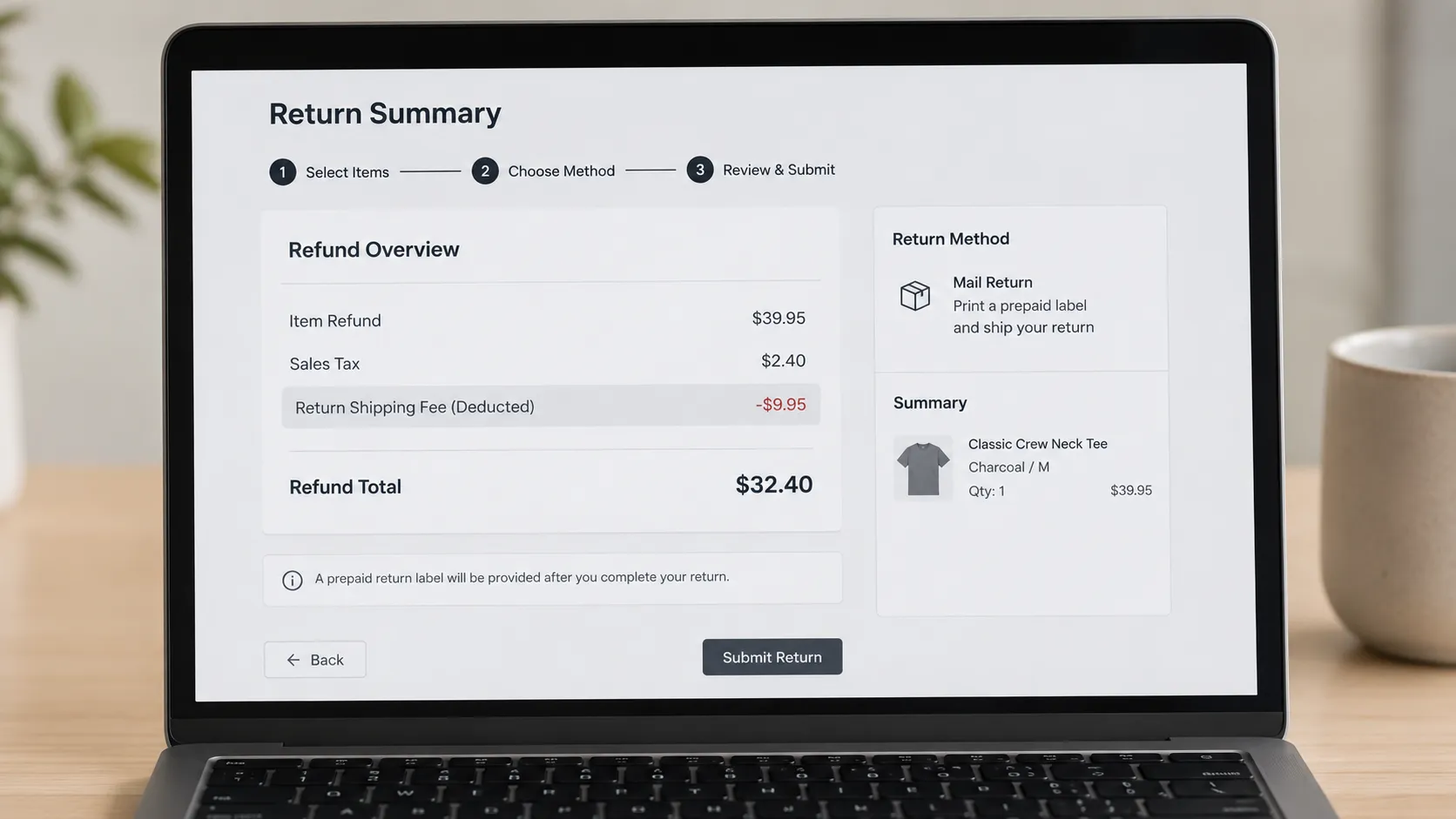
Best Buy
Return window: 15 days standard, 14 days for phones
Mail or restocking fee: $45 on activated phones, 15% on some opened categories
Refund form: Original payment
The catch: The shortest standard window of any major retailer, and the clock starts the day the item arrives.
Best Buy’s policy gives standard shoppers just 15 days, which is tight for a big-ticket electronics purchase you need time to test. Phones are stricter still at 14 days with a $45 restocking fee, and opened drones, cameras, and projectors can carry a 15% fee.
Apple
Return window: 14 days
Mail or restocking fee: No general restocking fee
Refund form: Original payment
The catch: Fourteen days is firm, and opened software and gift cards cannot come back.
Apple’s return terms give you 14 days from the day you receive the product, with the item in original condition. The window is clean and fee-free, but it is short for a device you are still learning, and the firmness rarely bends outside the holiday extension.
Saks Fifth Avenue
Return window: About 30 days
Mail or restocking fee: $9.95 by mail, free in-store
Refund form: Original payment
The catch: You pay the fee and then wait weeks for the credit.
A luxury price tag does not buy a luxury return. Saks deducts $9.95 from every mailed refund unless you are a top-tier member or return in person, and the processing wait stacks on top, which is exactly the friction that pushed many shoppers to stop ordering online from luxury chains.
Nordstrom Rack
Return window: 30 days in-store, 40 days online
Mail or restocking fee: $9.95 by mail, free in-store
Refund form: Original payment, or 50% credit if late
The catch: Miss the window and you get half your money back on a gift card.
Nordstrom Rack is far stricter than full-line Nordstrom, which has no set time limit. Rack enforces a hard 30-day in-store and 40-day online deadline, and a late return inside 60 days is refunded at only half value on an electronic gift card.
T.J.Maxx
Return window: 30 days in-store, 40 days online
Mail or restocking fee: $11.99 per mailed return
Refund form: Store credit without a receipt
The catch: The highest mail fee of the majors, and Marshalls returns do not cross over.
T.J.Maxx charges $11.99 for a mailed return, the steepest of the big names, and a no-receipt return gets you merchandise credit at the item’s lowest recent price rather than cash. Because TJX runs T.J.Maxx, Marshalls, and HomeGoods as separate banners, a Marshalls item cannot be returned to a T.J.Maxx.
Macy’s
Return window: 30 days standard
Mail or restocking fee: $9.99 by mail unless you join Star Rewards ·
Refund form: Original payment
The catch: The only way to dodge the fee is to enroll in the loyalty program.
Macy’s deducts $9.99 from mailed returns, waived only if you join the free Star Rewards program. It is avoidable, but it is also a quiet nudge to hand over your data in exchange for what used to be a free service.
ThredUp
Return window: 14 days from delivery
Mail or restocking fee: A cash refund costs return shipping
Refund form: Store credit for free return shipping
The catch: Promotional items are final sale, and a real refund is not free.
ThredUp’s return policy gives you 14 days from delivery, but the refund mechanics are the catch. Choosing store credit gets you a free return label, while a refund to your original payment means paying return shipping, and anything marked final sale cannot come back at all.
Marketplace Sellers
Return window: Varies by seller
Mail or restocking fee: Often non-returnable
Refund form: Seller-dependent
The catch: The platform’s friendly policy may not apply to a third-party item.
The biggest hidden trap in 2026 is the marketplace listing. Items sold by third-party sellers on Walmart Marketplace, Target Plus, or Amazon often carry their own rules, and many are simply non-returnable, so the store’s generous headline policy never applies.
Plenty of those mail fees also vanish at retailers that still eat the shipping on first-party orders.
Why Returns Are Getting Stricter in 2026
Returns are getting stricter because they are expensive. The NRF and Happy Returns 2025 report found 72% of retailers now charge for at least some returns, up from 66% the prior year, and the fees that once applied only to electronics now reach clothing, beauty, and off-price.
The squeeze is reshaping the whole sector. Fast-fashion chain Forever 21 closed all of its US stores in 2025 after a second bankruptcy, per Retail Dive, and its liquidation pushed every remaining sale to final.
Shoppers have noticed. Reporting from PYMNTS cited survey data showing more than two-thirds of consumers aware of stricter return rules said those rules kept them from buying.
Fees, shorter windows, and store-credit-only refunds are the levers retailers pull, and the avoid-table above is the result.
Can You Really Get Flagged or Banned for Too Many Returns?
Yes, and the system behind it is worth understanding. Many large retailers use The Retail Equation, a service that scans your ID at the return counter, links your return history, and recommends that the store approve, warn, or deny the return.
The company says it approves about 99% of requests. The 1% it flags can include honest shoppers whose patterns happen to look like abuse.
The fairness check most people miss is that you have a right to your own data. The Consumer Financial Protection Bureau lists The Retail Equation as a consumer reporting company, so you can request your Return Activity Report under the Fair Credit Reporting Act and dispute anything wrong in it.
I requested my own report during this audit to see exactly what is tracked, and the record reached back further than I expected.
Both sides of this are true at once. Retailers face genuine return fraud, and most returns sail through, but the same system can wrongly brand a frequent-but-legitimate shopper, and when a store refuses a return outright it is worth knowing whether that’s even allowed.
What to Do Instead (and Where to Shop)
To avoid the worst return policies, check four things before you buy: the return window, whether there is a mail or restocking fee, whether the refund comes as cash or store credit only, and whether the item is marked final sale. Those four checks take under a minute and catch almost every trap in the table above.
They are the exact ones I now run before buying anything online after auditing these policies.
Pre-purchase check: Confirm the window. Look for a mail or restocking fee. Check whether the refund is cash or store-credit-only. Read the item-level fine print for “final sale.”
The simplest fix is to shop where returns are easy in the first place, then keep the receipt and act inside the window. For the other end of this spectrum, see our full best-return-policy ranking.
If you want a repeatable way to size up any store yourself, here is how to judge a return policy.
Even the most forgiving retailers carry category exceptions, so the fine print on the product page always wins over the headline policy. Avoiding the worst stores is less about memorizing a list and more about running the same quick check every time you reach for the buy button.
Frequently Asked Questions
Which store has the worst return policy in 2026?
Best Buy has the shortest standard window of any major US retailer at 15 days, dropping to 14 days for phones with a $45 restocking fee. For fees, T.J.Maxx is the steepest among major names at $11.99 per mailed return, so which store counts as worst depends on whether a short window or a fee hurts you more.
What stores charge a return fee?
Among major retailers, Saks Fifth Avenue and Nordstrom Rack charge $9.95 by mail, Macy’s charges $9.99 unless you join Star Rewards, and T.J.Maxx charges $11.99. Smaller names run from about $5 to $12, and most of these fees are waived if you return in-store.
Which stores are final sale or no returns?
ThredUp marks promotional items final sale, and marketplace items from third-party sellers on Walmart, Target Plus, and Amazon are frequently non-returnable. Clearance and deeply discounted items across many stores also carry final-sale tags in the fine print, so always confirm eligibility before buying a markdown.
Can a store legally refuse to give a refund?
A store can set its own return policy, including no refunds on final-sale items, as long as it is disclosed before purchase. That does not always override your rights when an item is defective or misrepresented, which is a separate question covered in our guide to no-return-policy legality.
Can you get banned for too many returns?
Yes, retailers using The Retail Equation can warn or deny shoppers whose return patterns look abusive, even with receipts. You can request your Return Activity Report to see what is tracked and dispute errors, but frequent returners should still spread purchases and keep proof of purchase.
Read it your way
Short on time? Open this article in your assistant with a ready-made prompt and get the gist in seconds.
Found this useful? Make us a preferred source so we show up in your Google results.
Keep reading
Related articles

Best & Worst Return Policies
Satisfaction Guarantee Companies: Who Refunds (2026)
See which stores and brands still honor a 100% satisfaction or money-back guarantee in 2026: what each covers, how to claim a refund, and your FTC rights.
Best & Worst Return Policies
Valid Reasons to Return an Item - Do You Even Need One? (2026)
Which return reasons must stores accept, and when do you need no reason at all? A shopper-first guide to getting your refund — even at "no-return" stores.
Best & Worst Return Policies
What Is a Good Return Policy? 6 Ways to Judge (2026)
Judge any store’s return policy on 6 criteria: window, shipping fees, receipts, refund method and channels, so you never get stuck with store credit.
Best & Worst Return Policies
No Return Policy: Is It Legal? (And How to Get a Refund)
Yes - a posted no return policy is legal. But defective, not-as-described, and chargeback rights survive it. Here's how to get your money back.
The discussion
Comments
Every comment is reviewed before it goes live.