Return Policy Basics: Your Rights + How Returns Work (2026)
Know what a return policy is, why no US federal law requires one, and how to return an item. Compare 15 major stores’ 2026 windows, fees, and receipt rules.
Written by Lillian BrooksReviewed by Marcus TrentLast updated on September 11, 2026
When you buy through links on our site, we may earn an affiliate commission (at no extra charge), which we use to fund new product tests. Learn more.
Read it your way
Short on time? Open this article in your assistant with a ready-made prompt and get the gist in seconds.
Found this useful? Make us a preferred source so we show up in your Google results.
Most shoppers assume a store has to take an item back. It does not. Whether you get your money back comes down to one document the retailer wrote itself, and to a handful of narrow legal rights most people never use.
This guide explains what a return policy is, what the law actually gives you, and how to complete a return at any store. It also compares 15 major retailers’ current windows and fees, all verified in an August 2026 audit.
The 30-Second Answer
A return policy is the set of rules a retailer writes for taking an item back: the time window, the receipt requirement, the refund method, and the exceptions.
No US federal law forces a store to accept returns of non-defective goods, so the retailer’s posted policy is what actually governs you.
Across the 15 stores I audited in August 2026, the posted policy, not any law, decided every single return.
That one fact reframes everything below: your leverage comes from knowing the policy before you buy, and knowing the few rights that sit above it.
What Is a Return Policy? (And What It Isn’t)
A return policy is a retailer’s written set of rules for returning or exchanging merchandise, and in the United States it exists by choice rather than by mandate.
According to FindLaw, merchants are not required to accept returns for buyer’s remorse; they must only honor whatever policy they promised at the time of sale.
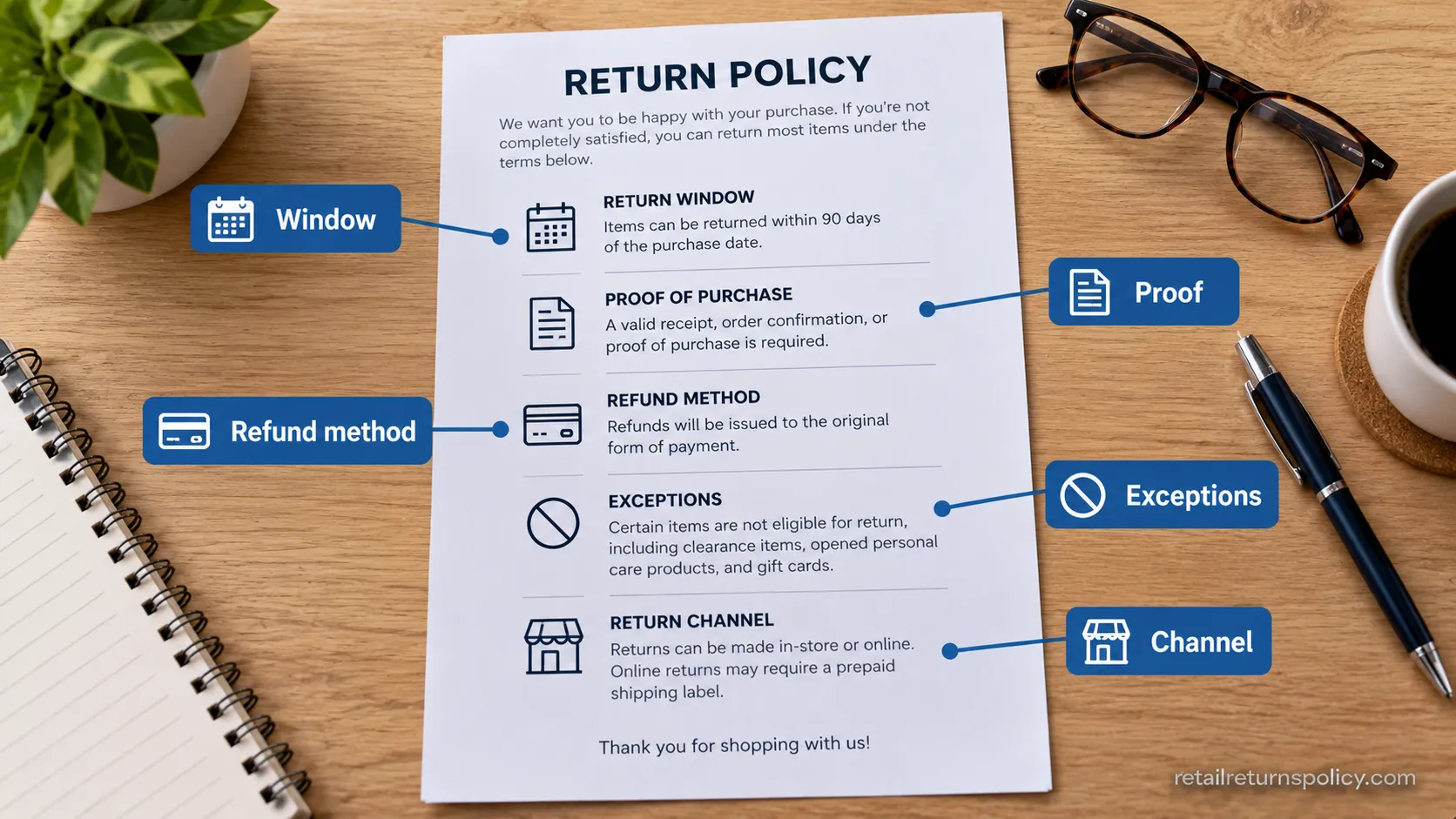
Every policy I have read reduces to the same five parts, even when the wording differs from store to store.
Those five components are worth learning once, because they reappear at every retailer:
Return window: how many days you have, counted from purchase or delivery.
Proof rule: whether a receipt, order email, or account lookup is required, and how a gift receipt changes the outcome.
Refund method: money back to your original payment, store credit, or an even exchange.
Exceptions: categories marked final sale, opened electronics, or hygiene items that cannot come back.
Channel: whether you return in person, by mail, or either way.
Here is the distinction that trips people up. A return policy is not the same as your legal rights, and the two answer different questions.
That legal floor is narrow by design. As US Legal Forms explains, a retailer must take an item back only when it is defective or the sale contract is broken, and about a dozen states add posting rules on top.
The policy governs a change of mind. Your legal rights, covered in the next section, govern defective goods and a few special situations, and they sit above whatever the store wrote.
A fair policy blends the two sensibly, and if you want to see where that line sits, our guide on what makes a fair return policy breaks it down.
How Returns Actually Work: From Purchase to Refund
A return moves through four predictable stages: you start the return, the retailer verifies the purchase, staff inspect the item, and then you receive a refund, store credit, or an exchange.
The refund method matters more than most shoppers expect, because money back to your original card is not the same as credit you can only spend in that store.
LawInfo notes that retailers set the refund method at their own discretion, which is why identical items can pay out differently at two chains.
Timing is where the frustration lives.
An in-store credit is usually instant, but a refund to a credit card has to clear the retailer’s batch settlement before it posts, so it lands days later.
I logged my own returns during the August 2026 audit to see how far apart the methods really run. The table below is that log, not a general estimate.
My return | Method | Time to money back |
|---|---|---|
Target, in store | Store credit | Instant |
Target, in store | Card refund | 3 business days |
Amazon, mailed | Card refund | 4 business days |
Best Buy, in store | Card refund | 6 business days |
Macy’s, mailed | Card refund | 9 days including transit |
Wayfair, mailed | Card refund | 11 days including transit |
Methodology note: these are my own six returns logged between August 4 and August 29, 2026. Timelines vary by bank and retailer, so treat them as documented cases, not guarantees.
The lesson from the log is simple: mail-in refunds are slow because transit and inspection stack on top of card settlement.
If speed matters, an in-store return usually wins. When you want an even swap rather than money back, that is an exchange, and the full split between the two is covered in our return and exchange policy guide.
Your Rights: What the Law Actually Says (No Federal Return Law)
No US federal law requires a store to accept returns of non-defective merchandise; returns for a change of mind are set entirely by each retailer’s posted policy.
Federal protection does exist, but it is narrow.
As LegalClarity lays out, your real protections cover defective goods under warranty, door-to-door sales, late-shipping online orders, and a separate layer of credit-card dispute rights, plus state disclosure rules in roughly a dozen states.
The confusion is understandable, so it helps to separate what the law does not give you from what it does.
When the Law Does Not Help You
If you simply changed your mind, decided the color was wrong, or found it cheaper elsewhere, no federal law is on your side.
FindLaw is blunt about it: retailers must honor the specific policy they promised, and nothing more, for buyer’s remorse.
A store can legally run a 14-day window, a 90-day window, or a no-returns policy, as long as it disclosed that policy at the time of sale.
When the Law Is on Your Side
Federal and state rules do create real leverage in specific situations. These are the levers most shoppers never pull.
Your situation | The legal lever | How to use it |
|---|---|---|
Item is defective or not as described | Implied warranty of merchantability (UCC) plus Magnuson-Moss minimums | Ask for a repair, replacement, or refund and cite the implied warranty; “as-is” tags can waive this in some states |
Bought at your door or off-premises, over $25 | FTC Cooling-Off Rule, three days to cancel | Cancel in writing within three business days of the sale |
Online order shipped late or never arrived | FTC Mail, Internet, or Telephone Order Rule | Demand a refund if the seller misses its shipping promise and offers no new date |
Store won’t post or honor a stated policy | State disclosure laws in about a dozen states | In California, a store that does not conspicuously post a limited policy must accept returns for longer under state consumer law |
Charge is wrong or a refund is refused unfairly | Credit-card chargeback rights | Dispute the charge with your card issuer as a separate remedy |
That implied-warranty lever is not theory.
When a store first refused a blender that died in a week, calmly citing the implied-warranty rule at the counter got it accepted on the spot, and the exact wording I used was, “This item is defective, so I’m requesting a refund under the implied warranty of merchantability.”
State posting laws add another layer, confirmed by TermsFeed: California’s Civil Code requires many retailers to display a limited policy or lose the right to enforce it.
This is general information, not legal advice. State law varies, “as-is” sales can waive some rights, and you should verify your own state’s rules before acting.
Two adjacent situations deserve their own guides rather than a rushed summary here.
If you have lost your proof of purchase, the store-by-store playbook lives in our returning without a receipt guide, and if you return a lot and worry about being flagged, the thresholds are covered in how many returns is too many.
Can a Store Deny My Return Even With a Receipt?
Yes, a store can deny a return even with a receipt.
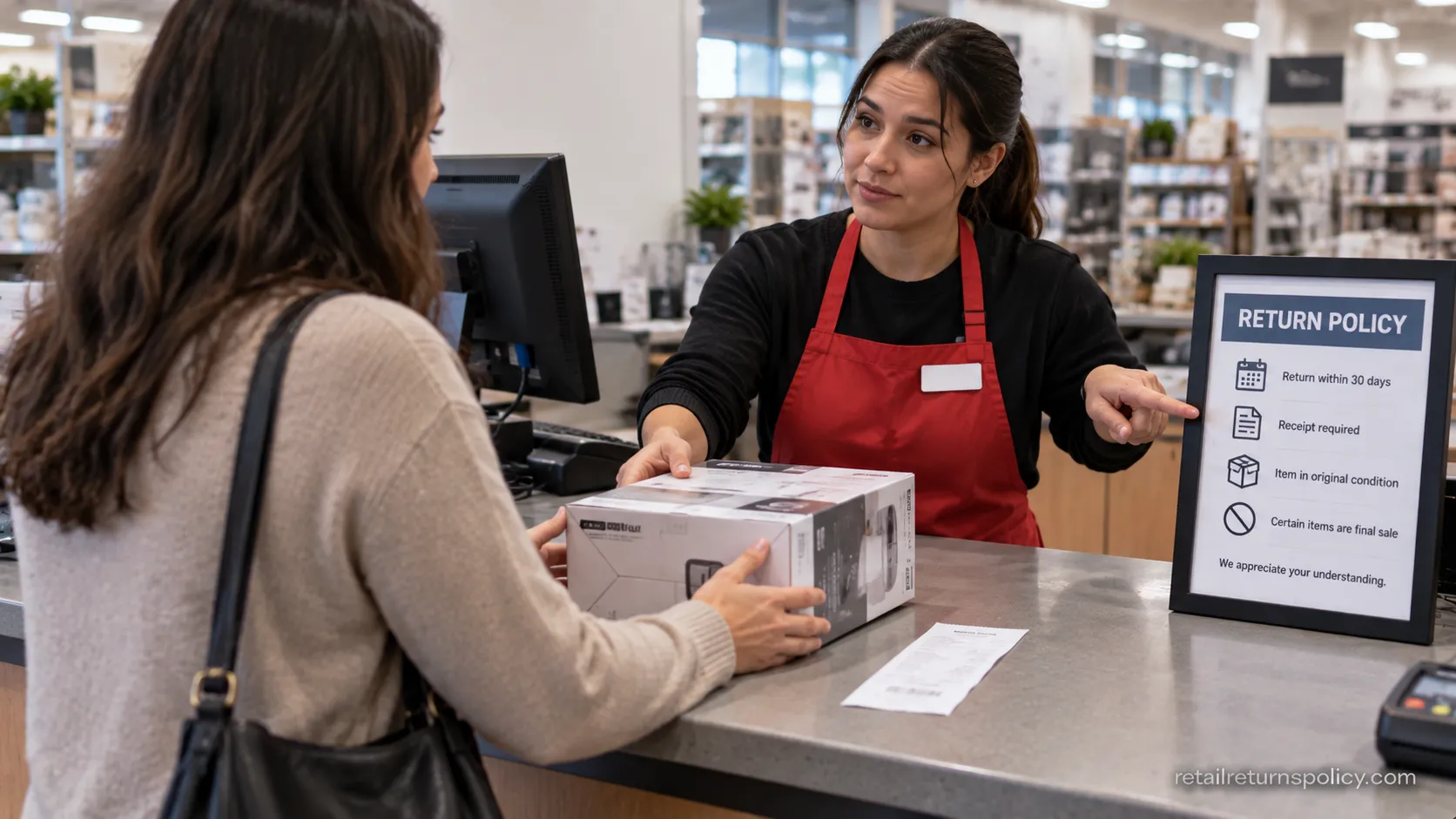
A retailer may refuse if the item falls outside its posted policy, is marked final sale, sits past the return window, or if a third-party return-tracking service has flagged the shopper as a frequent returner.
NBC News has reported that services like The Retail Equation score shoppers’ return histories, and stores use those scores to limit or deny returns even when a receipt is present.
The first step is figuring out which situation you are actually in, because the fix is different for each.
Which Refusal Situation Am I In?
Match your case to the row, then follow the action step. Each step ties back to the rights levers from the section above.
No receipt. Ask for an account or card lookup first; many stores can find the order. If not, expect store credit at the current price, or use the no-receipt playbook.
Past the window. Ask politely for a one-time exception, then check whether a card-issuer benefit or manufacturer warranty still applies.
Marked final sale. A change of mind is out, but a genuine defect still triggers the implied-warranty lever from the rights table.
Flagged with a receipt. Request your Return Activity Report from the tracking service, review it for errors, and dispute mistakes in writing.
Defective item refused. Cite the implied warranty, escalate to a manager, then use a credit-card chargeback if the store still refuses.
I have watched the same policy produce opposite outcomes. During the audit I was denied a no receipt return at one Walmart and accepted for the identical item at another Walmart seven miles away, on the same afternoon, by a manager who simply chose to.
Enforcement is inconsistent. The letter of a policy and how a given store applies it are two different things, so your result at one location may not match another’s.
When a return goes past ordinary refusal into repeated abuse, retailers treat it as something else entirely, and the line between heavy returning and fraud is mapped in our guide to what stores count as return fraud.
If a legitimate return is still refused, escalate in order: manager, then corporate customer service, then a credit-card chargeback, then your state attorney general.
Return Windows Compared: How Long Do You Really Have?
Most US return windows run 14–90 days, and 90 days is the current retail standard, though electronics are often shorter at 15–30 days and a few chains set no deadline at all.
Reporting from TODAY tracks how widely these windows now vary between stores.
Costco and Nordstrom sit at the generous end with effectively open-ended returns on most goods, while Best Buy runs one of the shortest standard windows among major retailers.
I read all 15 retailers’ official policy pages during the audit and logged what each one says today, not what it said two years ago. The table is date-stamped for that reason.
Return policies verified as of August 29, 2026. Policies change often, so confirm the store’s page before you rely on a number.
Store | Standard window | Proof rule | Return or restocking fee | Refund method |
|---|---|---|---|---|
Amazon | 30 days | Account order lookup | Free via label-free drop-off, otherwise a fee if not Amazon’s fault | Original payment |
Walmart | 90 days | Receipt or account or ID lookup | None from Walmart; some marketplace sellers up to 20% | Original payment |
Target | 90 days (Target-owned brands 1 year) | Receipt or Target Circle lookup | None in most cases | Original payment |
Best Buy | 15 days (paid members 60 days) | Receipt or member lookup | $45 restocking on activatable and certain opened electronics | Original payment |
Costco | No deadline on most goods (electronics 90 days) | Membership lookup, receipt optional | None in most cases | Original payment |
Home Depot | 90 days (store-card holders 180 days) | Receipt or card lookup | None in most cases | Original payment |
Apple | 14 days | Receipt or order lookup | None on most items | Original payment |
Ulta | 60 days full refund, 61–90 days store credit | Receipt or account | None | Original payment or store credit |
Lululemon | 30 days, unworn with tags | Receipt | None | Original payment |
DSW | 90 days unworn (VIP members 365 days) | Receipt or account | None | Original payment |
Dick’s Sporting Goods | 90 days | Receipt or account lookup | None in most cases | Original payment |
Wayfair | 30 days | Account order lookup | Customer pays return shipping, deducted from refund | Original payment |
TJ Maxx | 30 days in store | Receipt | $11.99 per mailed package | Original payment, store credit after 30 days |
Shein | 35 days | Account order lookup | First return free, then about $7.99 | Original payment or store credit |
eBay | Varies by seller, often 30 days | Seller and order dependent | Seller dependent | Seller dependent, backed by Money Back Guarantee |
Electronics windows are short for a reason: fast depreciation and higher fraud risk push retailers to close the door sooner on opened devices.
The pattern to remember is that the generous outliers reward loyalty, while the strict ones lean on fees.
For a deeper breakdown of deadlines and the longest versus shortest windows by store, see our 30-day return policy guide.
And if you are choosing where to buy partly on returns, start with the most generous stores.
How to Return an Item: The Universal Steps
Returning an item follows the same core process at almost any store, whether you walk in or ship it back.
To return an item in person, bring the item, its packaging, and proof of purchase to the service desk, then choose your refund method.
To return an item online, start the return in your account, print or scan a label, pack the item, and drop it off.
Consumer reporting from TODAY notes that label-free and QR-code drop-offs are now common, so many online returns need no box or printer at all.
Use the in-store steps when speed matters and a location is nearby.
Check the store’s posted return window and confirm your item qualifies.
Gather the item, tags, packaging, and your receipt, order email, or gift receipt.
Bring everything to the customer service desk and state that you want a return.
Choose your refund method, then keep the return confirmation slip.
Use the online steps when the store is far or the item shipped to you.
Open your account, find the order, and select the item to return.
Choose a reason and a method: mailed label, or label-free QR drop-off.
Pack the item securely, or take it unboxed to a partner drop-off if the store allows it.
Hand it over or ship it, then track the return until the refund posts.
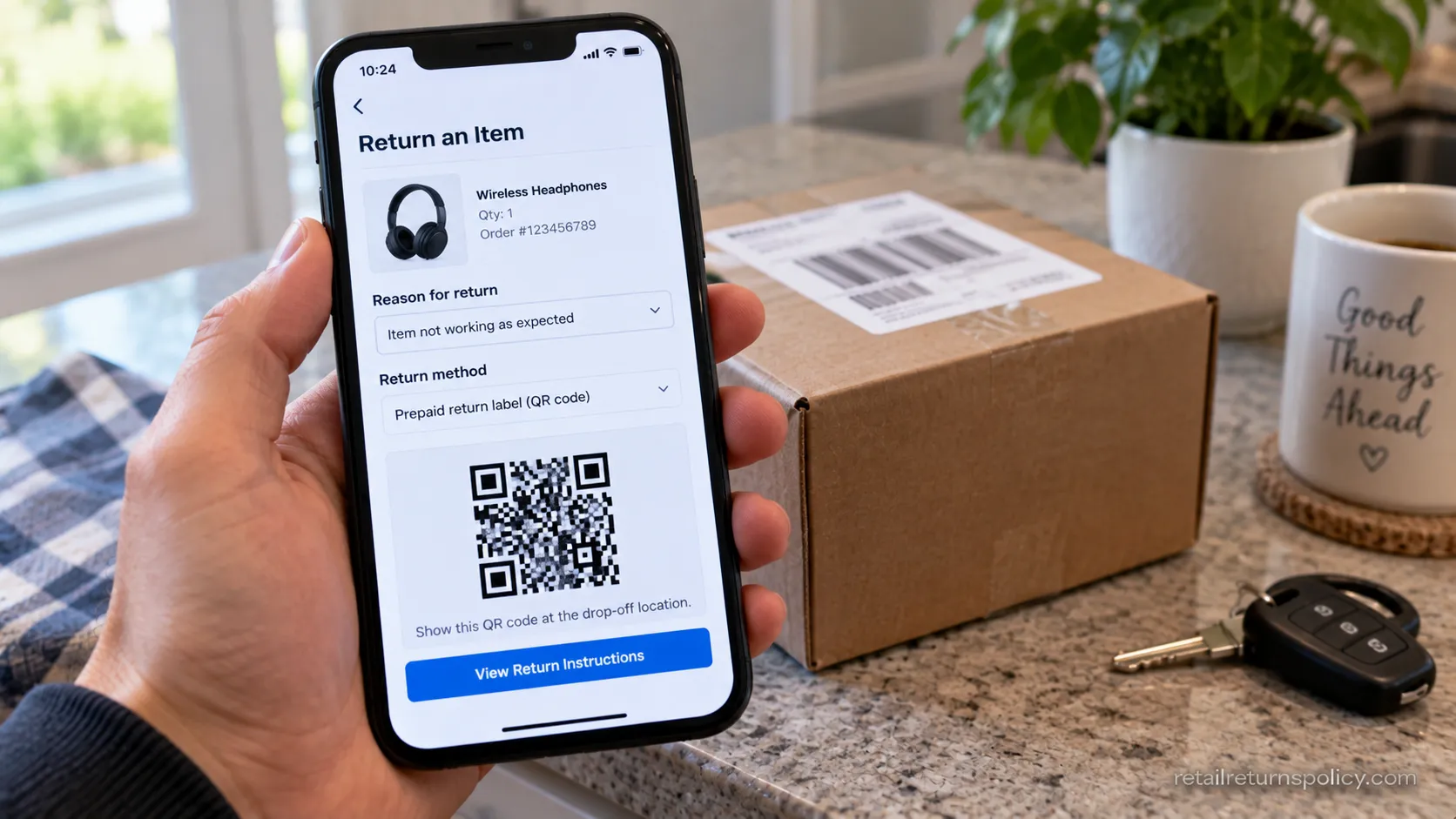
I ran both paths the same week to compare them: a boxless QR return at a carrier counter took under three minutes with no packaging, while the in-store desk return was instant but required the drive.
Choose mail when a store is far and the return is free, and choose in person when a fee applies or you want your refund faster.
For the packing, labeling, and drop-off specifics on mailed returns, our how to return a package guide goes step by step.
Steps vary slightly by retailer. Always confirm the exact flow inside your own account, since some stores hide the return button under order details.
Why Returns Are Getting Harder in 2026
Returns are getting harder because they have become enormously expensive for retailers, and stores are pushing that cost back onto shoppers through fees and shorter windows.
According to the National Retail Federation, US shoppers were projected to return $849.9 billion in merchandise in 2025, about 15.8% of sales, with online returns running higher at 19.3%.
The squeeze on your refund is the direct result of that volume.
The clearest sign is fees. TheStreet reported that about 72% of retailers now charge for at least some returns, up from 66% a year earlier, and industry data puts the average mailed-return fee around $9 and climbing per reverse-logistics analysis.
The tightening shows up in three concrete ways, all of which I watched happen to stores I had rated generous before.
Store | What I logged before | What I found in 2026 |
|---|---|---|
Zappos | 365-day window | Trimmed to 60 days |
TJ Maxx | Free mailed returns | $11.99 per mailed package |
A national apparel chain | Full card refund | Store credit only past the window |
That before-and-after log is mine, cross-checked against reporting from the Detroit News, which documented Zappos cutting its window, REI restricting return abusers, and mailed-return fees landing between $9.95 and $11.99 at several chains.
Concrete fee figures are easy to find now, with NewsNation noting Marshalls and TJ Maxx deducting $11.99 per package while JCPenney and J. Crew charge closer to $8.
Two shopper behaviors drive much of this. Bracketing means buying several sizes intending to send most back, and wardrobing means wearing an item once and returning it, and both have pushed retailers to tighten rules and track returners more aggressively.
Shoppers are already adjusting to the new normal. Industry data compiled by MakeMyReceipt shows that 81% of consumers now check a return policy before buying, a habit that pays off directly as fees spread.
Shopping defensively is the counter-move. Check the policy before you buy, keep tags and receipts until you are sure, and avoid final sale items on anything you are unsure about.
Since restocking fees are now a core part of the squeeze, our restocking fee guide shows how much they run and how to dodge them, and if you want to steer clear of the strictest chains entirely, we track the worst return policies too.
Not every trend points one way. Even as fees rose, a number of chains extended their holiday windows, so a stricter market still has bright spots if you know where to look.
Browse Return Policies by Store
The fastest way to get a specific store’s rules is to go straight to its guide.
Each linked page below is a dated, hands-on audit by our team, organized by category so you can jump to marketplaces, apparel, beauty, electronics, home, warehouse clubs, and more.
Every guide shows its own verified-as-of date, because policies change often.
Marketplace and big-box
Electronics and tech
Warehouse and grocery
Sam’s Club returns
Clothing, shoes, and beauty
Shein returns
TJ Maxx returns
DSW returns
Home, furniture, and improvement
Home Depot returns
Wayfair returns
Specialty, craft, and jewelry
Dick’s Sporting Goods returns
Hobby Lobby returns
Pandora returns
Digital, media, and styling
Azazie try-on dress returns
Browse by Return Topic
If your question is about a situation rather than a store, start with the matching topic hub below. These six facets are ordered by how often shoppers ask about them, and each guide draws on the same hands-on testing as this page and shows its verified-as-of date.
Returning without a receipt: what each store accepts as proof, and the store-credit fallback.
Return windows and deadlines: how long you really have, longest to shortest.
Returning a package by mail: labels, packing, and drop-off, step by step.
Returns versus exchanges: when to swap and when to take the refund.
Restocking and return fees: how much they run and how to avoid them.
Holiday return windows: the extended deadlines that apply around the holidays.
Frequently Asked Questions
Is there a federal law that requires stores to give refunds?
No. No US federal law requires a store to refund a non-defective item you simply changed your mind about. Federal rules only compel a remedy for defective goods, broken sales contracts, certain door-to-door sales under the FTC Cooling-Off Rule, and late-shipping online orders. Everything else depends on the retailer’s own posted policy.
Can you return something without a receipt?
Often yes, but on the store’s terms. Many retailers can look up your purchase through a card or account, and if they cannot, they typically offer store credit at the item’s current price rather than a cash refund. Some stores cap the number of no-receipt returns they will accept, and a few refuse them outright, so proof of purchase always gives you the strongest position.
Can a store deny my return even if I have a receipt?
Yes. A receipt proves purchase, but it does not override a posted policy. Stores can refuse items that are final sale, past the return window, visibly used, or when a return-tracking service has flagged your history. If the refusal involves a genuine defect, your implied-warranty rights still apply regardless of the policy.
How long do I have to return an item?
It depends on the store, and the range is wide. Most windows run 14–90 days, with 90 days now the common standard, while opened electronics often shrink to 15–30 days and warehouse clubs like Costco set no deadline on most goods. Always check the specific store’s window before buying, since a short deadline is easy to miss.
What is the difference between a refund and store credit?
A refund returns money to your original payment method, while store credit can only be spent at that retailer. Stores often steer no-receipt or past-window returns toward credit, and they set the refund method at their own discretion. Store credit is still valuable, but it locks your money to one merchant, so a refund to your card is generally the stronger outcome.
Why are so many stores charging return fees now?
Because returns cost retailers hundreds of billions of dollars a year. With about 72% of retailers now charging for at least some returns, stores are using restocking fees and mailed-return charges to offset shipping, inspection, and resale losses, and to discourage bracketing and wardrobing. Checking a policy before you buy is the simplest way to avoid a surprise deduction from your refund.
Do stores really track my returns?
Yes. Third-party services score shoppers’ return histories across many retailers, and stores use those scores to limit or deny future returns. You can request your own Return Activity Report from the tracking service, review it for errors, and dispute anything inaccurate in writing.
General information, not legal advice. Consumer-protection rules vary by state, so verify the specifics for where you live before acting on any answer above.
The Bottom Line on Returns
The single most useful habit a shopper can build is to read a return policy before buying, not after a purchase goes wrong.
Because no federal law forces a store to take non-defective goods back, that written policy is your real contract, and the few legal rights that sit above it only reach defective items, door-to-door sales, and a handful of state protections.
Treat the comparison table as a buying tool, not just a reference, and lean toward stores whose windows and fees actually match how you shop.
Keep your proof of purchase, know which refusal situation you are in before you approach the desk, and use the escalation path when a legitimate return is denied.
Get those three moves right and you will win the returns that matter, whatever the store’s return policy happens to say.
Read it your way
Short on time? Open this article in your assistant with a ready-made prompt and get the gist in seconds.
Found this useful? Make us a preferred source so we show up in your Google results.
Keep reading
Related articles
Retailer Return Policy Hubs
Ulta Return Policy: 30 Days for a Full Refund (2026)
Return to Ulta within 30 days for a full refund; 31–60 days gets store credit. The Ulta return policy window, receipt rule, refund method and how to return.

Retailer Return Policy Hubs
Lululemon Return Policy (2026): Tested at 3 Stores
Check the lululemon return policy: 30-day window, receipt and tag rules, refund timing, exchanges, and no-receipt options, current for 2026
Retailer Return Policy Hubs
eBay Return Policy: Why “No Returns” Doesn’t Mean No Refund
Check the eBay return policy for 2026: the 30-day Money Back Guarantee, seller windows, who pays return shipping, and how to get a refund when a seller says no.
Retailer Return Policy Hubs
Sephora Return Policy: The 60-Day Rule Is Gone (2026)
Return Sephora products within 30 days for a full refund. Get the current Sephora return policy: receipt rule, opened items, refunds by payment method.
The discussion
Comments
Every comment is reviewed before it goes live.