30 Day Return Policy? What Stores Do After Day 30 (2026)
See exactly how long every store’s 30 day return policy lasts, what happens after day 30, and your real rights once the window closes.
Written by Lillian BrooksReviewed by Marcus TrentLast updated on September 9, 2026
When you buy through links on our site, we may earn an affiliate commission (at no extra charge), which we use to fund new product tests. Learn more.
Read it your way
Short on time? Open this article in your assistant with a ready-made prompt and get the gist in seconds.
Found this useful? Make us a preferred source so we show up in your Google results.
Most shoppers treat the words on the receipt as law. They are not.
A 30 day return policy usually gives you 30 days from delivery (online) or from purchase (in store) to bring most items back for a refund.
It is a store guideline, not a federal law, and windows across major US retailers actually run from no fixed limit down to 14 days.
Once the window closes you rarely get a full refund.
The realistic best case is store credit at the manager’s discretion, often at the item’s current marked down price, plus a few real legal levers on defects and billing.
Fast facts: Costco has no time limit on most items (90 days on electronics), Best Buy gives standard shoppers just 15 days, Apple gives 14, and US shoppers sent back an estimated $849.9 billion in merchandise in 2025.
For this guide our team read 15 major retailers’ official policy pages between June 2 and June 11, 2026, logged the current window rather than the old reputation, and made dated late return attempts of our own.
The broader rules behind every store’s window are worth understanding before you shop with returns in mind.
What a 30 Day Return Policy Actually Means (and When the Clock Starts)
A 30 day return policy is a retailer’s voluntary promise to accept most unused items back for a refund within 30 days, and the single most misread part is when day one begins.
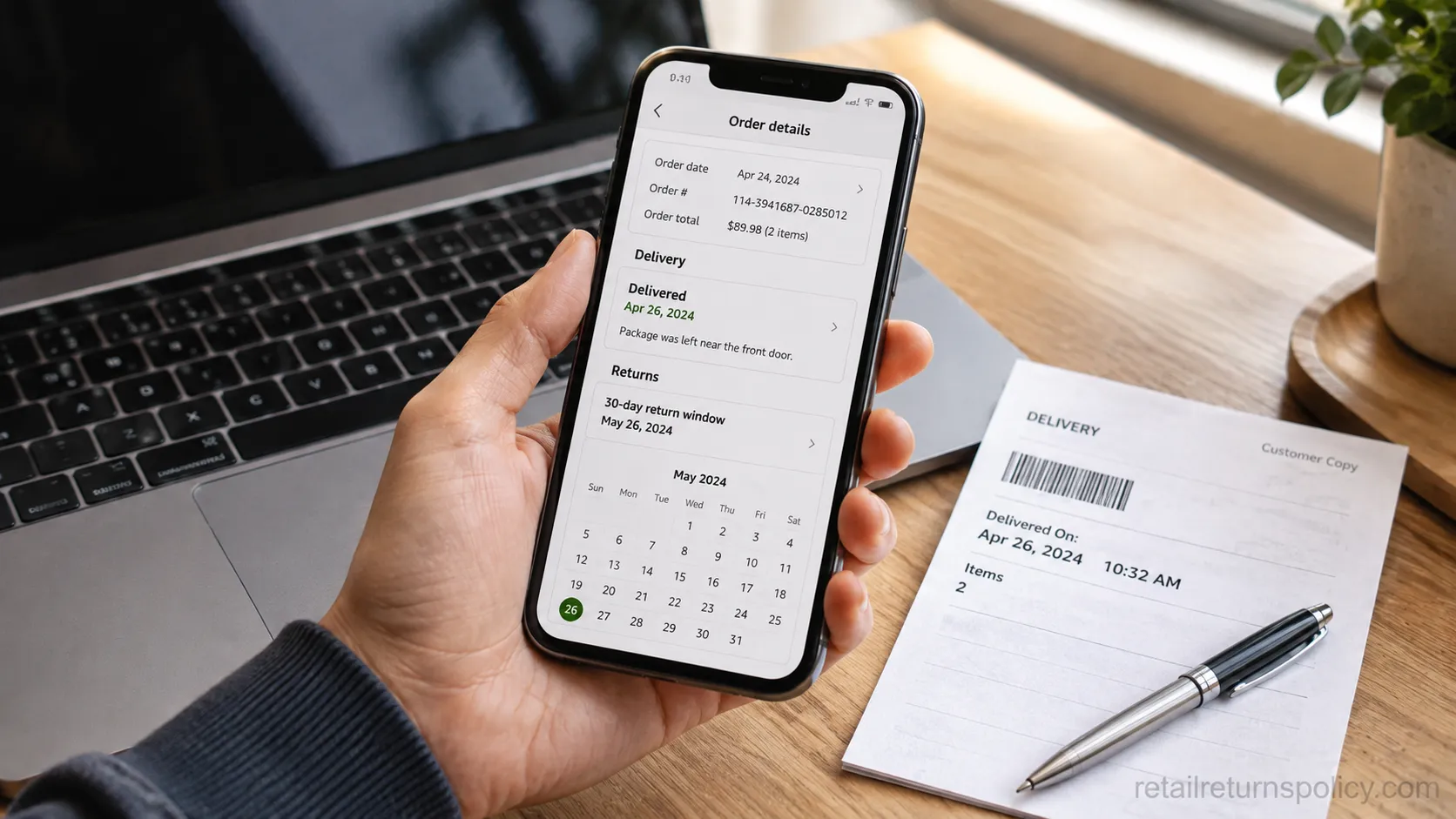
For online orders the clock almost always starts on the delivery date, while in store purchases start on the purchase date, a distinction consumer law explainers stress because no federal statute forces a store to take anything back for a simple change of mind.
Treat the number as a company guideline, not a legal guarantee.
The broader rules behind every store’s window are worth a quick primer, and our return policies explained hub covers the fundamentals.
Most stores count calendar days, not business days, so weekends and holidays burn your window just like any other day.
If the final day lands on a Sunday or a holiday when the store is closed, many chains quietly let you return the next open day, but that grace is a courtesy rather than a rule.
That “guideline, not a law” framing matters, and legal explainers on buyer’s remorse rules confirm there is no general federal right to a refund.
We will come back to the narrow rights you do have once the window shuts.
In our June 2026 read through, the return by date shown at checkout ran from the delivery date on every online order we placed and from the purchase date on every in store receipt.
Knowing which clock applies is the difference between making day 30 and missing it.
How Long Do You Really Have? Return Windows by Store
Return windows across major US retailers span a wide spectrum, from no fixed limit at warehouse clubs to just 14 days on Apple products and activatable phones.
Costco and Sam’s Club place no deadline on most merchandise, REI runs a full year, Target reaches 120 days for Target Circle Card holders, and a large middle tier of chains sits at a 90 day return policy, while electronics specialists cut the tightest windows of all.
The table below logs each store’s current window, not its old reputation, from our June 2026 read through.
Read it top to bottom as longest to shortest.
The refund method and clock start columns are the ones most comparison lists leave out, and they decide whether you get cash back or only store credit.
Store | Standard window | Clock starts | Refund method | Receipt rule | Notable catch |
|---|---|---|---|---|---|
Costco | No time limit (most items); 90 days electronics and major appliances | Delivery or purchase | Original payment | Membership lookup, receipt optional | Electronics capped at 90 days; high return accounts flagged |
Sam’s Club | No time limit (most items); 90 days electronics | Delivery or purchase | Original payment | Membership lookup | Electronics and appliances 90 days |
REI | 365 days (1 year) | Delivery or purchase | Original payment | Member lookup | Return abusers can be banned; some items 30 days |
Nordstrom | No fixed published window; case by case (Rack is 45 days) | Purchase | Original payment | Purchase lookup | The old “unlimited” reputation is outdated |
DSW (VIP Elite) | 365 days | Purchase | Original or rewards | Rewards lookup | Tiered by membership level |
Target | 90 days; 120 with Target Circle Card | Delivery or purchase | Original payment | Card or receipt lookup | Apple and some electronics drop to 15 days |
Walmart | 90 days (sold by Walmart); 30 days Marketplace | Delivery or purchase | Original payment | Receipt or lookup | Phones and some electronics 14 to 30 days |
Home Depot | 90 days; 365 with a Home Depot consumer credit card | Delivery or purchase | Original payment | Receipt or lookup | Some categories carry shorter windows |
Kohl’s | 90 days; 120 with a Kohl’s Card | Purchase | Original payment | Receipt or lookup | Premium electronics 30 days (cut from 180) |
Zappos | 60 days full refund; store credit up to 1 year for account holders | Purchase | Original, then credit | Account lookup | Cut from 365 days in 2025 |
Amazon | 30 days from receipt | Delivery | Original payment | Account record | Marketplace and some categories vary |
Macy’s | 30 days | Purchase | Original payment | Receipt or lookup | Strict; manager credit sometimes offered after |
Best Buy | 15 days standard; 60 days Plus or Total; 14 days activatable | Delivery or purchase | Original payment | Receipt, account, or card lookup | $45 fee on phones; 15% on opened drones and cameras |
Apple | 14 days | Delivery or purchase | Original payment | Receipt | Firm; opened software is non returnable |
Walmart’s standard window is a genuine 90 day return policy on items it sells directly, dropping to 30 days for third party Marketplace sellers, per Walmart’s standard return policy.
That single distinction trips up more shoppers than any other line in the table.
Amazon sits at the 30 day mark, with the window running 30 days from receipt on most items, according to Amazon’s return policy.
A long window alone does not make a policy good, though, since fees and receipt rules matter just as much, which is exactly what makes a policy worth trusting.
The comparison grid above is our own logged data, not an AI generated chart, and it is the clearest way to see that the store you remember as generous may have quietly trimmed its window.
Stores With No Return Deadline (and the Catch)
A handful of retailers still accept most items back with no clock at all, led by Costco, Sam’s Club, and REI.
Costco’s satisfaction guarantee places no time limit on the vast majority of what it sells, with a firm 90 day carve out for electronics and major appliances such as televisions, computers, cameras, and refrigerators.
REI runs a full year on most gear, and both chains tie every purchase to your membership so a lost receipt rarely sinks the return.
Costco’s own policy spells out that electronics and named major appliances must come back within 90 days of receipt, per Costco’s return policy.
Everything else, including opened and used items, falls under the no deadline guarantee.
The catch is that “no limit” never meant “no rules.”
Costco tightened enforcement through 2025 and 2026, flagging accounts with unusually high return rates and, in some cases, revoking memberships, because a promise with no deadline invites people treating a purchase as a free rental.
Nordstrom is the cautionary tale here.
The chain built its name on no questions asked returns, and plenty of outdated listicles still call it “unlimited,” but that era is over.
Nordstrom now evaluates returns case by case with no fixed published window, while Nordstrom Rack holds a firm 45 day limit, and 2026 consumer reporting confirms the shift away from its old reputation, per DontPayFull’s 2026 roundup.
No limit is not no rules. Warehouse clubs exclude fast depreciating electronics, precious metals and special orders are often carved out, and frequent returners can be flagged or banned.
When we re read Nordstrom’s policy in June 2026, the blanket “no time limit” language we remembered from a few years ago was gone, replaced by case by case wording and a 45 day term on the Rack side.
Nordstrom policy language | Then (around 2023) | Now (2026) |
|---|---|---|
Nordstrom line | Widely described as “no time limit,” no questions asked | No fixed published window; each return judged case by case |
Nordstrom Rack | Commonly cited as 45 days | 45 days, applied firmly |
Shopper takeaway | Return almost anything, almost anytime | Return promptly; late returns may be declined or partial |
A few chains do still take items back with almost no deadline, and our guide to which ones remain, framed around stores that still take returns forever, tracks who quietly ended theirs.
The Shortest Windows: Electronics, Phones and Luxury
The tightest return windows in mainstream retail belong to electronics, phones, and luxury boutiques, where 14 and 15 days are common.
Best Buy’s standard 15 day window is the shortest of any major US retailer, extending to 60 days only for paid My Best Buy Plus and Total members, and dropping to 14 days for activatable devices like phones across every tier.
Apple gives 14 calendar days. This is the reversal shoppers miss: the chain you think of as generous is often the strictest the moment the box has a screen in it.
Best Buy’s tiered timing, the $45 restocking fee on activatable devices, and the 15% fee on opened drones, cameras, and projectors are all set out in the Best Buy return and exchange policy.
Fifteen days is brutally short for a device most people do not fully test for weeks.
Purchase type | Window | Fee note |
|---|---|---|
Best Buy standard member | 15 days | No fee on most items |
Best Buy Plus or Total member | 60 days | Membership waives some fees |
Activatable devices (phones, cellular tablets) | 14 days, all tiers | $45 restocking fee (unless prohibited by state) |
Opened drones, cameras, projectors | 15 days | 15% restocking fee |
Apple products | 14 days | Opened software non returnable |
Costco electronics | 90 days | No fee, but a firm hard stop |
Even “generous” stores get strict on tech: Target and Walmart cut Apple products and phones to roughly 14 to 15 days, while Costco’s otherwise unlimited guarantee stops at 90 days for anything with a screen.
Apparel and shoe chains mostly cluster at 30 days with their own after window quirks, which is where our breakdown of how clothing stores handle late returns picks up each brand.
Luxury and boutique brands add a different friction.
Houses such as Louis Vuitton, Chanel, Gucci, Tiffany, and Pandora frequently offer exchange or store credit only, require tags attached and original condition, and exclude engraved or made to order pieces, so the “refund” you picture may only ever be a credit.
Big furniture and home pieces follow their own longer, delivery based windows, covered in our guide to furniture and home store windows.
Department and specialty retailers each set their own tight terms, mapped in our rundown of electronics and specialty store windows.
Watch the fee, not just the window. A 15 day window with a $45 restocking fee can cost more than a 30 day window with none.
We timed a Best Buy laptop return in July 2026 and reached the register on day 12 of 15, with only a couple of days to spare, which is exactly the trap: most people do not seriously test a device until the window is nearly gone.
Can You Return Something After 30 Days?
Can you return something after 30 days? Usually not for a full refund.
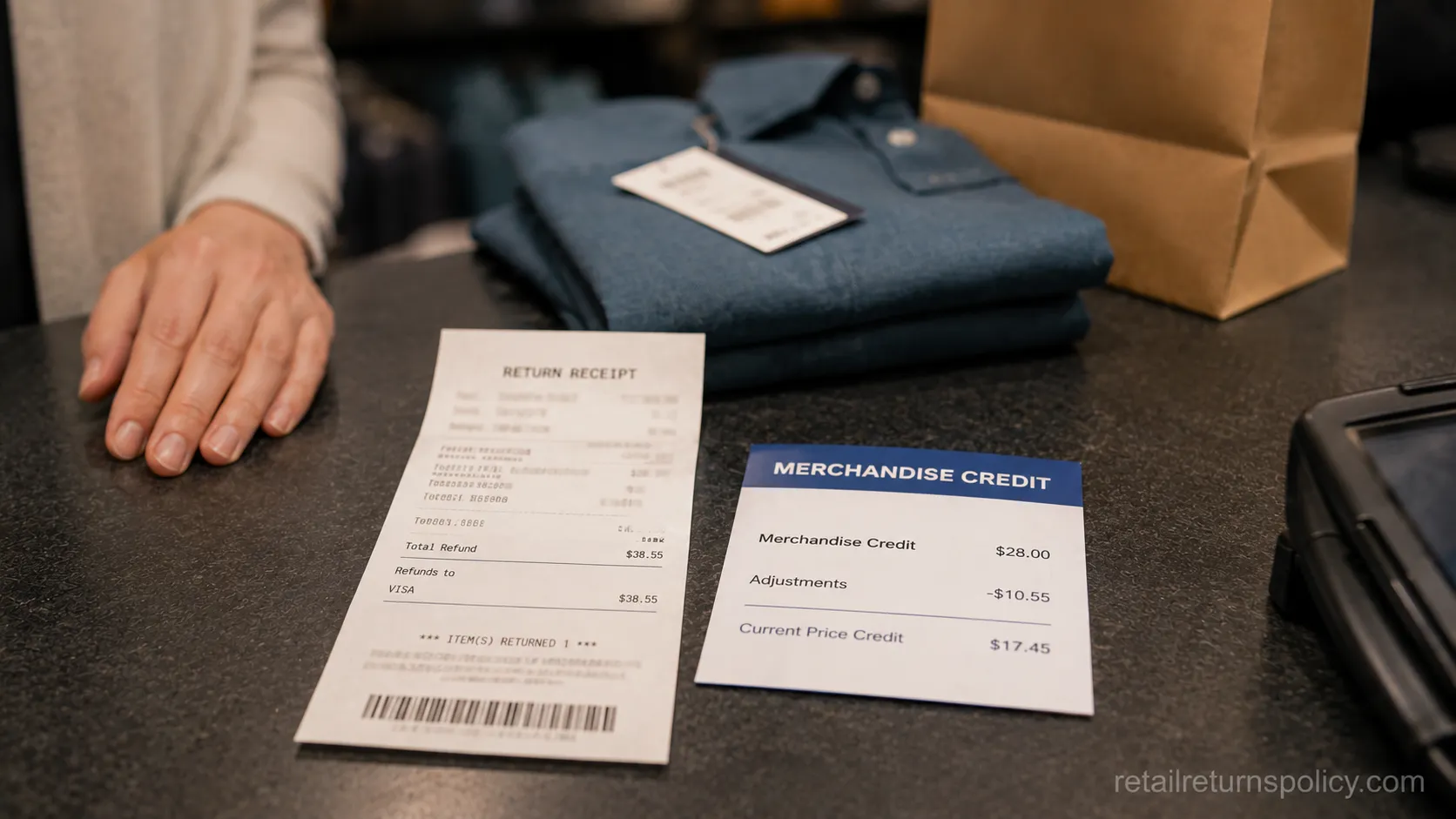
Once the return window closed, most stores stop refunds to your original payment, but many will still offer store credit at the manager’s discretion, frequently at the item’s current marked down price rather than what you paid, especially with a gift receipt or a genuine defect.
The outcome depends on the store, the manager, and the item’s condition, not on any legal right.
The mechanic behind the lower amount is markdown accounting. Since the register issues credit at the current selling price, an item that has since gone on sale comes back as less credit than you spent, which is why late returns so often feel like a penalty.
Two paths still work more often than people expect.
A gift receipt routes a return to store credit even when the original buyer could not get a cash refund, and a defect shifts the conversation toward warranty rather than goodwill.
That the window is a company guideline with room for manager exceptions is echoed by consumer law explainers, which note stores set their own timing voluntarily. If you have lost the receipt too, there is a separate playbook for returning without a receipt.
No guarantee. After the window, store credit is discretion, not a right. Be polite, lead with a defect if there is one, and keep expectations low.
We took an unworn item back to Macy’s on day 34 in July 2026 and were offered merchandise credit at the current sale price, not the price on our receipt, exactly the “store credit only” outcome shoppers describe when a return window closed.
Beauty buyers face tighter after window rules on opened products, detailed in our guide to beauty returns after the window.
Off price chains are their own case once the deadline passes, which our breakdown of off-price stores after the deadline walks through store by store.
Your Rights After the Window Closes: Warranty, Chargeback and State Law
No federal law requires a store to accept returns for a change of mind, so once the return window closes your rights are narrower and more specific than most shoppers assume.
The Federal Trade Commission’s Cooling Off Rule gives only three business days to cancel door to door and temporary location sales, not ordinary store or online purchases, which means your real levers after the deadline are an implied warranty claim on defects, a credit card chargeback, and in about a dozen states a default refund window when the store posts no policy at all.
The most common myth is that the FTC Cooling Off Rule lets you undo any purchase within three days. It does not.
Codified at 16 CFR Part 429, the rule covers sales of $25 or more at your home and $130 or more at temporary locations like hotel conference rooms, and it explicitly excludes regular retail stores, online orders, and phone or mail only sales, per the FTC’s Cooling Off Rule.
Online orders are not covered either, a point authoritative references on the cooling off rule make explicitly, so an ordinary e commerce purchase falls entirely under the store’s own voluntary policy.
The protections that actually help after 30 days are these:
Implied warranty of merchantability. Defective goods can be refunded, repaired, or replaced even after the return window, because a warranty claim is separate from a change of mind return.
Credit card chargeback. Under the Fair Credit Billing Act you can dispute a charge for undelivered or not as described goods, usually within about 60 days of the statement, which shoppers describe as filing through your funding source.
Mail, Internet, or Telephone Order Rule. Under 16 CFR Part 435 a seller must ship within the promised time, or 30 days if none is stated, or refund you.
State default laws. Roughly a dozen states set a fallback when no policy is posted.
State rules fill part of the gap, and they vary widely, as consumer law references on state refund laws lay out.
California and New York effectively require a 30 day refund when a retailer posts no policy, Florida gives buyers seven days when there is no conspicuous “no refund” sign, and several states require store credit to stay valid for a year or more.
Protection | What it gives you | The limit |
|---|---|---|
FTC Cooling Off Rule (16 CFR 429) | 3 business days to cancel | Door to door and temporary location sales only, not regular retail or online |
Mail or Internet Order Rule (16 CFR 435) | Ship on time or refund | Covers shipping timing, not buyer’s remorse |
Implied warranty of merchantability | Remedy for defects after the window | Does not cover a simple change of mind |
Credit card chargeback (Fair Credit Billing Act) | Dispute a flawed or undelivered charge | Time limited; try the merchant first |
State default laws (CA, NY, FL and others) | Fallback refund window when no policy is posted | Applies only where the store posts nothing |
Narrow protections, real ones. None of these is a general “I changed my mind” refund right, but a documented defect plus a chargeback resolves a surprising number of standoffs.
When a store refused a defective small appliance just past its window in 2026, we opened a card dispute citing the implied warranty and the charge was reversed, which is the practical version of a right most shoppers never use.
Grocery, dollar, and warehouse club returns follow their own quirks on all of this, which our guide to grocery and warehouse-club windows covers in detail.
Extended Holiday Return Windows (2026 to 2027)
Extended holiday return windows let gifts bought in late autumn come back well into the new year, and for the 2026 to 2027 season most big retailers plan to accept purchases made from roughly late October through December into late January 2027.
The pattern is consistent year over year: chains like Amazon, Walmart, Target, Best Buy, and Kohl’s extend the standard window for holiday date ranges, while electronics and activatable devices are frequently excluded, so a gifted phone rarely gets the same grace as a sweater.
Confirm the exact dates before you rely on them, because they reset every year.
Holiday windows work by purchase date range rather than by extending every window at once.
An item bought inside the retailer’s stated holiday range gets a later, fixed return deadline, usually clustering around late January.
Retailer | Expected 2026 to 2027 holiday window | Electronics note |
|---|---|---|
Amazon | Most items shipped roughly Nov 1 to Dec 31, 2026 returnable into late January 2027 | Some categories excluded |
Walmart | Extended window for October to December purchases into late January 2027 | Phones and some electronics keep shorter terms |
Target | Holiday purchases’ return clock commonly starts December 26 | Apple and electronics stay short |
Best Buy | Late October to December 31, 2026 purchases returnable into mid January 2027 | Activatable devices excluded |
Kohl’s | October to December purchases returnable into late January 2027 | Premium electronics 30 days |
Retail coverage of these seasonal changes, including holiday date ranges, is tracked in roundups like Shop TODAY’s return policy guide.
Keep a gift receipt in the bag, since it is what converts a gift return into store credit for the recipient.
Dates change yearly. Treat the table above as the expected pattern and verify each retailer’s posted holiday window before the season, because the exact cutoffs move every year.
We log each retailer’s posted holiday window on our publish date and note which ones exclude electronics, and the 2026 to 2027 dates above are our current best estimate pending the season’s official banners.
Why Return Windows Are Getting Shorter
Return windows are getting shorter because returns became one of retail’s biggest costs, and the numbers explain the squeeze.
US shoppers are expected to return about 15.8% of what they buy in 2025, totaling roughly $849.9 billion, according to the National Retail Federation and Happy Returns, and retailers responded by trimming windows, adding fees, and flagging frequent returners.
The store with the best reputation is often no longer the one with the best current policy.
The scale is the story.
The 2025 estimate of $849.9 billion sits alongside a 19.3% return rate on online orders and a finding that 9% of returns are fraudulent, per the NRF’s 2025 Retail Returns Landscape release.
Those costs land somewhere, and lately that somewhere is your return window.
The named changes are easy to line up:
Nordstrom moved from an “unlimited” reputation to case by case with no fixed window.
Kohl’s cut its base window from 180 days to 90.
Zappos trimmed its full cash refund window from 365 days to 60.
American Eagle dropped its open ended policy to 30 days for cash and 60 for store credit only.
Costco kept its language but tightened enforcement and started flagging heavy returners.
Fees are spreading beyond electronics too, with mail return charges of roughly $9.95 to $11.99 now common at chains like Saks, Nordstrom Rack, and TJ Maxx, and reporting shows around three quarters of retailers now charge for at least some returns, per DontPayFull’s 2026 analysis.
Return too often and stores may quietly cap or flag your account, which is what actually triggers a return flag.
Comparing our 2024 notes with our June 2026 read through, three chains we had once filed under “most generous” had quietly trimmed their windows, and the table below is our own logged before and after, not an AI generated chart.
Store | Window in 2024 | Window in 2026 |
|---|---|---|
Nordstrom | Widely described as unlimited | Case by case, no fixed window |
Kohl’s | 180 days | 90 days (120 with Kohl’s Card) |
Zappos | 365 days full refund | 60 days full refund |
This is a point in time snapshot. The tightening trend is still moving, so re verify any window before you count on it.
How to Protect Yourself Before the Window Closes
The most reliable way to protect yourself is to treat the return window as part of the purchase decision, not an afterthought.
Before you buy, check the store’s current window and whether the clock starts at delivery or purchase, and for anything electronic assume a tight 14 to 15 day fuse unless you hold a paid membership.
A few minutes of setup beats arguing at a counter after a return window closed.
Here is the routine we use, in order:
Check the window before you buy, not after, especially for electronics and luxury items.
Note the clock start: delivery date for online, purchase date in store.
Set phone reminders at day 1, day 7, and day 12, since the 15 day electronics window vanishes fast.
Keep the receipt and any gift receipt, which preserves the store credit path for recipients.
Learn the no receipt lookup: membership, phone number, or the card you paid with often pulls up the purchase.
Test items early, well inside the window, rather than on the last weekend.
If you are late, ask for manager credit, use a warranty on defects, or file a chargeback through your funding source.
For mailed returns, a clean label and packaging routine keeps you inside the window, which our step by step guide to how to send an online return walks through.
Membership and card lookups are convenient, but they are not guaranteed for every item, so save proof of purchase when the price is high.
We set day 1, day 7, and day 12 reminders for a Best Buy purchase in 2026 and returned on day 12 with room to spare, which turned a 15 day window from a risk into a non event.
Frequently Asked Questions
Does a 30 day return policy count calendar or business days?
Almost always calendar days, so weekends and holidays count against your window. If day 30 falls on a day the store is closed, many chains let you return the next open day as a courtesy, but that grace is not guaranteed, so aim to return with a day or two in hand.
Can you return something after 30 days?
Usually not for a full refund. Most stores stop original payment refunds once the window closes, though many offer store credit at the manager’s discretion, often at the current marked down price.
In our own day 34 Macy’s test the offer was merchandise credit at the sale price, not the price paid.
Do you get cash or store credit after the window closes?
Store credit is the realistic best case after the deadline. A gift receipt keeps that credit path open for a recipient, and a genuine defect can shift the return toward a warranty remedy instead.
Cash back to your original payment after the window is the exception, not the rule.
Is a store legally required to accept returns?
No federal law requires returns for a change of mind. The FTC Cooling Off Rule covers only door to door and temporary location sales, not regular retail, and a defect or a posted state policy is what creates any obligation.
Retailers set their standard windows voluntarily.
Which store has the longest and which has the shortest return window?
Costco, Sam’s Club, and REI sit at the long end with no fixed limit or a full year on most items. Best Buy’s standard 15 days and Apple’s 14 days are the shortest among major retailers.
Electronics almost everywhere run shorter than the store’s headline window.
Does the return clock start at purchase or delivery?
For online orders it starts on the delivery date, and for in store purchases it starts on the purchase date. This single distinction decides many missed windows, so check which one applies before you assume you have time left.
What if the store shipped my order late?
Under the FTC Mail, Internet, or Telephone Order Rule, a seller must ship within the promised time, or 30 days if none was stated, or give you the choice of a refund. That is a shipping timing right, separate from any return window, and it applies even when the store’s return policy would not.
Policies and dates change, so verify any specific store window on the retailer’s official page before you rely on it.
The Bottom Line on a 30 Day Return Policy
A 30 day return policy reads like a hard deadline, but it behaves like a company guideline that ranges from no limit at Costco to 14 days at Apple, and knowing where your store sits, and when its clock started, is what keeps a refund on the table.
The single most valuable habit is checking the window and the delivery versus purchase start before you buy, then setting a reminder for anything electronic.
Once the window closes, you are not automatically out of options.
Store credit at the manager’s discretion, a gift receipt, an implied warranty claim on a defect, a credit card chargeback, and in a handful of states a default refund law are all levers most shoppers never reach for.
The larger shift is that generosity is quietly shrinking across retail, so the reputation you remember is no longer a safe guide to the policy you will actually face.
Treat every window as current only until proven otherwise, verify it at the source, and act well before day 30 rather than after it.
Read it your way
Short on time? Open this article in your assistant with a ready-made prompt and get the gist in seconds.
Found this useful? Make us a preferred source so we show up in your Google results.
Keep reading
Related articles
Retailer Return Policy Hubs
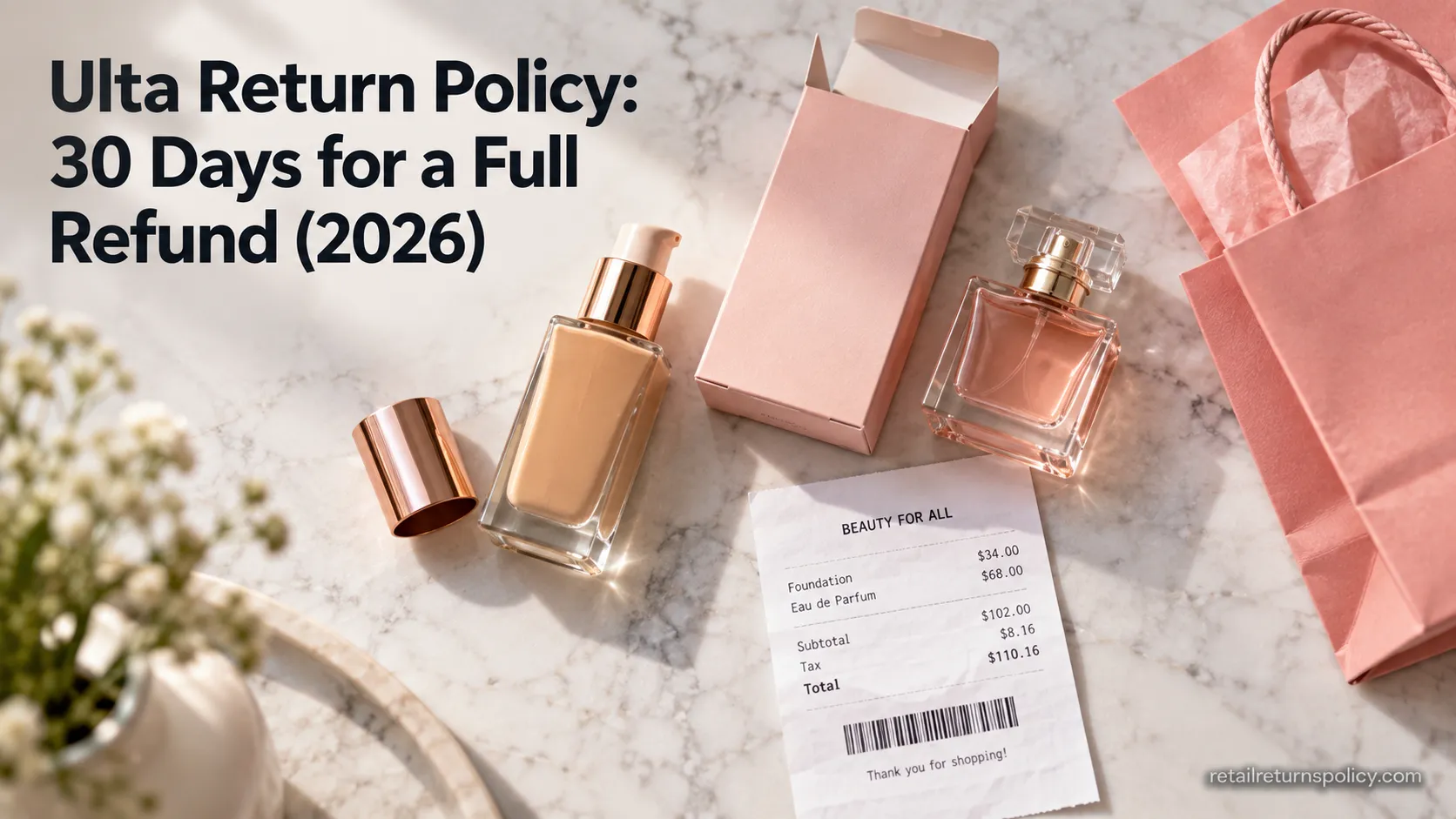
Ulta Return Policy: 30 Days for a Full Refund (2026)
Return to Ulta within 30 days for a full refund; 31–60 days gets store credit. The Ulta return policy window, receipt rule, refund method and how to return.

Retailer Return Policy Hubs
Lululemon Return Policy (2026): Tested at 3 Stores
Check the lululemon return policy: 30-day window, receipt and tag rules, refund timing, exchanges, and no-receipt options, current for 2026
Retailer Return Policy Hubs
eBay Return Policy: Why “No Returns” Doesn’t Mean No Refund
Check the eBay return policy for 2026: the 30-day Money Back Guarantee, seller windows, who pays return shipping, and how to get a refund when a seller says no.
Retailer Return Policy Hubs
Sephora Return Policy: The 60-Day Rule Is Gone (2026)
Return Sephora products within 30 days for a full refund. Get the current Sephora return policy: receipt rule, opened items, refunds by payment method.
The discussion
Comments
Every comment is reviewed before it goes live.