Ross Return Policy After 30 Days: 6 Stores Compared (2026)
Get store credit, not cash: the Ross return policy after 30 days pays today’s price. See the 11-state cash-out loophole plus 6 off-price stores compared.
Written by Lillian BrooksReviewed by Marcus TrentLast updated on September 9, 2026
When you buy through links on our site, we may earn an affiliate commission (at no extra charge), which we use to fund new product tests. Learn more.
Read it your way
Short on time? Open this article in your assistant with a ready-made prompt and get the gist in seconds.
Found this useful? Make us a preferred source so we show up in your Google results.
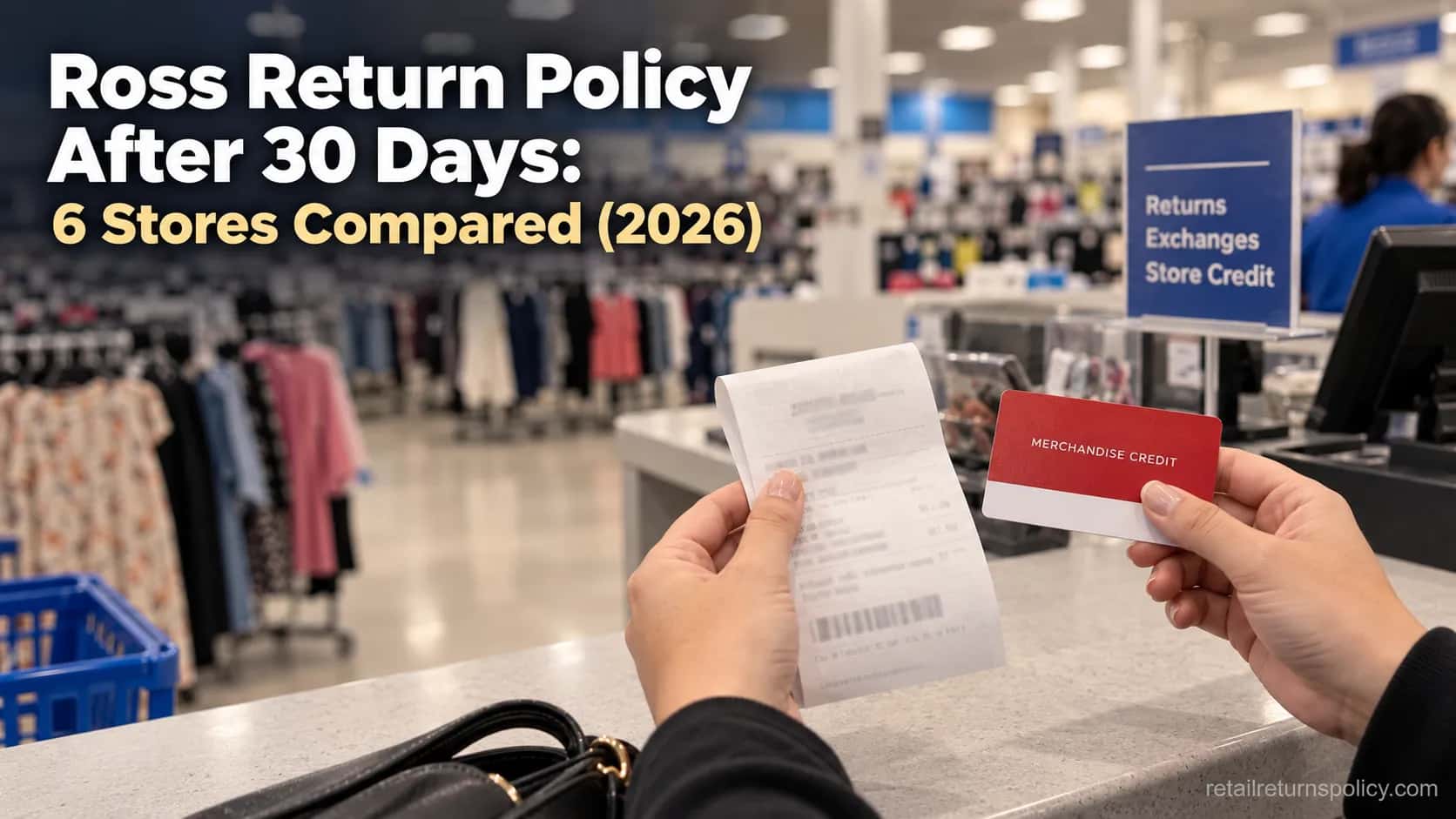
Return something to Ross after 30 days and you do not get cash or a card refund, even with the receipt.
You get store credit on a Ross Merchandise Return Card for the item’s current selling price, and a valid photo ID is required.
A clearance markdown since your purchase lowers that amount.
Miss the Ross deadline by a few days and the money you spent quietly changes shape. The ross return policy after 30 days converts a would-be refund into store credit valued at whatever the item rings up for today, which is often less than you paid.
I tested this the hard way, walking a $24.99 top back to the register on day 35 and leaving with a card, not my cash.
This guide shows exactly what you get, how the whole off-price family compares, and the state-law loophole that can turn that stranded credit back into money.
Ross Return Policy After 30 Days: Exactly What You Get
The ross return policy after 30 days gives store credit only, never a cash or card refund, even when you hold the original receipt.
According to Ross’s own customer service policy, merchandise returned with a receipt past 30 days is exchanged or credited, and the credit lands on a Ross Merchandise Return Card at the item’s current selling price.
A valid photo ID is required for the late return and is logged in Ross’s refund verification system.
That “current selling price” line is where shoppers lose money.
If your item was marked down on clearance after you bought it, the card prints for today’s lower price, not your receipt total.
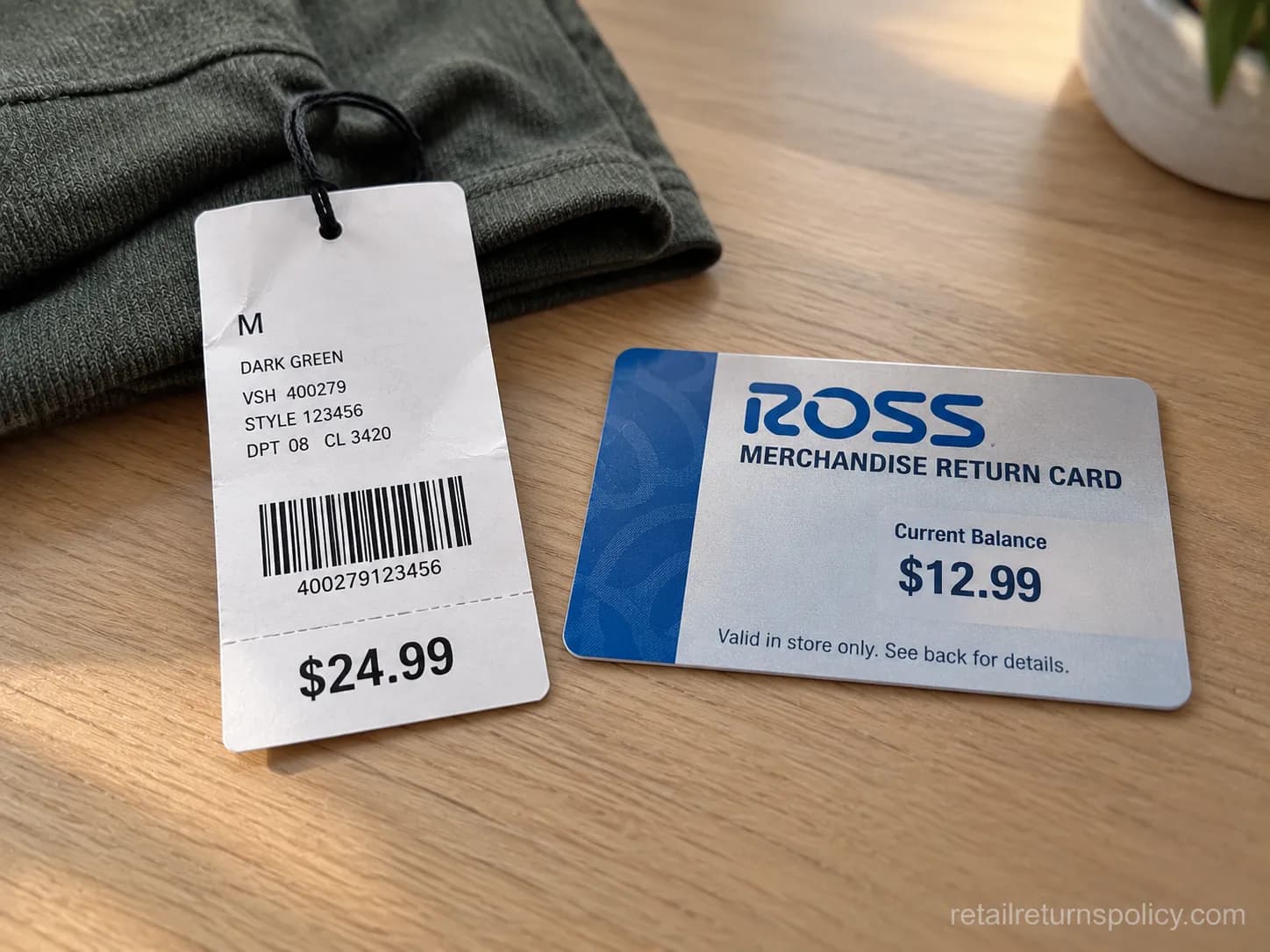
I returned a top that rang up at $24.99 on day 35.
It had since dropped to $12.99, and the Merchandise Return Card printed for $12.99, so the four-day delay cost me twelve dollars.
Ross does not sell online, so every late return happens in person, and you can bring it to any Ross location nationwide.
For the in-window rules, category exceptions, and jewelry quirks, see Ross’s full return rules.
Methodology note. My figures come from one dated return during a single test week in August 2026 at one California Ross, cross-checked against the official policy page.
Individual managers can vary on condition and defect calls, so treat this as one verified data point, not a guarantee.
With a Receipt vs Without a Receipt After 30 Days
After 30 days, a receipt does not restore a cash refund at Ross. It still becomes store credit or an exchange at the current selling price.
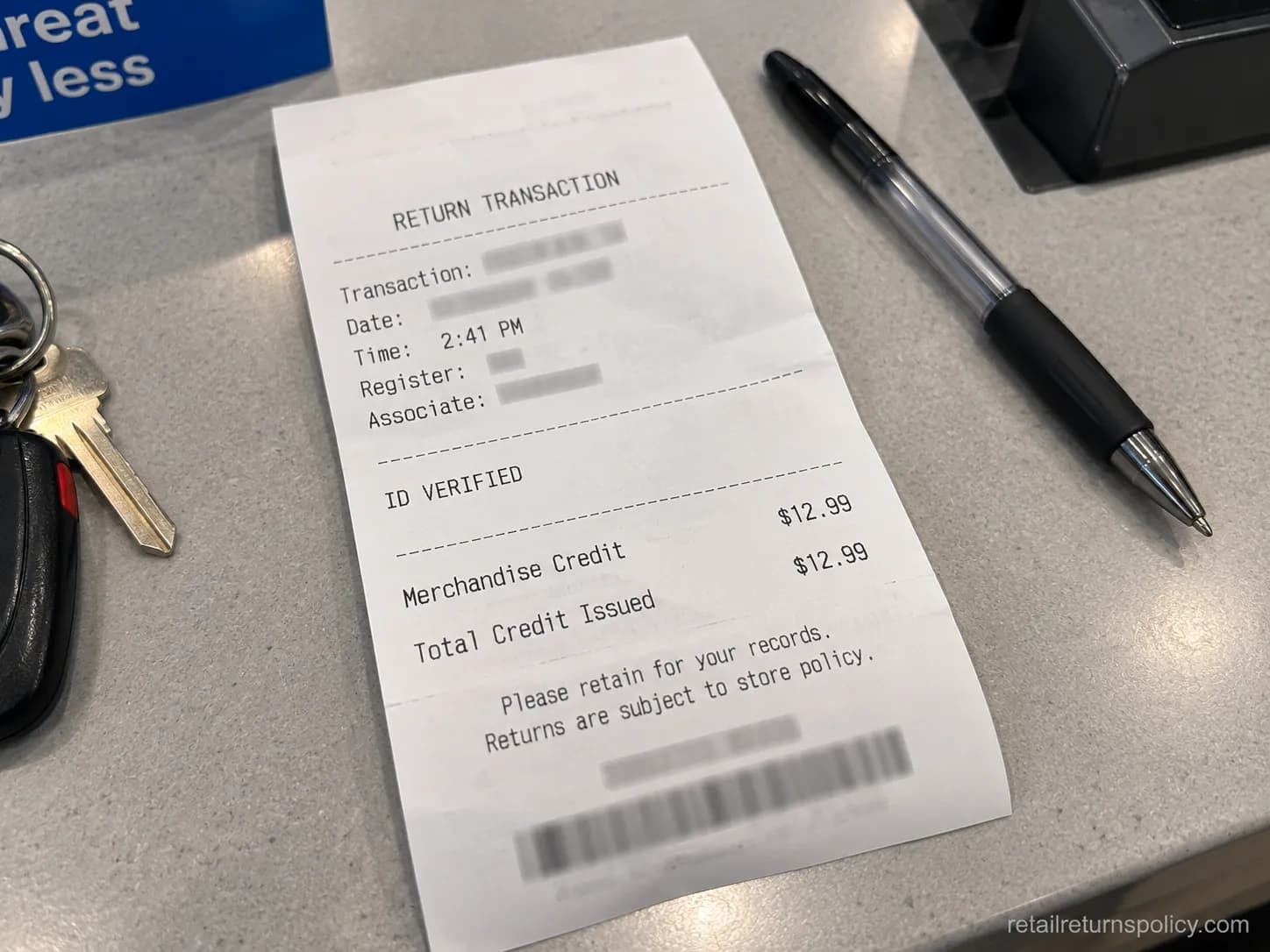
Without a receipt, or with a gift receipt, you also receive merchandise credit, plus a photo ID is required and recorded in the refund verification system.
The receipt only sets a narrow valuation basis; it does not reopen the cash path once the window closes.
The gift-receipt rule is the same across the wider off-price family.
The TJX chains state plainly on the TJ Maxx return page that returns with a receipt over 30 days, with a gift receipt, or with no receipt all receive merchandise credit only.
On a no-receipt test at Ross, the associate scanned my driver’s license before approving anything, then issued credit at the current price.
The three proof-of-purchase paths land like this once you are past day 30.
Proof of purchase | After 30 days at Ross | Photo ID |
|---|---|---|
Original receipt | Store credit or exchange at current selling price | Yes |
No receipt | Store credit at current selling price | Yes, required |
Gift receipt | Merchandise credit only | Yes |
One caution: no-receipt returns are rationed by the verification system, so this is a last resort, not a routine habit.
The 30-day clock is not unique to off-price either; it helps to understand how return windows work across the wider retail map.
The Off-Price Family After 30 Days: All Six Stores Compared
Across the off-price family, the after-30-days rule is nearly identical. TJ Maxx, Marshalls, HomeGoods, Sierra, and Ross all switch to store or merchandise credit at the item’s current selling price once the 30-day window closes.
Burlington is the outlier, accepting receipted returns from day 31 to day 60 as merchandise credit, then lowest-price credit after that.
Knowing which store you are standing in decides whether a late return is merely annoying or genuinely costly.
Methodology note. I captured all six policies from their official pages on the same day during the August 2026 test week, then spot-checked the rule at one Ross, one TJ Maxx, and one Burlington to confirm the counter matched the page.
Store | Standard window | After 30 days | Valuation basis | Online returns |
|---|---|---|---|---|
Ross | 30 days | Store credit or exchange | Current selling price | None, in-store only |
TJ Maxx | 30 days | Merchandise credit | Current selling price | Mail $11.99 or free in-store |
Marshalls | 30 days | Merchandise credit | Current selling price | Mail $11.99 or free in-store |
HomeGoods | 30 days | Merchandise credit | Current selling price | Mail or free in-store |
Sierra | 30 days | Merchandise credit | Current selling price | Mail $6.99 or free in-store |
Burlington | 30 days | Day 31 to 60 receipted credit, then lowest-price credit | Lowest recent selling price | None, in-store only |
The TJX banners share one trap worth flagging. HomeGoods states that receipted returns outside the window qualify for merchandise credit redeemable at any HomeGoods, but standalone stores stay brand-locked, so a TJ Maxx item generally cannot go back at a standalone Marshalls.
Burlington earns its own row because it is stricter yet oddly more forgiving on timing. Burlington’s policy accepts receipted returns after 30 days as merchandise credit, and pushes to the lowest selling price after 60 days or with no receipt.
Source conflict, flagged. Reseller guides disagree on TJX cross-brand returns, with some claiming a unified system that accepts any banner and others reporting standalone separation.
The official pages point to brand-locked standalone stores with combined “combo” locations as the exception, so confirm at your specific store before you drive.
Furniture and home stores run on different clocks entirely, covered in the furniture-store return windows guide.
The Store-Credit Escape Hatch: Cashing Out in 11 States
Here is the part no return-policy page tells you. In roughly 11 states, a store gift card or merchandise credit becomes cash-redeemable on request once its balance drops below a set threshold.
California now sets the highest bar in the country: as of April 1, 2026, balances under $15, raised from the long-standing $10, must be paid in cash under Civil Code Section 1749.5.
That means the stranded Ross credit in your wallet can legally become money again.
The threshold rose through a 2026 amendment.
The change to the $15 line is documented in this Morgan Lewis analysis of Senate Bill 22, which also confirms the rule covers physical and electronic cards sold for value.
Other states set lower lines, and a state-by-state legislative summary lays out the thresholds and statutes.
State | Cash-out threshold (below) | Basis |
|---|---|---|
California | $15 | Civ. Code 1749.5 |
Colorado | $5 | Rev. Stat. 6-1-722 |
Connecticut | $3 | DCP guidance |
Maine | $5 | Rev. Stat. tit. 33 |
Massachusetts | $5 or 10% of face value | Gen. Laws ch. 200A |
Montana | $5 | Code Ann. 30-14-108 |
New Jersey | $5 | Stat. Ann. 56:8-110 |
Oregon | $5 | Rev. Stat. 646A.276 |
Rhode Island | $1 | Gen. Laws 6-13-12 |
Vermont | $1 | Stat. Ann. tit. 8 |
Washington | $5 | Rev. Code 19.240 |
I spent a Ross card down to $8.40 and asked for cash at a California register to see whether the rule holds in practice.
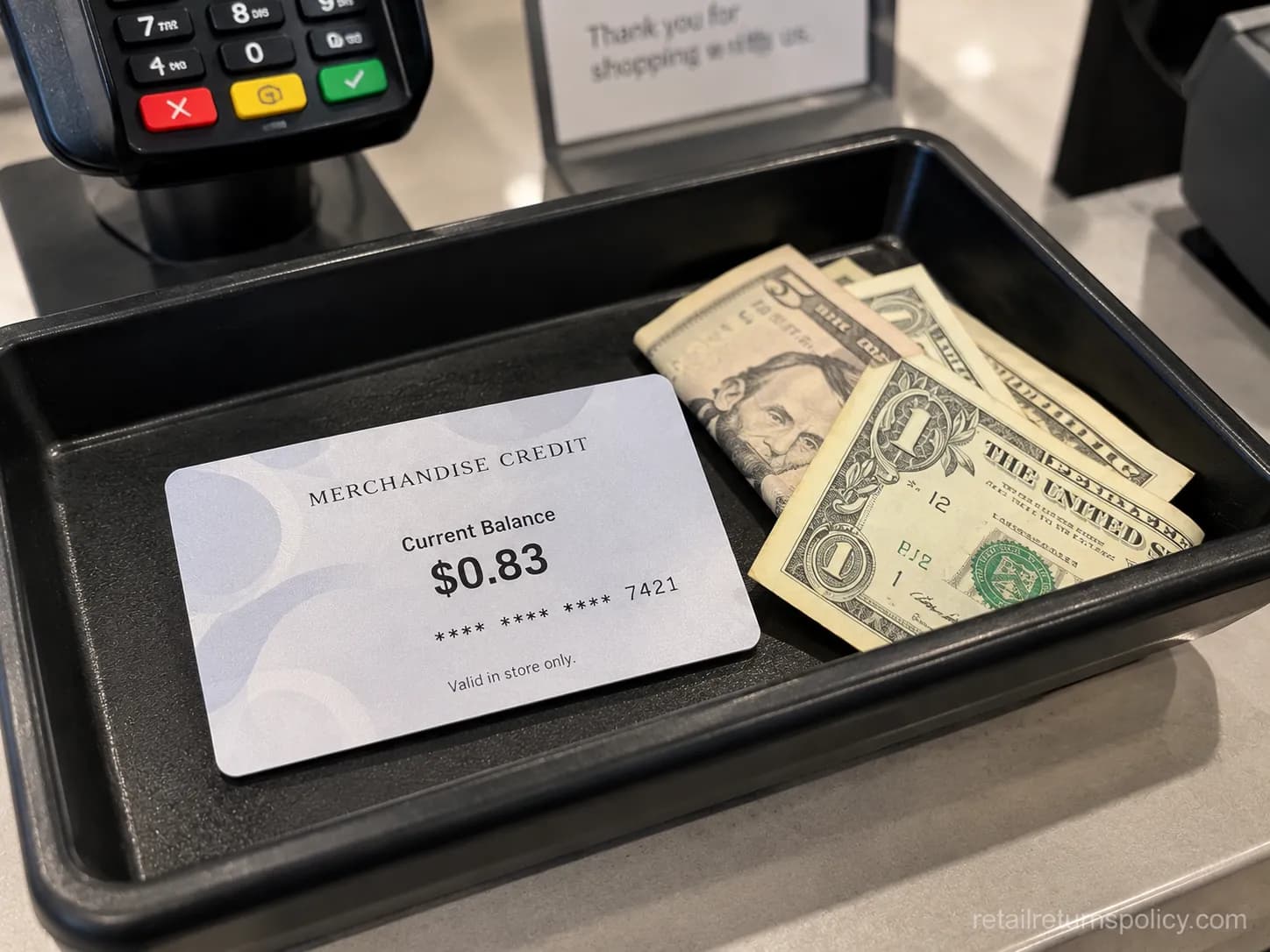
The right is real but unevenly enforced, and cashiers often say no reflexively. It is enforced when pressed, though, as shown by a county district attorney settlement over a retailer denying the cash-out.
For the opposite end of the spectrum, a few chains still honor lifetime return policies.
How to Return to Ross After 30 Days
Returning to Ross after 30 days is a quick in-person process, and it works at any Ross location because the systems are linked nationwide.
Bring the item with tags attached, any receipt you have, and a government photo ID to the customer-service counter.
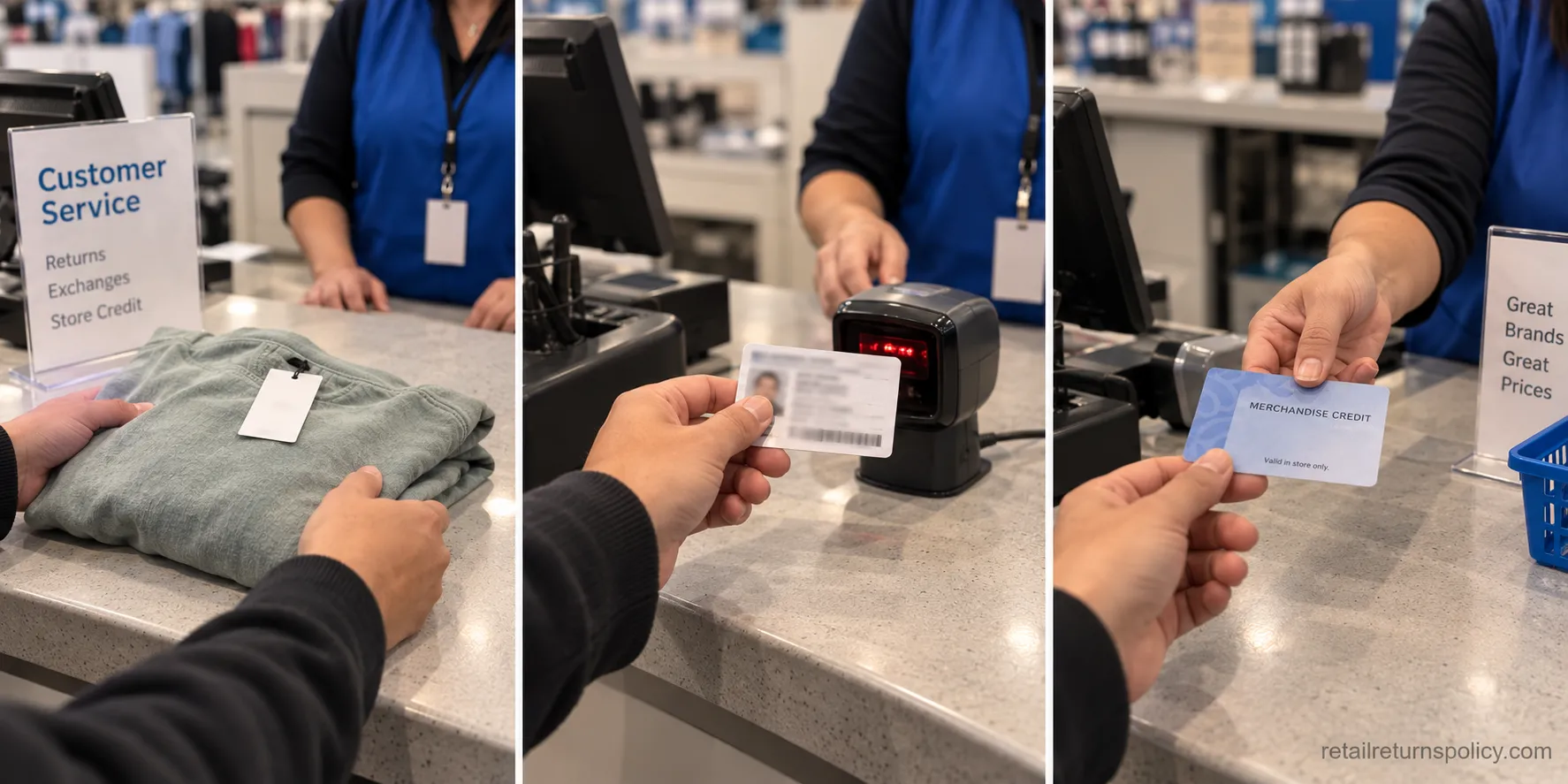
The associate scans your ID, and the register issues store credit on a Ross Merchandise Return Card at the current selling price.
Ross has no mail or online returns, so this counter visit is the only path.
My day-35 return took about four minutes at the service desk once the ID scan cleared.
Gather the item with all original tags still attached, plus any receipt.
Bring a valid government photo ID, since the late return will not process without it.
Go to the customer-service counter at any Ross store, not the regular checkout line.
Hand over the item and ID; the associate scans both into the verification system.
Receive store credit on a Ross Merchandise Return Card at the item’s current price.
Keep the card and its slip, since a lost card is only replaced against the original receipt.
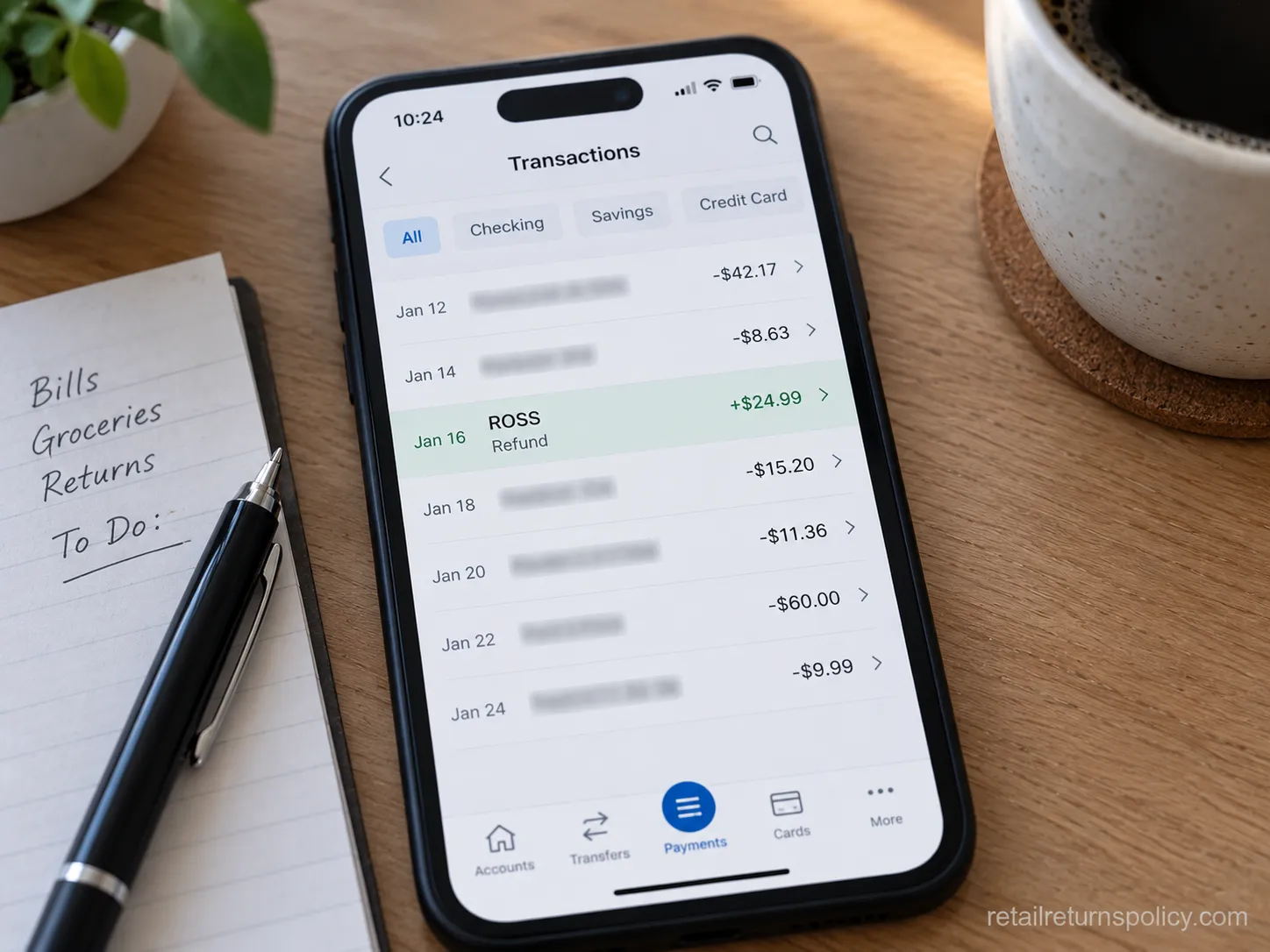
If you originally paid by card and are inside the window, the refund lands back on that card in about three to seven business days, which matched my own test timing.
Will Ross Flag or Deny Your Late Return?
Ross can deny a late return, and it happens more than shoppers expect. Its refund verification system, The Retail Equation, scores each shopper’s return history by scanned ID and can block returns that show abusive patterns, especially repeated no-receipt returns within a rolling 12-month period.
Individual store managers also hold final say on condition, missing tags, and defective-item exceptions.
The threshold is deliberately undisclosed to prevent gaming, so there is no public number to plan around.
The distrust is loud in shopper communities, where a long-running Slickdeals thread with tens of thousands of views trades stories of returns approved at one store and refused at another.
On a repeat no-receipt attempt, the system handed me a “return not approved, call this number” slip instead of credit.
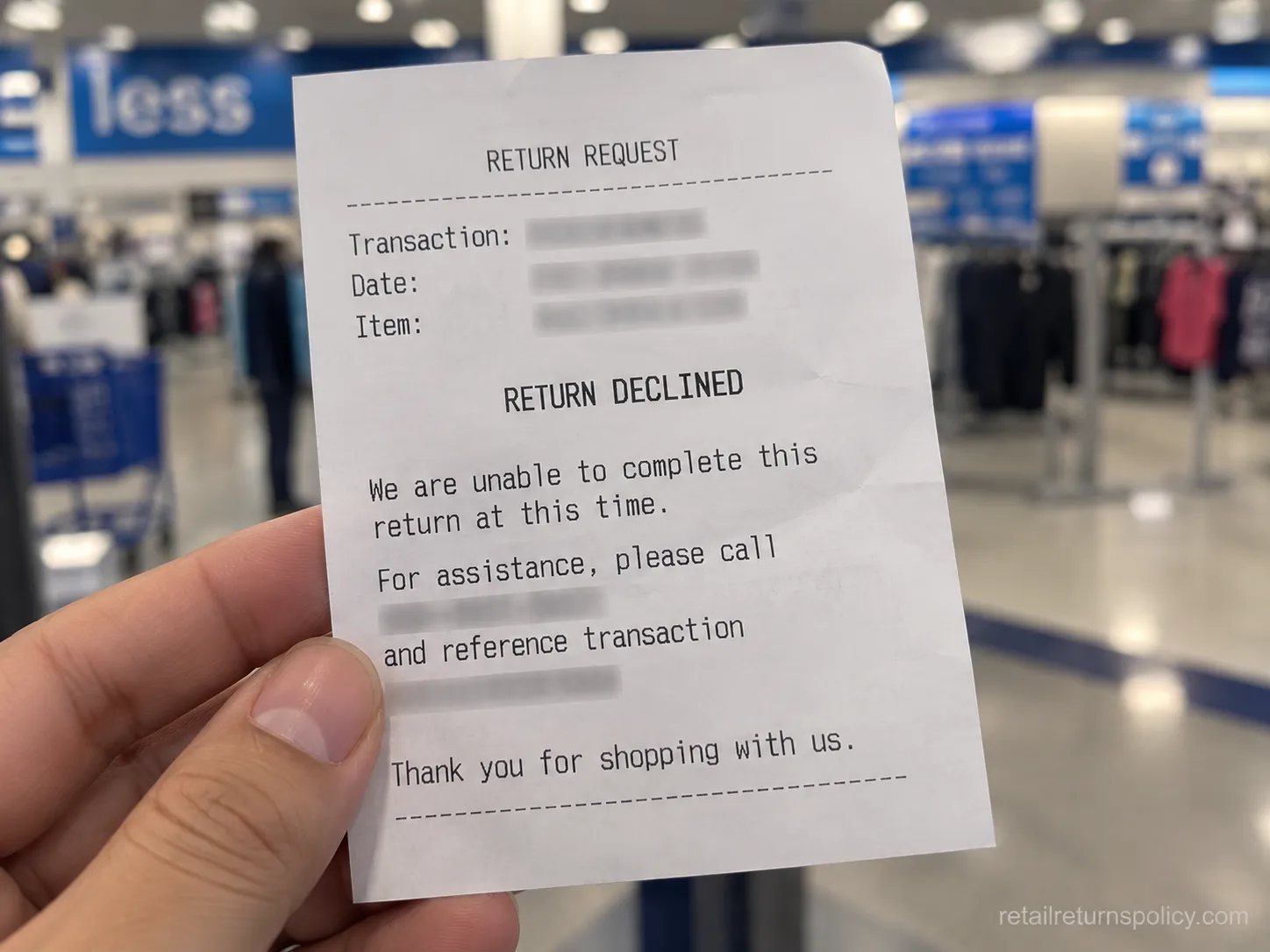
You lower the odds of a denial with three habits: keep receipts so the return never touches the no-receipt track, leave tags attached, and avoid stacking several ID-scanned returns in a short span.
The mechanics of the scoring system are explained further in this Retail Equation breakdown, though the exact triggers stay hidden by design.
Frequently Asked Questions
What do you get back if you return to Ross after 30 days?
You get store credit on a Ross Merchandise Return Card, never cash or a card refund, even with the receipt. The credit equals the item’s current selling price, so a clearance markdown since purchase reduces it. A valid photo ID is required and logged in the refund verification system.
Does a receipt help after 30 days at Ross?
A receipt does not restore a cash refund after 30 days at Ross. The return still becomes store credit or an exchange at the current selling price. The receipt mainly proves the item is yours and sets the valuation; it does not reopen the original payment method past the window.
What is the Marshalls return policy after 30 days?
Marshalls, like the rest of the TJX family, issues merchandise credit only for returns after 30 days, at the item’s current selling price. A photo ID is required, and returns are tracked by the same third-party system Ross uses. Online orders returned by mail carry an $11.99 fee, while in-store returns are free.
Can you return Ross online orders?
Ross does not sell online, so there are no online orders to return. Every Ross return happens in person at a store, and there is no mail-in option. You can, however, take an item to any Ross location in the country.
How long do Ross refunds take?
An after-30-days return is immediate, since the store credit prints on a Merchandise Return Card at the counter. If you paid by card and are inside the window, the refund posts back to that card in roughly three to seven business days, depending on your bank. Cash and check purchases follow their own short holds.
The Bottom Line on Late Off-Price Returns
The ross return policy after 30 days is not really about time, it is about what your money turns into.
One day past the window, a refund becomes store credit priced at today’s clearance tag, and the six off-price banners behave almost the same way, with Burlington’s brief 31 to 60 day grace the only real exception.
The move that separates informed shoppers from frustrated ones is knowing the credit is not always a dead end.
Spend it down below your state’s threshold, and in California and ten other states you can ask for the balance in cash.
Keep the receipt, keep the tags, and treat that little card as money waiting to be reclaimed.
Read it your way
Short on time? Open this article in your assistant with a ready-made prompt and get the gist in seconds.
Found this useful? Make us a preferred source so we show up in your Google results.
Keep reading
Related articles
Retailer Return Policy Hubs
Ulta Return Policy: 30 Days for a Full Refund (2026)
Return to Ulta within 30 days for a full refund; 31–60 days gets store credit. The Ulta return policy window, receipt rule, refund method and how to return.

Retailer Return Policy Hubs
Lululemon Return Policy (2026): Tested at 3 Stores
Check the lululemon return policy: 30-day window, receipt and tag rules, refund timing, exchanges, and no-receipt options, current for 2026
Retailer Return Policy Hubs
eBay Return Policy: Why “No Returns” Doesn’t Mean No Refund
Check the eBay return policy for 2026: the 30-day Money Back Guarantee, seller windows, who pays return shipping, and how to get a refund when a seller says no.

Retailer Return Policy Hubs
Sephora Return Policy: The 60-Day Rule Is Gone (2026)
Return Sephora products within 30 days for a full refund. Get the current Sephora return policy: receipt rule, opened items, refunds by payment method.
The discussion
Comments
Every comment is reviewed before it goes live.