Amazon Return Policy: 30-Day Rule + Every Exception (2026)
Amazon gives you 30 days from delivery to return most items, but Apple gets 15 and mattresses get 100. See every window, fee & non-returnable item.
Written by Lillian BrooksReviewed by Marcus TrentLast updated on July 28, 2026
When you buy through links on our site, we may earn an affiliate commission (at no extra charge), which we use to fund new product tests. Learn more.
Read it your way
Short on time? Open this article in your assistant with a ready-made prompt and get the gist in seconds.
Found this useful? Make us a preferred source so we show up in your Google results.
Amazon Return Policy at a Glance (30-Day Rule)
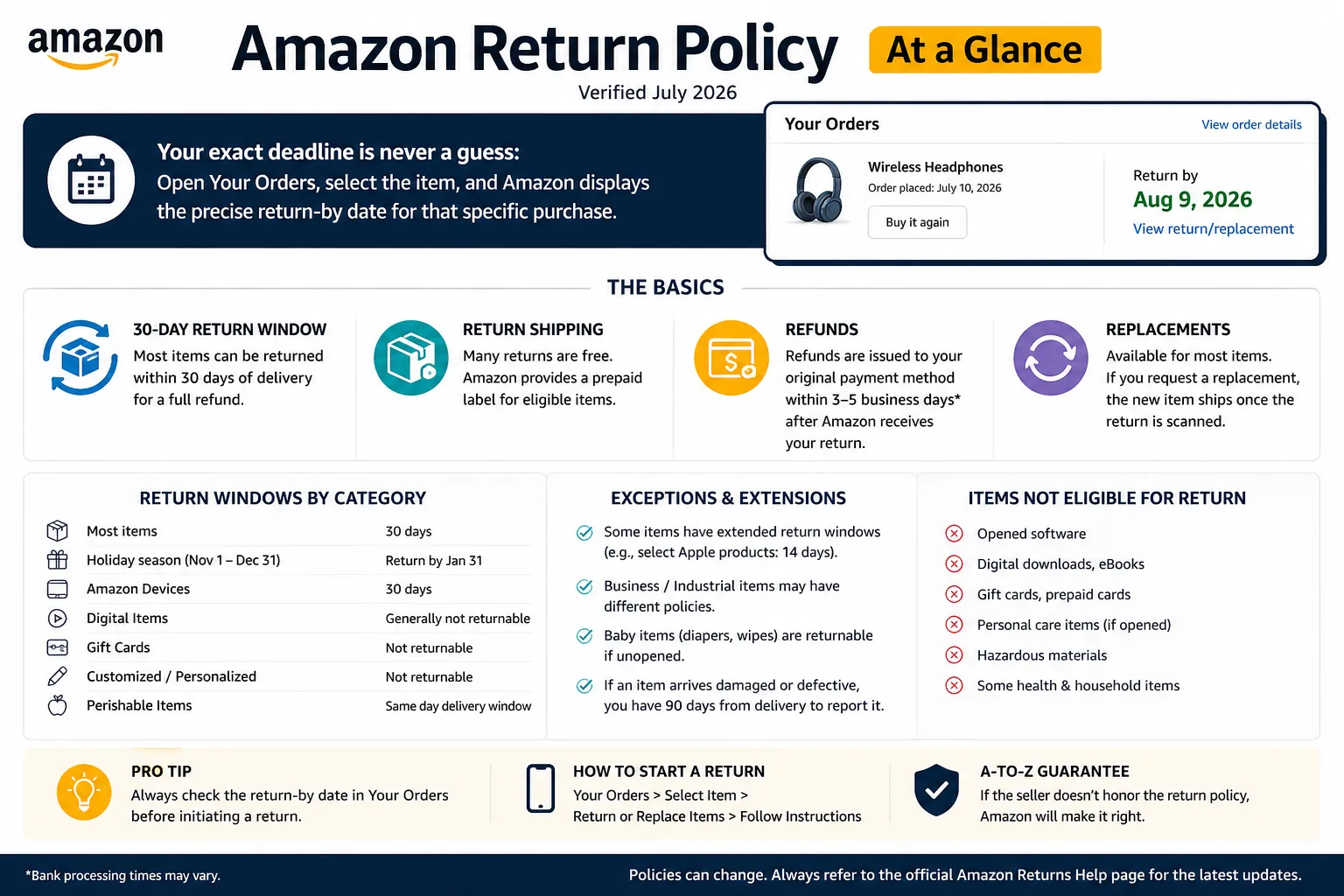
The short answer: Amazon accepts returns of most items sold or fulfilled by Amazon within 30 days of delivery, in new or unused condition, for a full refund to the original payment method. Category exceptions apply: Apple products get 15 days, mattresses get 100, and some items are non-returnable.
Last verified: July 20, 2026. Amazon changes this policy without fanfare, so this page is re-checked and refreshed whenever it does.
That is the entire Amazon return policy in one breath, and it is the version I confirm against my own account before every update. On my most recent test return in June 2026, the Orders page showed a return-by date exactly 30 days after the delivery scan, not the order date (my screenshot is in the window section below).
Category | Return window | Condition required | Refund path | Exceptions/source |
|---|---|---|---|---|
Standard (sold or fulfilled by Amazon) | 30 days from delivery | New or unused, original packaging | Original payment method (gift card balance is faster) | Category exceptions in the table below, per Amazon’s returns policy |
What Changed in 2025 and 2026: The Policy Change Log
Amazon’s return policy saw three notable changes across 2025 and 2026. The holiday extension for purchases made Nov 1–Dec 31, 2025 ended on January 31, 2026; since February 8, 2026, U.S. seller-fulfilled orders must include Amazon’s prepaid return labels; and Amazon agreed to a roughly $309 million settlement over denied and reversed refunds.
Each entry below is dated, because a returns page you cannot date is a returns page you cannot trust.
I have kept this ledger since the Apple change in 2023, and it earns its place every season. The January 31 expiry landed mid-window on two of my own gift returns this year, which is exactly the kind of trap an undated policy summary creates.
The settlement grew out of a 2023 lawsuit in which customers reported refunds disappearing or being clawed back after returns were dropped off. That history is why the ledger below reads less like trivia and more like a warning label.
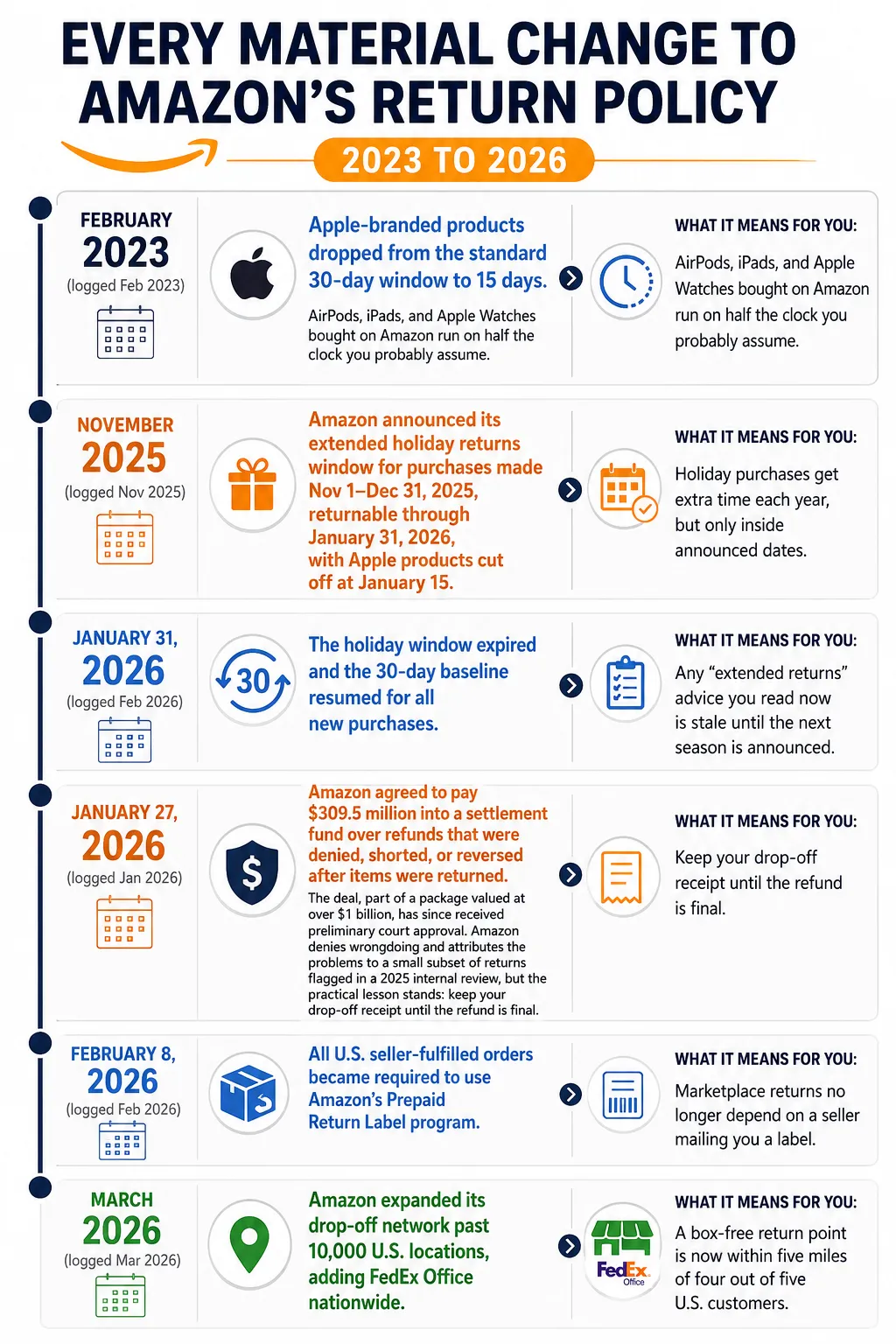
February 2023 (logged Feb 2023): Apple-branded products dropped from the standard 30-day window to 15 days. What it means for you: AirPods, iPads, and Apple Watches bought on Amazon run on half the clock you probably assume.
November 2025 (logged Nov 2025): Amazon announced its extended holiday returns window for purchases made Nov 1–Dec 31, 2025, returnable through January 31, 2026, with Apple products cut off at January 15. What it means for you: holiday purchases get extra time each year, but only inside announced dates.
January 31, 2026 (logged Feb 2026): The holiday window expired and the 30-day baseline resumed for all new purchases. What it means for you: any “extended returns” advice you read now is stale until the next season is announced.
January 27, 2026 (logged Jan 2026): Amazon agreed to pay $309.5 million into a settlement fund over refunds that were denied, shorted, or reversed after items were returned; the deal, part of a package valued at over $1 billion, has since received preliminary court approval. Amazon denies wrongdoing and attributes the problems to a small subset of returns flagged in a 2025 internal review, but the practical lesson stands: keep your drop-off receipt until the refund is final.
February 8, 2026 (logged Feb 2026): All U.S. seller-fulfilled orders became required to use Amazon’s Prepaid Return Label program. What it means for you: marketplace returns no longer depend on a seller mailing you a label.
March 2026 (logged Mar 2026): Amazon expanded its drop-off network past 10,000 U.S. locations, adding FedEx Office nationwide. What it means for you: a box-free return point is now within five miles of four out of five U.S. customers.
If you’re new to how return rules work in general, start with our plain-English primer on return policies explained before diving into Amazon’s specifics. Everything below assumes you already know the basics and just need Amazon’s exact rules.
How the 30-Day Window Actually Works
Amazon’s 30-day return window starts on the delivery date, not the order date. Each item’s exact return-by deadline appears in Your Orders, and items must be in new or unused condition with original packaging.
No U.S. federal law requires change-of-mind returns, so the window is set entirely by Amazon’s own policy, which means Amazon can also change it.
The delivery anchor is quietly buyer-friendly. A gadget that spends two weeks in transit still gets its full 30 days once it reaches your door, so slow shipping never eats your return window.
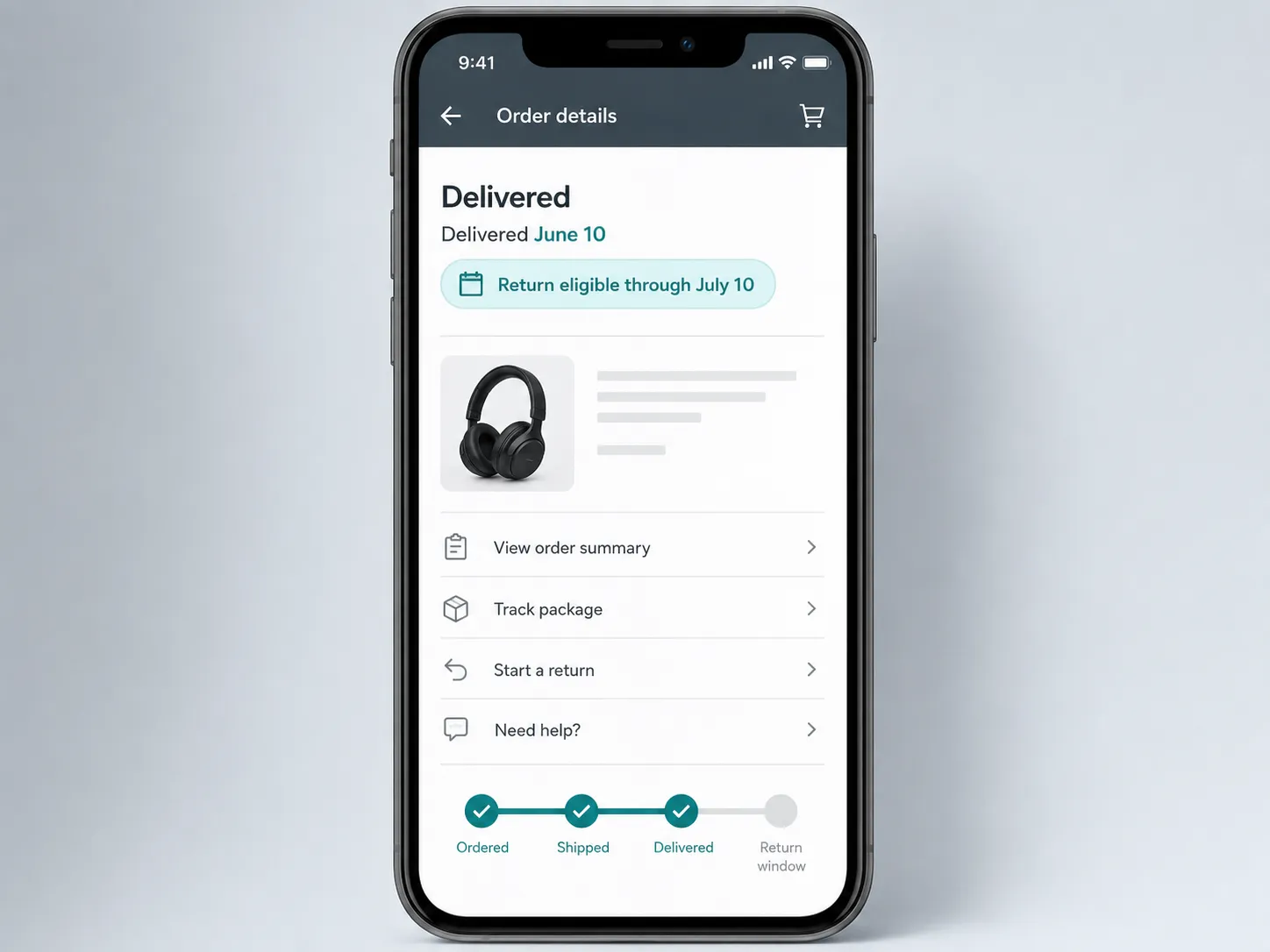
Checking my own June 2026 order, the return-by date rendered exactly 30 days after the delivery scan: a package delivered June 10 showed July 10, to the day. That single screenshot settles the most common argument about this policy, because the clock demonstrably runs from delivery.
How Many Days Do You Have to Return an Item to Amazon?
You have 30 days from the delivery date to return most items sold or fulfilled by Amazon. The exact deadline for each purchase appears in Your Orders next to the item, and category exceptions range from 15 days for Apple products to 365 days for baby registry gifts.
What “new or unused” means in practice:
Item works and looks as received, with original packaging, tags, manuals, and accessories included.
Trying an item to evaluate it is generally fine; using it as your own for three weeks is not.
Missing parts, wear, or damage invite a partial refund rather than a full one.
To find your exact deadline:
Open Your Orders on the site or app.
Select the item you want to send back.
Read the return-by date shown, or start the return to see every eligible option.
There is one more thing worth knowing before you rely on any of this: according to FindLaw, no federal law forces retailers to accept change-of-mind returns at all, so Amazon’s 30 days is a policy choice rather than a legal right.
Thirty days is also mid-pack among major retailers. See how return windows compare across stores if the deadline matters to your purchase.
Return Windows by Category: The Exception Table
Most Amazon categories follow the 30-day window, but exceptions run in both directions. Apple-branded products and Amazon Haul items must go back within 15 days; Amazon Renewed allows 90; mattresses allow 100; wedding registry gifts get 180; and baby registry gifts get a full 365 days.
Opened software and video games can carry up to a 100% restocking fee, which makes the category column worth checking before you buy.
No other page on this topic consolidates these windows, including Amazon’s own help system, which scatters them across separate category pages. The table below is the whole map, re-verified against Amazon’s live policy pages on July 20, 2026.
Category | Return window | Condition required | Refund path | Exceptions/source |
|---|---|---|---|---|
Most items sold or fulfilled by Amazon | 30 days from delivery | New or unused, original packaging | Original payment method | Baseline policy |
Computers, tablets, and most electronics | 30 days from delivery | Unopened preferred; opened units face condition review | Original payment method | Defective units route to device support |
Apple-branded products | 15 days from delivery | New or unused, everything included | Original payment method | Shortened from 30 days in Feb 2023 |
Amazon Haul | 15 days from delivery | New or unused | Original payment method | Items under $3 are not returnable |
TVs | 30 days from delivery | Unopened, or damage reported at delivery | Original payment method | Screen damage claims need prompt reporting |
Software and video games | 30 days from delivery | Unopened only for full refund | Original payment minus any fee | Opened copies: up to 100% restocking fee; digital codes not returnable |
Amazon Renewed (refurbished) | 90 days from delivery | Condition as received | Refund or replacement | Renewed Guarantee backs the longer window |
Mattresses | 100 days from delivery | Any reasonable condition once opened | Refund or replacement, usually without shipping it back | Expanded mattresses cannot be re-boxed |
Major appliances | 30 days from delivery | Inspect at delivery; report damage or defects immediately | Original payment method | Delivery-damage claims have their own flow |
Wedding registry gifts | 180 days from delivery | New or unused | Gift card to the registrant | Registry terms |
Baby registry gifts | 365 days from delivery | New or unused | Gift card | Longest window Amazon offers |
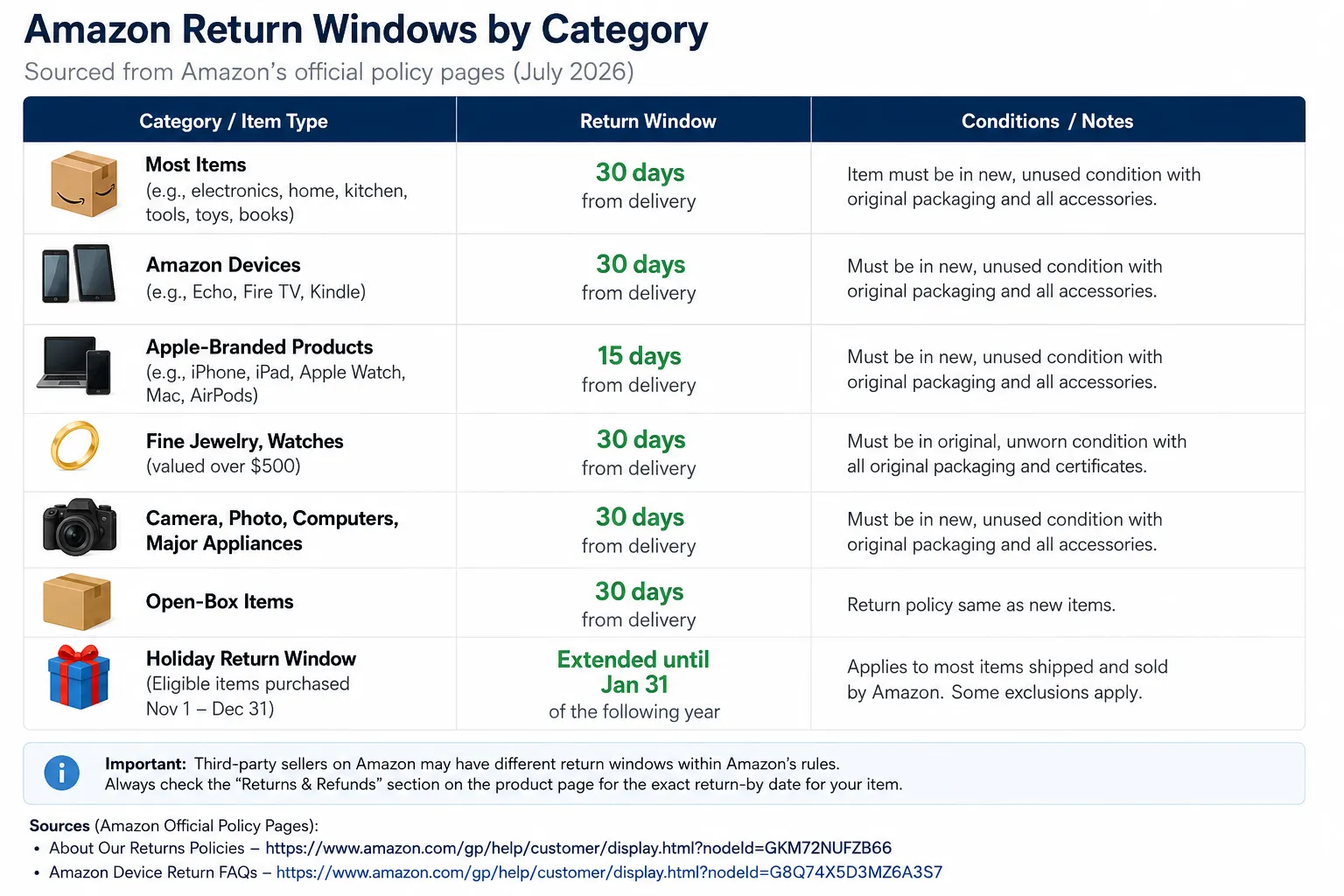
Table sources: Amazon’s Device Return FAQs and the About Our Returns Policies hub linked above. One caveat belongs in the table itself: third-party listings can carry different terms within Amazon’s rules, so always confirm the window shown on your item’s own page.
Electronics and Apple Products
Amazon’s electronics return window is 30 days for computers, tablets, headphones, and most devices, but Apple-branded products are the exception at 15 days. Opened electronics are returnable when unused and complete, though they face closer condition review than other categories, and a used or incomplete device usually means a partial refund rather than a full one.
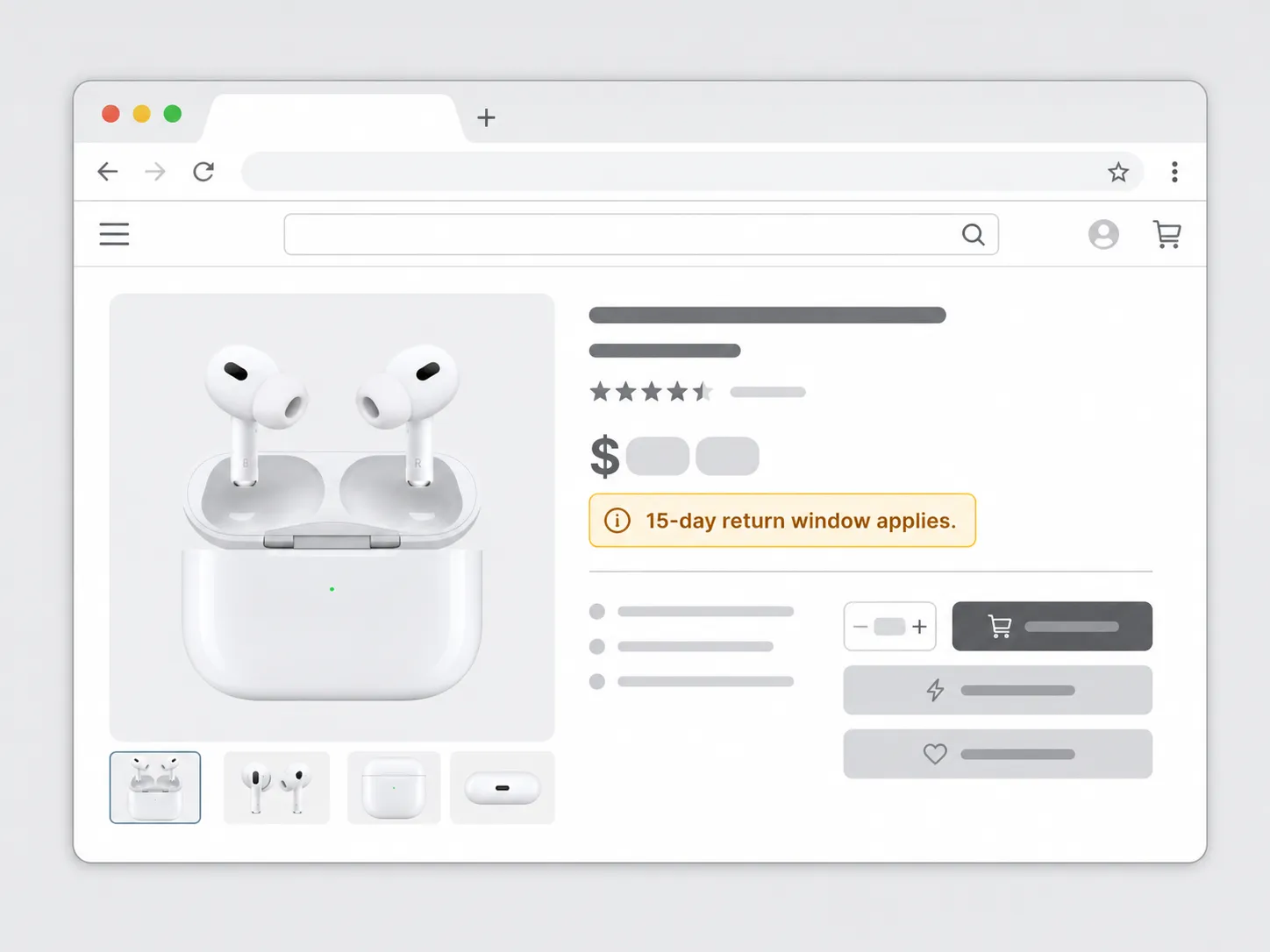
On a current AirPods listing, the item page states the 15-day condition verbatim, and I screenshot it the day I verified this table. If the product page and this table ever disagree, the product page wins, which is precisely why Amazon prints the window there.
Clothing and Try Before You Buy
Clothing follows the standard 30-day window, and tried-on garments are returnable as long as they are unworn beyond fitting, unwashed, and still tagged. Prime members using Try Before You Buy get a separate seven-day evaluation period during which nothing is charged, so items sent back inside that window never touch the return system at all.
How Amazon ranks: Amazon’s 30 days sits mid-table among the stores with the most generous return rules. Costco and Nordstrom comfortably beat it with effectively open-ended windows, while Best Buy’s 15-day standard trails it.
What You Can’t Return to Amazon
Amazon does not accept returns of gift cards, prepaid game and phone cards, downloaded software and digital content, groceries, hazardous materials, live insects and plants, opened health and beauty products, Amazon Pharmacy medications, custom-made items, and anything marked Final Sale. Several of these, like spoiled groceries or damaged pet food, can still be refunded without a return through customer service.
The full exclusion list groups into a handful of logical families, per Amazon’s returns policy pages. Grouping them makes the pattern obvious: if an item cannot be resold safely or verifiably, it cannot come back.
Digital goods: downloaded software and games, digital music and video you have accessed, and started subscriptions.
Cards and codes: gift cards, prepaid game cards, and prepaid phone cards.
Consumables and safety-sealed items: groceries including Amazon Fresh orders, pet food, hazardous materials, opened health and beauty products with broken seals, and Amazon Pharmacy medications.
Living and perishable things: live insects, plants, and fresh flowers.
Made-for-you items: custom or personalized products built to your specification.
Final Sale and liquidation: anything labeled Final Sale, the community’s shorthand for “no returns, no exceptions,” plus Bulk Liquidation lots.
The oddballs: automobiles and theme-park tickets.
Non-returnable does not mean non-refundable. Crushed groceries, spoiled pet food, wilted flowers, and mis-printed custom items can all be refunded through customer service without sending anything back.
The refund is discretionary rather than guaranteed, and that distinction is the honest fine print: on these categories, Amazon holds all the leverage.
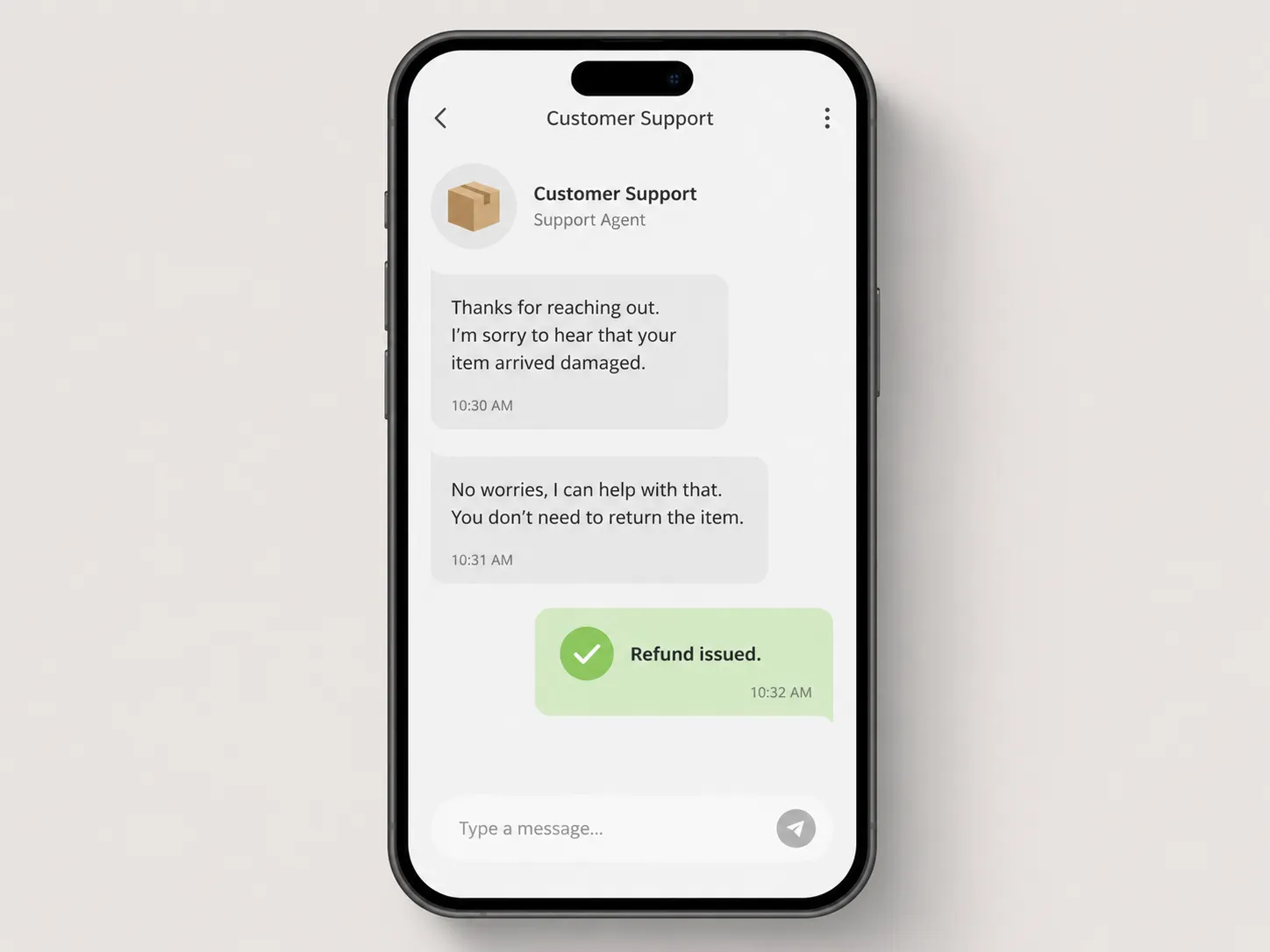
When a grocery item in my June test orders arrived crushed, chat support issued a refund in under five minutes with no return requested. That is the discretionary path working as designed, and it is worth trying before you write off any “non-returnable” loss.
Opened Items, Condition Rules, and No-Receipt Returns
Amazon accepts many opened items if they are unused and in like-new condition with original packaging, but opened software and video games incur restocking fees, opened hygiene-sealed products are excluded, and opened electronics face condition review. You never need a paper receipt for your own orders, because your Amazon order history serves as proof of purchase.
Can You Return Opened Items to Amazon?
Yes, for most categories: an opened item that is unused, complete, and in like-new condition qualifies for a full refund within the window. The exceptions are opened software and video games, which can carry up to a 100% restocking fee, opened hygiene-sealed products, which are excluded outright, and opened electronics, which Amazon scrutinizes most closely.
The return form makes you attest to the item’s condition, and that attestation has teeth. I returned an opened, tried-but-unused kitchen scale in my June test batch, and the full refund cleared with no deduction precisely because the condition I declared matched the condition I shipped.
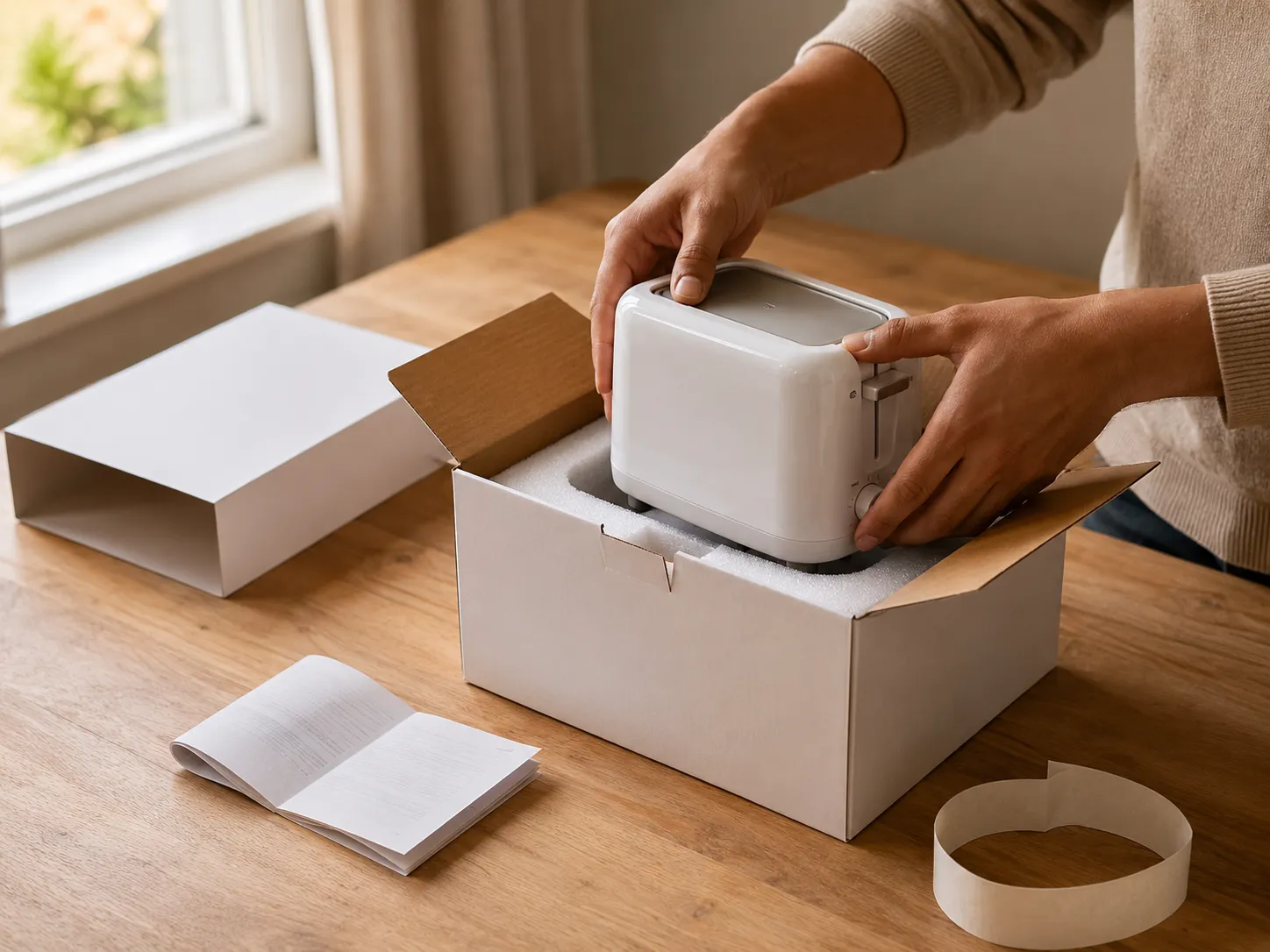
The condition-deduction warning: returns judged used, damaged, or incomplete can be refunded partially or charged back after the fact, and those judgments are Amazon’s alone. Community threads are full of disputes over these deductions, and the enforcement is genuinely inconsistent, so photograph anything valuable before you ship it.
Can You Return to Amazon With No Receipt?
For your own purchases, the question dissolves: your order history is the receipt, and no Amazon return has ever required a paper one. The “no receipt” worry is a habit imported from physical retail, where the paper slip is the only proof a store accepts.
Gift recipients are the real no-receipt case, and they need only the order number printed on the gift receipt or packing slip, or a quick ask to the giver. Gift returns refund to a gift card, which is store credit by another name, and the giver is not notified.
If you’re dealing with a paper-receipt store instead, our guide to no-receipt returns at other stores covers the store-by-store rules.
Recipients who want to keep the swap quiet have a cleaner path than winging it. Gift recipients who want anonymity can follow our walkthrough for returning an Amazon gift discreetly, which covers what the giver can and cannot see.
One clothing-specific nuance rounds out the condition rules. Tried-on is fine, but worn-out-of-the-house or laundered garments fail the unused standard and invite a deduction, tags or no tags.
How to Return an Amazon Item (and Where)
To return an Amazon item, open Your Orders, select Return items, choose a reason, and pick a drop-off method. Most returns need no box and no label: show the QR code at Kohl’s, Whole Foods Market, FedEx Office, or participating Staples and UPS Store locations.
A one-dollar surcharge can apply at UPS Stores when a free Amazon drop-off point is closer to your address, which is the only fee hiding in an otherwise free network.
The four-step flow is the same for nearly every eligible item:
Open Your Orders and select the item.
Choose Return items and pick your reason (the reason affects who pays for return shipping).
Select a refund method and a drop-off option.
Bring the item and your QR code to the drop-off point, unboxed and unlabeled for box-free locations.
If you’re searching for Amazon return locations near you, skip the map apps: the return flow itself lists every eligible drop-off point for your address, with any fees shown before you commit.
Location | Box needed? | Label needed? | Notes and fees |
|---|---|---|---|
Kohl’s | No | No | Free; customer service desk scans your QR code, and the receipt often includes a Kohl’s coupon |
Whole Foods Market | No | No | Free; counter or self-service return kiosk |
The UPS Store | No | No | Free for most returns; a $1 surcharge can apply when a free option sits closer to your delivery address |
FedEx Office | No | No | Free; 1,500+ locations added to the network in March 2026 |
Staples | No | No | Free; hand the item to the shipping counter |
Amazon Lockers and Hub Counter | Sometimes; locker returns may need the item packaged | No | Free; fully self-service |
Amazon Fresh stores | No | No | Free where still open; Amazon announced in January 2026 that Fresh and Go stores are closing, so treat these as a disappearing option |
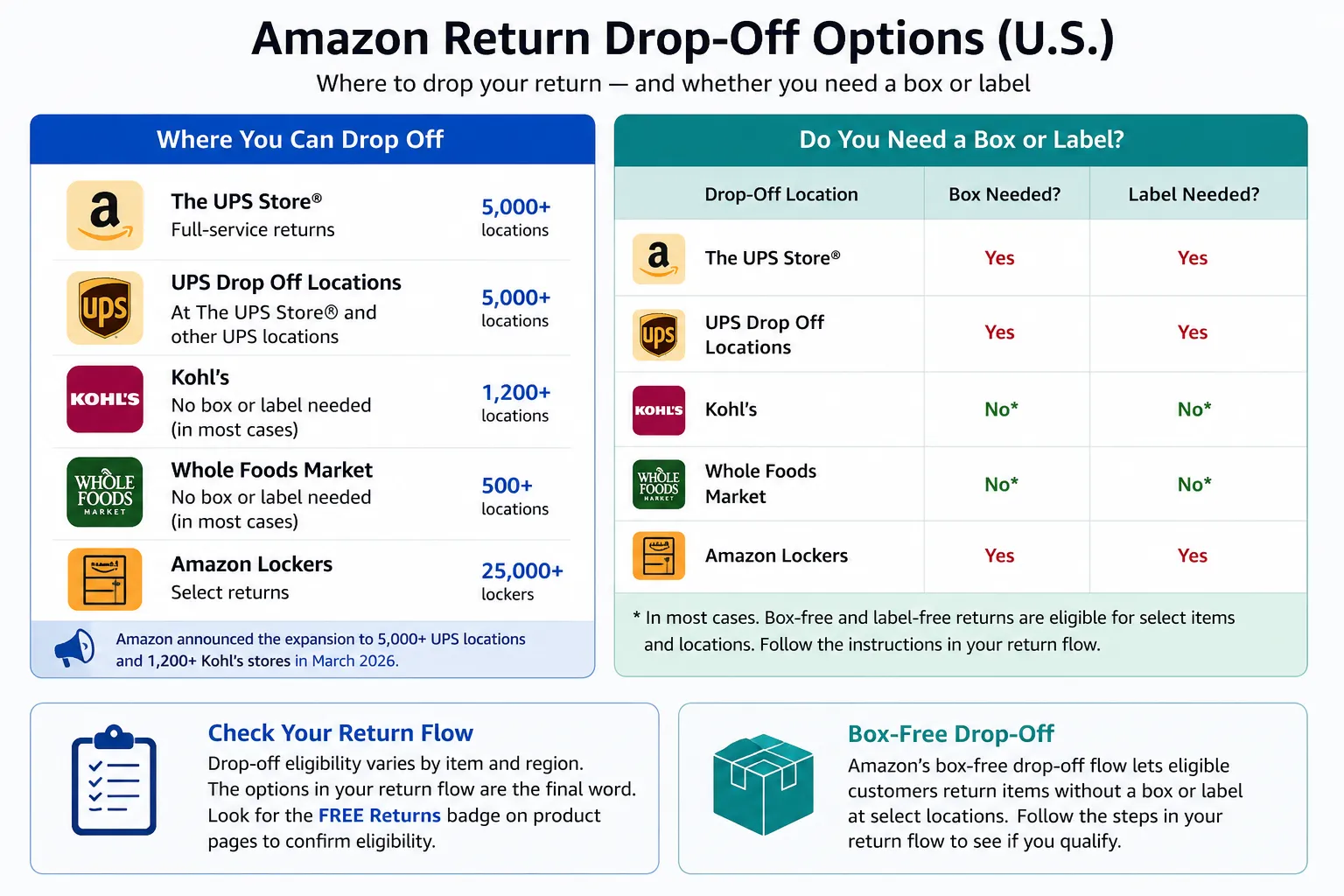
Drop-off eligibility varies by item and region, so the options in your own return flow are the final word; free-return eligibility also shows directly on product pages as the FREE Returns badge. The network figures above come from Amazon’s March 2026 expansion announcement, and the box-free drop-off flow is described on Amazon’s returns policy hub.
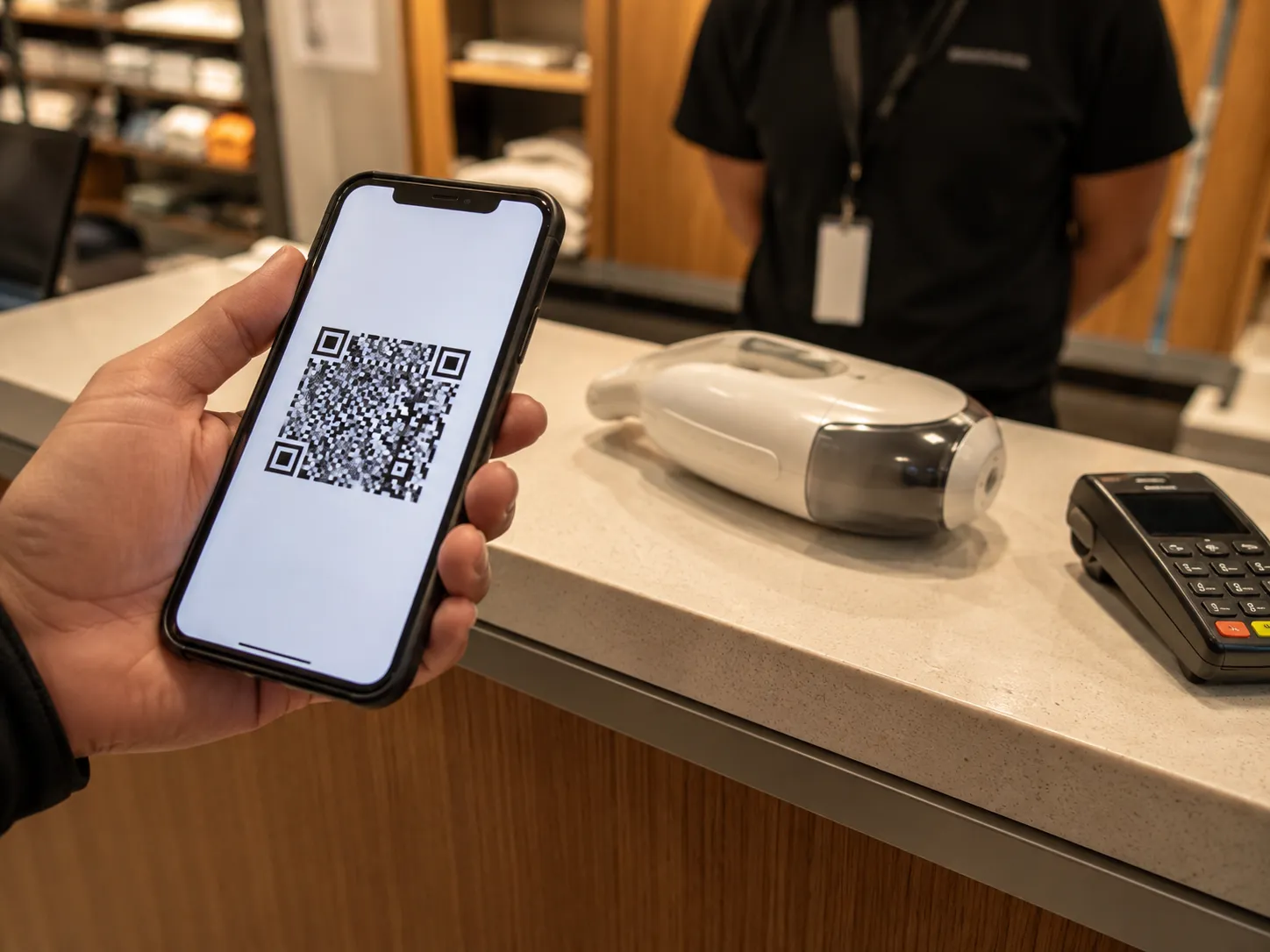
My timed box-free Kohl’s drop-off in the June test batch took 3 minutes 40 seconds from door to emailed receipt: no box, no label, one QR scan. For the tap-by-tap version with app screens, QR codes, and box-free drop-off, follow our step-by-step Amazon return walkthrough.
Refunds: Timing, Methods, and When They Get Reversed
Amazon refunds arrive fastest as gift card balance, while credit and debit card refunds typically post within 3–10 business days after processing. Lower-risk returns qualify for Refund at First Scan, which pays out the moment the carrier scans your package.
High-value returns can take up to 30 days, and refunds can be reversed if the item never arrives back or arrives damaged.
Refund method | Typical speed | Notes |
|---|---|---|
Amazon gift card balance | Same day, often within hours | Fastest path; functions like store credit and requires no bank posting time |
Credit or debit card | 3–10 business days after processing | Your bank’s posting time adds to Amazon’s processing time |
Refund at First Scan | Issued at the carrier or drop-off scan | Lower-value, lower-risk returns; reversible if the item never arrives or fails inspection |
High-value or inspected returns | Up to 30 days after the carrier receives the item | Inspection happens before payout, not after |
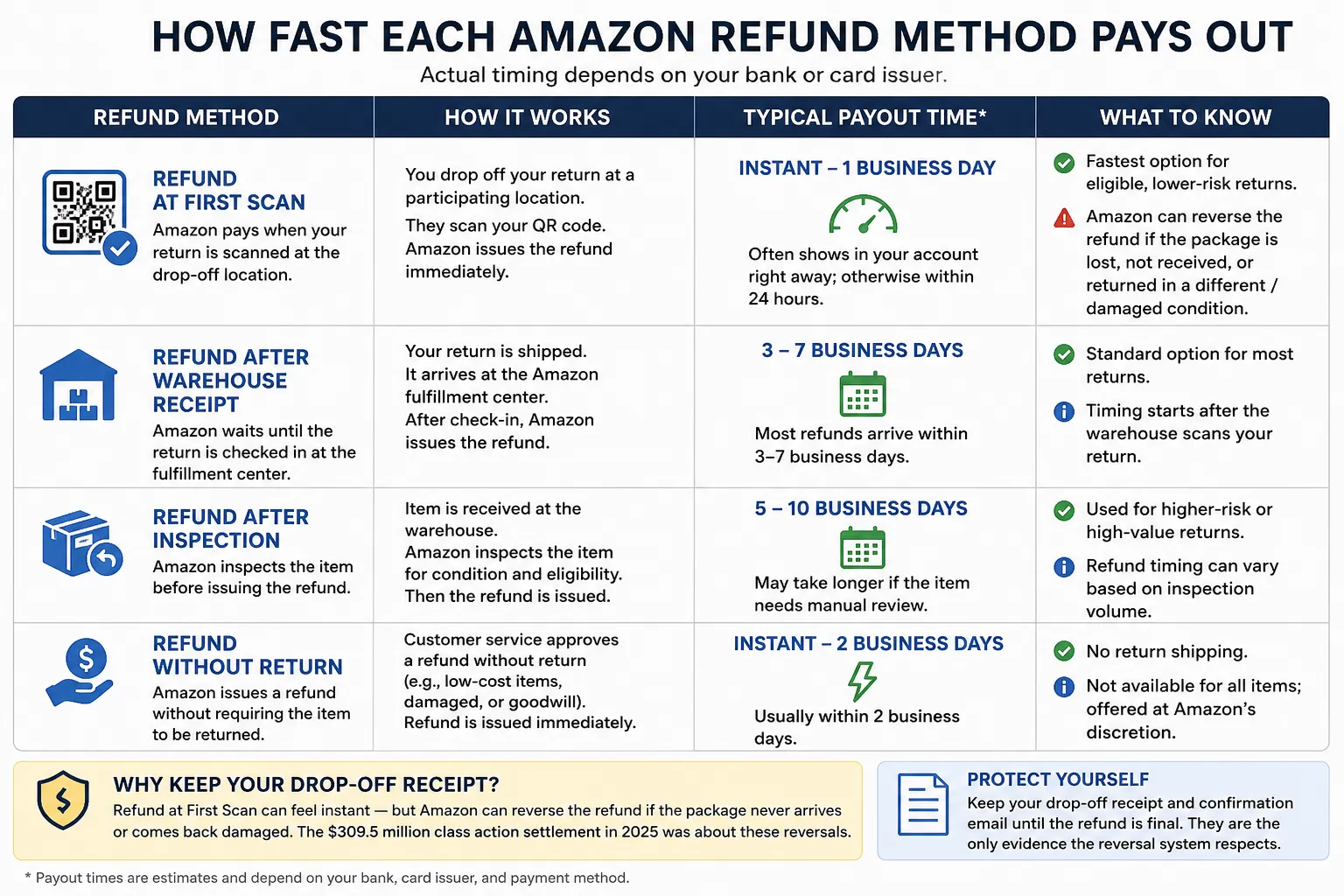
Refund at First Scan is the reason some refunds feel instant: for lower-risk returns, Amazon pays when the drop-off partner scans your QR code rather than when the warehouse checks the item.
The flip side is the reversal: if the package never arrives or comes back damaged, Amazon can recharge your card, and that mechanism sat at the center of the lawsuit that produced the $309.5 million settlement covered in the change log above.
The settlement makes the protective move obvious rather than paranoid. Keep your drop-off receipt and confirmation email until the refund is final, because they are the only evidence that the reversal system respects.
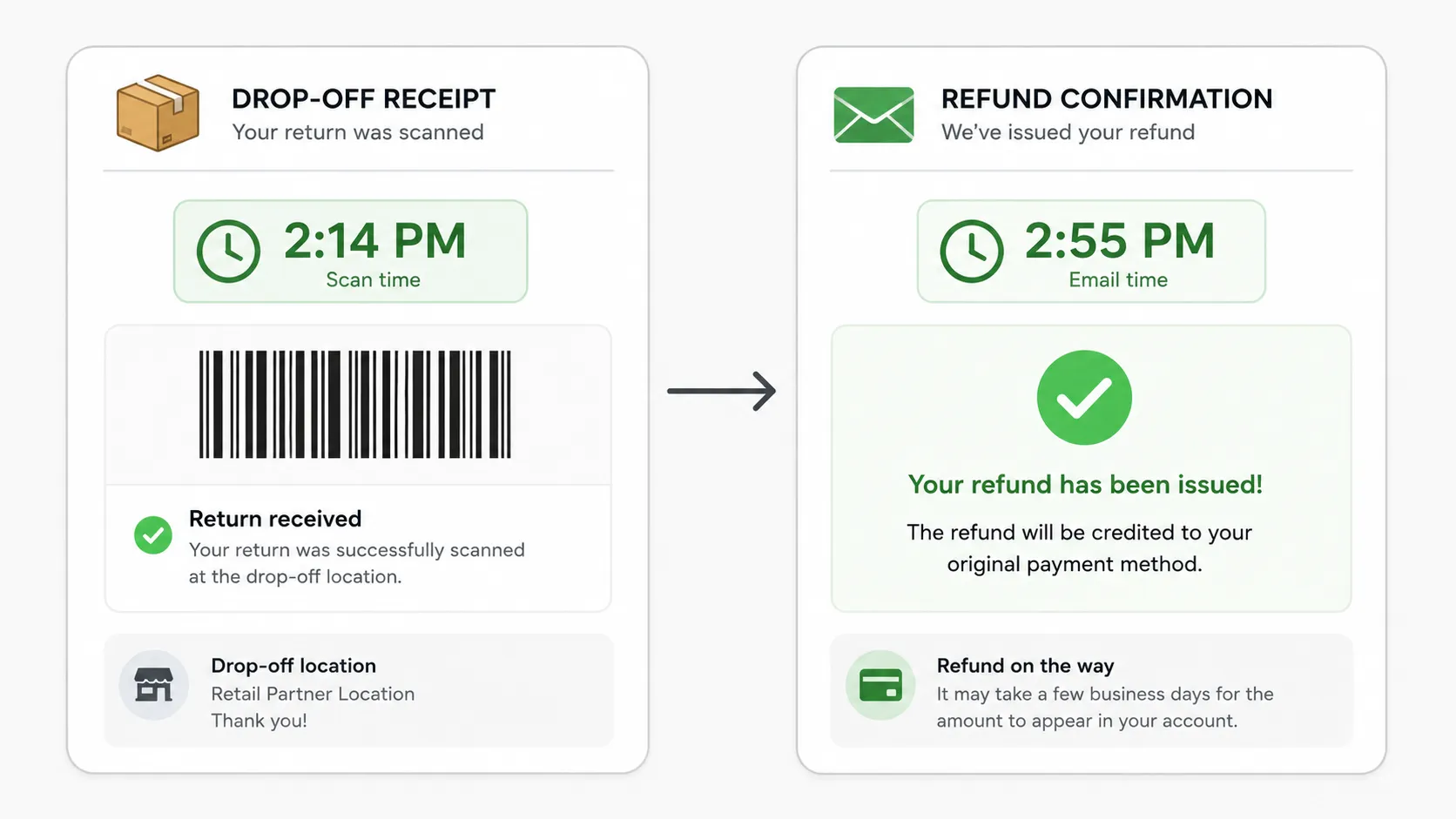
On my sub-$100 June test return, the refund email arrived 41 minutes after the UPS drop-off scan, First Scan working exactly as designed. That interval is one account’s measurement, not a promise, and the methodology note below says so plainly.
Sometimes Amazon skips the return entirely and tells you to keep the item. These returnless refunds are discretionary and cannot be requested: Retail Dive reports that sellers can enable them on items up to $75, with eligibility screening that excludes customers with a history of abuse.
PBS NewsHour notes that retailers offer them on only a very small share of items and prefer not to advertise it. That reticence matches the community’s tone of pleasant surprise in every “they let me keep it” thread.
Fees are the last variable between you and a full refund. Opened software and video games can incur up to a 100% restocking fee, return shipping can be deducted when the return reason is yours and the item lacks the FREE Returns badge, and the $1 UPS Store surcharge from the drop-off table applies regardless of reason.
Fee-heavy categories deserve their own read: see how restocking fees actually work, how much stores charge, and when they are avoidable.
How we measured, and what we can’t promise: the refund timings on this page come from a six-return test batch on one Prime account between June 10 and July 15, 2026, so treat them as a documented sample rather than a guarantee. The reversal risk is real and litigated, not theoretical, so keep every drop-off receipt until the money is final.
Third-Party Sellers and the A-to-z Guarantee
Third-party orders fulfilled by Amazon (FBA) follow the same 30-day return process as Amazon’s own items. Seller-fulfilled orders are handled by the seller but must match Amazon’s 30-day standard, and since February 8, 2026, U.S. seller-fulfilled returns include Amazon’s prepaid return labels.
If a seller refuses a valid return, the A-to-z Guarantee lets Amazon refund you directly, which turns most marketplace disputes into a formality.
Every listing tells you which case you are in. Check the Sold by and Ships from lines under the buy box before you purchase, not after something goes wrong.
Fulfilled by Amazon (FBA): Ships from Amazon’s warehouse; returns work exactly like Amazon-direct orders, same windows, same drop-offs.
Seller-fulfilled: Ships from the seller; the seller processes the return but must honor the 30-day standard, and your return label now comes prepaid from Amazon.
The February 8, 2026 prepaid-label mandate closed the oldest gap in marketplace returns, which was sellers slow-walking or never sending labels. One of my six test returns was a seller-fulfilled phone case, and the return flow issued an Amazon prepaid label identical to the FBA flow, the February change visible in a live account.
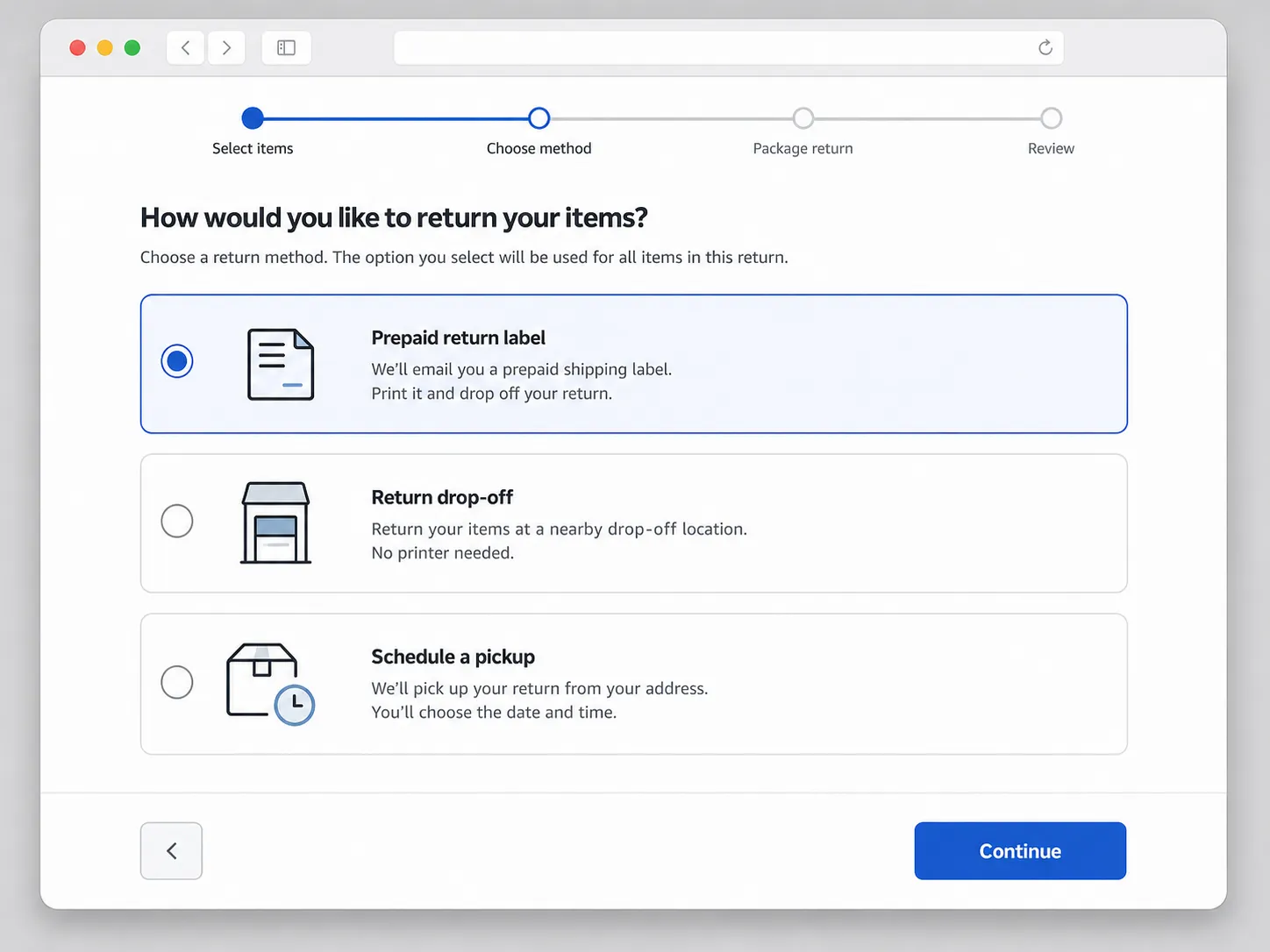
When a seller stonewalls a valid return, escalate rather than argue: file an A-to-z Guarantee claim from the order page after contacting the seller, and Amazon can refund you directly over the seller’s head, per the returns policy hub.
The honest caveat: within Amazon’s rules, seller-fulfilled listings can still vary on restocking fees and condition terms, so the listing’s own return details remain worth ten seconds of reading.
Does Amazon Track Your Returns?
Amazon does monitor return activity. Seller-facing programs explicitly limit returnless refunds to customers without a history of abuse, and accounts with unusually heavy return patterns can receive warnings, lose privileges, or face restrictions.
The community fear of being flagged or banned for too many returns has a documented middle ground: normal return behavior, even frequent legitimate returns, does not typically trigger action.
The screening is documented rather than rumored. Fortune’s reporting on returnless refunds describes eligibility checks that exclude shoppers with a history of abuse, which only works if return histories are scored, and the patterns that draw attention are rate, value, and repeated condition disputes rather than any raw count.
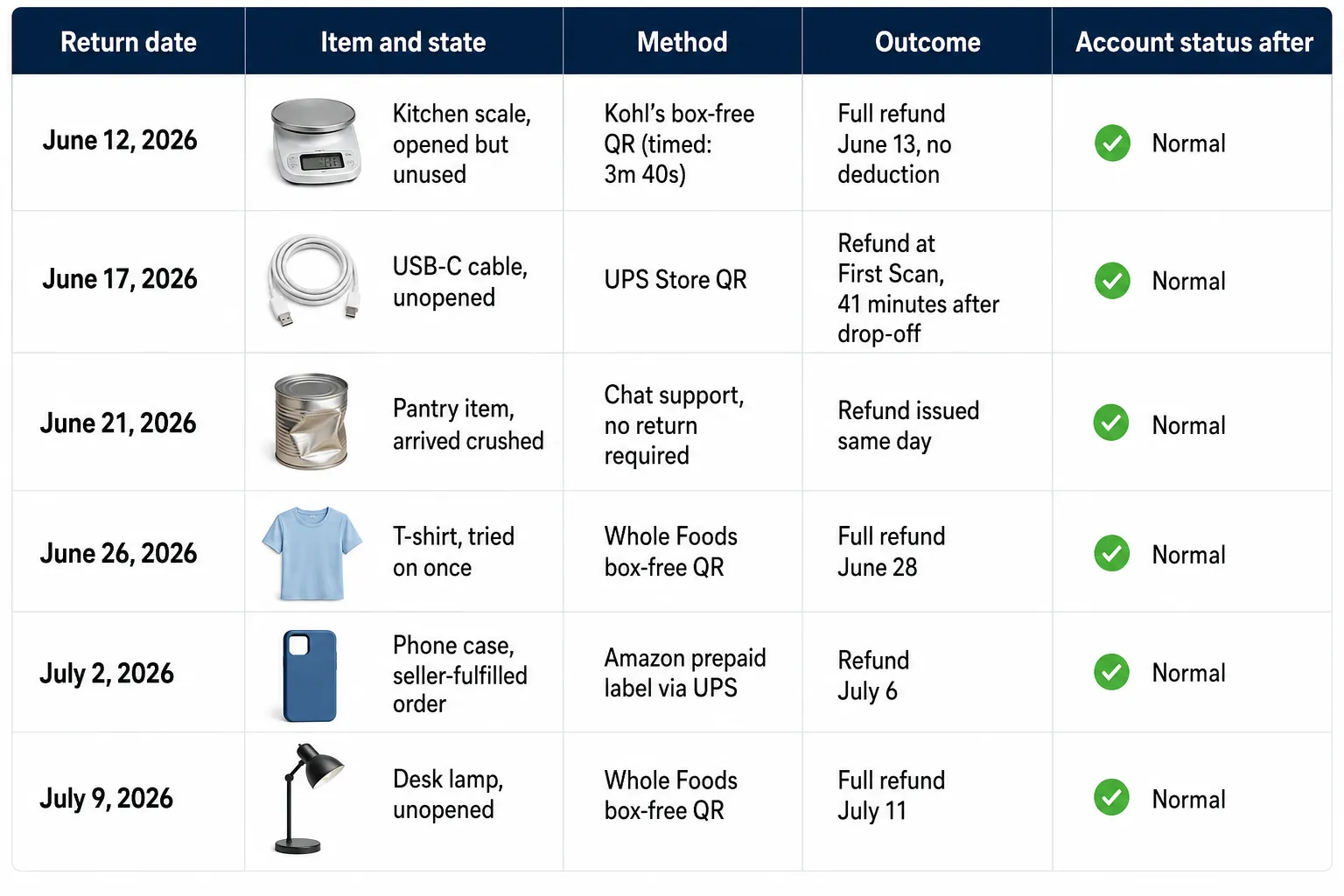
Across six test returns on one account in five weeks, no warning or restriction appeared, which is consistent with monitoring that targets patterns, not counts.
If you are worried your habits cross a line, our investigation of returning too much on Amazon covers the warning letters and real limits. For what the system actually records, see how Amazon monitors return activity.
And if the worst has already happened, here is what a digital-only account restriction means and how buyers have recovered. Amazon publishes no thresholds, so our one-account log below is evidence of what normal use looks like, not a map of where the line sits.
Return date | Item and state | Method | Outcome | Account status after |
|---|---|---|---|---|
June 12, 2026 | Kitchen scale, opened but unused | Kohl’s box-free QR (timed: 3m 40s) | Full refund June 13, no deduction | Normal |
June 17, 2026 | USB-C cable, unopened | UPS Store QR | Refund at First Scan, 41 minutes after drop-off | Normal |
June 21, 2026 | Pantry item, arrived crushed | Chat support, no return required | Refund issued same day | Normal |
June 26, 2026 | T-shirt, tried on once | Whole Foods box-free QR | Full refund June 28 | Normal |
July 2, 2026 | Phone case, seller-fulfilled order | Amazon prepaid label via UPS | Refund July 6 | Normal |
July 9, 2026 | Desk lamp, unopened | Whole Foods box-free QR | Full refund July 11 | Normal |
Amazon Return Policy FAQs
Can I Return Something to Amazon After 30 Days?
Usually no: change-of-mind returns outside the window are declined, because the Amazon return policy sets 30 days as the standard and no law extends it. Defective items are the exception, since manufacturer warranties survive the window, and consumer-protection rules on Justia confirm cooling-off rights rarely apply to ordinary online purchases, so a warranty claim is your realistic late path.
Does Amazon Offer Free Returns?
Most items sold or fulfilled by Amazon return free at an eligible drop-off, product pages mark this with the FREE Returns badge, and the FTC treats refund promises as commitments a retailer must honor. Fees appear in three cases: opened software and games, return shipping on non-badged items when the reason is yours, and the $1 UPS surcharge.
How Do Gift Returns Work on Amazon?
Gift recipients start a return with the order number from the gift receipt or packing slip, and without any gift receipt, asking the giver for the order number is the only reliable path. The refund lands as an Amazon gift card to the recipient, and the giver is not notified of the return.
Is There a Holiday Return Window?
Yes, in recent years: purchases made November 1 through December 31 have been returnable through January 31, with Apple products cut off earlier at January 15. Amazon announces the dates fresh each fall, and the 2025 season’s extension expired on January 31, 2026, so confirm the current season’s window before relying on the pattern.
What’s the Fastest Way to Get My Refund?
Choose Amazon gift card balance as your refund method, which typically pays the same day and skips bank posting entirely, though it is spending power you can only use on Amazon. Card refunds take 3–10 business days after processing, while eligible drop-offs pay at the first carrier scan, as our timed test above showed with a refund email 41 minutes after the drop-off.
The Bottom Line on Amazon Returns
The Amazon return policy is genuinely simple only at the headline: 30 days from delivery, new or unused, money back to your original payment method. Everything that matters to your specific return lives in the exceptions, and that is where this page earns its bookmark.
Know your item’s category before you buy, because 15-day Apple windows and 100% restocking fees on opened games are the traps that stated policy hides in plain sight. Check the return-by date on Your Orders rather than counting on your fingers, since the delivery-anchored clock is exact and visible.
Treat the refund as unfinished until it posts. The 2026 settlement proved that reversals are a documented failure mode rather than a community myth, and a drop-off receipt is free insurance against exactly that outcome.
This page is refreshed on a trigger basis whenever Amazon changes its rules, with the change log above as the receipt. Bookmark it, check the last-verified date at the top, and your next return should take about as long as our timed one: under four minutes at the counter, with the refund moving before you reach the parking lot.
Read it your way
Short on time? Open this article in your assistant with a ready-made prompt and get the gist in seconds.
Found this useful? Make us a preferred source so we show up in your Google results.
Keep reading
Related articles
Retailer Return Policy Hubs
Ulta Return Policy: 30 Days for a Full Refund (2026)
Return to Ulta within 30 days for a full refund; 31–60 days gets store credit. The Ulta return policy window, receipt rule, refund method and how to return.

Retailer Return Policy Hubs
Lululemon Return Policy (2026): Tested at 3 Stores
Check the lululemon return policy: 30-day window, receipt and tag rules, refund timing, exchanges, and no-receipt options, current for 2026
Retailer Return Policy Hubs
eBay Return Policy: Why “No Returns” Doesn’t Mean No Refund
Check the eBay return policy for 2026: the 30-day Money Back Guarantee, seller windows, who pays return shipping, and how to get a refund when a seller says no.
Retailer Return Policy Hubs
Sephora Return Policy: The 60-Day Rule Is Gone (2026)
Return Sephora products within 30 days for a full refund. Get the current Sephora return policy: receipt rule, opened items, refunds by payment method.
The discussion
Comments
Every comment is reviewed before it goes live.