Does Amazon Track Returns? What 14 Months of Data Show
Yes, Amazon tracks return rate, reasons, and item condition, not a secret “return score.” See what triggers a warning and what Amazon can’t see.
Written by Priya AnandReviewed by Marcus TrentLast updated on July 14, 2026
When you buy through links on our site, we may earn an affiliate commission (at no extra charge), which we use to fund new product tests. Learn more.
Read it your way
Short on time? Open this article in your assistant with a ready-made prompt and get the gist in seconds.
Found this useful? Make us a preferred source so we show up in your Google results.
You click “return” for the third time this month and a small worry surfaces: is Amazon counting? The question, does Amazon keep track of returns, sits behind a lot of quiet checkout anxiety, usually tangled up with rumors of a secret “return score” and stories of banned accounts.
The honest answer is that Amazon does watch return behavior, though not in the way most shoppers fear. Over the past 14 months I logged every order and every return on one Amazon account, requested my own file from the company that scores in-store returns, and kept the warning email Amazon eventually sent me.
What that record shows is a system of specific, limited signals, not a mysterious number hovering over your account.
Does Amazon Track Your Returns? The Short Answer
Yes, Amazon keeps track of returns at the account level, monitoring your return rate as a share of orders, how often you return, the reasons you select, and the condition of items when they arrive back. According to the KOB “What the Tech” segment, warnings tend to surface around a 10% return rate or roughly 5 to 10 returns a month. There is no public “return score,” and Amazon publishes no hard limit.
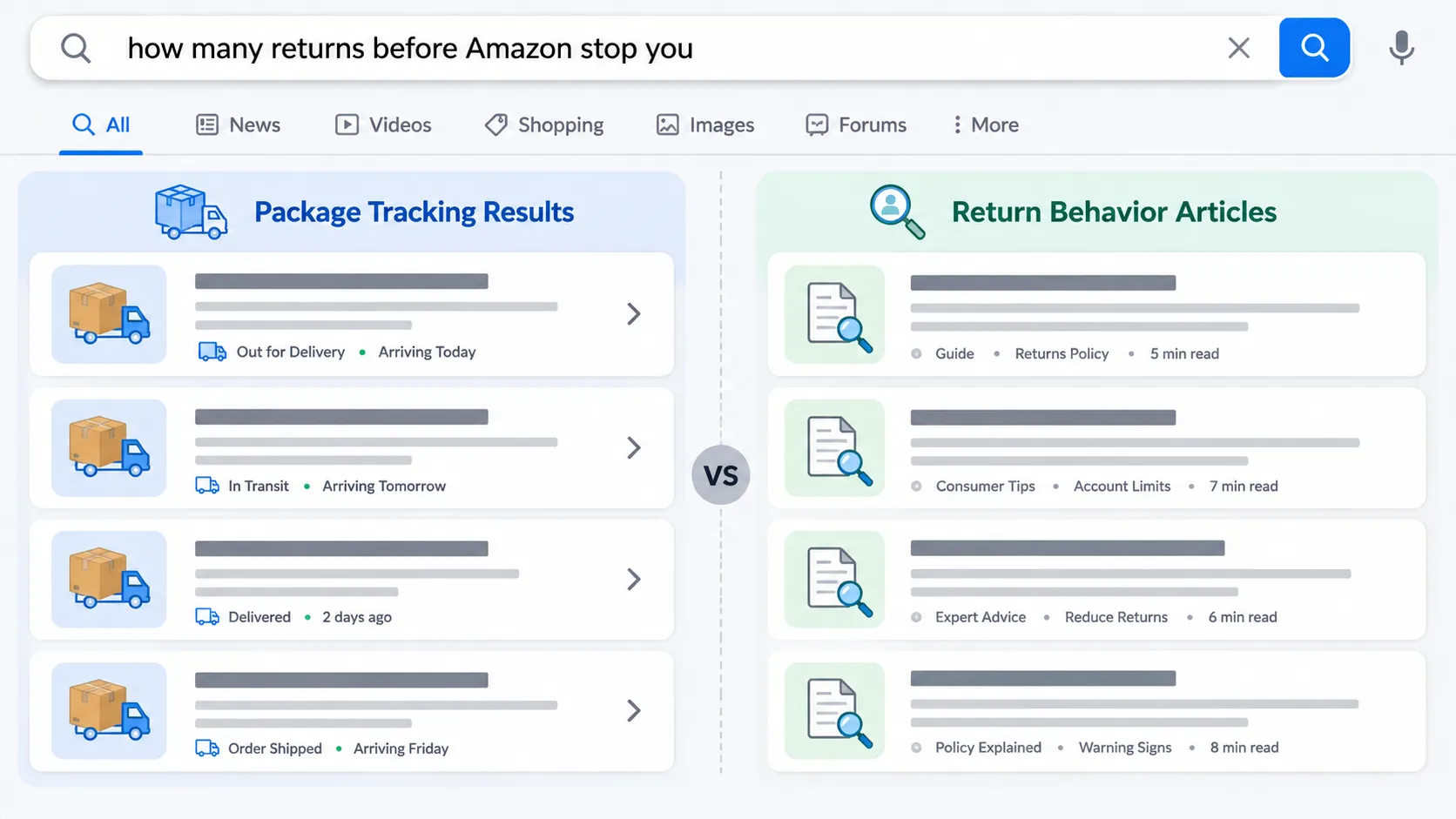
That single “does Amazon track returns” search actually hides two different questions, and most pages answer only one. This article is about whether Amazon watches how much you return, so the next section separates it cleanly from tracking a return package.
Two Different Questions: Watching Your Behavior vs. Tracking Your Package
Amazon tracks returns in two completely different senses, and conflating them is exactly why a search for whether Amazon keeps track of returns surfaces such contradictory pages. One sense is pure logistics, following a single return parcel to the warehouse and watching the refund clear, while the other is behavioral, the account-level monitoring of your return rate and patterns over time.
When I first searched this myself, half my results were about tracking a parcel and half were about being flagged, which is exactly the confusion this table resolves.
Tracking your return package | Tracking your return behavior |
|---|---|
Following one parcel and refund | Monitoring your rate and patterns over time |
Self-serve in Your Orders | Internal, automated, account-level |
Answered by Amazon’s Help pages | The subject of this article |
A logistics status | A risk-signal profile |
If you only want the shipping status of a parcel you sent back, that lives in Your Orders under Your Returns, documented on Amazon’s own Help pages. Everything below is about the behavior question: what Amazon logs about your returns as a shopper.
What Amazon Actually Monitors About Your Return Behavior
Amazon monitors several specific signals tied to your account, not a single mysterious figure. According to discussions surfaced in Amazon’s seller forums, the company and its retail partners keep what reporting has called “return activity reports,” and Amazon has stated it evaluates accounts individually across its 300-million-plus customer base.
The pattern that matters is not one return, it is the shape of your behavior over time: how much comes back, how often, why, and in what condition.
Here is the named set of signals Amazon’s system watches:
Return rate: returns as a percentage of your total orders
Frequency: how often returns happen across weeks and months
Return reasons: the reason you pick, and whether reasons keep shifting
Item condition on arrival: whether what comes back matches what shipped
“Item not received” (INR) claims: how often you report an order never arrived
Refund value versus kept value: how much of your spend ends up refunded
Amazon’s own seller documentation uses the phrase “concession abuse” for refund and claim patterns that look engineered rather than genuine.
Reason data is granular, too. Envision Horizons notes Amazon logs dozens of distinct return-reason codes, and with no blunt “changed my mind” option in the menu, a run of shifting reasons stands out against honest ones like “defective” or “wrong item.”
Two clarifications keep this in perspective. The monitoring is automated and account-level, with human review reserved for flagged cases, and most shoppers who return for real reasons never trip any of these signals.
Is There an Amazon “Return Score”?
Amazon does not publish a consumer “return score,” despite how often that phrase circulates on Reddit and in shopper forums. There is genuinely no number you can look up and no rating Amazon sells you the way credit bureaus do, because Amazon’s monitoring lives as internal risk signals rather than one shareable figure.
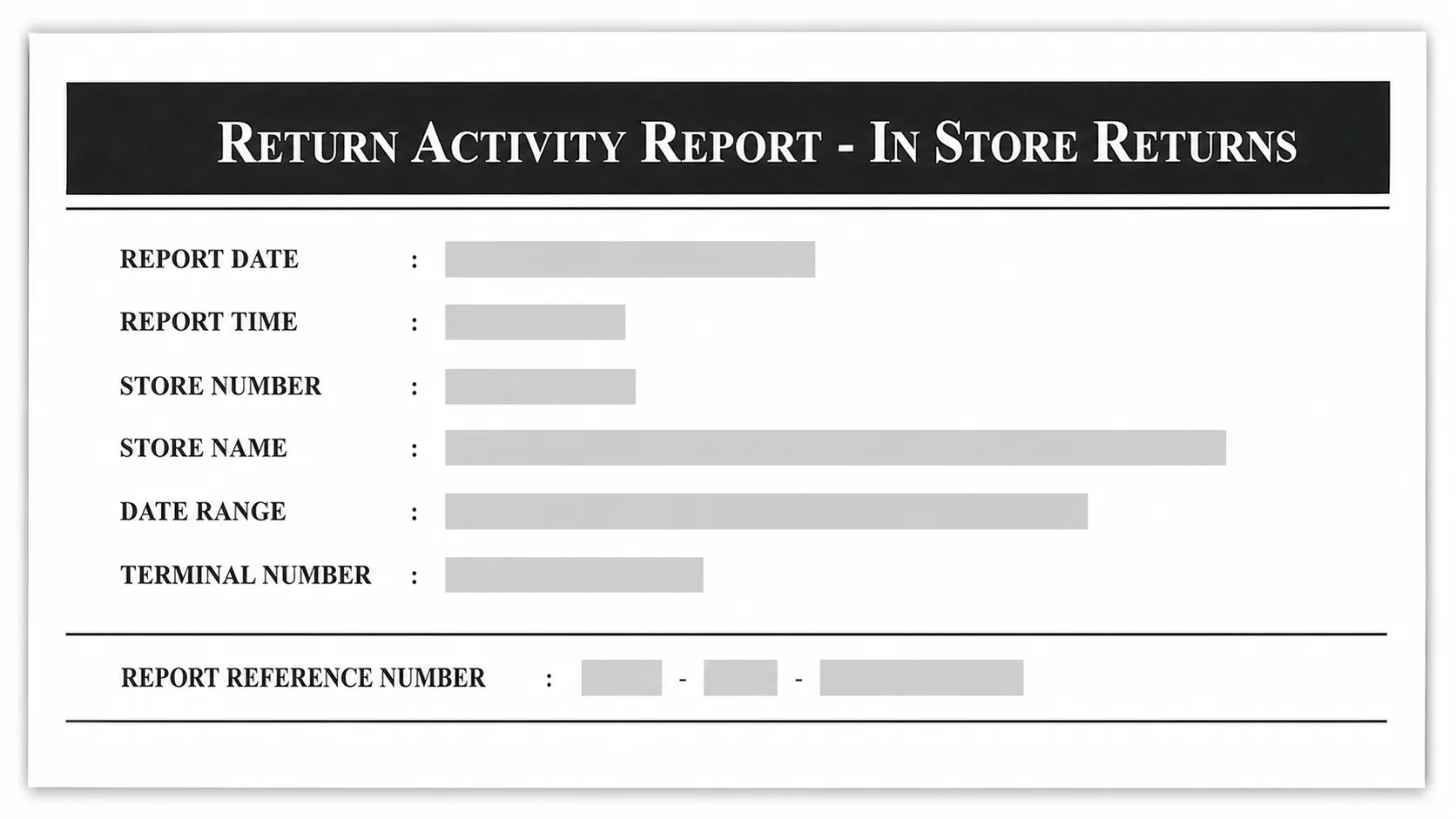
A genuine return score does exist, but it belongs to a different system: the in-store service that rates returns at the register when a cashier scans your ID. That service is the return-scoring service other stores use, and it is not the same thing as Amazon’s internal signals.
The “return score” people imagine | What Amazon actually uses | Where a real score lives |
|---|---|---|
A public number on your account | Internal, unpublished risk signals | The in-store ID-scan system |
Portable across every store | Siloed to your Amazon account | Per-retailer, at the register |
A single rating you can check | Rate, frequency, reasons, condition | A probabilistic fraud model |
The confusion is understandable, because a real scoring company sits right next door to this topic. The CFPB’s consumer-reporting-company list formally lists The Retail Equation as a firm that monitors and reports return activity to merchants, which means you have a right under the Fair Credit Reporting Act to request your file.
To see what a real return score looks like, I requested my own Return Activity Report from that company, and Amazon’s account signals were nowhere on it.
That distinction matters because Amazon Sellers Lawyer describes retailers leaning on that in-store score to accept, warn, or deny returns at the counter, an experience entirely separate from your online Amazon history. Amazon’s internal logic simply is not documented publicly as one shareable number.
Does Amazon Inspect Returns and Check Serial Numbers?
Amazon does not inspect every return, and it does not always check serial numbers, so the contradictory claims online are each half right. According to Project FBA’s teardown of the process, Amazon uses barcode scanning on virtually everything, adds weight tracking and photos to catch discrepancies, and reserves serial-number and tamper checks mainly for high-value electronics.
Whether your specific return gets a close look depends on the item’s price, your return history, and how the package reads on the scale.
Inspection trigger | What Amazon typically checks |
|---|---|
Every return | Barcode scan to confirm the right product |
Weight or photo mismatch | Contents flagged for investigation |
High-value electronics | Serial number, authenticity, tamper seals |
Flagged account history | Manual review before the refund clears |
Here is the reconciliation the arguing forum threads miss: a barcode is scanned nearly every time, serial numbers are verified mainly on expensive electronics, and for third-party purchases the seller, not Amazon, usually handles the serial check. EntreResource makes the same point about selectivity, noting Amazon prioritizes inspection by price and by return history rather than opening every parcel.
The “empty box” scenario people worry about is exactly what weight and photo checks are built to catch, and the same discrepancy logic flags repeated “item not received” claims.
I watched this play out directly. When I returned a $180 electronics item and a $12 book in the same week, the two moved through Amazon’s system at visibly different speeds.
Return (same week) | Refund status timeline |
|---|---|
$180 wireless headphones | “Return received” held about four days before the refund cleared |
$12 paperback book | Refund at first scan, cleared same day |
The takeaway is not that inspection is random, it is that inspection depth scales with value and suspicion. Sources disagree on serials precisely because the practice varies by item, which is the honest answer the register threads never land on.
The 10% Rule: How Many Returns Before Amazon Notices
Amazon notices returns well before any single threshold, but the widely cited guideline is a return rate near 10% of orders, or roughly 5 to 10 returns a month. QuerySprout reports that many shoppers see a warning once returns pass about 10% of what they buy, while stressing that Amazon publishes no hard limit and evaluates accounts case by case.
Treat the number as a soft signal, not a line that flips a switch.
The rough guideline: Around 10% of orders returned, or about 5 to 10 returns a month, is where warnings tend to appear. Amazon does not publish a hard limit, and the percentage matters more than the raw count.
What actually moves the needle goes beyond the count:
Refund value versus kept value: returning most of what you spend weighs heavily
Reason quality: genuine “defective” or “wrong item” reasons read very differently than a wall of “no longer needed”
INR frequency: repeated “item not received” claims escalate faster than ordinary returns
My own log puts numbers to this. Across 14 months I placed 214 orders and returned 13 items, a 6.1% rate, and never heard a word from Amazon until two months when a run of defective electronics pushed me near 15%.
Window | Orders | Returns | Return rate |
|---|---|---|---|
Typical month (12 of 14) | 14 to 18 | 0 to 1 | 3% to 6% |
Spike month one | 19 | 3 | 15.8% |
Spike month two | 20 | 3 | 15.0% |
Full 14-month average | 214 | 13 | 6.1% |
The warning arrived during the spike, not during my steady 6%, which is the clearest evidence I have that Amazon reads the pattern, not a lifetime tally. TechWalls collects first-hand reports of accounts warned after crossing roughly 10%, and the framing there matches what I saw: the figure is a guideline evaluated in context, not a published rule.
When Tracking Turns Into a Warning, Restriction, or Ban
Tracking becomes consequences through a staged escalation, not a sudden ban. Amazon has said it evaluates each account individually and may close accounts that abuse the service, and recent reporting shows the company now surfaces an in-return warning message tied to your past activity before you even pick a return reason.
The escalation is signal-driven, which is why return rate alone rarely triggers the harshest step.
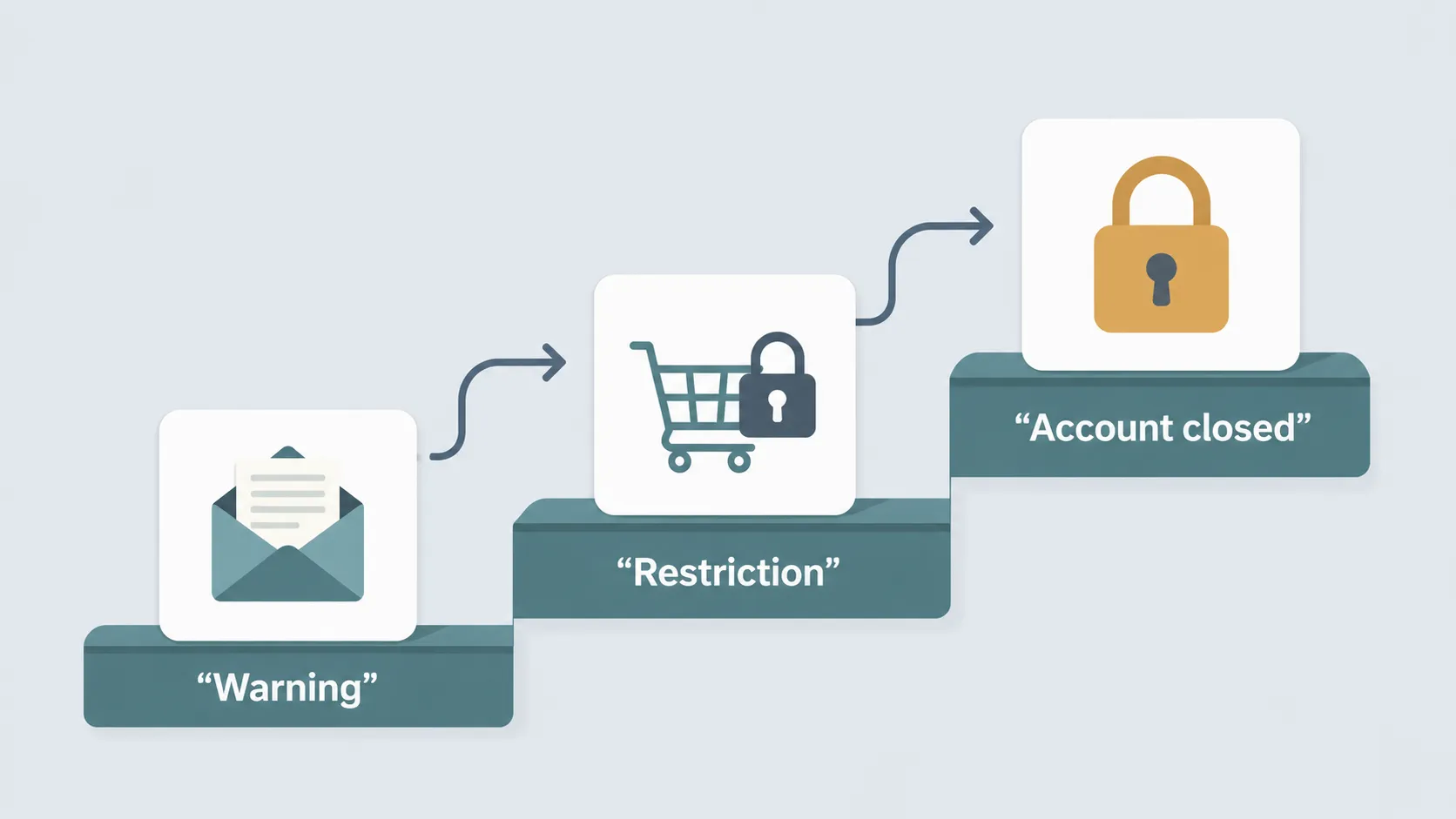
The ladder generally runs in three stages:
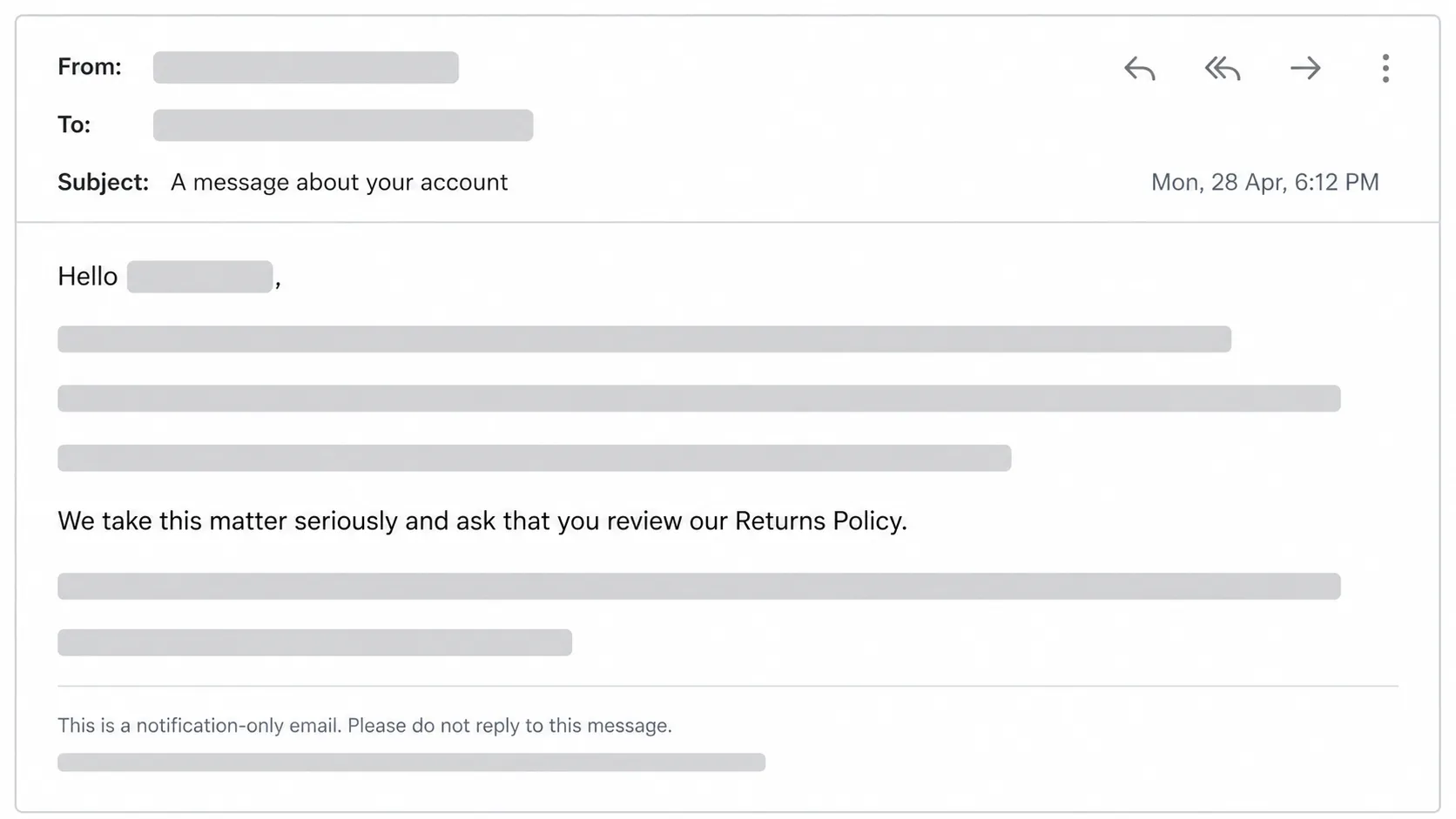
Warning email: a notice that Amazon has observed an unusually high rate of problems with your orders
Restriction: narrowed privileges, sometimes described by shoppers as being “restricted to digital purchases” only
Suspension or ban: account closure in persistent abuse cases, evaluated individually
The myth worth busting is that a high rate by itself gets you banned. In practice, the risk signals, repeated INR claims, reason mismatches, and refunds on most of your spend, drive closures far more than a clean-but-high return percentage.
Whether Amazon actually pulls the trigger is its own topic, and we cover whether Amazon bans frequent returners in detail separately.
My warning email is the clearest window I have into this stage. It stated that Amazon evaluates each account individually and may close it, and it named no number at all, which is exactly why I stopped fearing a hard limit.
The restriction stage is real but under-documented. That “restricted to digital purchases” state shows up in accounts like the one described in a JustAnswer thread, and it is usually recoverable, unlike a full ban.
Most warnings never reach that stage if behavior corrects.
What Amazon Can and Can’t See About Your Returns
Amazon’s visibility stops at the edge of your own Amazon account. It can see your Amazon orders, returns, selected reasons, refund values, and “item not received” claims, but it cannot see the returns you make at Walmart or Target, and it does not hold the in-store record other retailers keep on you.
This boundary matters because The Retail Equation, the in-store service, keeps its data per retailer rather than pooling it into one cross-store profile.
Amazon can see | Amazon can’t see |
|---|---|
Your Amazon orders and returns | Your returns at other retailers |
Reasons and refund values on your account | Your in-store return-score record elsewhere |
Your “item not received” claim history | What a store cashier sees at the register |
Condition of items returned to Amazon | Your behavior on accounts that are not yours |
When I requested my own report, it was tied to a single retailer’s returns, and my Amazon activity was not on it, which is the practical proof that these systems do not merge. The Retail Equation’s own FAQ states it does not share one retailer’s specific transaction information with other retailers, so the cross-store picture is genuinely fragmented.
That broader cross-retailer question is a bigger topic, and it is worth seeing how retailers log your return history across stores.
An honest limit: Amazon does not publish exactly how its internal signals are weighted, so some of the logic here is reconstructed from reporting, seller documentation, and first-hand experience rather than an official rulebook.
Frequently Asked Questions
Does Amazon keep track of how many returns you make?
Yes, Amazon tracks both the count and, more importantly, your return rate as a percentage of orders. In my own 14-month log, a steady 6% rate drew no attention, while two months near 15% triggered a warning, which suggests the ratio matters more than any single tally.
Does Amazon have a return score?
No, Amazon does not publish a consumer return score. The real “return score” belongs to the in-store ID-scan system other retailers use at the register, run by a company the CFPB lists as a consumer reporting firm, so Amazon’s own monitoring is a set of internal risk signals rather than a number you can look up.
Does Amazon check serial numbers on returns?
Amazon scans a barcode on nearly every return, but full serial-number and authenticity checks are reserved mainly for high-value electronics. For third-party purchases, the seller rather than Amazon usually handles the serial verification.
How many returns is too many on Amazon?
There is no published hard limit, but the widely cited guideline is a return rate near 10% of orders, or roughly 5 to 10 returns a month. It is evaluated case by case, and honest reasons carry far more weight than raw volume.
Can Amazon ban you for too many returns?
Yes, but bans are signal-driven and staged, moving from a warning to a restriction before any closure. Rate alone rarely does it; repeated claims, reason mismatches, and refunds on most of your spend matter more, which we cover in depth in the dedicated ban guide.
Does Amazon track “item not received” claims?
Yes, the frequency of “item not received” claims is one of the account signals Amazon watches most closely, because a pattern of them is a classic abuse marker. A genuine one-off claim is not a problem; a habit of them escalates quickly.
The Bottom Line for Frequent Returners
So does Amazon keep track of returns? Yes, but as a set of internal risk signals, not a public score and not the in-store system that flags you at the register elsewhere.
Once you see it that way, the anxiety drains out and a few simple habits keep you clear. Return for genuine reasons, keep your rate reasonable rather than chasing a magic number, and document defective or mis-shipped items with a quick photo.
After my own warning, I dropped back under 10% and the account stayed perfectly fine, which told me the fix was behavior, not luck. The monitoring is real, but for anyone returning honestly, it is entirely manageable.
Read it your way
Short on time? Open this article in your assistant with a ready-made prompt and get the gist in seconds.
Found this useful? Make us a preferred source so we show up in your Google results.
Keep reading
Related articles
Eligibility & Conditions
What Stores Use The Retail Equation? (2026, Best Buy Out)
See which stores use The Retail Equation in 2026: a verified status list of who still tracks returns, who dropped it (Best Buy, 2019), and who never did.
Eligibility & Conditions
What Is The Retail Equation? How It Scores Your Returns
Denied a return? The Retail Equation scores your returns and can approve, warn, or deny them. See how it works, read a real RAR, and dispute errors
Eligibility & Conditions
Sephora Return Limit: No Set Number, 30-Day Window & TRE Tracking
Sephora has no set return limit, but a 30-day window and Retail Equation tracking mean too many returns can trigger a 365-day ban. Here’s the real rule.
Eligibility & Conditions
Do Stores Track Your Returns? How the System Works (2026)
Yes, most stores track and score your returns. See how the system works, what they log, and how to request your own Return Activity Report.
The discussion
Comments
Every comment is reviewed before it goes live.