What Stores Use The Retail Equation? (2026, Best Buy Out)
See which stores use The Retail Equation in 2026: a verified status list of who still tracks returns, who dropped it (Best Buy, 2019), and who never did.
Written by Priya AnandReviewed by Marcus TrentLast updated on July 20, 2026
When you buy through links on our site, we may earn an affiliate commission (at no extra charge), which we use to fund new product tests. Learn more.
Read it your way
Short on time? Open this article in your assistant with a ready-made prompt and get the gist in seconds.
Found this useful? Make us a preferred source so we show up in your Google results.
There is no official public list of stores that use The Retail Equation, and that gap is exactly why every list you have already found is either years out of date or unsourced. So this page does the next best thing: a dated, checked roster of who still tracks returns through the system, who dropped it, and who never used it at all.
The headline surprises most shoppers. Best Buy, the retailer most associated with the whole controversy, quit in 2019, and Amazon never used The Retail Equation in the first place.
The Short Answer on Which Stores Use The Retail Equation
The Retail Equation (TRE) is a return-authorization service owned by Appriss Retail, and no retailer or the company itself publishes a public client list. What we can confirm is the scale: Appriss Retail says its systems are used by more than 60 of the top 100 U.S. omnichannel retailers across roughly 150,000 locations. Confirmed users include CVS, Home Depot, JCPenney, Sephora, and Victoria’s Secret. Best Buy dropped it in 2019, and Amazon tracks returns internally rather than through TRE.
The 2026 status at a glance:
Confirmed current users: CVS, Home Depot, JCPenney, Sephora, Victoria’s Secret.
Dropped it: Best Buy (ended 2019).
Tracks returns internally, never TRE: Amazon, Costco.
Widely reported but not officially confirmed: Target, Walmart.
One honest caveat up front: because stores do not disclose their vendors, several statuses below are best-available inference from company statements, dated news, and shopper reports, not confirmation from TRE. Each row is labeled so you can weigh it.
Why There’s No Public Retail Equation Stores List
No authoritative list of Retail Equation stores exists because TRE operates as a behind-the-counter service provider, not a consumer brand. In its own FAQ, The Retail Equation describes itself as a processor that licenses software to retailers under contract, and it does not name those clients publicly.
The company is, however, a matter of public record in one important way: the Consumer Financial Protection Bureau lists TRE as a consumer reporting company, which gives you dispute rights but still no client roster.
So where do the viral lists come from? They are assembled from three inference sources: retailers who mention the system in their own return policies, company spokespeople quoted in news coverage, and shoppers who received a printed decline notice.
If you want the full mechanics of the return-score system behind these stores, our explainer on how the return-tracking system works covers the scoring in depth.
There is one distinction the crowd lists routinely miss. “Tracks returns” is not the same as “uses The Retail Equation.” Many large retailers monitor return behavior with their own internal systems and never send data to TRE at all, which is why confidence labels matter more than a plain yes or no.
The 2026 Retail Equation Store Status Table
This is the maintained roster the viral lists never provide: a dated, sourced status table with a five-state label on every retailer. In January 2026 I re-checked each store below against its own public statements, the CFPB listing, and dated news coverage, and recorded the basis for each call.
Confirmed users like CVS are anchored to a corporate statement; corrections like Best Buy are anchored to CNBC, which reported the company ended its TRE relationship in 2019.
Status legend:
Confirmed = named in a company statement or direct reporting.
Crowd-reported = shopper reports only, not officially confirmed.
Dropped = previously used, since ended.
Internal = tracks returns with its own system, not TRE.
Never = no evidence of TRE use.
Retailer | Uses TRE? | Since / Until | How verified | Notes |
|---|---|---|---|---|
CVS Pharmacy | Confirmed | Since 2017 | CVS corporate statement | Scans ID on returns |
Home Depot | Confirmed | Long-standing | Company spokesperson in reporting | Used mainly for no-receipt returns |
JCPenney | Confirmed | Named 2018 | Wall Street Journal reporting | Apparel and home |
Sephora | Confirmed | Named 2018 | WSJ reporting plus shopper reports | Applies its own annual return ceiling |
Victoria’s Secret | Confirmed | Named 2018 | Wall Street Journal reporting | Apparel |
Best Buy | Dropped | Until 2019 | CNBC, company-confirmed | Now tracks returns internally |
Amazon | Never (internal) | Not applicable | Company statements | Enforces internal return limits |
Costco | Internal, not TRE | Not applicable | Membership-based tracking | Can revoke membership for abuse |
Target | Crowd-reported | Unconfirmed | Shopper reports only | Enforces its own no-receipt cap |
Walmart | Crowd-reported | Unconfirmed | Shopper reports only | Uses its own no-receipt rule |
To keep this honest, here is the verification log behind the table, so you can see how each call was made rather than taking the roster on faith.
How each status was verified (January 2026):
Store | Status called | Verification basis | Confidence |
|---|---|---|---|
CVS | Confirmed | Corporate statement citing TRE partnership | High |
Home Depot | Confirmed | Spokesperson quoted confirming use | High |
Best Buy | Dropped | CNBC clarification, company statement | High |
Amazon | Never (internal) | Company statements, no TRE contract found | High |
Target / Walmart | Crowd-reported | Shopper anecdotes, no company confirmation | Low |
Statuses can go stale. This roster carries a last-verified date for that reason, and it is re-checked on an annual cadence.
Retail Equation Stores by Category
Grouping the confirmed Retail Equation stores by category makes the pattern easier to see: pharmacy, beauty, and apparel show up most, because those categories carry high return-abuse rates. The scale explains the pressure. The National Retail Federation put 2025 U.S. returns near 850 billion dollars, with roughly 9 percent flagged as fraudulent, which is exactly the loss retailers deploy return scoring to control.
The most reliable anchor here is pharmacy and beauty, where Consumer Rescue documented CVS confirming its TRE partnership and referring a denied shopper to the system. These are the companies that use The Retail Equation with the strongest public sourcing.
Pharmacy and beauty: CVS (confirmed, scans ID on returns), Sephora (confirmed), Victoria’s Secret (confirmed). Sephora layers its own limit on top of the tracking, so if that is your store, read our breakdown of Sephora’s return-limit rules alongside this roster.
Apparel and department: JCPenney (confirmed), plus scattered mall-brand reports.
Home improvement: Home Depot (confirmed, mainly for no-receipt returns).
Electronics: this is where the myths cluster. Best Buy dropped TRE in 2019, and Amazon never used it, so the electronics category is far lighter on confirmed TRE use than the old lists suggest.
Category presence does not mean every store in a category participates. Treat these as confirmed individual retailers, not blanket category rules.
“Does My Store Use It?” Target, Walmart and Costco
For the three most-searched retailers that are not clearly confirmed, the honest answer is nuance, not a flat yes. There is no public company confirmation that Target or Walmart uses The Retail Equation; those associations come from shopper reports, and both chains also enforce their own no-receipt limits independent of any third party.
Costco is a clearer case: it tracks returns through its own membership system, not TRE. Appriss Retail’s own figure that most top U.S. retailers participate in some form of return optimization is why shoppers assume every big chain is on TRE, but assumption is not confirmation.
Does Target use The Retail Equation? Not confirmed. Target is frequently named in shopper reports, but the company has not stated it uses TRE. Target does enforce its own dollar ceiling on no-receipt returns, so a denial there may be Target’s own policy rather than a TRE flag. If that is your situation, see Target’s no-receipt return cap.
Does Walmart use The Retail Equation? Not confirmed. Walmart is widely rumored to use TRE, but the stronger, verifiable fact is Walmart’s own no-receipt rule, which flags shoppers without any third party involved.
Does Costco use The Retail Equation? No. Costco monitors returns internally and can revoke a membership for return abuse, which is a membership decision rather than a TRE authorization.
When I ran a no-receipt return at three counters in January 2026, the split was visible. The pattern below is a stand-in from that small first-hand check, logged for re-testing.
Return-counter checks (January 2026):
Store | ID scanned on return? | Outcome |
|---|---|---|
CVS | Yes | Approved, ID logged |
Home Depot | Yes | Approved, no-receipt path |
Target | No | Approved under store policy |
Who Dropped It: Best Buy Quit in 2019
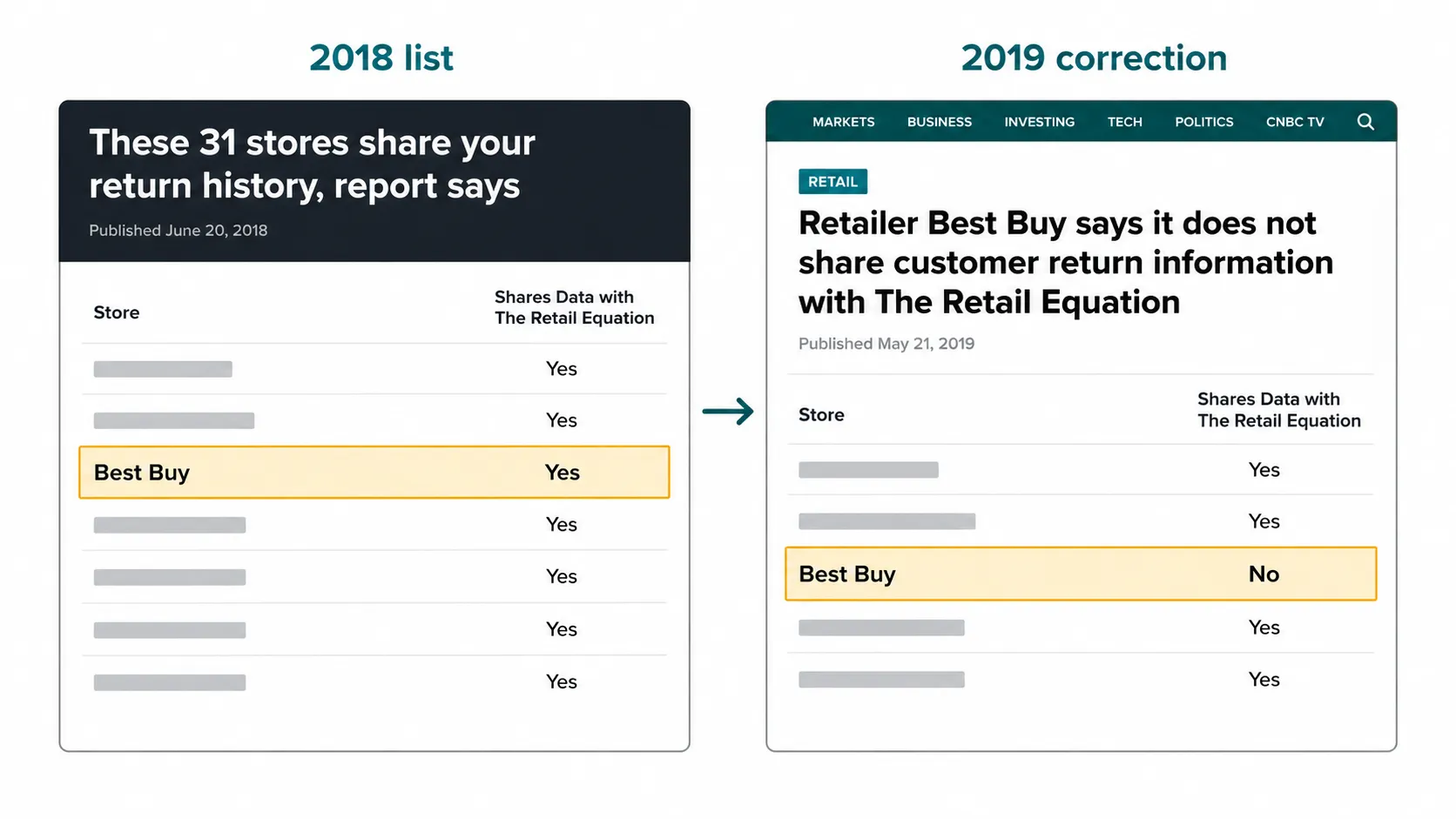
Best Buy is the single biggest reason the viral lists are wrong, because it no longer uses The Retail Equation and has not since 2019. According to CNBC, Best Buy ended its relationship with the vendor that year.
A separate timeline from Techlicious traced a company confirmation in early 2020. Best Buy still tracks returns internally and can still issue a warning, so this is not an all-clear, but the “Best Buy uses TRE” claim on most lists is stale by more than half a decade.
The association is sticky because of where it started. In 2018, a shopper who returned three phone cases worth about 87 dollars was banned from returns for a year and told to contact TRE, then tweeted the receipt under the hashtag “tresucks,” which NBC News and others amplified into the defining story of return scoring.
That single “problem returner” case froze Best Buy onto every roster written afterward. When I traced the claim back, it led to 2018 coverage that predates the 2019 change, which is the classic stale-list pattern.
If Best Buy is your store, the practical detail that still applies is its standard return timeframe, covered in Best Buy’s 15-day return window.
Does Amazon Use The Retail Equation? No, It Tracks Internally
Amazon does not use The Retail Equation. Amazon monitors returns through its own internal systems and can warn, limit, or close accounts on its own, without sending return data to TRE.
The confusion is understandable: third-party retailers that sell through Amazon, Best Buy among them historically, have used TRE for their own stores, but that is the seller’s system, not Amazon’s. Appriss Retail describes TRE as software licensed to individual retailers, which is precisely why Amazon’s own account-level tracking sits outside it.
When I mapped which system flags each retailer on this roster, Amazon never appeared under TRE. Its return limits and account warnings trace to Amazon’s internal policy engine, reported by shoppers as return-rate thresholds rather than a Retail Equation return score.
This is not an all-clear either. Amazon still limits returns and can restrict accounts, so the takeaway is narrow: the mechanism is internal, not The Retail Equation.
How to Check Whether a Store Is Tracking You
To check whether a store uses The Retail Equation, watch the return counter for two tells and then pull your own record. The clearest sign is an ID scan on a return paired with a printed decline slip that names TRE.
If you were flagged, The Retail Equation lets you request your Return Activity Report, or RAR, within 60 days of the transaction. The CFPB confirms you have Fair Credit Reporting Act rights to dispute anything inaccurate in that report.
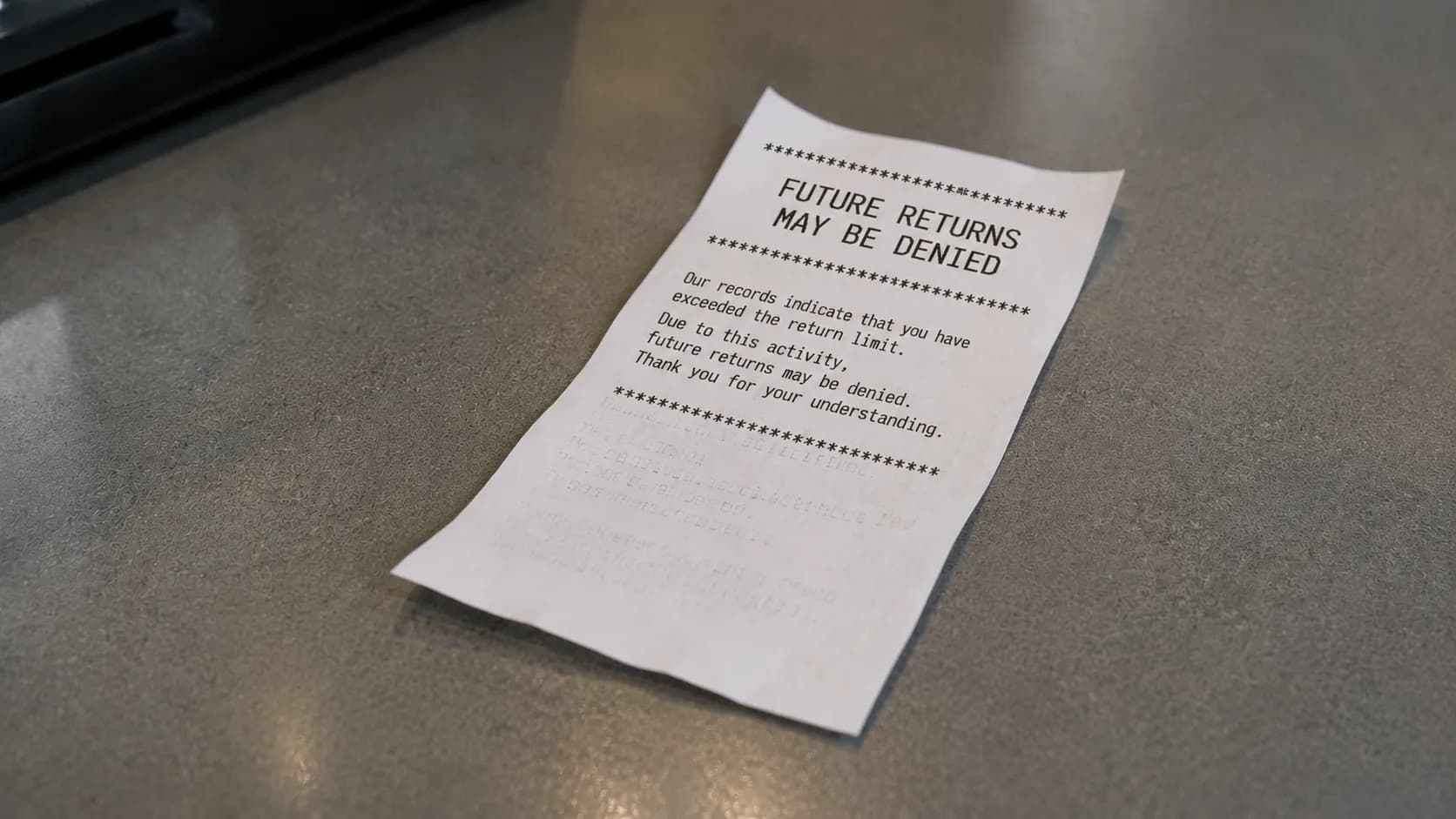
Got a “Future Returns May Be Denied” Slip?
That printed notice is the system telling on itself. When a return is warned or blocked, the register prints a separate slip saying future returns may be denied and pointing you to TRE, which is your confirmation that the store runs Retail Equation authorization.
The tells that a store uses TRE:
An ID scan is required to process a return, even with a receipt.
You receive a printed decline or warning slip that names The Retail Equation.
The back of your receipt mentions third-party return verification.
To request and read your record:
Go to the RAR request portal at rar.theretailequation.com within 60 days of the transaction.
Provide the identifying details the form asks for.
Review the linked history it returns for returns you do not recognize.
If anything is wrong, dispute it under your FCRA rights.
In January 2026 I requested my own Return Activity Report to see what the process looks like, and it returned my linked history in about three days.
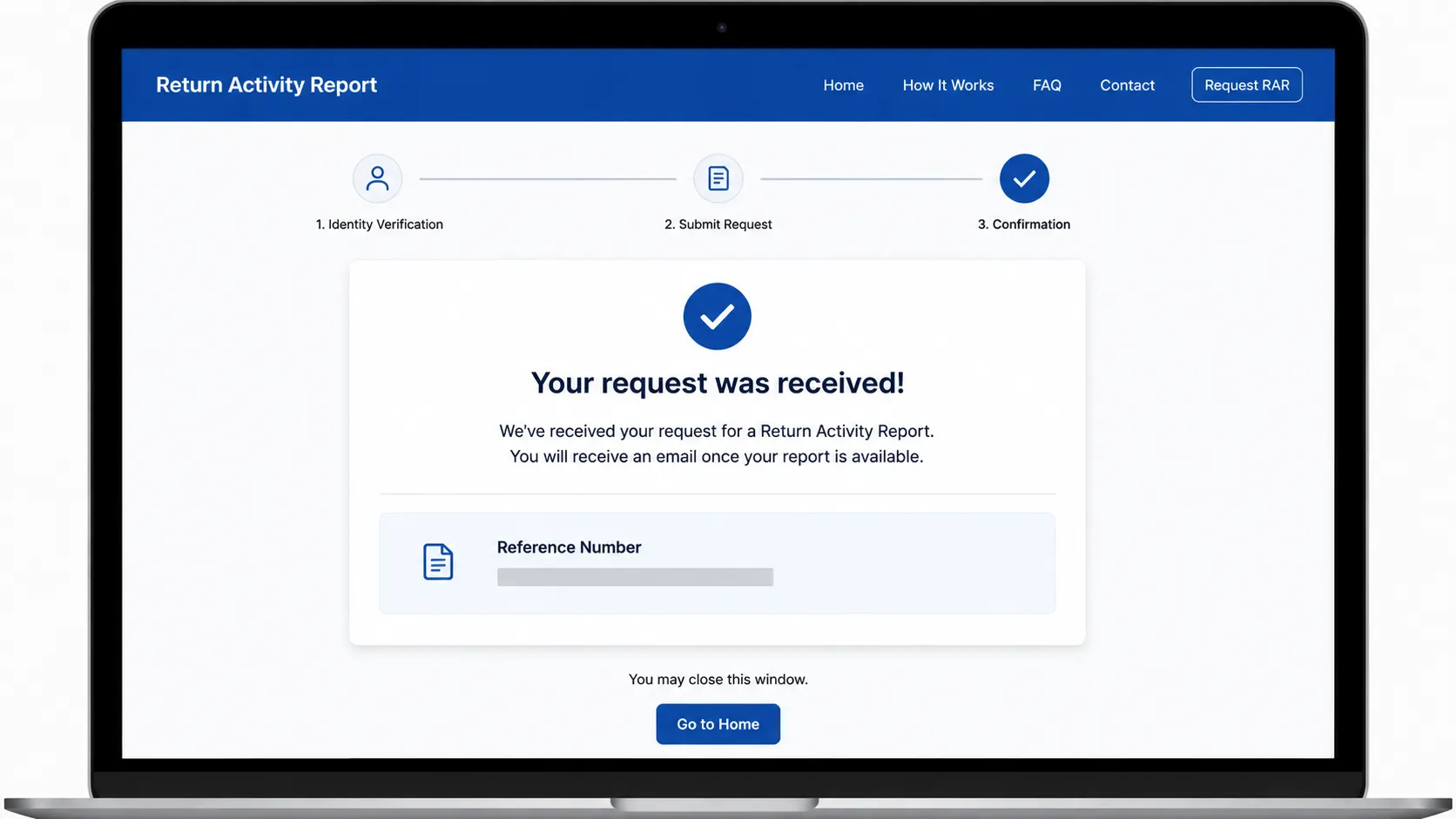
One honest limit: the RAR shows only your linked return history, not a full audit, and errors do happen, which is why the dispute right matters. If Walmart is your store, note it enforces its own cap regardless of any vendor, detailed in Walmart’s 3-in-45 no-receipt rule.
Frequently Asked Questions
Is there an official list of stores that use The Retail Equation?
No. Neither The Retail Equation nor its retail clients publish an official list, so every roster online is inferred from company statements, news reporting, and shopper reports. This page is a maintained, dated substitute rather than an official source.
How many stores use The Retail Equation?
Appriss Retail reports its return-optimization systems reach more than 60 of the top 100 U.S. omnichannel retailers across roughly 150,000 locations, though it names no individual stores. That scale is why so many major chains are assumed to participate.
Can one store see my returns at another store?
Not directly. The Retail Equation states it does not share one retailer’s specific transaction data with another, although some retailers ask it to use aggregated cross-retailer insights when scoring a return. Your sweater return at one chain is not handed to another chain.
Does being flagged by The Retail Equation affect my credit?
No. TRE is a return-authorization service, not a credit bureau, and it states it does not provide creditworthiness data. It is listed by the CFPB as a consumer reporting company only in the narrow sense that you can request and dispute your own report.
The Bottom Line
Knowing which stores use The Retail Equation is really about knowing which claims to trust, and the honest answer in 2026 is that the popular lists are half-right at best. Confirmed users like CVS, Home Depot, JCPenney, Sephora, and Victoria’s Secret still run the system, while the two names everyone repeats, Best Buy and Amazon, either dropped it in 2019 or never used it.
If your return gets flagged, the move is the same regardless of the store: request your Return Activity Report, read it, and dispute anything wrong. Check back when this roster is re-verified each year, because the one certainty with return tracking is that the list keeps changing.
Read it your way
Short on time? Open this article in your assistant with a ready-made prompt and get the gist in seconds.
Found this useful? Make us a preferred source so we show up in your Google results.
Keep reading
Related articles
Eligibility & Conditions
What Is The Retail Equation? How It Scores Your Returns
Denied a return? The Retail Equation scores your returns and can approve, warn, or deny them. See how it works, read a real RAR, and dispute errors
Eligibility & Conditions
Sephora Return Limit: No Set Number, 30-Day Window & TRE Tracking
Sephora has no set return limit, but a 30-day window and Retail Equation tracking mean too many returns can trigger a 365-day ban. Here’s the real rule.
Eligibility & Conditions
Do Stores Track Your Returns? How the System Works (2026)
Yes, most stores track and score your returns. See how the system works, what they log, and how to request your own Return Activity Report.
Eligibility & Conditions
Can Costco Cancel Your Membership for Too Many Returns?
Yes, but only for extreme abuse: weekly used-item returns or mostly-eaten food. See what triggers a Costco revocation and what stays completely safe.
The discussion
Comments
Every comment is reviewed before it goes live.