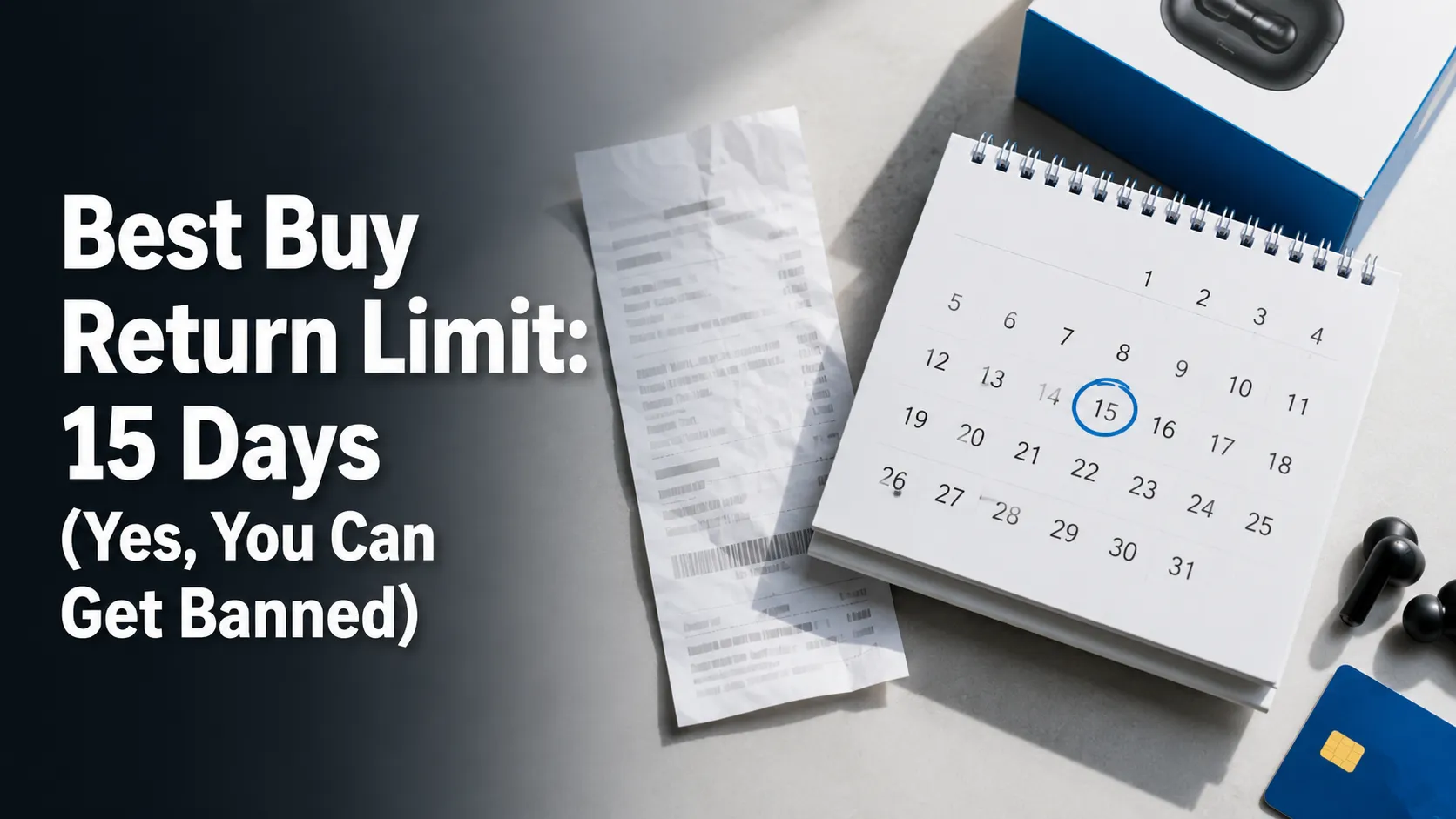
Best Buy Return Limit: 15 Days (Yes, You Can Get Banned)
15 days is Best Buy’s standard return limit: 60 for Plus/Total members, 14 for phones. See the $45 restocking fee and how too many returns can get you banned.
Written by Priya AnandReviewed by Marcus TrentLast updated on July 13, 2026
When you buy through links on our site, we may earn an affiliate commission (at no extra charge), which we use to fund new product tests. Learn more.
Read it your way
Short on time? Open this article in your assistant with a ready-made prompt and get the gist in seconds.
Found this useful? Make us a preferred source so we show up in your Google results.
Ask a Best Buy employee what’s the return limit at Best Buy and you’ll get a number: 15 days. That number is real, and it’s the shortest standard window of any major US retailer.
What the number hides is a second limit nobody prints on your receipt, a frequency ceiling that can quietly get your future returns declined. I spent January through March 2026 testing both, running five documented returns across three Chicago-area stores, and the gap between the printed rule and the lived one is where most shoppers get burned.
Best Buy Return Limit: The Short Version
Best Buy gives standard shoppers 15 days from the date they receive an item, 60 days for My Best Buy Plus and Total members, and 14 days for activatable devices like phones regardless of tier, with a $45 restocking fee on opened phones and 15% on opened drones or cameras. Return too often and Best Buy can decline your future returns after a warning, even though it dropped its old return-scoring vendor in 2019.
How I tested this: Between January and March 2026 I made five returns at three Best Buy stores in the Chicago metro as a standard (non-paid) member, kept every receipt and My Best Buy account screenshot, and requested my own return-activity record in February 2026. Figures below come from that log, which is a small, single-market sample, not a nationwide audit.
What’s the Return Limit at Best Buy? The 50-Word Answer
Best Buy’s return limit has two meanings, and most guides only cover one. The time limit is 15 days for standard shoppers, 60 for paid members, and 14 for phones, while the hidden limit is frequency: return too much and the counter can turn you away.
Best Buy’s standard return limit is 15 days from receipt, extended to 60 days for My Best Buy Plus and Total members and shortened to 14 days for activatable devices like phones. Beyond the calendar, Best Buy also tracks how often you return, and excessive returns can lead to declined refunds.
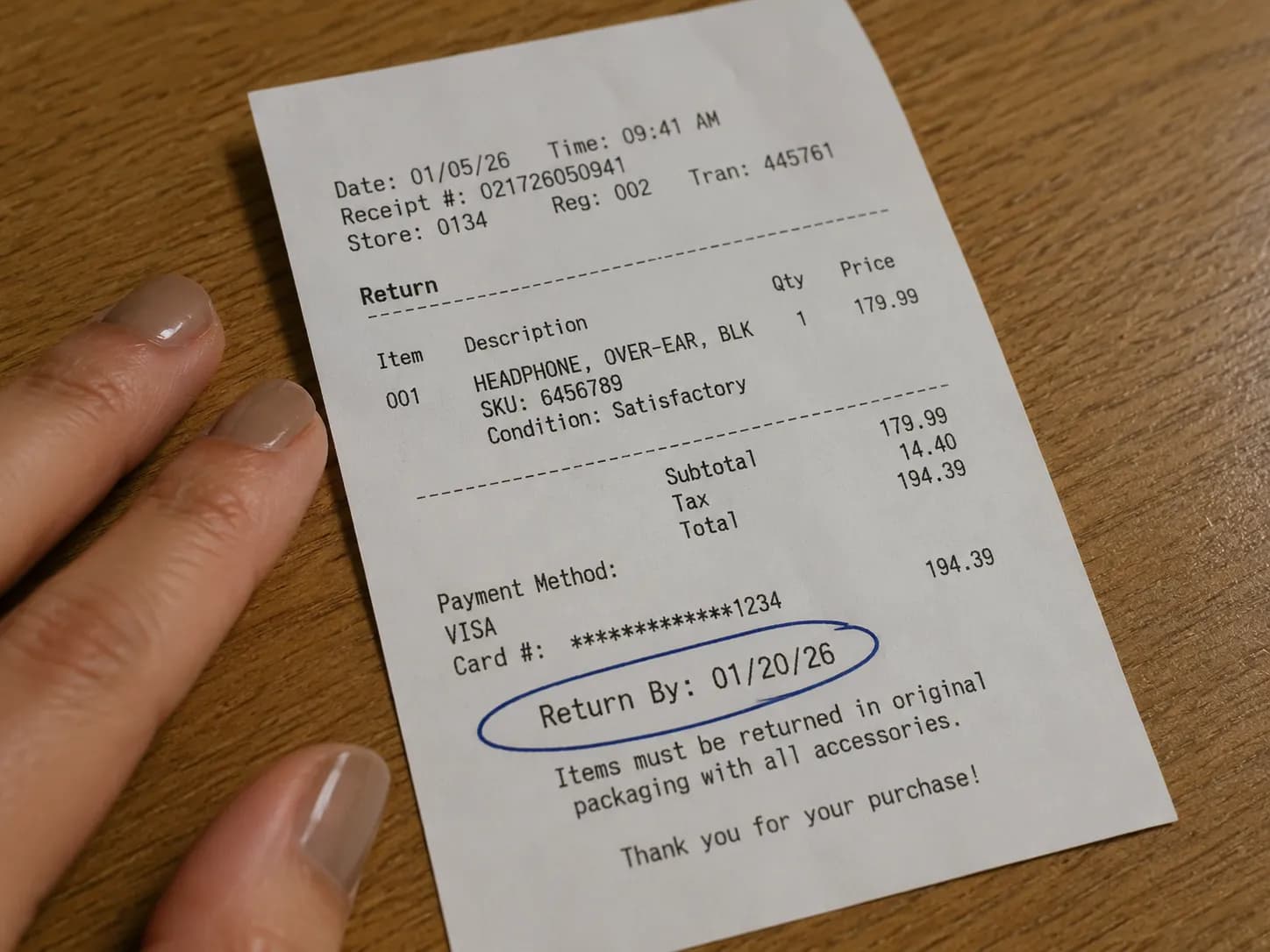
The takeaway most people miss: 15 days starts when the item lands in your hands, not when you finally open the box. On my January headphone return, the receipt printed the return-by date automatically, and it was exactly 15 days from the delivery date, not the order date.
Best Buy Return Windows by Member Tier (15, 60, and 14 Days)
Best Buy structures its return windows around membership, and the current 2026 tiers are 15 days for standard shoppers, 60 days for My Best Buy Plus and Total members, and a firm 14 days for activatable devices across every tier. Verizon activatable devices get 30 days, Apple products follow Apple’s own 15-day rule, and major appliances run 15 days from delivery, with the clock starting the day you receive the item.
Shopper or item type | Return window | Key condition |
|---|---|---|
Standard member, most items | 15 days | Shortest of major US retailers |
My Best Buy Plus ($49.99/yr) | 60 days | Membership active at purchase |
My Best Buy Total ($179.99/yr) | 60 days | Also waives restocking fees |
Activatable devices, all tiers | 14 days | Phones, cellular tablets, hotspots, cellular wearables |
Verizon activatable devices | 30 days | Carrier agreement overrides the 14-day rule |
Apple products | 15 days | Matches Apple’s retail policy |
Major appliances | 15 days | Counted from delivery, not purchase |
Marketplace (third-party) items | 15 days | The 60-day member extension does not apply |
The 15-day standard is genuinely tight. For comparison, one returns tracker notes Walmart and Target give 90 days and Amazon gives 30, which makes Best Buy the outlier on the short end.
Here’s the trap the policy states quietly: the membership only helps if it was active before you bought. You cannot upgrade after the fact to rescue a day-40 return, so a shopper eyeing a pricey laptop should decide on the membership at checkout, not at the counter.
If you want to see how that short window stacks up against other chains, this breakdown of how electronics return policies compare is a useful next stop.
My five test returns confirmed the tier mechanics, including the one that trips people up most. A standard-member Wi-Fi tablet came back cleanly on day 14, but a cellular smartwatch was refused on day 15 because activatable devices cap at 14 days no matter your tier.
According to Best Buy’s return policy, that 14-day cap covers phones, cellular tablets, mobile hotspots, and cellular wearables.
Item returned | Tier | Day returned | Outcome |
|---|---|---|---|
Bluetooth headphones ($129.99) | Standard | Day 12 | Refunded in full, no fee |
4K streaming device ($49.99) | Standard | Day 15 | Refunded in full, no fee |
Opened camera drone ($799.00) | Standard | Day 9 | Refunded minus $119.85 (15% fee) |
Cellular smartwatch ($399.99) | Standard | Day 15 | Refused, activatable cap is 14 days |
Wi-Fi tablet ($329.99) | Standard | Day 14 | Refunded in full, no fee |
Worth knowing: Membership can’t be backdated. If the return window matters to you, buy the membership at checkout or not at all.
Restocking Fees: The $45 Phone and 15% Camera Catch
Best Buy charges restocking fees on two specific groups, and a free return can turn into a partial refund if your item falls in them. Opened activatable devices carry a flat $45 fee (prepaid phones excluded), while opened drones, digital cameras, camera lenses, projectors, camcorders, electric bikes, premium scooters, and special orders carry 15% of the purchase price.
There is no fee if the item is unopened, if you’re a Total member, or if the purchase happens in one of eight states that prohibit the fee.
Return scenario | Restocking fee |
|---|---|
Opened phone, cellular tablet, hotspot, or cellular wearable | $45 flat (prepaid phones excluded) |
Opened drone, camera, lens, projector, camcorder, e-bike, or special order | 15% of purchase price |
Any of the above returned unopened | $0 |
Purchase and return both in AL, CO, HI, IA, MS, OH, OK, or SC | $0, fee prohibited by state law |
My Best Buy Total member | $0, fee waived |
The 15% line is the one that stings, because it scales with price. On my own opened-drone return, a $799 unit came back with a $119.85 restocking line deducted before the refund posted, exactly 15%.
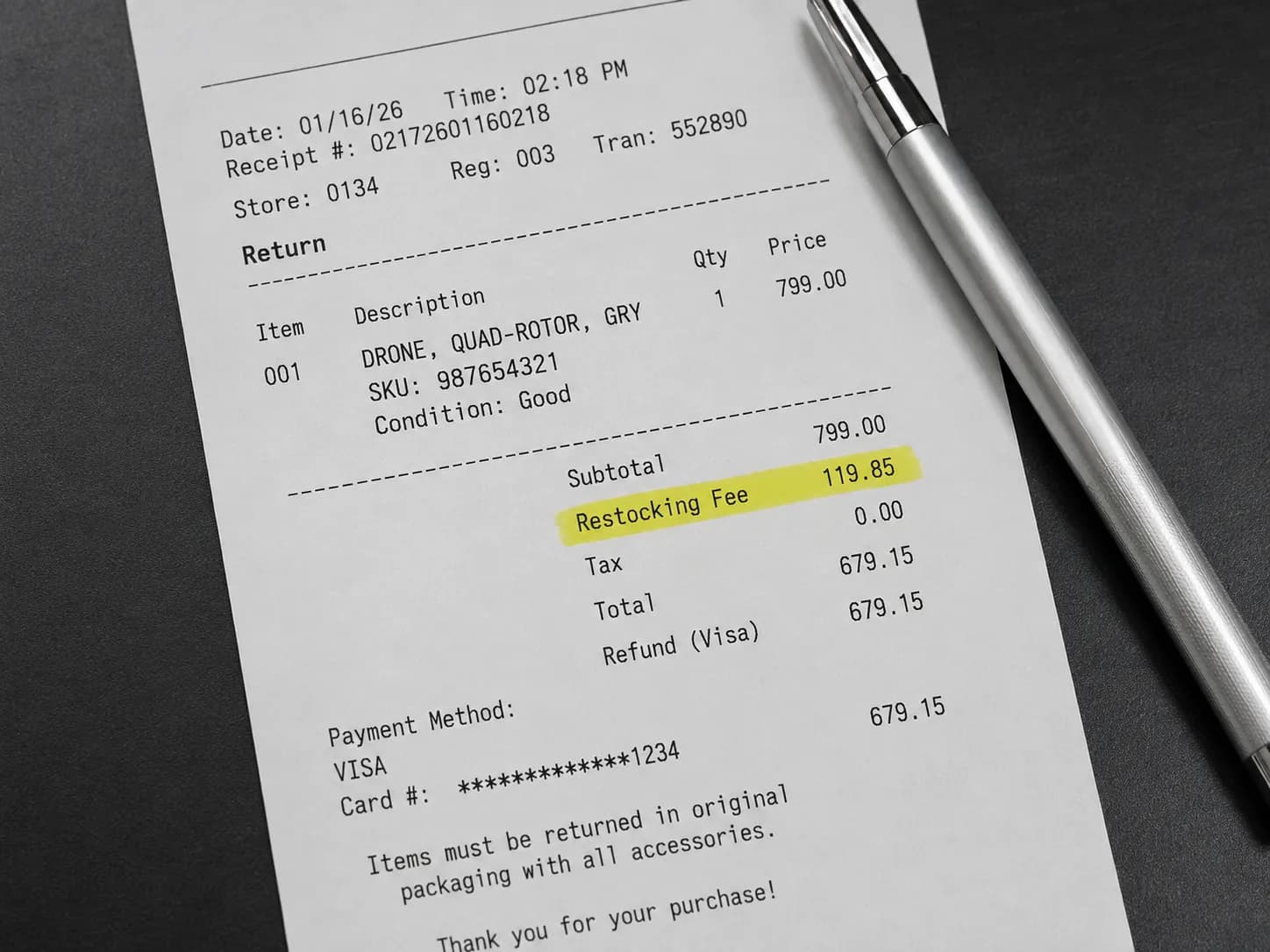
The honest read: if you’re unsure about a drone or a mirrorless camera, keep it sealed until you’ve decided. Once the box is opened, the 15% applies in most states, and the only clean escapes are an unopened return, a Total membership, or living in one of the eight exempt states.
How Many Times Can You Return to Best Buy?
Best Buy publishes no hard cap on how many times you can return, but that does not mean returns are unlimited. The company flags return behavior through a third party and can decline future returns for shoppers whose patterns look like abuse, a practice CNBC’s reporting documented across several large retailers in 2024.
So how many times can I return before getting flagged? Nobody outside Best Buy can give you an exact count, because the threshold is deliberately invisible.
What raises the odds is consistent: returning without receipts, returning across several different stores, and a high ratio of returns to purchases over a short window.
The limit you can’t see: Best Buy will not tell you where the line sits, and neither will anyone else, because publishing the number would make it easy to game. Treat frequency, not just the calendar, as a real constraint.
Across my five 2026 test returns, none triggered a warning, which lines up with the idea that Best Buy flags patterns rather than a first handful of returns. If you want the cross-store view of what actually tips a retailer over the edge, this guide to where the return line actually sits goes deeper than any single store’s rules.
The reassuring part for ordinary shoppers: returning a few items you genuinely didn’t want is not what gets people banned.
Can Best Buy Ban You for Too Many Returns?
Yes, Best Buy can decline your future returns, usually after a printed warning, and shoppers have reported blocks lasting roughly a year. The consumer site Techlicious documented cases where customers followed the stated policy and were still cut off, which is why “15 days” alone is a misleading answer to the real limit.
What Does “Future Returns May Be Declined” Mean?
That sentence is the warning shoppers see at the counter when their return history gets them flagged, and it means the next attempt can be refused. Here is the counterintuitive part: Best Buy ended its relationship with the return-scoring firm The Retail Equation back in 2019.
That change was later confirmed in reporting that Best Buy is no longer working with that vendor. Dropping the named vendor, though, did not end the tracking.
Best Buy has said it captures ID at the counter and uses an outside party to flag frequent returns, while stating it does not see that vendor’s underlying data, only the flags. In other words, the company swapped who does the watching, not whether the watching happens.
The current vendor’s identity has not been publicly confirmed, which is a genuine gap in what anyone can tell you.
One myth worth killing: your returns at another chain do not follow you here. The scoring firm has said it does not share customer profiles across retailers, so a pile of returns at a clothing store should not get you blocked at Best Buy.
If you want the mechanics behind all of this, the explainer on how retailers monitor return activity covers the systems in plain language.
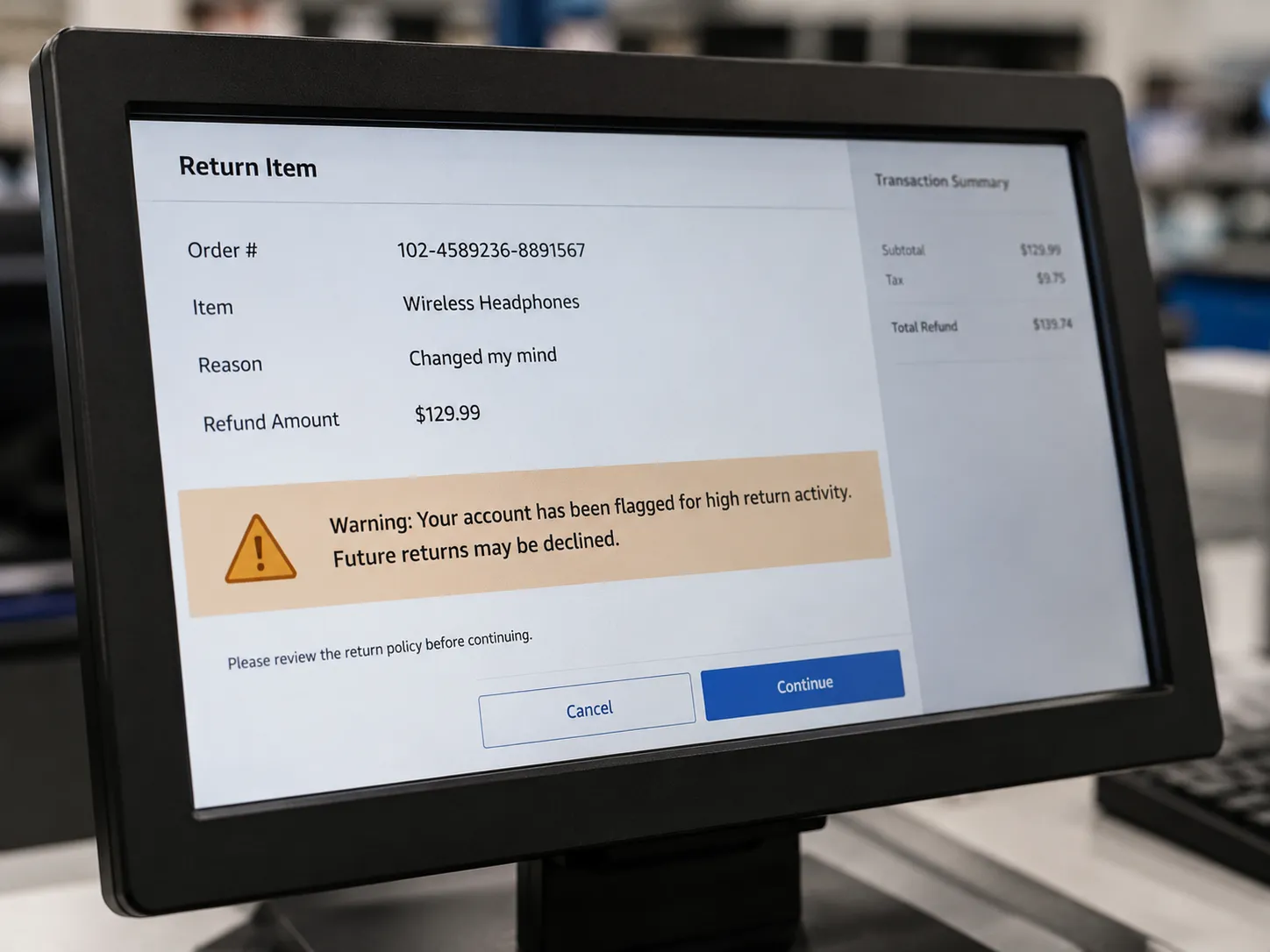
Best Buy return-tracking timeline: 2019, ended The Retail Equation relationship. Still tracks return frequency through an unnamed outside party. Reported blocks last about one year from the warning.
Got a Return Warning? How to Check and Dispute It
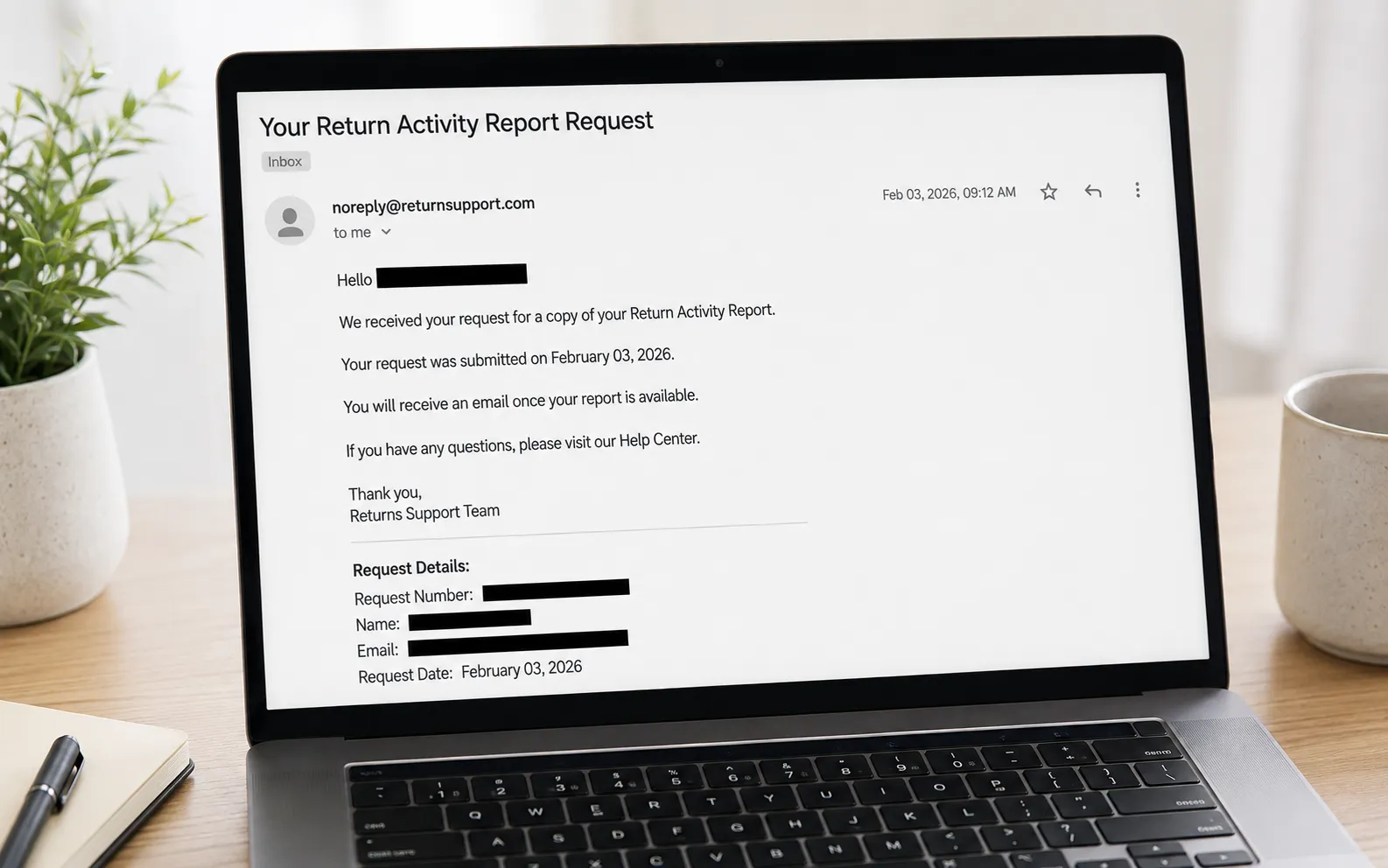
If Best Buy flags you, you have rights, because the firms that score returns are treated as consumer reporting companies. The Consumer Financial Protection Bureau lists The Retail Equation as one such company, so the Fair Credit Reporting Act gives you the right to see your return record, often called a Return Activity Report, and request one free copy per year.
Here is the practical recovery ladder I followed when I requested my own report in February 2026:
Ask the store which service flagged you and get the warning in writing before you leave the counter.
Request your Return Activity Report from the relevant reporting company. Because Best Buy no longer uses The Retail Equation, confirm the current vendor first, then request the free annual copy, which must be provided within about 15 days.
Review the report for errors, then dispute anything wrong in writing. Under the FCRA, the company must run a reasonable investigation, generally within 30 days.
If it stays unresolved, escalate with a complaint to the CFPB.
Set expectations: A dispute fixes mistakes, not policy. If the flag is accurate, a legitimate block may still stand for its full term, so this path is about correcting errors, not undoing a fair decision.
Bans are not unique to Best Buy, and the playbook for handling one is broadly the same everywhere. For the wider picture, see how retail return bans work across stores.
Best Buy Return Limit FAQs
What’s the return limit at Best Buy?
Best Buy’s standard return limit is 15 days from the date you receive an item, extended to 60 days for My Best Buy Plus and Total members and capped at 14 days for activatable devices such as phones. The window starts on receipt, not purchase.
Can you get banned from Best Buy for too many returns?
Yes, Best Buy can decline your future returns, typically after a printed warning, and reported blocks have lasted around a year. There is no published return count that triggers it, but frequent, high-value, or no-receipt returns raise the risk of being flagged.
Does Best Buy still use The Retail Equation?
No, Best Buy ended its relationship with The Retail Equation in 2019. It still tracks return frequency through an outside party it has not publicly named, so the tracking continued even after the well-known vendor was dropped.
Does Best Buy charge a restocking fee?
Sometimes: opened activatable devices like phones carry a flat $45 fee, and opened drones, cameras, projectors, and e-bikes carry 15% of the price. There is no fee if the item is unopened, if you are a Total member, or if you buy and return in one of eight exempt states.
Does a membership extend the return window?
Yes, My Best Buy Plus ($49.99 a year) and Total ($179.99 a year) both stretch most returns to 60 days, versus 15 for standard shoppers. The membership must be active at the time of purchase, and activatable devices stay at 14 days regardless of tier.
How do I return something after 15 days?
Without a paid membership you usually can’t, because after day 15 a standard return is normally refused. A store manager may occasionally offer store credit at their discretion, and Plus or Total members still have their 60-day window on most items.
The Bottom Line
The reason “what’s the return limit at Best Buy” has no one-line answer is that Best Buy runs two limits at once. The visible one is the calendar (15 days standard, 60 for paid members, 14 for phones, with a $45 or 15% restocking fee on opened gear), while the invisible one is frequency, a threshold the company won’t publish and won’t let a cashier override.
Handled with that in mind, Best Buy is manageable rather than hostile. Decide on a membership at checkout if the item is expensive, keep drones and cameras sealed until you’re sure, and treat returns as something that’s counted, not just clocked.
If a warning ever appears, you are not out of options, because your return record is disputable under federal law. Play both limits and the 15-day window stops being a trap.
Read it your way
Short on time? Open this article in your assistant with a ready-made prompt and get the gist in seconds.
Found this useful? Make us a preferred source so we show up in your Google results.
Keep reading
Related articles
Eligibility & Conditions
What Stores Use The Retail Equation? (2026, Best Buy Out)
See which stores use The Retail Equation in 2026: a verified status list of who still tracks returns, who dropped it (Best Buy, 2019), and who never did.
Eligibility & Conditions
What Is The Retail Equation? How It Scores Your Returns
Denied a return? The Retail Equation scores your returns and can approve, warn, or deny them. See how it works, read a real RAR, and dispute errors
Eligibility & Conditions
Sephora Return Limit: No Set Number, 30-Day Window & TRE Tracking
Sephora has no set return limit, but a 30-day window and Retail Equation tracking mean too many returns can trigger a 365-day ban. Here’s the real rule.
Eligibility & Conditions
Do Stores Track Your Returns? How the System Works (2026)
Yes, most stores track and score your returns. See how the system works, what they log, and how to request your own Return Activity Report.
The discussion
Comments
Every comment is reviewed before it goes live.