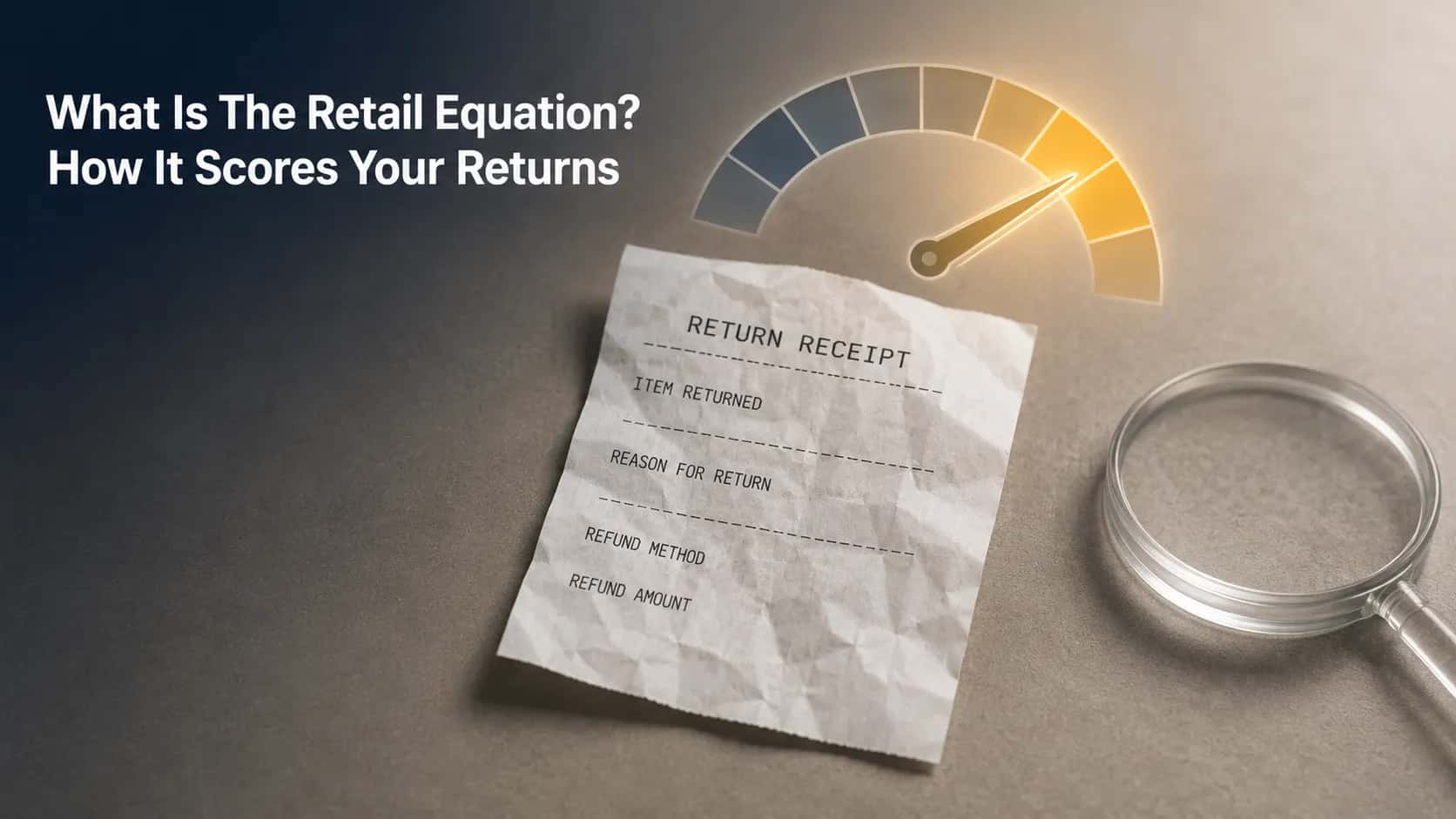
What Is The Retail Equation? How It Scores Your Returns
Denied a return? The Retail Equation scores your returns and can approve, warn, or deny them. See how it works, read a real RAR, and dispute errors
Written by Priya AnandReviewed by Marcus TrentLast updated on July 20, 2026
When you buy through links on our site, we may earn an affiliate commission (at no extra charge), which we use to fund new product tests. Learn more.
Read it your way
Short on time? Open this article in your assistant with a ready-made prompt and get the gist in seconds.
Found this useful? Make us a preferred source so we show up in your Google results.
You handed over an unopened item and a valid receipt, and the register still said no. The cashier pointed at a slip naming a company you had never heard of: The Retail Equation.
If that is why you are here, the short version is that a scoring system, not the clerk, made the call. You have more leverage than the receipt suggests.
The Retail Equation is best understood as a credit bureau for your returns. This guide explains what it is, how the score works, how to read the report behind a denial, who owns the company now, and what your rights actually are.
What Is The Retail Equation?
The Retail Equation (TRE) is a software and analytics company in Irvine, California that scores shoppers’ return and exchange activity for retailers, then recommends whether a store should approve, warn, or deny a given return.
The Consumer Financial Protection Bureau lists TRE on its register of consumer reporting companies, which is why the “credit bureau for your returns” comparison is more than a metaphor.
TRE says it approves roughly 99% of return requests and flags only the small share whose patterns resemble fraud or abuse.
The 20-second answer: The Retail Equation is a third-party system retailers use to score returns. It reads your ID, links your past returns at that chain, assigns a risk score, and tells the store to approve, warn, or deny. It does not touch your credit score, and you can request and dispute the report behind any denial.
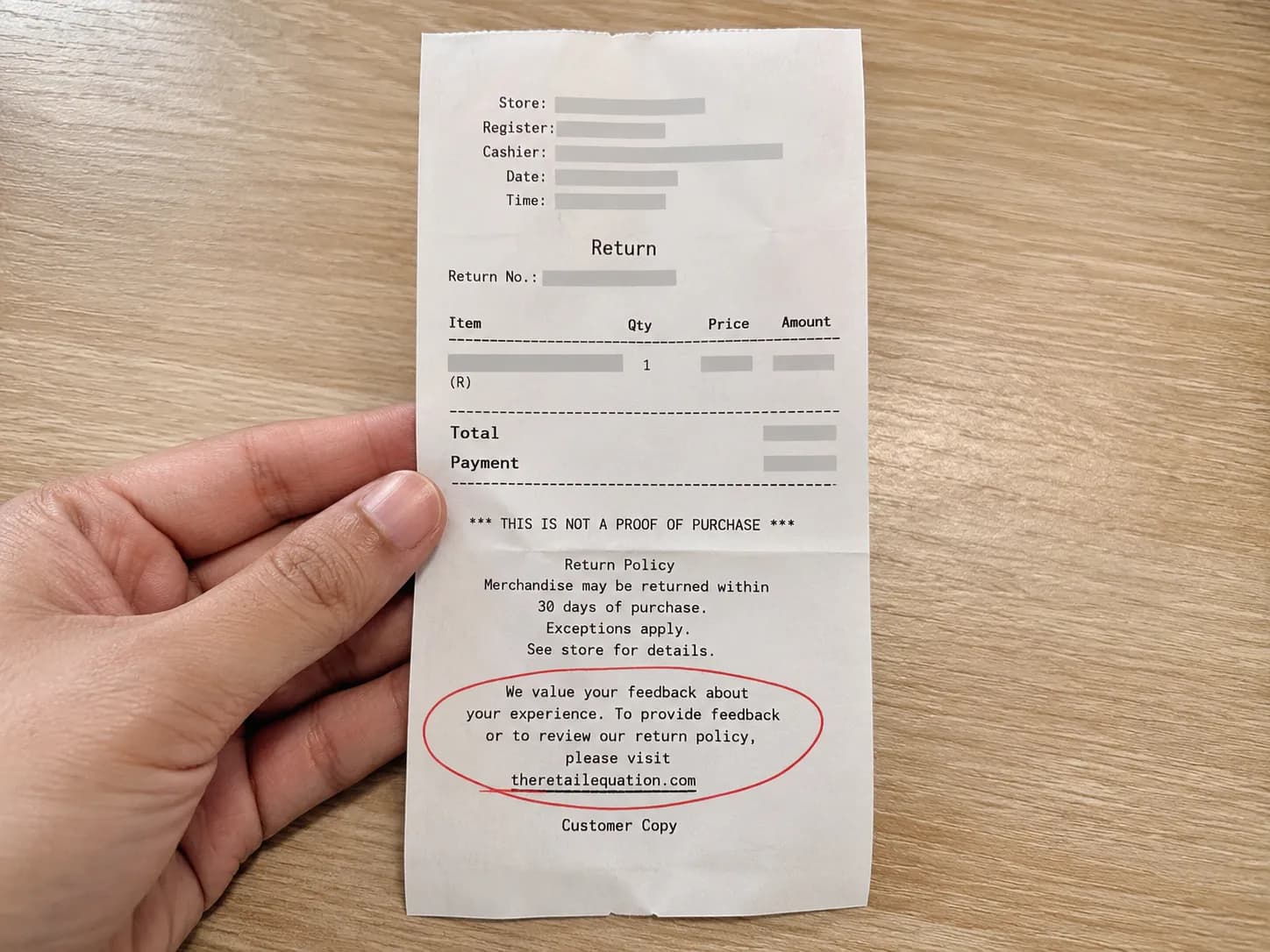
Most shoppers never learn TRE exists until a return is refused. That is by design: the system runs in the background, and the printed slip pointing to TRE.com is usually the first sign of it.
The scale is real. Return abuse is a genuine cost, with the National Retail Federation reporting that U.S. returns reached about $890 billion in 2024, or 16.9% of sales.
TRE positions its scoring as a way to catch the sliver of that total tied to fraud while keeping generous return policies alive for everyone else.
Reality check: the vast majority of returns sail through. According to The Retail Equation’s own FAQ, the roughly 1% who get warned or denied tend to trigger specific patterns, not a single ordinary return.
How The Retail Equation Works: From ID Scan to Approve, Warn, or Deny
The Retail Equation works by turning a return into a data lookup. When you return or exchange an item, the store scans your driver’s license or ID, sends the transaction to TRE, and TRE links it to your prior return history at that same retailer.
It then calculates a per-retailer risk score and returns one of three recommendations, which the store almost always follows. As CNBC has reported, that score can override a store’s stated return policy, and the cashier cannot reverse it.
Here is the flow in plain terms. Your ID identifies you, your linked history feeds a model, the model outputs a score, and the score maps to a decision.
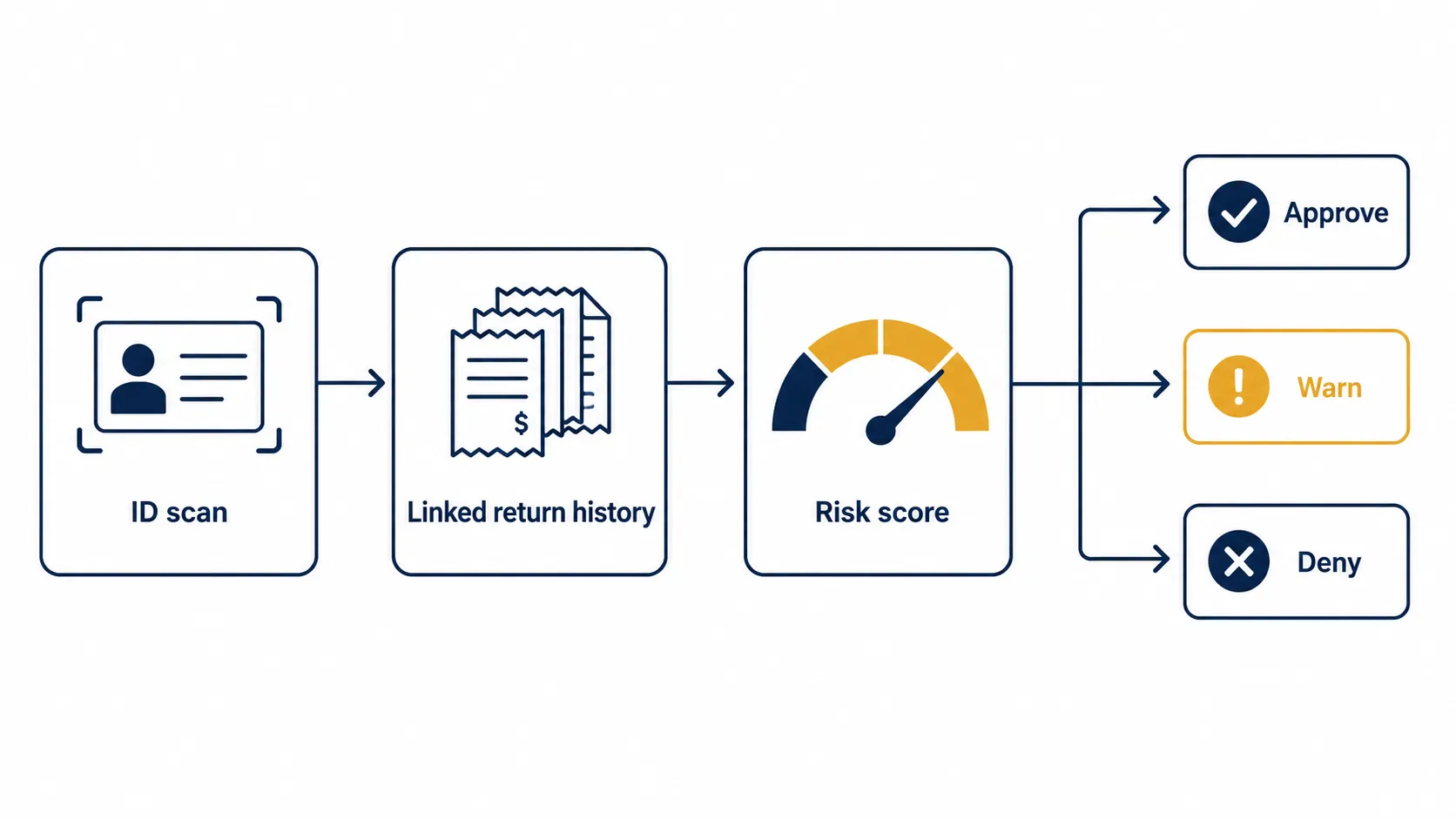
The three outcomes are simple, but the consequences differ.
Decision | What it means at the counter | What you can do |
|---|---|---|
Approve | The return is accepted normally | Nothing; keep the receipt |
Warn | The return is accepted, with a printed caution that you are near a limit | Slow your returns at that chain; request your report |
Deny | The refund or exchange is refused on the spot | Get the transaction ID, request your report, dispute errors |
A crucial and widely misunderstood point: the score is calculated per retailer, not shared across chains. Identical behavior can be fine at a lenient store and flagged at a strict one, because each retailer sets its own thresholds.
The Retail Equation’s FAQ states plainly that one retailer’s transaction data is not shared with another.
Does it track returns you made with a receipt? Yes, a receipt proves the purchase, but the return itself is still logged and counted toward your pattern at that chain.
TRE sits inside the broader machinery of how stores track your returns, so a receipt does not exempt you from being scored.
When I returned a set of unopened items recently, the associate scanned my license before touching the product. That single detail tells you who is really deciding: the system reads you first, and the person at the counter is just relaying the answer.
What Is a Return Activity Report (RAR), and How Do You Read One?
A Return Activity Report (RAR), sometimes printed as a Retail Activity Report, is the file The Retail Equation holds on your returns at a given retailer, and it is the record behind any warning or denial. It lists each return and exchange transaction TRE considered, and you can request it through The Retail Equation’s RAR portal up to 60 days after the transaction.
Under the Fair Credit Reporting Act, the CFPB notes you are also entitled to one free report per year, provided within 15 days of your request.
The RAR is the single most useful document you can pull after a denial, because it shows exactly what the system is holding against you. Request it by transaction ID from the portal, by phone using the number on your receipt, or by email.
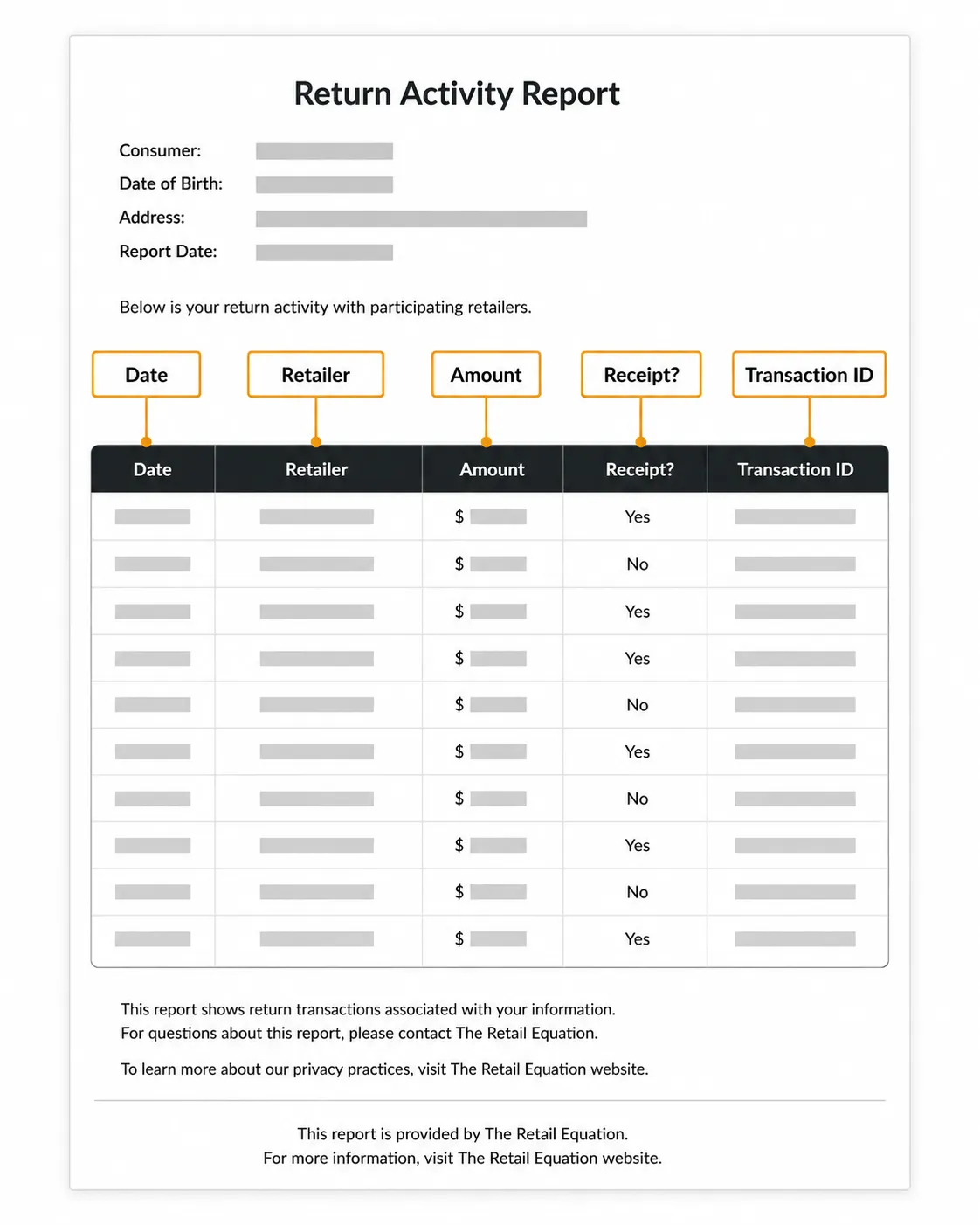
Here is what each field on a typical RAR tells you.
RAR field | What it shows you |
|---|---|
Transaction date | When each return or exchange was logged |
Retailer | Which chain reported it (data is per-retailer) |
Dollar amount | The value of each returned item |
Receipt status | Whether the return was receipted or not |
Transaction ID | The reference you need to request or dispute the record |
What the RAR will not tell you matters just as much. It does not reveal your risk score, each retailer’s exact thresholds, or the full list of stores that use TRE.
When I requested my own report, it arrived by email within about a week and listed roughly a dozen transactions, some going back more than a year. Reading it turned a vague “you return too much” into a concrete list I could actually check for errors.
Who Owns The Retail Equation? Appriss, Gemspring, and the 2025 Timeline
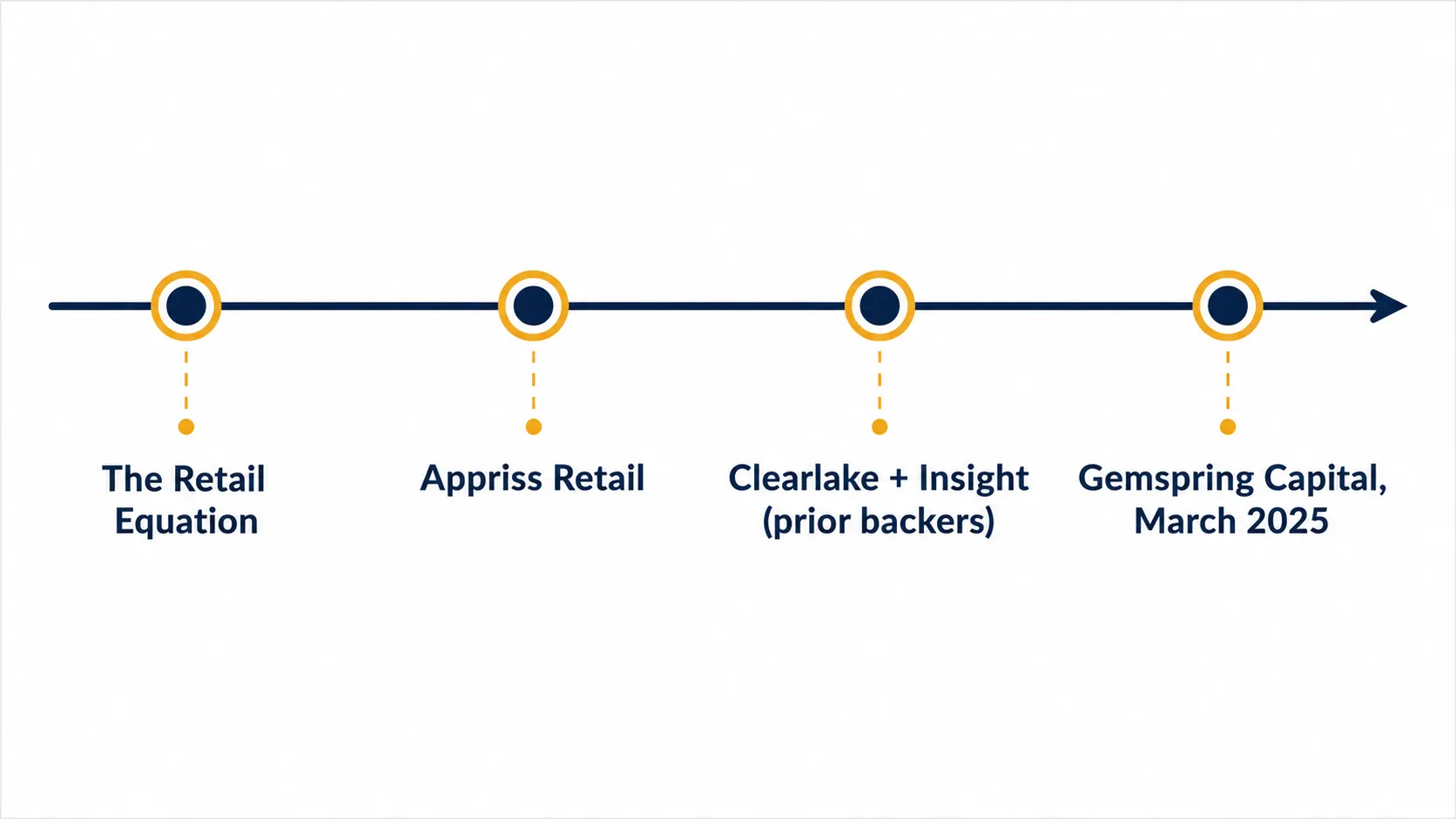
The Retail Equation is owned by Appriss Retail, and the current corporate parent picture changed in 2025, a fact most consumer explainers still get wrong. In March 2025, Gemspring Capital acquired Appriss Retail from its prior backers, the private equity firms Clearlake Capital and Insight Partners.
Financial terms were not disclosed. The CFPB register still names Appriss, Inc. as TRE’s owner, so the chain runs from The Retail Equation up to Appriss Retail and now to Gemspring.
Scale explains why this matters to a shopper. Appriss Retail says its platform is trusted by more than 60 of the top 100 U.S. retailers, so the entity behind your denial is large and well capitalized.
TRE’s software has historically reached tens of thousands of storefronts. For the current roster, see which retailers actually use it, since participation shifts over time.
For most shoppers, the ownership change is background, not a practical difference. When I cross-checked the records in mid-2026, many consumer pages still listed only Appriss and had missed the Gemspring deal entirely, which is exactly the kind of stale detail that can make older advice feel untrustworthy.
Is The Retail Equation a Credit Bureau? Your FCRA Rights (and What TRE Says)
The Retail Equation occupies an odd middle ground: the CFPB lists it as a consumer reporting company, yet TRE says it is not a credit bureau in the lending sense. Both statements are true at once, and the distinction decides what you can do.
Because it is a consumer reporting company, you have Fair Credit Reporting Act rights to access your report, dispute inaccurate entries, and require an investigation, generally within 30 days. Because it is not a credit reporting agency for loans, it does not affect the credit score a lender sees.
Here is what your FCRA rights give you, in practice.
The right to see the RAR behind a decision.
The right to dispute entries you believe are wrong.
The right to have unverifiable information corrected or removed.
TRE’s own position is that it is a service provider that processes data for retailers and does not determine creditworthiness. That is why your mortgage rate is safe even if your return privileges at one chain are not.
The tension is not merely academic. Shoppers have argued the system brands them unfairly, and a class action tracked by ClassAction.org described the resulting flag as a “scarlet letter” of returns, applied with no appeal at the counter.
For the litigation itself, see the record of past lawsuits and privacy claims; this guide sticks to the rights that apply to an ordinary flagged shopper.
A note on limits: this article explains your rights, but it is not legal advice, and TRE’s exact legal status has been contested in court. When I pulled my own RAR, it carried only return transactions and no credit-score data, which matched TRE’s claim that it does not feed lending decisions.
5 Myths About The Retail Equation, Corrected
Plenty of what circulates about The Retail Equation is wrong, and the myths cause the two costliest mistakes: assuming a receipt guarantees a refund, and assuming one store’s flag bans you everywhere. The corrections below draw on TRE’s own disclosures and on reporting from outlets like NBC News, which documented shoppers with valid receipts who were still warned or denied.
Return volume is enormous, but per the National Retail Federation only a small fraction is fraud, and only about 1% of shoppers get flagged.
Myth | The reality |
|---|---|
Stores share your return data with each other | The score is per retailer; one chain’s data is not shared with another |
Being flagged hurts your credit score | It does not affect your lending credit at all |
A receipt means the store must accept the return | Receipted returns are still logged and counted toward your pattern |
Every major store uses The Retail Equation | Participation changes; for example, Best Buy ended its use of TRE in 2019 |
A cashier can override the denial | They cannot; the system, not the clerk, makes the call |
Can the cashier override it?
No, the associate is only relaying a recommendation the software already made. That is why arguing at the counter rarely works, and requesting your report does.
My own RAR reinforced the first myth’s correction: it listed returns only from retailers I had actually visited, with nothing bleeding in from other chains. That is the clearest sign the per-retailer design is real rather than a marketing line.
Flagged or Denied? What to Do Next
If The Retail Equation flagged or denied your return, the fix is a short, ordered process, and panic is the wrong first move. Most bans are time-limited, often around a year, and they apply per retailer rather than everywhere.
Your job is to get the record, check it, and dispute anything wrong, using the FCRA rights the CFPB describes.
Note the transaction ID printed on the warned or denied receipt; without it, a report request stalls.
Request your Return Activity Report through the portal, by phone, or by email, within the 60-day window.
Review every entry for errors, such as a duplicated return or a transaction you never made.
Dispute inaccuracies in writing, so you keep a dated record, and expect an investigation within about 30 days.
If the record is accurate but you followed the posted policy, escalate through the retailer first and keep every receipt.
For a full walkthrough of the letter and your rights, see how to dispute an incorrect return record, which covers the FCRA process step by step.
Be honest with yourself first: a dispute fixes errors, but it will not erase an accurate high return count. When I requested my report, the transaction ID was the one detail that unblocked everything, so the receipt you are tempted to throw away is the receipt you need.
The Retail Equation FAQs
Does The Retail Equation affect my credit score?
No, The Retail Equation scores your returns, not your creditworthiness, and it does not feed the credit report lenders use. It is listed as a consumer reporting company for return data only, so a return flag stays in the returns world.
How do I get my Return Activity Report?
Request it through The Retail Equation’s online portal, by phone using the number on your receipt, or by email, up to 60 days after the transaction. Under the FCRA you are also entitled to one free report per year, delivered within about 15 days, and mine arrived by email in roughly a week.
How long does a return ban last?
Bans are usually time-limited, commonly about one year, and they apply at the specific retailer that flagged you rather than across all stores. Each chain sets its own thresholds, so a strict store and a lenient one can treat the same behavior differently.
Does it track returns I made with a receipt?
Yes, a receipt proves the purchase, but the return is still logged and counted toward your pattern at that retailer. Keeping receipts helps you dispute errors, not avoid tracking.
Who owns The Retail Equation now?
The Retail Equation is owned by Appriss Retail, which Gemspring Capital acquired in March 2025 from Clearlake Capital and Insight Partners. The CFPB register still names Appriss as the owner.
Can a cashier override a denial?
No, the denial comes from The Retail Equation’s recommendation, and store staff cannot reverse it at the register. Your route is to request your report and dispute any errors.
The Bottom Line
The Retail Equation turns your returns into a scored file, and once you see it that way, a denial stops feeling random and starts looking like something you can act on. The system reads your ID, scores your history at that chain, and tells the store to approve, warn, or deny, while your credit score stays untouched and your Return Activity Report stays one request away.
That is the leverage the receipt hides. You can pull the report, check it for errors, and dispute what is wrong, and you now know who runs the company and what your FCRA rights are.
Treat The Retail Equation as the returns bureau it is, keep your receipts and transaction IDs, and a future denial becomes a problem with a clear next step rather than a dead end.
Read it your way
Short on time? Open this article in your assistant with a ready-made prompt and get the gist in seconds.
Found this useful? Make us a preferred source so we show up in your Google results.
Keep reading
Related articles
Eligibility & Conditions
What Stores Use The Retail Equation? (2026, Best Buy Out)
See which stores use The Retail Equation in 2026: a verified status list of who still tracks returns, who dropped it (Best Buy, 2019), and who never did.
Eligibility & Conditions
Sephora Return Limit: No Set Number, 30-Day Window & TRE Tracking
Sephora has no set return limit, but a 30-day window and Retail Equation tracking mean too many returns can trigger a 365-day ban. Here’s the real rule.
Eligibility & Conditions
Do Stores Track Your Returns? How the System Works (2026)
Yes, most stores track and score your returns. See how the system works, what they log, and how to request your own Return Activity Report.

Eligibility & Conditions
Can Costco Cancel Your Membership for Too Many Returns?
Yes, but only for extreme abuse: weekly used-item returns or mostly-eaten food. See what triggers a Costco revocation and what stays completely safe.
The discussion
Comments
Every comment is reviewed before it goes live.