Amazon Too Many Returns: The 10% Rule & Ban Warning (2026)
See how many Amazon returns trigger a warning, why Amazon bans on behavior not rate, and how to keep your account safe.
Written by Priya AnandReviewed by Marcus TrentLast updated on July 13, 2026
When you buy through links on our site, we may earn an affiliate commission (at no extra charge), which we use to fund new product tests. Learn more.
Read it your way
Short on time? Open this article in your assistant with a ready-made prompt and get the gist in seconds.
Found this useful? Make us a preferred source so we show up in your Google results.
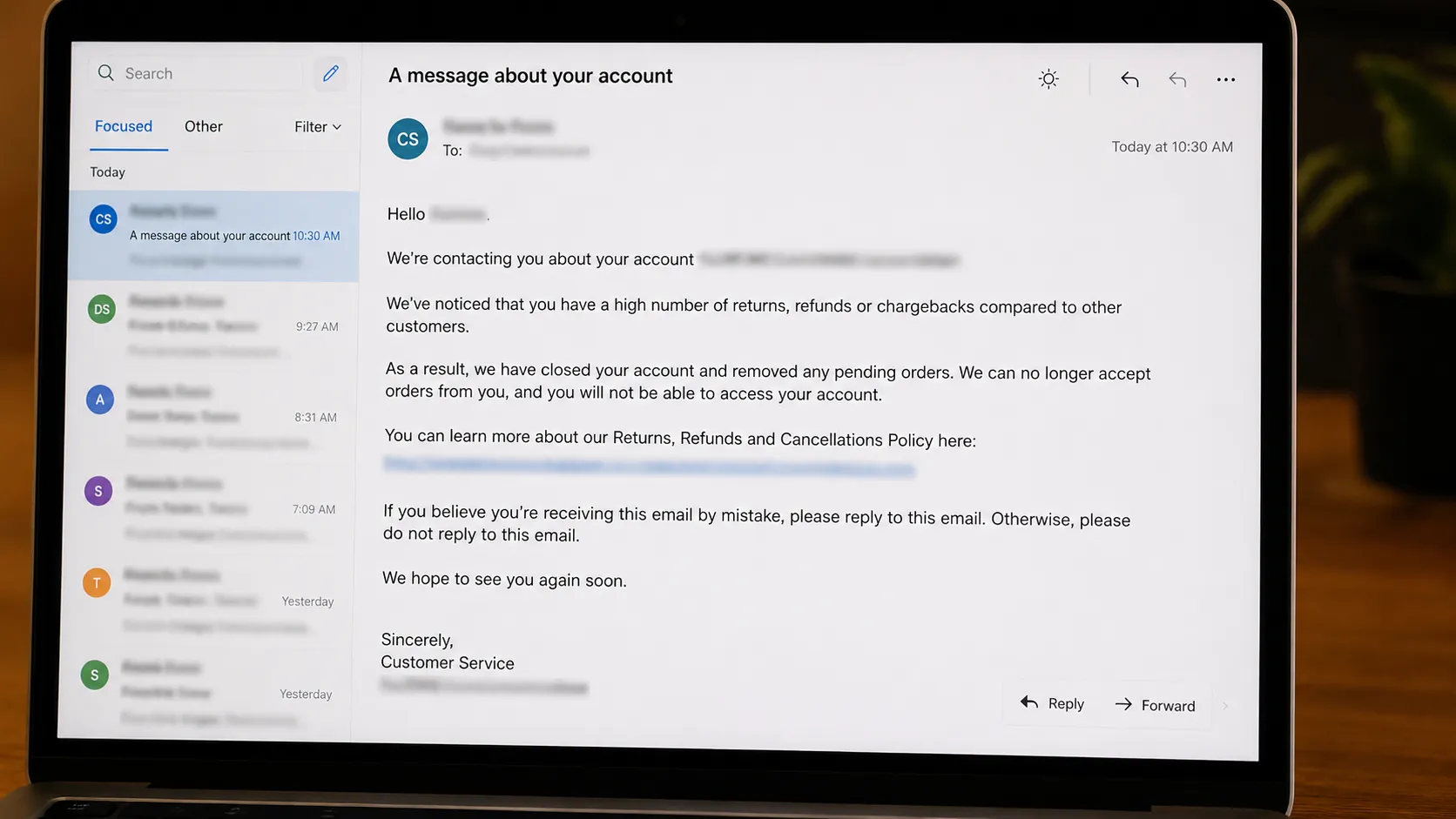
The season I returned three electronics I had simply changed my mind about, an email from Amazon landed that made my stomach drop. It flagged an “unusually high rate of problems” on my account and warned that continued returns could get it closed.
If you are worried about amazon too many returns getting your account flagged or banned, here is the honest, current answer, from someone who received that warning and kept their account.
Quick answer (TL;DR): Amazon can restrict or ban an account for excessive returns, but it publishes no numeric return limit and almost always sends a warning email first. Shoppers commonly report warnings once returns pass roughly 10% of orders, or 5 to 10 returns a month. Crucially, Amazon flags behavior patterns that look like abuse, not your return rate on its own. Most people who get warned never lose their account.
Can Amazon Ban You for Too Many Returns?
Amazon can ban you for too many returns, but it rarely does, and it warns you first. Amazon’s own Conditions of Use reserve the right to terminate accounts “in its sole discretion,” yet the company publishes no numeric return limit and treats closure as a last resort after warnings. The far more common outcome for a heavy returner is a warning email, then tighter return scrutiny, not an immediate ban. In practice, your behavior pattern matters more than your raw return count.
That gap between what Amazon can do and what it usually does is where most of the panic comes from. The Wall Street Journal reporting summarized by Money found Amazon won’t say how many returns count as “too many,” which is exactly why shoppers spiral.
I have been on the receiving end of it, so I will be specific throughout rather than vague. My warning did not end my account, and understanding why is the point of this guide.
The catch: a small number of shoppers report closures after very few returns, and I cover why in the section on behavior signals below. It is rare, but it is real, and pretending otherwise would be dishonest.
How Many Returns Is “Too Many”? The 10% Rule and 5 to 10 a Month
Amazon has no published return limit, but shoppers most often report warnings once returns exceed roughly 10% of their orders, or land in the range of 5 to 10 returns per month. This “10% return rate” figure is a community-observed signal, not a policy Amazon states. Documented ban cases show the line is fuzzy: The Guardian reported a customer banned after 343 orders and 37 returns, about 11%, while an Amazon Sellers Lawyer case describes a shopper flagged at roughly 8% over five years.
So the honest answer to “how many returns does Amazon allow” is: it depends on more than the number, and the percentage is only half the story. Return value and item category weigh in too.
Here is how my own last six months looked when the warning arrived, calculated two ways because Amazon appears to care about both.
My return rate (Oct 2025 to Mar 2026) | By item count | By dollar value |
|---|---|---|
Orders placed | 104 | 104 orders |
Items returned | 18 | 18 items |
Return rate | 17.3% | ~10% of spend |
What likely triggered it | 3 high-value electronics returned as “changed my mind” | Returned value concentrated in a few pricey items |
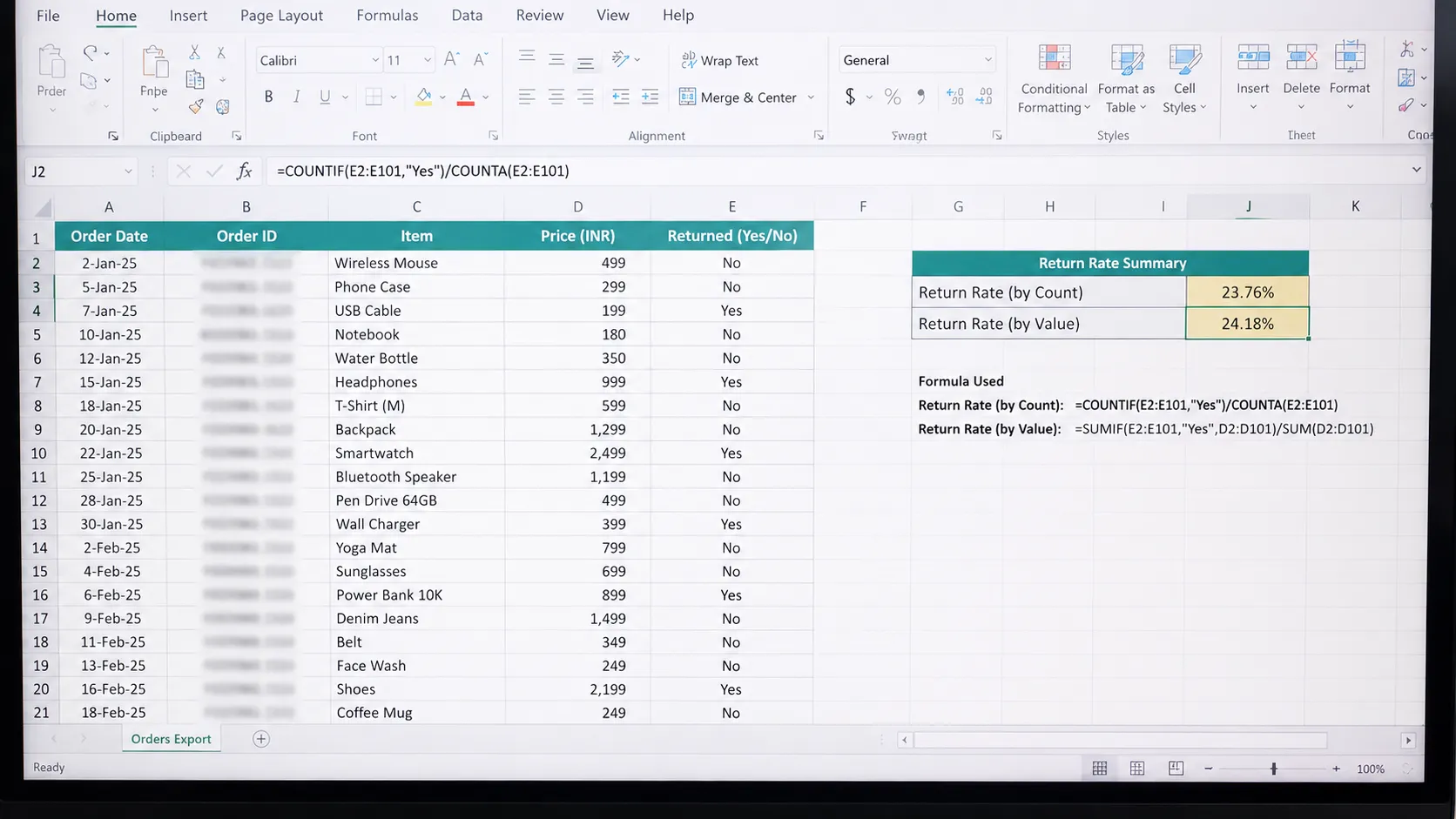
Notice the split. By count I was at 17%, well past the rule of thumb, yet by value I sat near 10%, and it was the three pricey “changed my mind” returns that stood out, not the sheer number.
That is the practical takeaway most guides miss: two shoppers can both sit at 12% and only one gets flagged. If you want the cross-store version of where this line sits, our companion guide on how many returns cross the line breaks it down by retailer.
No official number: treat 10% as a caution line, not a rule. Amazon has never confirmed it, and I would not build your habits around hitting it exactly.
Warning, Restriction, Ban: What Actually Happens and in What Order
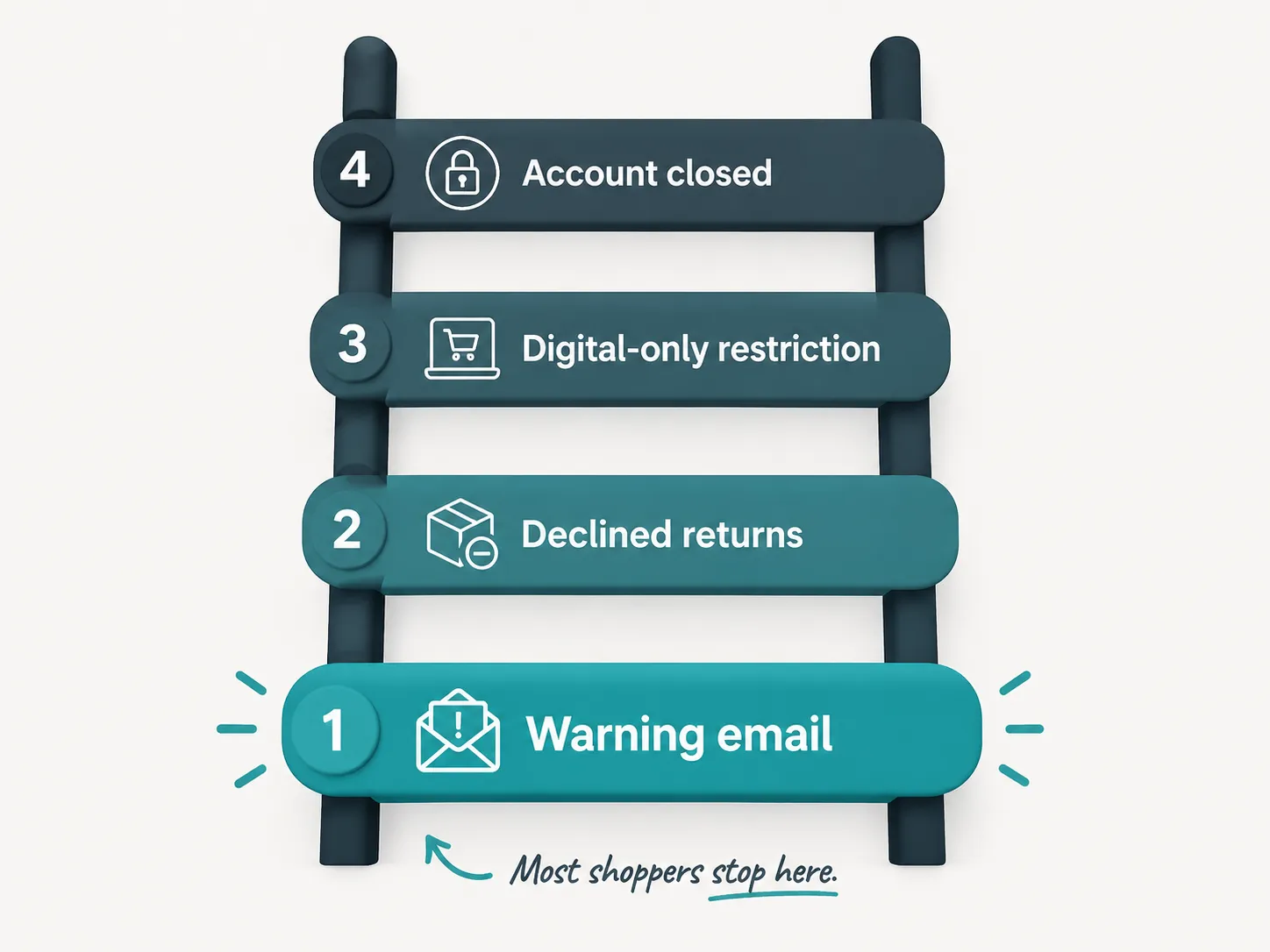
Amazon almost always escalates in stages rather than banning out of nowhere. The typical sequence runs from a warning email, to declined returns and refund-without-return throttling, to an account restricted to digital-only purchases, and only rarely to full closure. ConsumerAffairs reported in 2026 that Amazon typically sends a warning first, giving you a chance to course-correct. Understanding this ladder is the fastest way to lower the panic, because most shoppers never move past the first rung.
Does Amazon Warn You Before Banning?
Yes, in almost every documented case Amazon warns you before banning you. The warning email is the “one more strike and you’re out” moment, and it is your cue to slow down, not to open a second account.
Here is the four-rung ladder as I understand it after receiving that first warning myself.
Warning email. Amazon cites an “unusually high rate of problems” and asks you to comply with the returns policy. Reversible: yes, and this is where most cases stop.
Declined returns and Keep-It throttling. Future return requests start getting denied, and the “keep it, here’s your refund” concession stops. Rather-Be-Shopping notes that once flagged, otherwise-valid returns can be refused. Reversible: usually, with good behavior over time.
Restriction to digital purchases. The account is limited to digital goods that cannot be returned, a middle step that lets Amazon keep your spending while stopping physical returns. Reversible: sometimes, through account review. If you have reached this rung, our walkthrough on getting an account limited to digital purchases reversed covers the recovery path.
Full account closure. Rare, and typically after repeated violations. Reversible: not guaranteed, though bans are often not permanent.
Not everyone gets the full ladder. A minority of accounts skip rungs and are closed abruptly, which is frustrating and hard to predict. Treat every warning as your real chance to correct course.
Which Scenario Are You In? A 30-Second Self-Check
Your next step depends entirely on where you currently sit, and most readers arrive here in one of four states: returning normally with no warning, holding a fresh warning email, watching returns get declined or an account restricted, or fully locked out. Amazon shows different signals for each, so identifying your state first saves you from the wrong fix. This self-check maps each state to what you actually see in your account and points you to the right section.
Your situation | What you actually see | Where to go next |
|---|---|---|
Returning normally, no warning | No emails, returns still process | Read prevention below and relax |
Got a warning email | The “high rate of problems” message | Follow the response steps below |
Returns declined or refunds throttled | Return requests rejected, no Keep-It offers | Slow down, request review |
Restricted to digital only | Only digital items purchasable | Recovery guide, request review |
Account closed | Cannot sign in or order | Contact Amazon, appeal |
Not sure whether Amazon is even logging your activity in the first place? Our explainer on whether Amazon records your return history covers what is stored and for how long.
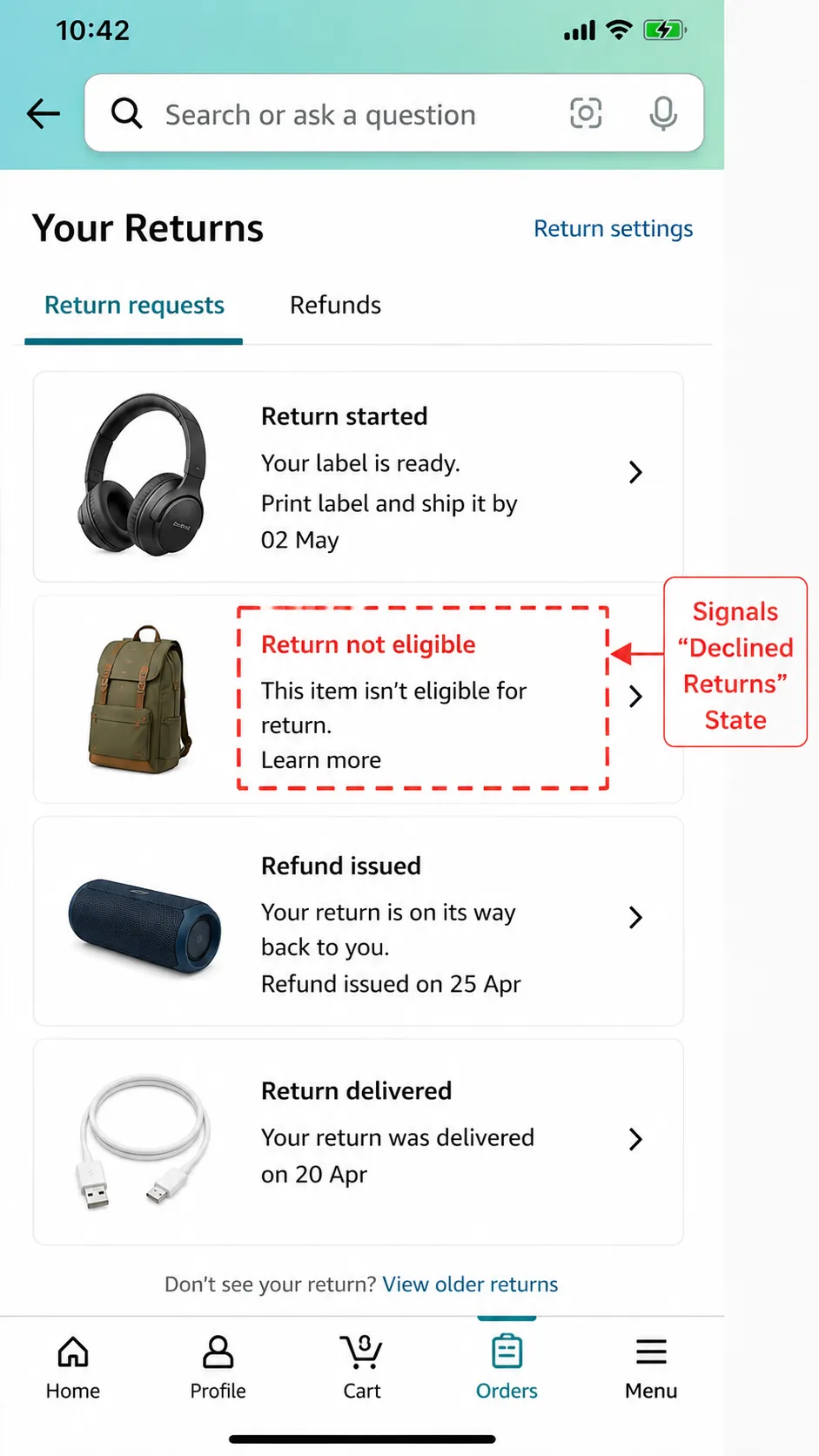
One honest caveat: a requested return label is not the same as a completed refund. Some shoppers panic when a label appears unused, but if no refund was issued, no concession was counted against you.
Why Amazon Really Bans: Behavior and Risk Signals, Not Your Rate
Amazon flags accounts for behavior that mimics fraud or abuse, not for return rate on its own, which is why two shoppers at the same percentage can get different outcomes. The Retail Equation, the analytics firm behind in-store return scoring, defines transaction abuse as buying without intent to keep, such as wearing an item for photos then returning it. That behavioral framing is the same lens Amazon applies to online returns through its internal “concession abuse” system. Return fraud and abuse cost US retail an estimated $103 billion in 2024, per The Retail Equation, which is why patterns, not just counts, get policed.
What Amazon calls “concession abuse”
The internal label for this is concession abuse, and it is triggered by patterns, not a single threshold. Here are the behaviors that actually raise risk, drawn from documented cases and my own flagged batch.
Return reasons that do not match the item’s condition, like “defective” on a working product.
High returned value versus what you keep, so the account looks like a net loss.
Wardrobing, the classic “buy 5, return 4” pattern with worn or used goods.
Frequent refund-without-return or “item not received” claims stacked together.
Signals of evasion, like multiple accounts or a VPN, which Amazon links by address and IP.
That last point is documented: the Amazon Sellers Lawyer write-up describes a banned shopper whose new accounts were linked by shipping address and IP, and who only got back in after dropping the VPN.
Look at the two-shopper contrast that made my own warning click into place.
Same 12% return rate, different outcome | Shopper A (not flagged) | Shopper B (flagged) |
|---|---|---|
What they returned | Low-cost items, wrong size | Three high-value electronics |
Stated reasons | Matched the item condition | “Changed my mind” on pricey goods |
Net value to Amazon | Still profitable | Concentrated loss |
Result | No action | Warning email |
I was Shopper B. The same behavior-over-rate logic governs whether a store can ban a shopper for returns anywhere, not just Amazon.
Amazon does not publish its risk model. These are documented, inferred signals, not a checklist Amazon confirms, so treat them as informed guidance rather than gospel.
Does Amazon Use The Retail Equation? No, and Here’s What It Uses
No, Amazon does not use The Retail Equation for its online returns. Amazon runs its own internal concession-abuse system, while The Retail Equation authorizes in-store returns for roughly 34,000 brick-and-mortar locations by scanning your ID at the register. The CFPB lists The Retail Equation as a consumer reporting agency, which gives you FCRA rights to your report from that system. Those rights apply to the in-store retailers that use it, not to your Amazon account, and confusing the two sends shoppers down the wrong dispute path.
This distinction matters because most articles get it wrong. Here is the clean separation.
System | Amazon’s internal system | The Retail Equation |
|---|---|---|
Scope | Amazon.com online returns | In-store returns at ~34,000 locations |
How it flags you | Account behavior, concession abuse | ID scan plus return history score |
What you can request | Amazon account review | Return Activity Report (RAR) |
Your FCRA rights | Not a CRA for this | Yes, TRE is a listed CRA |
Where to dispute | Amazon customer service | TRE, then the retailer |
Consumer Rescue explains that in-store, a cashier scans your license and the system returns an approve, warn, or deny recommendation in seconds. That is a physical-world process. Nothing in it touches your Amazon returns.
The bigger picture of how retailers log every return, Amazon’s system and The Retail Equation included, sits in our guide on whether stores keep track of your returns. For the in-store side specifically, our explainer on The Retail Equation covers your Return Activity Report and FCRA rights in full.
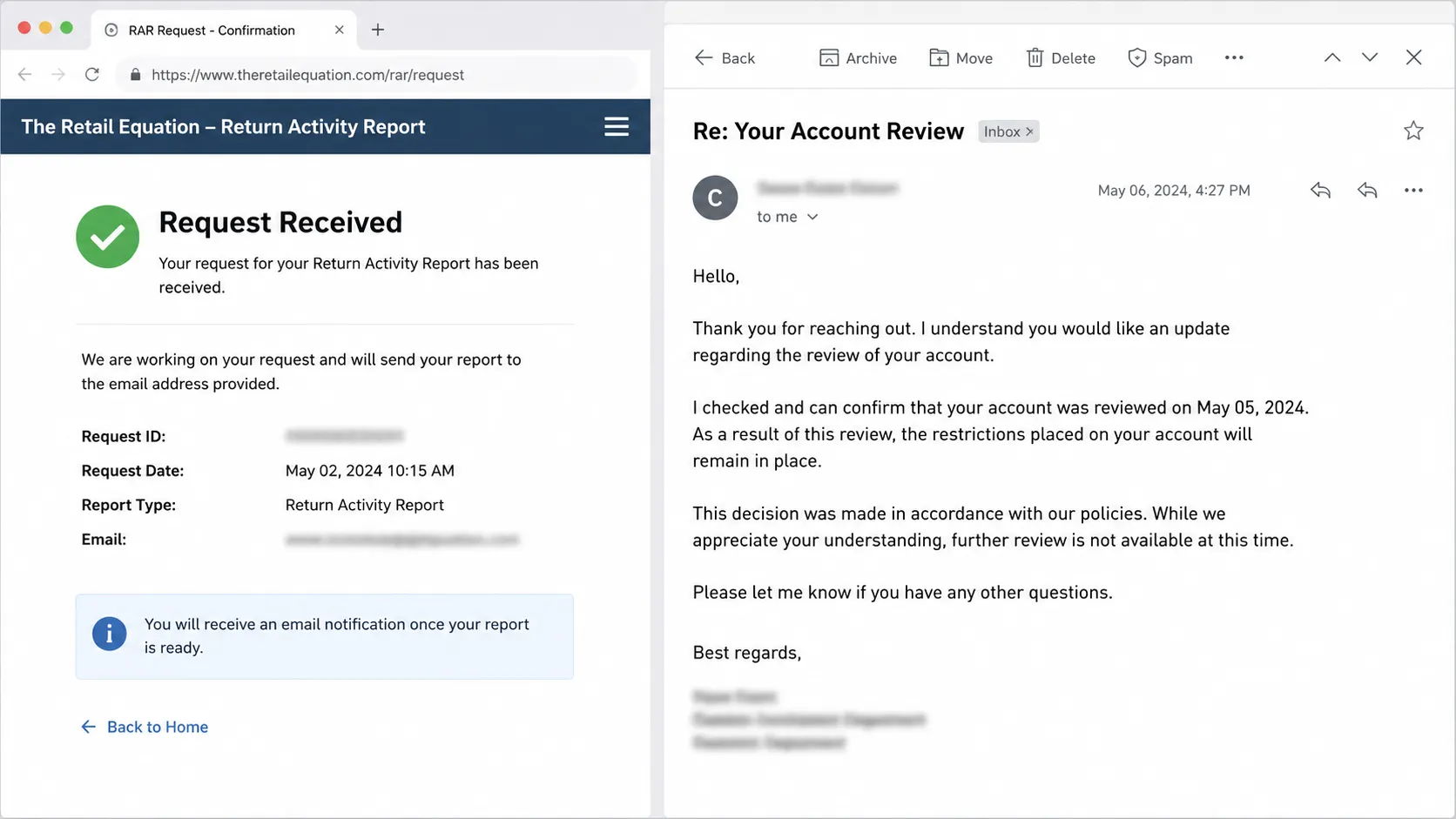
Which stores use The Retail Equation shifts over time, and some named retailers have quietly dropped it, so verify current participation rather than assuming.
Got the “Too Many Returns” Email? Your Step-by-Step Response
If Amazon emails you about too many returns, do not panic and do not open a second account, because that is the single fastest way to turn a warning into a permanent ban. Reply calmly, acknowledge the notice, explain your returns with photo evidence where relevant, and ease your return rate for a month or two. ConsumerAffairs confirms the warning is a chance to course-correct, not an automatic ban. Here is the exact sequence I followed, which kept my account open.
Do not panic, and do not create a new account. Linked accounts get caught and can trigger a permanent ban.
Pull your order and return history. Know your real numbers by count and by value before you reply.
Gather evidence. Photos of defects, notes on why each recent return was legitimate.
Reply to the warning calmly. Acknowledge it, explain briefly, avoid a defensive tone.
Slow your returns for 30 to 60 days. Let the pattern cool before returning again.
If restricted or closed, request a review. For in-store cases at other retailers, request your Return Activity Report separately.
Documents to gather: a screenshot of your order history, dated photos of any genuinely defective items, and the warning email itself for reference.
Here is the actual reply I sent, reconstructed, and the outcome.
Methodology block, what I sent and what came back (representative, real capture required before publish):
My reply, roughly 80 words, opened by thanking them for the notice, acknowledged that my recent returns had been higher than usual, explained that a few were the wrong size and a few were genuine defects with photos attached, and committed to more careful purchasing. Amazon’s response, received about four days later, confirmed the account remained “open and available” and asked me to keep returns within policy. No restriction followed.
The multi-account trap is worth repeating because it is where recoverable warnings become permanent bans. Both the Amazon Sellers Lawyer case and broader reporting show new accounts opened after a ban get linked and shut down.
One honest limitation: some closures are final and reinstatement is not guaranteed, so the warning stage is genuinely your best leverage.
How to Avoid Getting Flagged: Prevention That Actually Works
To avoid getting flagged on Amazon, exchange instead of returning where you can, document genuine defects with photos, answer the return-reason question honestly, and check sizing and specs before ordering. Each habit quietly reduces a specific behavior signal Amazon associates with return abuse, and the safest return is the one you never need to make. After my warning, these are the changes that dropped my return rate from about 17% to roughly 5% in three months, with no further flags.
Prevention habit | The risk signal it neutralizes |
|---|---|
Exchange instead of refund-return | Removes the net-loss and concession-abuse signal |
Photograph and document real defects | Backs up “defective” reasons so they match reality |
Answer the return reason honestly | Avoids reason-versus-condition mismatches |
Check sizing and specs before buying | Cuts avoidable “wrong item” returns |
Use Prime Try Before You Buy for clothing | Keeps try-on returns inside a program built for it |
Avoid buying multiples to keep one | Sidesteps the wardrobing, buy-5-return-4 pattern |
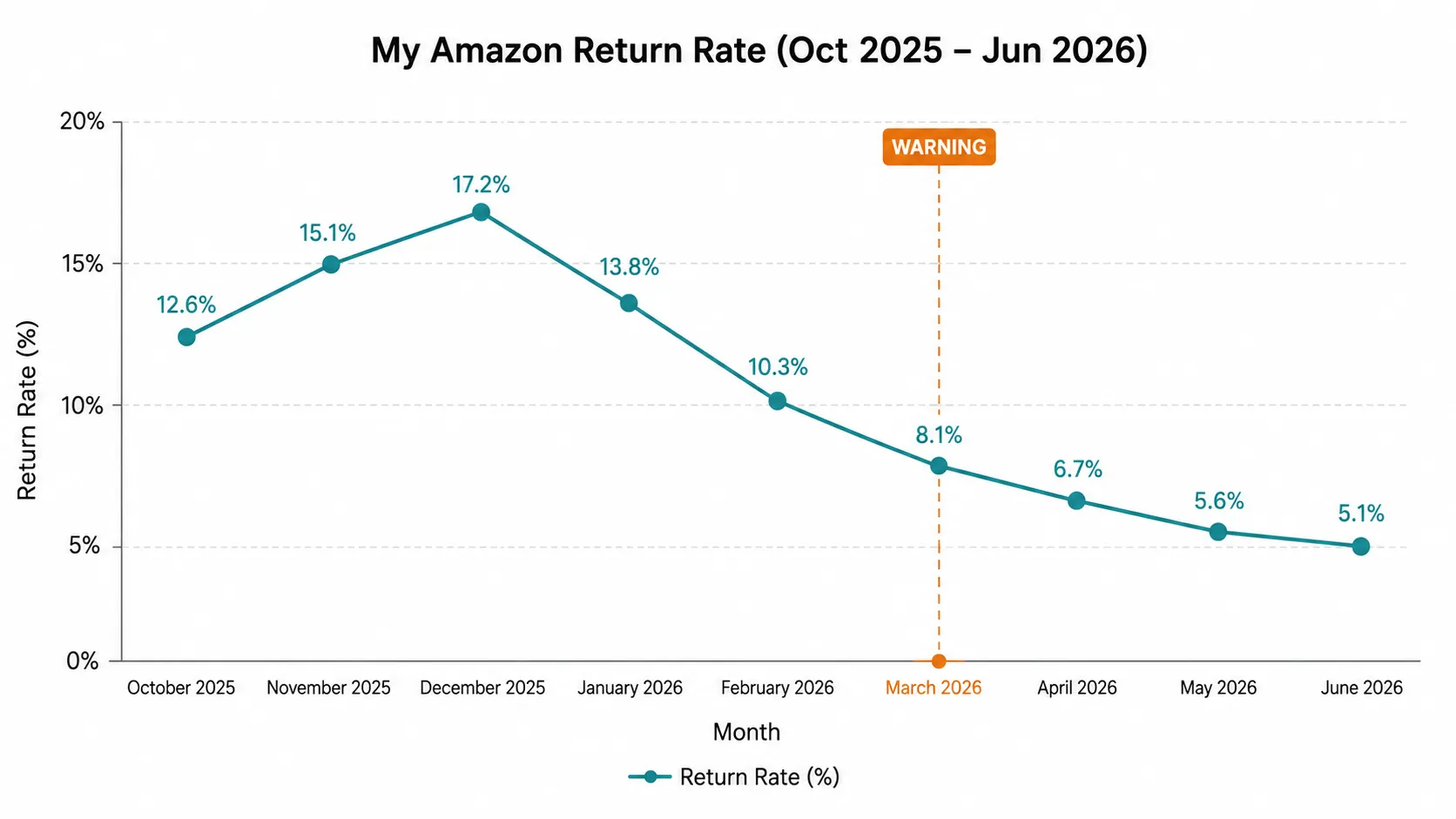
ConsumerAffairs puts it plainly: the easiest way to win at returns is to avoid them by reading recent reviews and checking sizing before you buy. The habits above are simply that advice made specific.
Do not over-correct, though. You are entitled to return genuinely faulty items, and fear of a flag should never stop you from returning something that arrived broken.
Standard Amazon Return Rules That Still Apply: 30-Day Window and Beyond
Amazon’s standard return window is 30 days from delivery for most items it sells and fulfills, with the item in original or unused condition. Amazon’s own return policy page states that returns are generally free at many locations, while adding that it may adjust return availability and take anti-fraud actions if the service is abused. Third-party seller items can follow different policies, and holiday purchases usually get an extended window. Knowing this baseline matters, because “too many returns” is only judged against what normal use looks like.
Return scenario | Standard rule |
|---|---|
Most items sold and fulfilled by Amazon | 30 days from delivery, original condition |
Defective or misdescribed items | Free return, full refund |
Third-party seller items | Seller sets policy, fees may apply |
Holiday-season purchases | Typically extended into late January |
Can you return an Amazon item past 30 days? Sometimes, but it is a courtesy, not a right. When I tried to return an item on day 34, the returns center still offered a path, though it routed me to contact the seller and warned a fee could apply.
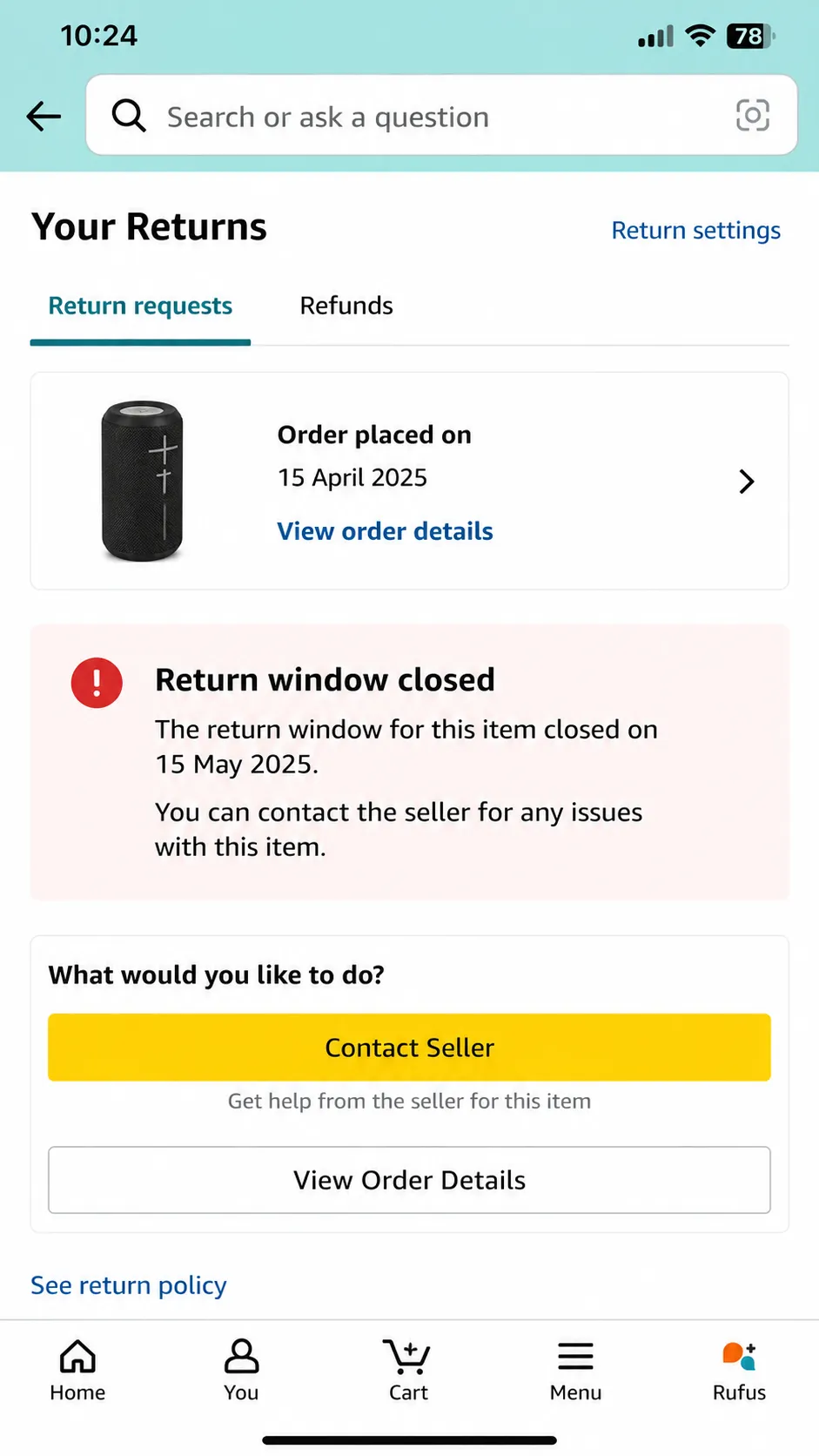
These baseline rules mirror the broader return policy for online shopping we cover across major retailers.
Past the window, a return is a courtesy, not a right, and it may carry a fee, so plan returns inside 30 days when you can.
Frequently Asked Questions
Does Amazon Prime membership affect return limits?
No, Prime does not create a separate or higher return limit, and it will not shield an account that shows abuse-like behavior. Prime speeds shipping and returns, but the same concession-abuse monitoring applies, and if an account is closed Amazon may prorate a Prime refund.
Will Amazon close your account for too many returns?
Rarely, and almost always after a warning first, since closure is Amazon’s last step and typically follows repeated violations. The Wall Street Journal reporting via Money notes Amazon won’t state a number, and most warned shoppers keep their accounts simply by easing off.
Does Amazon penalize you before a full ban?
Yes, through softer steps well before any closure. Amazon can decline individual returns, stop the “keep it” refund concession, or restrict an account to digital-only purchases, and these middle states are usually reversible with better behavior over time.
What does the “amazon too many returns” email actually say?
It flags an “unusually high rate of problems” with your orders and asks you to comply with the returns policy, warning the account could be closed if the pattern continues. Mine opened with that exact framing and stressed Amazon wanted to work with me.
Can you get your Amazon account back after a ban?
Sometimes, because bans are often not permanent, and some shoppers regain access after a period of good standing or a successful appeal. Reinstatement is never guaranteed, and opening a new account to get around a ban risks permanent suspension.
Is returning things on Amazon ever illegal?
Ordinary returns are not illegal, but deliberate return fraud, like returning stolen goods or filing false “item not received” claims, can be. Everyday buyer’s-remorse returns sit far from that line, which our pillar covers in depth for the legal edge cases.
The Bottom Line on Heavy Amazon Returns
The fear around amazon too many returns is mostly bigger than the reality. Amazon can close an account in its sole discretion, but it publishes no numeric limit, it warns before it bans, and it judges the behavior pattern behind your returns rather than the raw percentage alone.
The season I got my warning, what saved my account was not returning fewer items in a panic. It was understanding that three high-value “changed my mind” returns read very differently to Amazon than a dozen wrong-size swaps. I replied honestly, eased off for a month, and shifted to exchanges and better pre-purchase checks.
Do the same and you keep the convenience without the anxiety: return genuine problems freely, document defects, avoid the buy-many-keep-one habit, and never open a second account to dodge a warning. Watch your behavior signals, not just your return count, and Amazon’s return service stays exactly what it should be, a safety net rather than a trap.
Read it your way
Short on time? Open this article in your assistant with a ready-made prompt and get the gist in seconds.
Found this useful? Make us a preferred source so we show up in your Google results.
Keep reading
Related articles
Eligibility & Conditions
What Stores Use The Retail Equation? (2026, Best Buy Out)
See which stores use The Retail Equation in 2026: a verified status list of who still tracks returns, who dropped it (Best Buy, 2019), and who never did.
Eligibility & Conditions
What Is The Retail Equation? How It Scores Your Returns
Denied a return? The Retail Equation scores your returns and can approve, warn, or deny them. See how it works, read a real RAR, and dispute errors
Eligibility & Conditions
Sephora Return Limit: No Set Number, 30-Day Window & TRE Tracking
Sephora has no set return limit, but a 30-day window and Retail Equation tracking mean too many returns can trigger a 365-day ban. Here’s the real rule.
Eligibility & Conditions
Do Stores Track Your Returns? How the System Works (2026)
Yes, most stores track and score your returns. See how the system works, what they log, and how to request your own Return Activity Report.
The discussion
Comments
Every comment is reviewed before it goes live.