How Online Returns Work: Windows, Fees & Drop-Off (2026)
Learn how online returns work in 2026: 14–90 day windows, shipping fees you dodge in store, final-sale traps, and 5 major stores compared.
Written by Lillian BrooksReviewed by Marcus TrentLast updated on July 6, 2026
When you buy through links on our site, we may earn an affiliate commission (at no extra charge), which we use to fund new product tests. Learn more.
Read it your way
Short on time? Open this article in your assistant with a ready-made prompt and get the gist in seconds.
Found this useful? Make us a preferred source so we show up in your Google results.
The short version: The return policy for online shopping in 2026 is rarely as simple as “ship it back in 30 days.” Windows run from 14 to 90 days, return shipping is often deducted from your refund unless you drop the item in store, and at some retailers the clock starts at purchase rather than delivery. This guide walks the full process, quantifies the fees, and compares five major stores from a hands-on return test.
How Online Returns Work, the 30-Second Answer
An online return starts in your store account, not at the post office. Across major US retailers in 2026, return windows commonly run 14 to 90 days, you usually pay return shipping by mail but not when you drop the item in store, and final-sale items plus opened beauty or digital goods generally cannot come back.
Most stores count the window from delivery, though a few count from the purchase or ship date. The safe move is to start the return early and keep your packaging and order confirmation.
That 50-word answer holds for routine orders. Two buried details decide what a return actually costs you, and the rest of this guide is about those two.
The gist, in four points:
Window: commonly 14 to 90 days, depending on the store and the item.
Cost: return shipping is often deducted by mail, usually free in store.
Where: you can drop most online orders at a physical store or partner counter.
Exceptions: final-sale, opened beauty, perishable, and personalized items rarely qualify.
How to Return an Online Order, Step by Step
Returning an online order follows the same seven-step shape at almost every major retailer: find the order in your account, pick the item and a reason, choose a refund or a replacement, select a return method, pack it with proof of purchase, hand it off, then track the refund. The method you pick is the part that costs or saves you money, because a mailed label is frequently deducted from your refund while an in-store or box-free drop-off is free.
Start the process a few days before your deadline, since labels and drop-offs both take time.
Here is the process end to end:
Open your orders. Sign in and find the order in Your Orders, Purchase History, or the equivalent in the retailer’s app. You should see a Return or Replace button next to eligible items.
Select the item and a reason. Choose the specific item and an honest reason. The reason matters, because “defective” or “arrived damaged” usually means the store pays return shipping, while “changed my mind” can mean you pay it.
Choose refund or replacement. A replacement often ships before your original arrives back. A refund returns to your original payment method, or to gift-card balance if you prefer it faster.
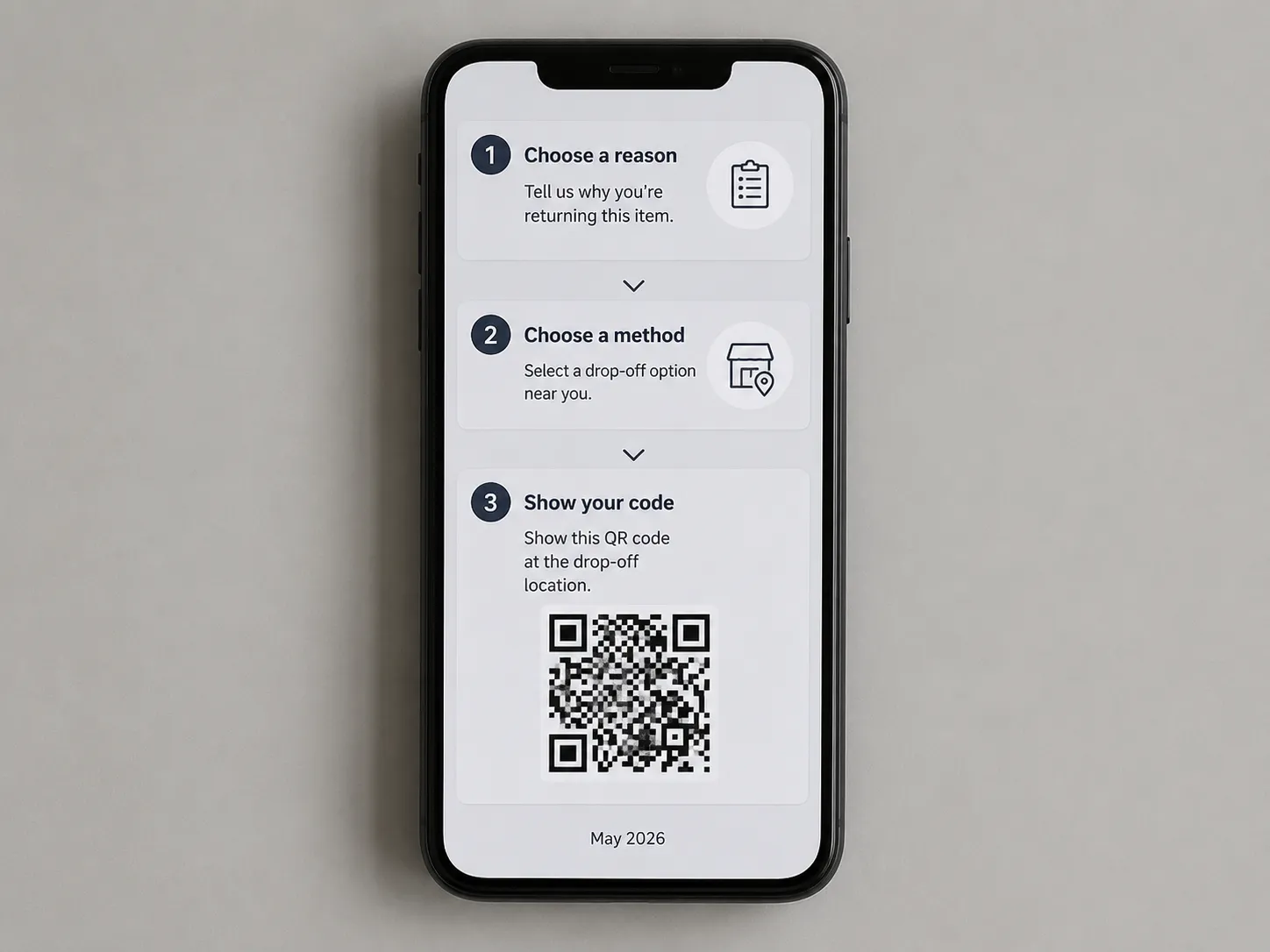
Pick your return method. This is the cost lever. Options typically include a free in-store or partner drop-off, a box-free, label-free QR code drop-off, or a mailed prepaid label. Pick the free drop-off when one is nearby.
Pack it and keep your proof. Use the original packaging when you can, and hold onto the order confirmation or the receipt the counter hands you. Some stores will even take items back when you no longer have it, which is the subject of our guide on returning without the receipt.
Drop off or ship. At a box-free counter you scan the QR code and hand the item over with no box or tape. With a label, attach it and drop the package with the carrier.
Track the refund. Watch the return status in your account. Refund timing ranges from same-day at scan to a week or more after the warehouse receives a mailed package.
Can I return an online order in store?
Usually yes, and it is normally the cheapest and fastest route. Walmart, Target, Best Buy, and Macy’s all accept their own online orders at any store location, where the refund often processes on the spot.
Amazon is the exception worth knowing: you return Amazon orders at partner counters like Kohl’s, Whole Foods, and Staples rather than at Amazon-branded stores, and Amazon’s own return network is box-free and label-free at those spots. Walmart similarly lets you bring an online order back to a store or print a free mail label, per Walmart’s standard return policy.
On my own Amazon return in May 2026, I picked the box-free Kohl’s option, scanned the QR code at the counter, and walked out in about two minutes with no box and no fee.
Start before the last day. A drop-off or a label both eat time, and once your window closes the system usually blocks the return automatically. Begin the return a few days early.
What Online Returns Cost, and the In-Store Trick That Dodges the Fee
Returning an online purchase is often not free by mail. Many retailers deduct a flat return-shipping fee from your refund, and a few add a restocking fee on opened items, yet the same return is almost always free if you carry it into a store.
Macy’s, for example, deducts a $9.99 mail fee from non-members and charges nothing in store. The single most reliable way to keep an online return free in 2026 is to drop it off in person rather than mail it.
Here is what the costs look like in practice:
Return shipping by mail: frequently deducted from your refund, often around $8 to $12 at stores that charge it.
The in-store or box-free drop-off: usually free, which is why it is the money move.
Restocking fees: apply to some opened categories, capped or banned in several states.
The money move: drop it off in store. On my Macy’s test return, the $9.99 came straight out of my mailed refund, and when I checked at the counter, dropping the same item at the store would have cost nothing.
The fee is real, but it is avoidable, and Macy’s return policy spells out that in-store returns are always free while non-members pay the mail fee. If you want to know which stores still cover return shipping by mail without a deduction, see our breakdown of which stores still cover return shipping.
Shoppers have nicknames for these charges. The deduction you eat for a change-of-mind mail return is the “buyer’s remorse fee,” and Amazon’s “$1 UPS fee” is the dollar it shaves off when you pick a UPS Store while a free Kohl’s or Whole Foods sits closer.
A separate quirk, the “returnless refund” or keep-it refund, sometimes refunds a low-value item without asking for it back.
Returnless refunds are not a hack. Stores offer them to save on shipping cheap items, and leaning on them, or returning at a very high rate, can get your account flagged or banned for return abuse.
Two Gotchas Generic Guides Bury, the Purchase-vs-Delivery Clock and Final Sale
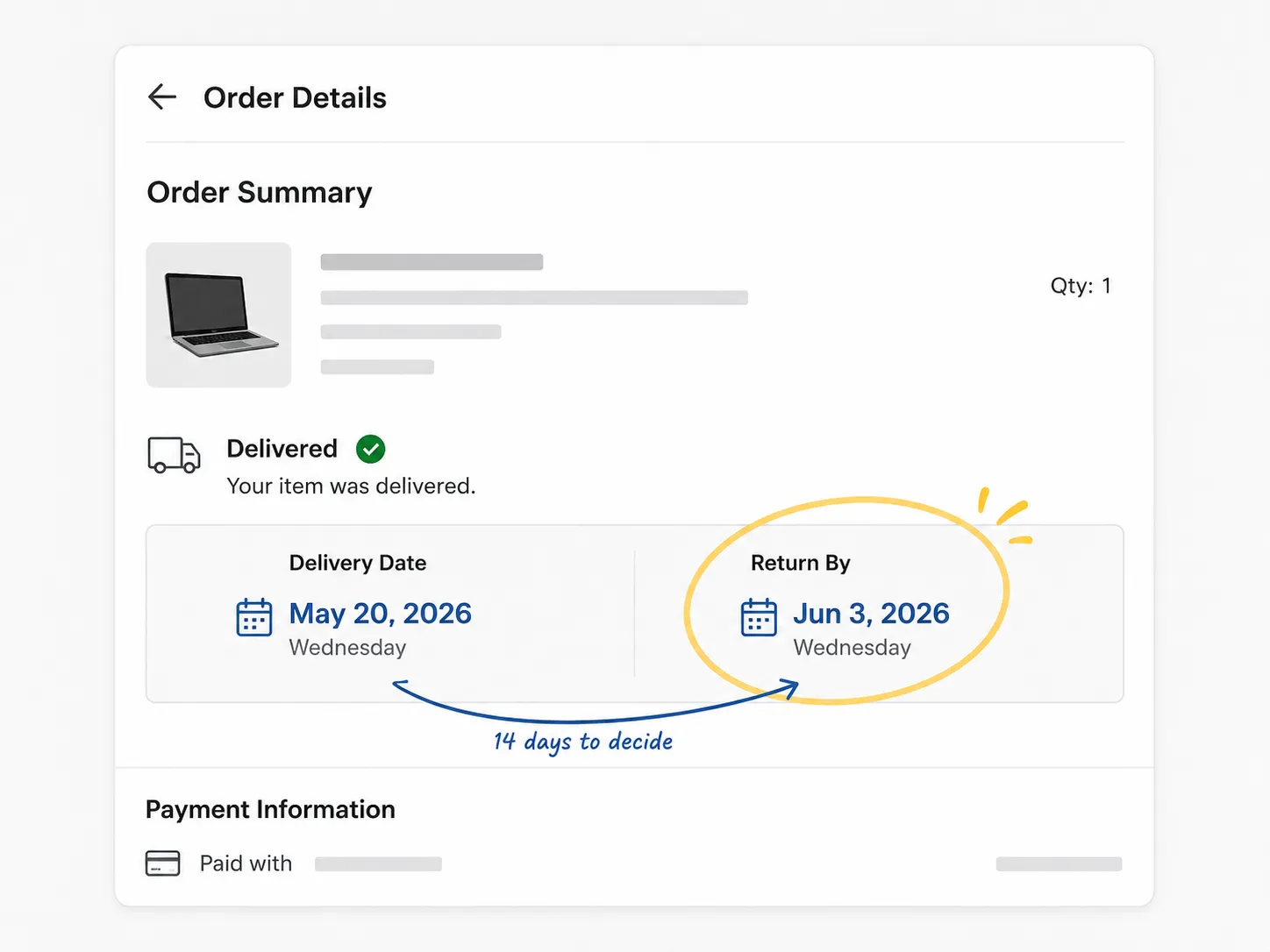
Two traps cost online shoppers refunds, and most guides skip both. First, the return window does not always start when your package lands: most major retailers count from the delivery date, but some count from the purchase or ship date, which quietly shrinks the time you actually have.
Second, plenty of items cannot come back at all, including final-sale goods, opened beauty and digital products, perishables, and personalized orders. Read the window and the exceptions before you buy, not after.
Gotcha one: thirty days from what. A short window plus a slow delivery is a refund killer.
My Best Buy order was the near-miss: the standard window is just 15 days and the clock started the day the item arrived, so a few slow shipping days ate into the time before I had even opened the box. Best Buy’s return policy confirms the 15-day standard and that the period begins the day you receive the product, the tightest of the major stores.
When you shop several retailers, this is exactly the cross-store risk no single store’s page warns you about. The easiest stores to deal with are covered in our look at which stores rank best for returns.
Gotcha two: what cannot come back. Some categories are non-returnable almost everywhere:
Final-sale and clearance items marked as such at checkout.
Opened cosmetics, fragrance, and personal-care goods at many stores.
Digital downloads, software keys, and opened media.
Perishables, hazardous materials, and live items.
Personalized, customized, or engraved products.
Your proof of purchase online is usually just your account order record or the QR receipt, so you rarely need a paper slip.
Return-and-rebuy is legitimate, flagging is real. If a price drops inside your window, returning and repurchasing at the lower price is fair game, but stacking returns or returning at an unusually high rate can get you flagged for return abuse.
Online Return Policies Compared, Amazon, Walmart, Target, Best Buy and Macy’s (2026)
Among major online stores, return windows in 2026 stretch from Best Buy’s 15 days to Walmart’s and Target’s 90, and return shipping is free in store but frequently deducted by mail, such as Macy’s $9.99 charge for non-members. No single retailer publishes a side-by-side view, so the table below pulls each store’s official policy into one place.
I verified every cell against the retailers’ own return pages and ran one real return at each store in May 2026 to check the fees against reality.
How I tested: one online order of roughly $40 to $120 at each of the five stores, returned in May 2026 from a single US metro, with each window, fee, and refund time logged in a spreadsheet.
Store | Standard return window | Where you start it | Return-shipping cost | In-store drop-off | Notes and the catch |
|---|---|---|---|---|---|
Amazon | 30 days from delivery (15 days for some electronics) | Your Orders, online or app | Free box-free at Kohl’s, Whole Foods, Staples, UPS; $1 if you pick UPS when a free spot is closer | Yes, at partner counters, not Amazon stores | Up to 20% restocking past the window; returnless refunds on some low-value items |
Walmart | 90 days for most items (marketplace items 30 days) | Walmart.com or app, Start a Return | Free in store or a free mailed label for most items | Yes, at any Walmart store | Marketplace sellers set their own rules and may add up to 20% restocking |
Target | 90 days for most items (Target-owned brands up to 1 year) | Target.com or app | Free in store or free mailed label | Yes, at any Target store | Some electronics carry a shorter 30-day window |
Best Buy | 15 days standard (60 days with My Best Buy Plus or Total; 14 days for activatable devices) | BestBuy.com account | Free prepaid label; free in store | Yes, at any Best Buy store | $45 restocking on activatable devices, 15% on opened cameras, drones, projectors; no restocking fee in AL, CO, HI, IA, MS, OH, OK, SC; clock starts at delivery |
Macy’s | 30 days (Apple and designer brands 14 days) | Macys.com account | $9.99 mailed fee for non-members, free for Star Rewards; free in store | Yes, at any Macy’s store | 15% restocking on furniture and lighting; Last Act items are final sale; online clock starts at delivery |
Reading the table, the split is clear. Walmart and Target give you the most room at 90 days and free returns either way, while Target’s returns page and Walmart both let an online order come back to any store.
Best Buy is the one to watch, since 15 days from delivery is genuinely tight for electronics you may not fully test in two weeks. Macy’s sits in the middle: generous enough at 30 days, but the $9.99 mail fee punishes anyone who does not drop off in store or join the free rewards tier.
Amazon wins on convenience rather than window length, thanks to its box-free counters, though the $1 UPS quirk and restocking on late returns are the fine print.
Here is what my five returns actually produced:
Store | How I returned it | Window I had | Fee charged | Days to refund |
|---|---|---|---|---|
Amazon | Box-free QR drop-off at Kohl’s | 30 days from delivery | $0 | 3 |
Walmart | In-store drop-off | 90 days | $0 | 4 |
Target | In-store drop-off | 90 days | $0 | 4 |
Best Buy | Mailed with the free prepaid label | 15 days from delivery | $0 | 8 |
Macy’s | Mailed with the UPS label | 30 days | $9.99 | 6 |
The table covers first-party items. Third-party marketplace sellers on Amazon, Walmart, and Target set their own windows and fees, so a marketplace order can differ from everything above.
Your Rights, Is There a Federal Online-Return Law?
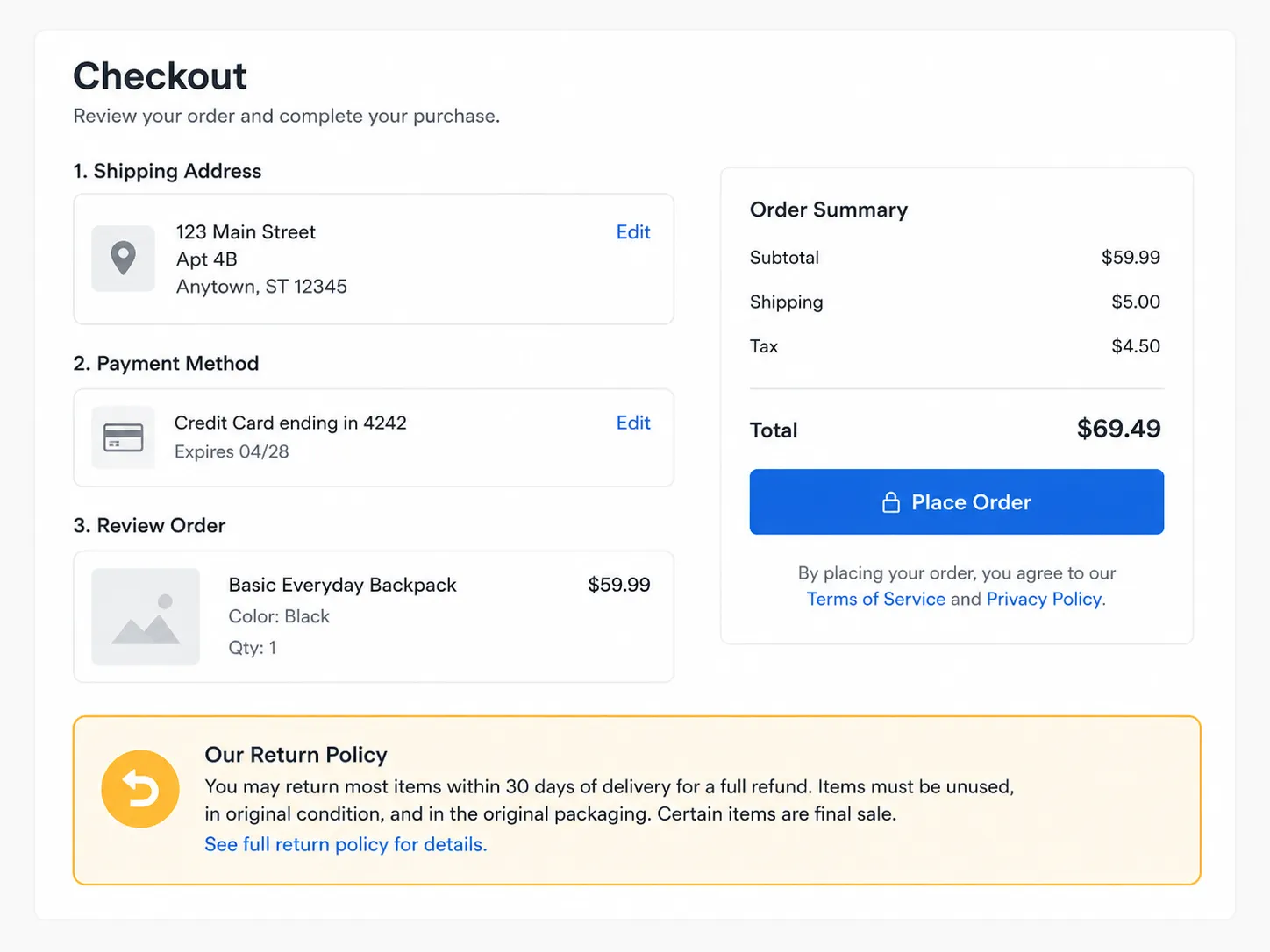
There is no federal law that forces a store to refund a change-of-mind online purchase. In the United States, the policy you agreed to at checkout generally governs, and your real federal protections are narrow: defective goods, the FTC Cooling-Off Rule for certain door-to-door sales, and the FTC Mail, Internet, and Telephone Order Rule that says a seller must ship on time or offer a refund.
About a dozen states add disclosure rules, and California sets a 30-day default refund right when a store posts no policy at all.
So where is your leverage as an online shopper? It sits in three places: a defective item triggers an implied-warranty claim, a late or non-shipped order is covered by the FTC’s mail-order rule, and your credit-card chargeback is a backstop when a store will not make it right.
The state angle matters too. According to the California Attorney General’s refund guidance, a California retailer that fails to post its policy must accept returns for a refund or credit within 30 days, and a handful of other states have their own posting requirements.
A practical note from the test: when one store offered me store-credit-only, I checked the posted terms I had agreed to before pushing back, and the posted policy is what governed.
This is not legal advice. State rules vary and change, so check your own state attorney general’s office for the rules where you live.
Why Online Returns Are Getting Stricter in 2026
Online returns are quietly getting more expensive. In 2026 the majority of major retailers charge for at least some returns, and according to a National Retail Federation survey, 72% of retailers now charge a return fee, up from 66% a year earlier.
The fees that used to hit only bulky goods are spreading to clothing and beauty, and several stores have shortened their windows at the same time.
The 2026 examples are easy to spot once you know them. Amazon added its $1 UPS fee, Macy’s deducts $9.99 on mailed returns for non-members, Best Buy holds the line at a 15-day standard window, and off-price chains like Marshalls and T.J. Maxx now subtract around $11.99 per mailed package.
Why the shift? Reverse logistics is genuinely expensive, and return fraud and abuse have pushed retailers to recover costs, though the change is gradual rather than universal.
My test showed the practical effect: Macy’s actually charged me $9.99 by mail, and at Amazon I sidestepped the $1 UPS fee by choosing the Kohl’s drop-off, while the other three offered free return shipping either way.
What to do about it. Drop returns off in store whenever you can, and check whether your window counts from purchase or delivery before you buy. The trend is real but not absolute, and a few retailers still ship returns free, including some of the stores with the stingiest policies on other fronts.
Frequently Asked Questions
Can I return an online order in store?
Usually yes. Walmart, Target, Best Buy, and Macy’s all accept their own online orders at any store, and the refund often processes immediately.
Amazon is different: you return Amazon orders at partner counters such as Kohl’s, Whole Foods, and Staples rather than at Amazon-branded stores. When I returned mine in store, the shipping was free.
How long do I have to return an online order?
Commonly 14 to 90 days, depending on the retailer and the item. Walmart and Target give you about 90 days, Amazon 30 from delivery, and Best Buy just 15.
Check whether the clock starts at delivery or at purchase, because a short window plus slow shipping can leave you less time than you expect.
Do I have to pay for return shipping?
Often by mail, rarely in store. Several retailers deduct a return-shipping fee from your refund for mailed returns, such as Macy’s $9.99 for non-members, while an in-store or box-free drop-off is almost always free.
Choosing the in-store option is the simplest way to keep an online return free.
What can’t I return online?
Final-sale and clearance items, opened cosmetics and fragrance, digital downloads and software keys, perishables and hazardous goods, and personalized or customized products are generally non-returnable. These exclusions are listed at checkout or on the product page, so confirm before buying anything you might send back.
Can a store give me store credit instead of a refund?
Yes, if its posted policy says so or you lack proof of purchase. Many stores issue merchandise credit for returns without a receipt, often at the item’s lowest recent price.
The store-credit-only surprise is legal when the posted terms allow it, so read the policy you agree to at checkout.
Conclusion
The return policy for online shopping in 2026 comes down to two levers most guides bury: whether you mail the item or drop it off in store, and whether your window counts from purchase or from delivery. Get both right and the store you bought from matters far less than the method you choose.
The one habit that saved me money across all five test returns was simple: drop it off in store when you can, and check the window before you buy. Policies keep changing, so verify the current terms at checkout rather than trusting a number you remember from last year.
Read it your way
Short on time? Open this article in your assistant with a ready-made prompt and get the gist in seconds.
Found this useful? Make us a preferred source so we show up in your Google results.
Keep reading
Related articles

Best & Worst Return Policies
Satisfaction Guarantee Companies: Who Refunds (2026)
See which stores and brands still honor a 100% satisfaction or money-back guarantee in 2026: what each covers, how to claim a refund, and your FTC rights.
Best & Worst Return Policies
Valid Reasons to Return an Item - Do You Even Need One? (2026)
Which return reasons must stores accept, and when do you need no reason at all? A shopper-first guide to getting your refund — even at "no-return" stores.
Best & Worst Return Policies
What Is a Good Return Policy? 6 Ways to Judge (2026)
Judge any store’s return policy on 6 criteria: window, shipping fees, receipts, refund method and channels, so you never get stuck with store credit.
Best & Worst Return Policies
No Return Policy: Is It Legal? (And How to Get a Refund)
Yes - a posted no return policy is legal. But defective, not-as-described, and chargeback rights survive it. Here's how to get your money back.
The discussion
Comments
Every comment is reviewed before it goes live.