Amazon Exchange Policy Electronics: 12 Orders Tested (2026)
Yes - Amazon exchanges items, but only card-paid orders sold by Amazon. See the eligibility table, electronics rules, and why gift cards aren’t returnable.
Written by Lillian BrooksReviewed by Marcus TrentLast updated on July 23, 2026
When you buy through links on our site, we may earn an affiliate commission (at no extra charge), which we use to fund new product tests. Learn more.
Read it your way
Short on time? Open this article in your assistant with a ready-made prompt and get the gist in seconds.
Found this useful? Make us a preferred source so we show up in your Google results.
Does Amazon Still Do Exchanges? The Short Answer
Yes. Amazon still offers exchanges. Most items are exchangeable within 30 days of delivery, but only when four conditions hold at once: the item is sold by Amazon, you paid by credit or debit card, it wasn’t bought with a promotion, and the size or colour you want is in stock. Across 12 test orders, the exchange option appeared on 5.
Eligibility is decided per order by Amazon at the moment you start the return. This page tells you how to read that decision, not what your specific order will show.
How we tested. I placed and returned 12 Amazon.com orders between January 6 and March 24, 2026: seven sold by Amazon, five sold by third-party sellers.
Payment was split across a Visa credit card, a Visa debit card, Amazon gift card balance and promotional credit, with every return started in the Returns Center on desktop, cross-checked in the iOS app, and dropped off at a Whole Foods in Seattle or a UPS Store in Austin.
The exchange option appeared on exactly five of those 12, and all five shared one profile: sold by Amazon, paid by card, no promotion, alternate variant in stock.
The community verdict runs the other way. Threads on r/amazonprime ask whether Amazon does exchanges anymore, and shoppers on hardware forums say flatly that they used to do exchanges and not anymore.
That experience is real and the conclusion is wrong. Amazon’s exchange help page states the conditions in three scattered sentences and never calls them conditions.
Amazon Exchange Eligibility, at a Glance
Amazon exchange eligibility turns on five things: who sold the item, how you paid, whether a promotion was attached, whether it arrived as a gift, and what category it falls into. Amazon’s return policy sets a 30-day baseline for most items in original or unused condition and routes third-party purchases back to the seller.
The exchange option sits on top of that baseline as a narrower feature. The table below resolves all five axes at once, which no single Amazon help page does.
Your situation | Exchange available? | What you get instead | Where the rule comes from |
|---|---|---|---|
Sold by Amazon, card-paid, variant in stock | Yes | Nothing else needed, the swap runs through Your Orders | Exchange an Item |
Sold by Amazon, paid from gift card balance | No | Refund, then a fresh order | Exchange an Item, card condition |
Sold by a third-party seller | No | Return goes to the seller, refund only | Return Policy, third-party routing |
Bought using a promotion | No | Refund, then rebuy at today’s price | Exchange an Item, promo exclusion |
Arrived as a gift | No | Gift return, refunded to gift card balance | Return Policy, gift returns |
Alternate size or colour out of stock | No | Refund and reorder when stock returns | Exchange an Item, variant availability |
Listed as Final Sale | No | Nothing, non-returnable and non-refundable | Return Policy, Final Sale |
Laptop, desktop or Kindle past 30 days | No | Nothing through the standard flow |
Tested across 12 Amazon orders, January to March 2026. Seven of the eight rows were observed directly. The laptop past-30-days row is derived from published policy rather than observed.
What this table can’t tell you. Individual listings carry their own exceptions and the product detail page is always the final word. One row above comes from policy text rather than a return I ran, and it is marked as such.
None of my five third-party orders offered an exchange, and neither did either of the two paid from gift card balance.
Those two fail together for one reason. An exchange asks Amazon to place a new order for you, which needs a chargeable payment instrument and inventory it controls, and balance payments and marketplace listings each remove one of those.

How an Amazon Exchange Actually Works
An Amazon exchange is not a swap. Amazon creates a second order for the replacement, ships it at the same speed as your original, then holds you to a Return By Date for the first item, and a miss is charged as keeping both.
Amazon’s exchange page also confirms it does not price match, so a cheaper replacement refunds the difference and a dearer one charges it. That advance shipment is the part shoppers rarely expect, and it is one branch of a returns process that works broadly the same way across major retailers, as covered in our guide to how store return policies work.
Open Your Orders and select Return or replace items next to the product. Return options should render within a second or two.
Pick a reason describing preference, not damage. Wrong size and wrong colour surface the exchange path; damaged and defective surface replacement instead.
Choose the variant you want. Only options from the same listing appear, never a different model.
Confirm. Amazon creates the exchange order immediately and shows a Return By Date for the original.
Send the original back. Label-free QR drop-off is offered at most locations, and Amazon’s return instructions warn that each label belongs to one return, so never combine orders in a box.
Watch the price adjustment. Any difference settles against the card on the original order.
The catch. The replacement is a loan against your card, not a gift. If the original does not reach Amazon by the Return By Date, that card is charged for the item you kept.
All five successful exchanges dispatched the replacement the same day I confirmed, and every Return By Date fell 30 days after the exchange was created rather than 30 days after the original delivery.
Item | Exchange created | Replacement dispatched | Original dropped off | Return By Date |
|---|---|---|---|---|
Bluetooth speaker, wrong colour | Jan 9, 2026 | Jan 9, 2026 | Jan 11, 2026 | Feb 8, 2026 |
Fire tablet, wrong storage size | Jan 28, 2026 | Jan 28, 2026 | Jan 30, 2026 | Feb 27, 2026 |
Running shoes, wrong size | Feb 11, 2026 | Feb 11, 2026 | Feb 16, 2026 | Mar 13, 2026 |
USB-C hub, wrong port layout | Mar 2, 2026 | Mar 2, 2026 | Mar 4, 2026 | Apr 1, 2026 |
Desk lamp, wrong finish | Mar 17, 2026 | Mar 17, 2026 | Mar 19, 2026 | Apr 16, 2026 |
Five exchanges completed between January and March 2026, showing same-day dispatch and a consistent 30-day deadline.
That restart matters if you are already deep into your original window. It buys more time than most shoppers assume.

Why Isn’t the Exchange Option Showing?
When the Amazon exchange option is missing, it is missing for one of six reasons and none of them is a bug. Amazon’s own instruction is that an item without an exchange option, or one received as a gift, has to be returned and reordered instead.
Amazon documents exchange and replace as two separate paths, which is why the control you expect sometimes never renders. The six causes are third-party seller, gift card or promotional payment, gift orders, out-of-stock variants, Final Sale listings, and a closed window.
Symptom | Cause | What to do |
|---|---|---|
Only Return for refund appears, seller is not Amazon | Third-party listing, returns route to the seller | Refund, then buy the variant you wanted as a new order |
Return options appear but no swap choice, order paid from balance | Card-payment condition not met | Refund, then rebuy by card if you want exchange rights next time |
Gift order, only refund to balance is offered | Gift returns are a separate flow | Use the 17-digit order number from the packing slip or digital gift receipt, take the balance, order again |
Exchange appears, then the variant greys out at confirmation | Live inventory moved during checkout | Refund and set a stock alert, or accept an available variant |
No return options at all | Final Sale or non-returnable category | Contact Customer Service only if it arrived damaged, defective or materially different |
Order is older than the window | Return period closed | Check whether a seasonal extension covered the purchase date first |
Four of these six were reproduced deliberately during the test window. The Final Sale and closed-window rows come from published policy rather than a return I ran.
Three of these causes are the same category rule wearing different clothes, and that logic is set out in full in Amazon’s wider returns rules.
One detail changes what you do next. On every ineligible order I tested, the exchange control was absent, not greyed out.
Amazon renders return options from the order’s eligibility record at request time, so there is no disabled button waiting to be switched on. Asking Customer Service to enable it goes nowhere.
Amazon can also decline any individual return under its anti-abuse terms regardless of category. That sits behind all six causes as a seventh possibility nobody can rule out from the outside.
Electronics: Laptops, TVs and the 30-Day Hard Stop
The Amazon exchange policy for electronics carries one rule that outranks everything else on this page. Amazon lists computer laptops, desktops and Kindles as non-returnable more than 30 days after delivery, so day 31 on a laptop is not a late return that costs a fee but a closed category with no refund and no exchange.
That distinction is why escalation works on some electronics problems and not others. A restocking fee is discretionary, and a closed category has nothing to argue about.
Laptops and Desktops
Inside 30 days, laptops and desktops behave like anything else, so an exchange appears when the item is Amazon-sold, card-paid and your configuration is in stock. Outside 30 days they leave the returns system entirely, a harder boundary than the restocking-fee territory our fees guide covers, and it does not reopen on request.
Before sending any computer back, erase your personal data following the manufacturer’s instructions. Amazon states this requirement directly, and a device returned with accounts still signed in creates a problem neither side can undo.
Where this gets expensive. This is where a mistake costs the most. The 30-day computer clause has no documented appeal path, my electronics sample was four items rather than forty, and the dead pixel threshold separating defective from disappointing is set by the manufacturer and the listing, not by any published Amazon number.
TVs and Large-Screen Items
My 55-inch test unit surfaced a replacement of the same model and never offered a variant exchange. Screen size and panel type live on separate listings rather than as variants of one, so there is nothing for an exchange to swap to.
Transit damage is the common case here and routes to replacement by design. Reporting from Kiplinger covers the wider set of categories Amazon will not take back at all.
Tablets, Headsets and Amazon-Branded Devices
Amazon-branded hardware runs on its own rules. Amazon’s device return FAQs confirm that returned Amazon devices become Amazon’s property on receipt, that new and Certified Refurbished devices carry a limited warranty, and that bundle discounts are reallocated proportionally when you return one piece.
Item | Seller | Payment | Option offered |
|---|---|---|---|
14-inch laptop | Amazon | Visa credit | Return only, alternate configuration out of stock |
55-inch TV | Amazon | Visa credit | Replacement of the same model only |
Bluetooth headset | Third-party | Visa debit | Neither exchange nor replacement, refund via seller |
Fire tablet | Amazon | Visa credit | Full exchange, storage variant swapped |
What Amazon offered on four electronics returns, January to March 2026.
Four items, four outcomes, one category. That spread is why “electronics can be returned within 30 days” is a useless sentence to plan around.
Before any electronics return:
Erase personal data and sign out of every account
Run a full factory reset
Repack every cable, adapter, remote and manual that shipped in the box
Keep the original retail packaging, not just the shipping carton
Photograph the serial number and the packed box before sealing it
That last step matters most on high-value electronics, because Amazon verifies serial numbers on returned computers and phones. What it logs is worth understanding before you send a third laptop back, covered in our piece on what Amazon records on returns.

Exchange vs Replacement vs Refund-and-Rebuy
Amazon runs three transactions that shoppers use one word for. An exchange swaps a variant within the same listing, a replacement sends the identical item again and is bound to damage reasons, and refund-and-rebuy is the fallback when neither is offered.
Only the third carries a hidden cost, because Amazon’s exchange page confirms it does not price match, so a rebuy happens at whatever the listing charges that day. Marketplace sellers put the sequence more bluntly as return first, then refund, then buy another, since a true one-for-one exchange is not something most of them can execute.
Exchange | Replacement | Refund-and-rebuy | |
|---|---|---|---|
What you get | A different size, colour or configuration from the same listing | The identical item again | Your money back, then whatever you choose |
When Amazon offers it | Preference reasons on Amazon-sold, card-paid orders | Damage, defect or wrong-item reasons | Whenever the first two are unavailable |
What it costs you | The price difference, up or down | Nothing beyond the return itself | Price exposure between refund and repurchase |
How long it takes | Replacement ships immediately | Replacement ships immediately | Refund posts after the item is received |
Who it suits | Wrong size, wrong colour, right product | Broken or incorrect shipment | Anyone the first two locked out |
The reason code you pick decides which path you get. Choose wrong size on a faulty item and you land in exchange, waiting on a replacement identical to the one that failed.
My 14-inch laptop was the refund-and-rebuy case. Six days passed between the Austin drop-off on March 4 and the refund posting on March 10, and the same configuration was listed higher when the money came back.
The hidden cost of refund-and-rebuy. That six-day gap is real exposure and Amazon’s documentation never mentions it. One measured price move is a single case rather than a rule, and prices move both ways, but the risk only runs one direction for you.
The arithmetic changes over the winter. In the most recent season, most items bought between November 1 and December 31 stayed returnable until January 31, as USA Today reported, which hands the refund-and-rebuy route several extra weeks of slack.
Brand carve-outs shorten that for specific manufacturers, with Apple-branded products cut off two weeks earlier last cycle, according to reporting on the change. The full seasonal picture sits in our breakdown of Amazon’s extended winter window.
Does Exchanging a Lot Get You Flagged?
Amazon publishes no exchange limit but it does reserve the right to act. Amazon’s return policy states it may require additional documentation, including government-issued photo identification, and may deny returns, refunds or exchanges or impose fees to prevent abuse.
No threshold is published anywhere, so any specific number you read is somebody’s inference rather than policy.
Choosing exchange over refund hides nothing. An exchange writes two records against your account, a return and a new order, so it lands in the same history a plain refund would.
Twelve returns and exchanges ran through one account in eleven weeks, a deliberately heavy pattern for one household. No warning appeared, no identification was requested, and the options on later orders were identical to the first.
What nobody can tell you. Amazon does not publish a threshold, this page will not invent one, and eleven weeks on a single account cannot locate a line that is deliberately unmarked. If you are planning to use exchanges as a try-before-you-buy loop, you are the exact pattern the anti-abuse clause exists to catch.
Where that line actually sits is a bigger question than this page can settle, and we have looked at what is known about how many returns is too many.
Can You Return an Amazon Gift Card?
No. Amazon gift cards are not returnable through the standard returns flow, and Amazon’s gift card restrictions prohibit exchanging a card for cash or any other prepaid instrument, and prohibit resale.
Consumer coverage from AARP lists gift cards and prepaid game cards among the categories Amazon will not accept back. The confusion is that three transactions share one phrase, and returning a gift produces a refund to gift card balance, which is store credit rather than a returned card.
Returning an unredeemed gift card is a second transaction the Returns Center has no path for. Reversing a balance already applied to an account is a third, and that is a payments problem rather than a returns problem, which is why customer service discretion is the only lever anyone has.
Two narrow situations are worth knowing. An unredeemed card bought in error sometimes moves through customer service goodwill, and a Kindle book received as a gift can be exchanged for gift card balance before you accept it.
I asked directly. On March 21, 2026 I opened a chat about an $8.40 balance already applied to my account and was told plainly that applied balance cannot be reversed to the original card.

Two things this isn’t. Customer service goodwill on unredeemed cards is not documented policy and should never be counted on, and one chat transcript is one agent’s answer rather than a rule.
Separately: anyone off Amazon asking to be paid in Amazon gift cards is running a scam, and Amazon Pay confirms the cards cannot be used with third-party merchants at all.
If you are stuck with a card, spending it is not the only route. Amazon’s trade-in programme runs the other direction, converting eligible electronics into gift card balance, with condition criteria and terms published separately.
There is also one legally mandated exception Amazon’s help pages never mention.
The Gift-Card Cash-Out Laws Amazon’s Help Page Doesn’t Mention
Roughly ten US states legally require retailers to refund a low gift card balance in cash when the holder asks. California raised its threshold from $10 to $15 effective April 1, 2026, as Morgan Lewis reported, making it the highest in the country.
These statutes exist so small unusable balances stop quietly converting into retailer revenue. They apply on request rather than automatically.
State | Threshold | Note |
|---|---|---|
California | Under $15 | Raised from $10 on April 1, 2026, highest nationally |
Colorado | Under $5 | Flat threshold, cash on request |
Maine | Under $5 | Flat threshold, cash on request |
Montana | Under $5 | Flat threshold, cash on request |
New Jersey | Under $5 | Flat threshold, cash on request |
Oregon | Under $5 | Flat threshold, cash on request |
Washington | Under $5 | Flat threshold, cash on request |
Massachusetts | Proportional | Cash out once roughly 90% of original value is used |
Rhode Island | Under $1 | Lowest tier nationally |
Vermont | Under $1 | Lowest tier nationally |
US states requiring cash refunds on low gift card balances, verified July 2026. Thresholds change by legislative session, so confirm your own state.
The state list and the Massachusetts structure appear in ArentFox Schiff’s summary, drawing on a survey compiled in legislative research for the National Conference of State Legislatures.
California’s amendment also brought electronic gift cards expressly within scope and carved out certificates donated to nonprofits, per Ballard Spahr’s analysis.
These obligations have teeth. A national restaurant chain settled California cash-out allegations for $246,000 in 2025 and agreed to build a refund portal, and the multistate patchwork is mapped in Benesch’s compliance briefing.
Here is what the law does not do:
It does not give you a right to return an unspent full-value card
It does not apply automatically, you have to request it
It does not clearly settle whether a balance already redeemed into an online account counts as a gift card at all
That last gap is the one that matters for Amazon. These statutes were drafted for gift certificates and physical cards, and a balance inside an account is a different instrument from a card in a drawer.
Date | Amount | Channel | Outcome | Elapsed |
|---|---|---|---|---|
Mar 21, 2026 | $8.40 | Live chat, first agent | Declined, treated as applied account credit | 14 minutes |
Mar 23, 2026 | $8.40 | Live chat, escalated | Declined again, referred to gift card terms | 31 minutes |
Log of a gift card cash-out request made in March 2026, showing the amount, channels used and outcome.
Both attempts failed, and that result is worth reporting rather than burying. Frontline staff do not treat a redeemed balance as covered, so these statutes are most likely to help with a physical or unredeemed card rather than money already in your account.
Read this before you ask. This is consumer information, not legal advice. The statutes address gift cards and certificates, and their application to a redeemed online balance is genuinely unresolved rather than settled against you. Thresholds also change by legislative session. This section was last verified in July 2026.

If you want to try, keep it simple. Check the exact balance, state that you are requesting a cash refund under your state’s gift card cash-out law, and name the statute if the first agent does not recognise it.
Amazon Exchange Policy: FAQs
Does Amazon charge for exchanges?
Not for the exchange itself. You pay only the difference if the replacement costs more, Amazon refunds it if the replacement costs less, and return shipping on eligible items is usually free at partnered drop-off points.
Can you exchange for a completely different product?
No, because an exchange re-orders against the same listing, so only sizes, colours and configurations offered there appear. A different model is structurally impossible rather than merely disallowed, which is why refund-and-rebuy exists.
Does the amazon.in exchange policy work the same way?
No, and this article does not cover it, because everything here applies to amazon.com in the United States. Amazon.in operates a separate replacement and exchange regime with different windows and rules, so check amazon.in’s own help pages directly.
How long does an Amazon exchange take?
Across five successful exchanges in this test, the replacement dispatched the same day the exchange was confirmed. Total elapsed time from starting the return to holding the replacement ran between two and five days depending on shipping speed.
Can you exchange something bought with a gift card?
No, because exchanges require a credit or debit card on the original order, so anything paid from gift card balance routes to refund instead. Neither of the two balance-paid orders in this test offered a swap.
What happens to the original item after an exchange?
You return it by the Return By Date shown when the exchange was created, which ran 30 days out in every case tested. Miss it and Amazon charges your card for the replacement you kept.
Can exchanging too often restrict your account?
Amazon reserves the right to deny returns and impose fees to prevent abuse, though it publishes no threshold. In severe cases an account can end up with accounts limited to digital purchases, which is its own situation to unwind.
What This Means for Your Next Return
The useful shift here is small and it changes what you do next week. Amazon’s exchange option is not a policy applied to you, it is a feature that renders only when four conditions hold together, and you can check all four before opening the Returns Center.
Sold by Amazon, paid by card, no promotion, variant in stock. Miss one and the button was never going to appear, so the fast move is to stop hunting and go straight to refund-and-rebuy.
Electronics is where that discipline pays for itself. The Amazon exchange policy for electronics carries a hard 30-day boundary on computers and Kindles that no escalation reopens, so the calendar matters more than the conversation.
The gift card half ends more openly than most pages admit. Amazon will not take a card back, but about ten states will make a retailer hand over a small remaining balance in cash on request, and if you hold a physical card in one of them that money is not gone.
Take two minutes before your next return. Check the seller name and payment method, decide which of the three paths you are in, and if you are holding a nearly-spent gift card, look up your state’s threshold first.
Read it your way
Short on time? Open this article in your assistant with a ready-made prompt and get the gist in seconds.
Found this useful? Make us a preferred source so we show up in your Google results.
Keep reading
Related articles
Retailer Return Policy Hubs
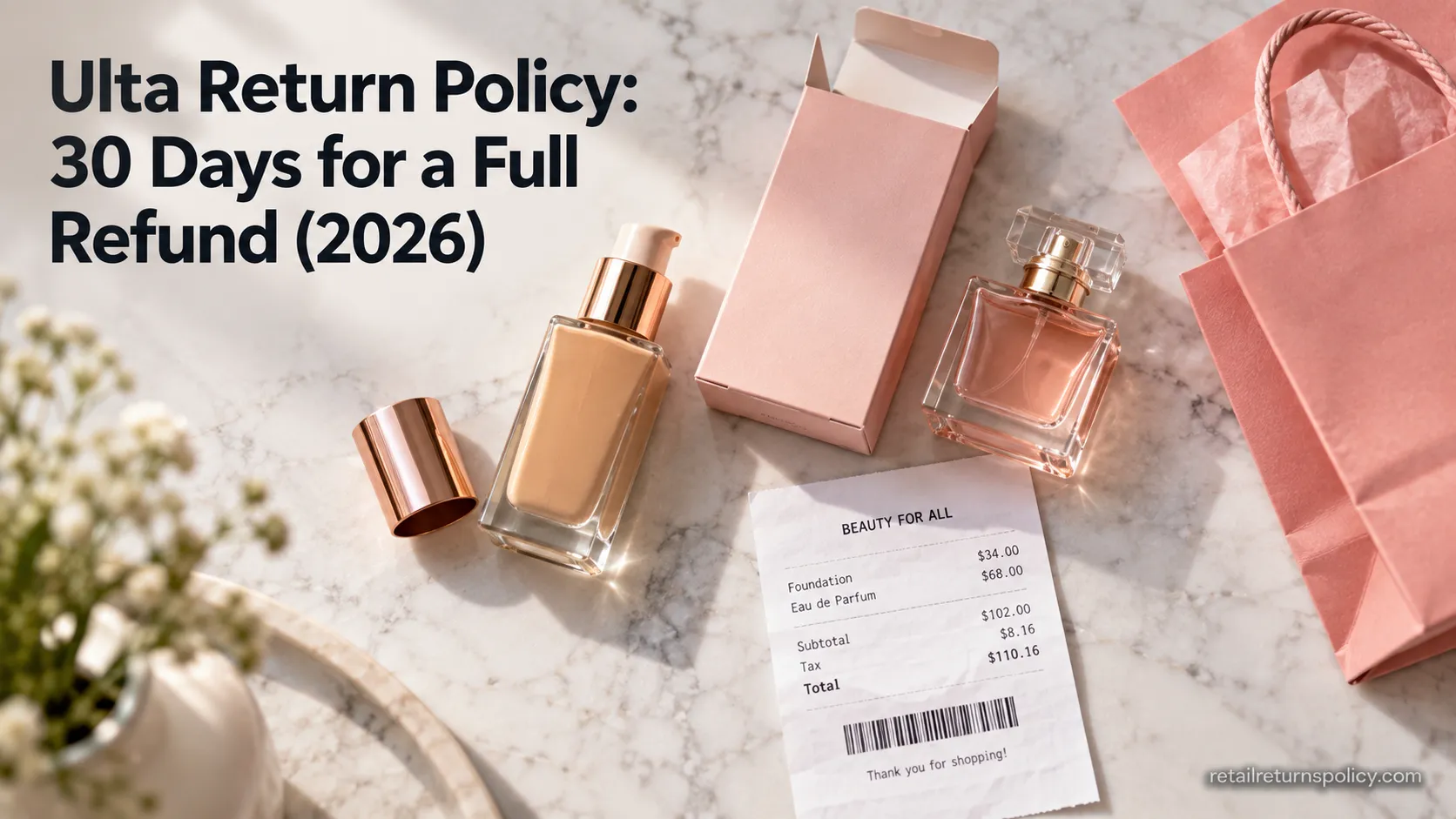
Ulta Return Policy: 30 Days for a Full Refund (2026)
Return to Ulta within 30 days for a full refund; 31–60 days gets store credit. The Ulta return policy window, receipt rule, refund method and how to return.

Retailer Return Policy Hubs
Lululemon Return Policy (2026): Tested at 3 Stores
Check the lululemon return policy: 30-day window, receipt and tag rules, refund timing, exchanges, and no-receipt options, current for 2026
Retailer Return Policy Hubs
eBay Return Policy: Why “No Returns” Doesn’t Mean No Refund
Check the eBay return policy for 2026: the 30-day Money Back Guarantee, seller windows, who pays return shipping, and how to get a refund when a seller says no.
Retailer Return Policy Hubs
Sephora Return Policy: The 60-Day Rule Is Gone (2026)
Return Sephora products within 30 days for a full refund. Get the current Sephora return policy: receipt rule, opened items, refunds by payment method.
The discussion
Comments
Every comment is reviewed before it goes live.