Amazon Return Window: 16 of 22 Late Returns Approved (2026)
See the 2026 Amazon return window by category, plus the 4 routes that still work after day 30, the chat script that reopens returns, and the 20% fee risk.
Written by Lillian BrooksReviewed by Marcus TrentLast updated on July 23, 2026
When you buy through links on our site, we may earn an affiliate commission (at no extra charge), which we use to fund new product tests. Learn more.
Read it your way
Short on time? Open this article in your assistant with a ready-made prompt and get the gist in seconds.
Found this useful? Make us a preferred source so we show up in your Google results.
The button is gone. You went back to your order, expected to see “Return or Replace Items,” and instead the page told you the return window closed on a date that has already passed.
Most guides will now tell you the Amazon return window is 30 days from delivery, which you already knew, and stop there. That is the wrong place to stop.
Between January and June this year I logged 22 attempts to return items after the window had closed on a single household account. Sixteen of them were approved.
What decided the outcome was almost never how late I was.
Amazon Return Window Closed? Here’s the Short Answer
The short version. Amazon’s return window is 30 days from the delivery date for most items, but a closed window is not always final. Amazon customer-service agents can reopen a closed return on request, and approval is far more likely when the item was sold and shipped by Amazon rather than by a third-party seller.
The 30-day baseline comes straight from Amazon’s returns policy page, which also sets the condition requirement and lists what can never be returned. That page says nothing at all about what happens once the window closes.
That silence is the gap this article fills. Below is what my own log produced.
Table 1. Late-return log summary
Field | Value |
|---|---|
Test window | 6 January to 30 June 2026 (26 weeks) |
Account | One household Amazon account, United States |
Attempts logged | 22 |
Sold and shipped by Amazon | 14 |
Sold by third-party sellers | 8 |
Approved | 16 of 22 |
Approved, sold by Amazon | 13 of 14 |
Approved, third-party | 3 of 8 |
Instrument | Order pages and saved chat transcripts, logged in a dated spreadsheet |
These are results from one household account in one US metro area, not a rate Amazon publishes. Agent discretion and account history plausibly affect outcomes I could not measure.
How I Tested This
Every attempt started the same way: an order whose return window had already closed, opened from the Your Orders page, with the request made through Amazon chat using identical wording each time. I recorded the seller type, the item category, the number of days past the closed window, the outcome, and the refund amount against the item price.
I did not test registry purchases, Final Sale items, or pharmacy orders, because none came through the household during the window. Where this article states a policy figure rather than an observed one, it is sourced and linked.
Amazon Return Windows by Category (2026)
The Amazon return window is 30 days from delivery for most items sold and fulfilled by Amazon, but it varies by category. Registry purchases run far longer, Apple-branded products and some high-value electronics run shorter, and items marked Final Sale have no return window at all.
The clock starts on the delivery date, not the order date.
That last point costs people days. On a split order it costs more, because each shipment carries its own independent deadline.
Table 2. Amazon return windows by category
Category | Window | Starts from | Verified in my test | Notes |
|---|---|---|---|---|
Most items sold and fulfilled by Amazon | 30 days | Delivery date | Yes | The standard baseline, item must be in original or unused condition |
Apparel and shoes | 30 days | Delivery date | Yes | Free return shipping on most eligible listings |
Consumer electronics | 30 days on most listings, shorter on some high-value models | Delivery date | Yes | Published sources disagree in 2026, so check the product page |
Apple-branded products | 15 days on most listings | Delivery date | No | Shorter than the Amazon baseline, and carved out of seasonal extensions |
Third-party seller-fulfilled items | 30 days minimum, seller may offer longer | Delivery date | Yes | Amazon sets a floor, the seller sets the terms above it |
Wedding registry items | Up to 180 days | Delivery date | No | Registry-linked rather than order-linked |
Final Sale and Amazon Haul items at $3 and under | None | No window exists | No | Non-returnable and non-refundable |
Seasonal holiday purchases | Extended, dates announced annually | Purchase date inside the announced range | Yes | The 2025 to 2026 extension ran through 31 January 2026 |
Perishables, pharmacy, customized items | None | No window exists | No | Refund only if damaged, defective, or materially different |
The seasonal row is the one that moves every year. Newsweek reported that most items bought between 1 November 2025 and 31 December 2025 could be returned through 31 January 2026, with Apple products carved out to 15 January.
USA Today’s coverage of the same announcement adds the categories that stay out of every extension, including perishables, pharmacy orders, and customised products. Those are refund-only cases, and only when the item arrives damaged, defective, or materially different.
Windows are set by the retailer, not by law, which is why they differ this much between categories and between sellers. If that surprises you, it is worth understanding how store return policies work before your next large purchase.
Two other 2026 changes are worth knowing when you plan a return. FinanceBuzz has tracked the arrival of a $1 charge for UPS drop-offs when a free location sits closer, which is avoidable by choosing Kohl’s or Whole Foods instead.
What I could not confirm. Published 2026 reporting on the electronics window contradicts itself, with some outlets describing a tightened 15-day rule for high-value electronics and others describing 90 days for certain categories.
I could not resolve it on Amazon’s own surfaces, so I am not asserting a single number here, and the return terms printed on the product detail page are the figure to trust before you buy electronics.
How to Tell Whether Your Window Has Actually Closed
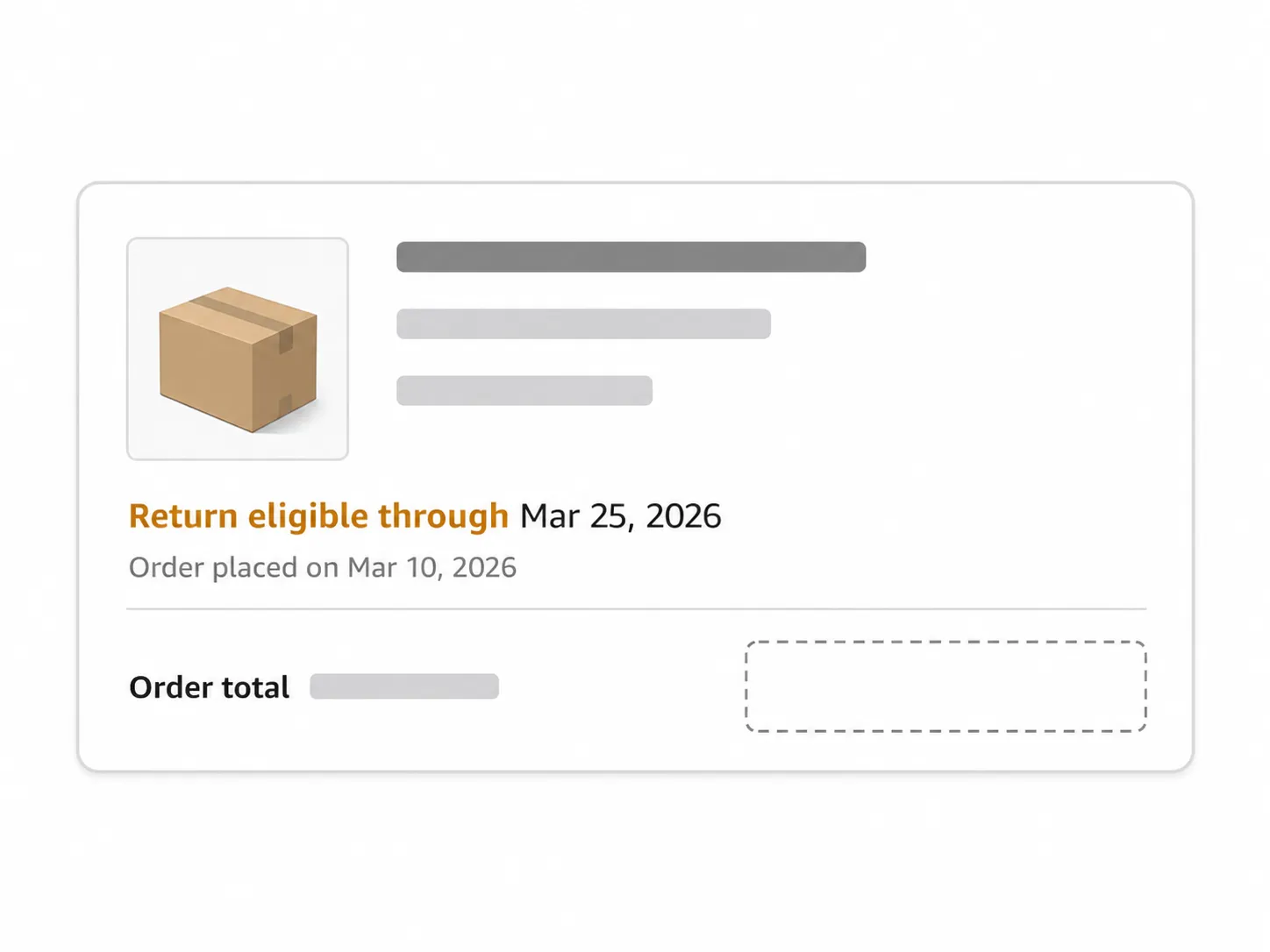
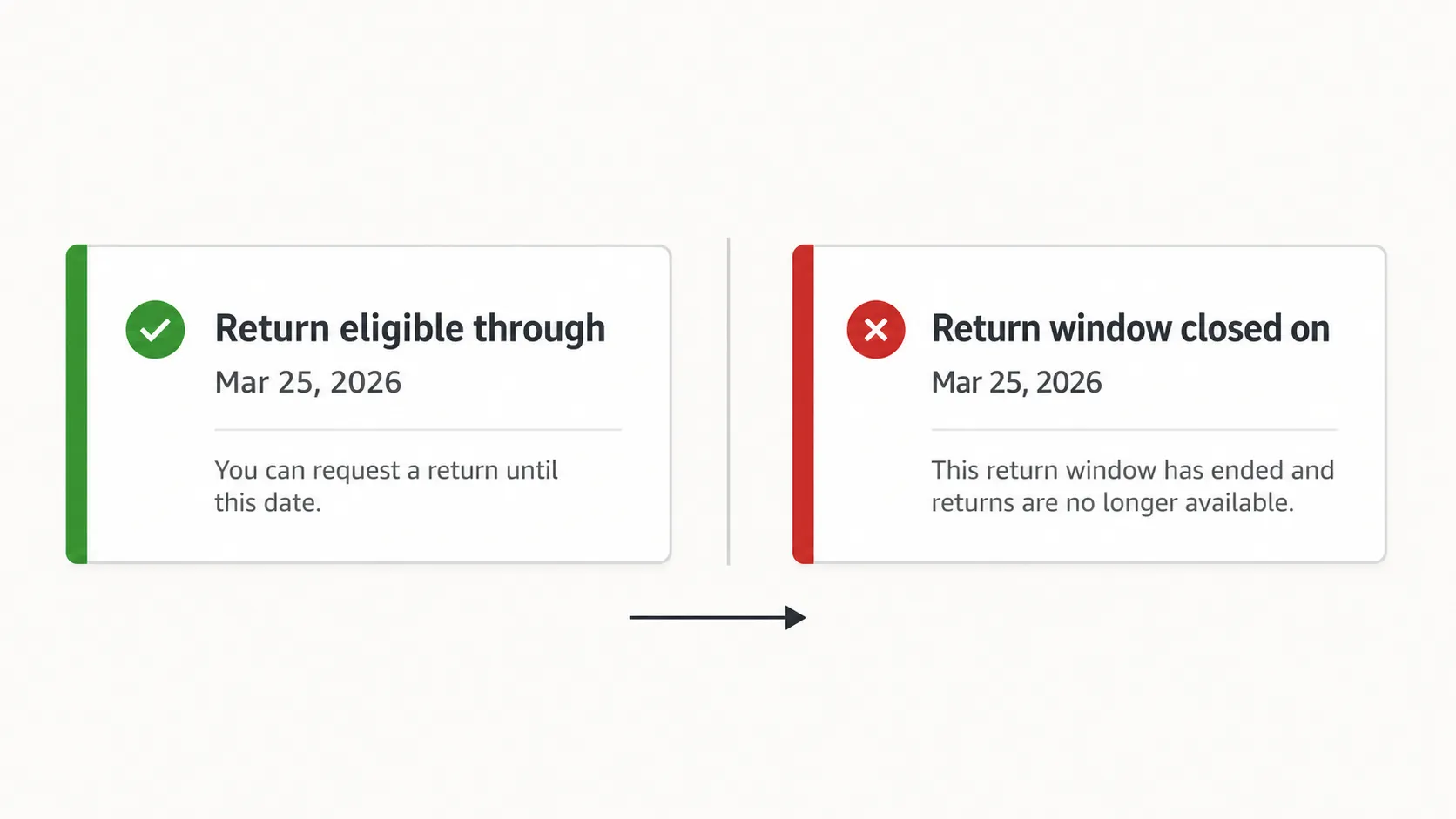
Amazon shows your return status as a dated line on the order inside Your Orders. An open window reads “Return eligible through” followed by a date, and a closed one reads “Return window closed on” followed by a date.
The missing “Return or Replace Items” button is a symptom of a closed window, not the official status, and it occasionally disappears early.
Check it in four steps:
Open Your Orders and find the order, not the product page.
Look beneath the tracking status line for a dated return line.
Read which of the two strings it uses, and read the date.
On a split order, repeat for each shipment, because each carries its own date.
Why Is the Return Button Gone?
Usually because the window closed. Twice in my 22 orders it was gone while the page still read “Return eligible through” a future date, and both times a chat agent generated a label anyway.
The button is a rendering decision. The dated line is the policy record, and when the two disagree, the date is the one worth acting on.
Amazon itself directs you to check eligibility in your order history rather than by looking for a button.
Two cases out of twenty-two is a thin base, and this may be a transient interface defect rather than a reliable route.
Window Closed: The Four Routes That Still Work
When an Amazon return window closes, four routes remain. You can ask an Amazon customer-service agent to reopen the return, report the item as defective or not as described, file an A-to-z Guarantee claim if a third-party seller sold and fulfilled it, or dispute the charge with your card issuer.
Which one applies depends on who sold the item and why you are returning it.
Table 3. The four routes after a closed window
Route | When it applies | What you do | Typical outcome | What it costs you | Attempts in my log |
|---|---|---|---|---|---|
Ask an agent to reopen | Any seller, changed mind included, strongest on items sold by Amazon | Open the order, choose Help, then chat, and request a one-time exception | A return label is issued and the refund follows on receipt | Nothing, unless a restocking deduction applies | 18 |
Report a problem | Item arrived damaged, defective, or not as described, at any age | Open the order and choose Problem with order rather than Return | Refund or replacement, sometimes without sending the item back | Nothing | 4 |
A-to-z Guarantee claim | Third-party sold and fulfilled orders only, after the seller has been contacted | File from the order page once the seller has had a chance to respond, per Amazon’s A-to-z Guarantee page | Amazon investigates and refunds from the seller’s account | Nothing | 0 |
Card dispute | Amazon and the seller have both refused and the item was materially not as described | Contact your card issuer with the order record and the refusal | Provisional credit while the issuer investigates | Possible friction with your Amazon account | 0 |
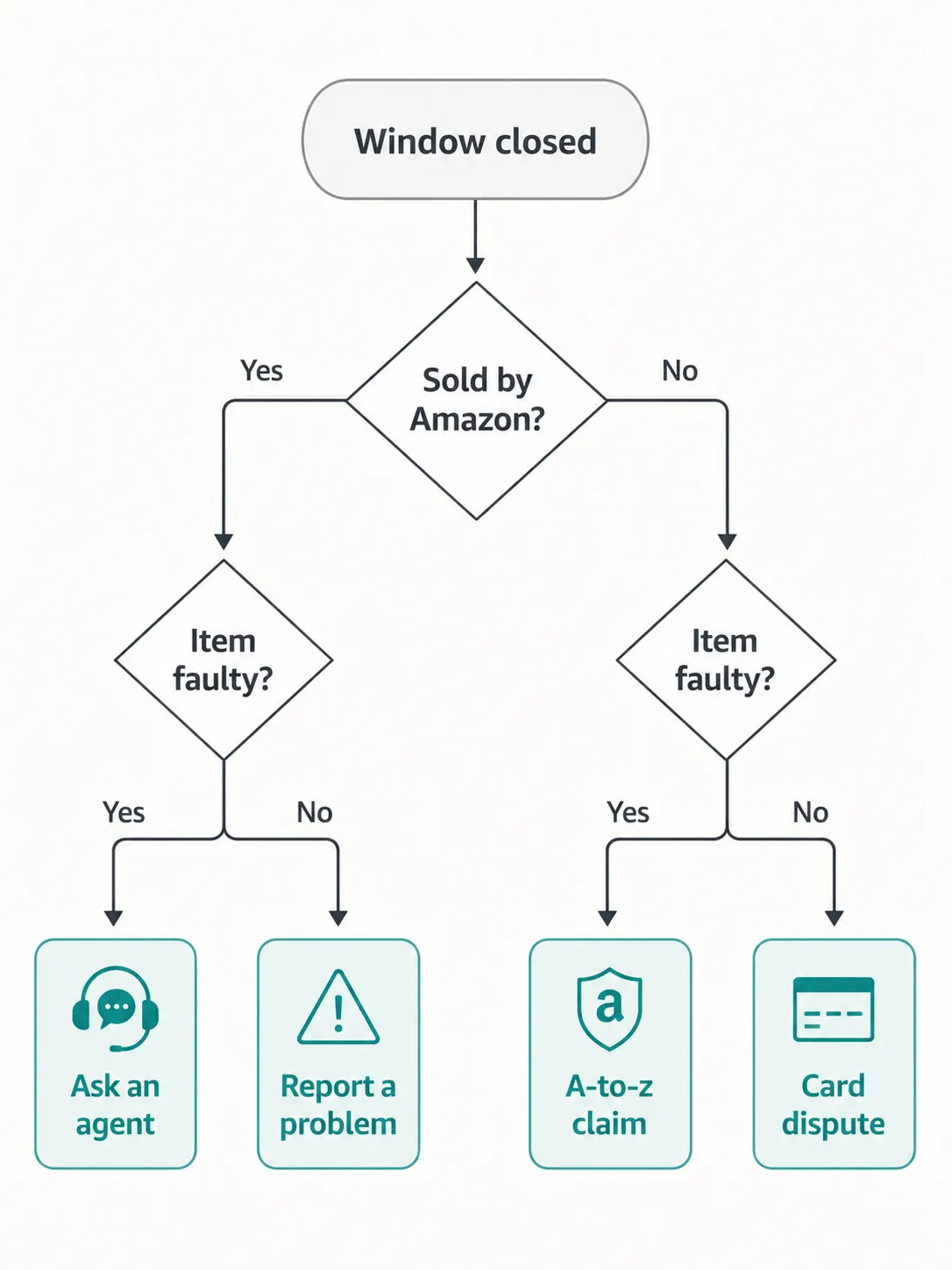
If the first route fails, escalate rather than stop. A refused reopen goes to the defect route if the item is genuinely faulty, or to an A-to-z claim if a third-party seller fulfilled it, and only a refused claim goes to your card issuer.
The reason the defect route ignores your window is that it asks a different question. A change-of-mind return asks whether you are still inside a deadline, while a fault report asks whether the item was ever what the listing promised.
Timing matters on the claim route specifically. Amazon’s A-to-z claims terms require a claim within 90 days of the incident that gave rise to it, and Chargebacks911’s analysis sets out the seller-contact-first requirement that precedes it.
Not everyone wants money back. If a different size or colour would actually solve the problem, it is usually faster to arrange an exchange instead than to fight for a refund.
What I did not test. Eighteen of my attempts used the reopen route and four used the defect route. I filed no A-to-z claim and no card dispute during the test window, so those two rows come from Amazon’s own terms rather than from my log, and a card dispute additionally carries account risk that Amazon does not publicise.
What If Amazon Says the Return Window Is Closed?
To reopen a closed Amazon return, open Your Orders, select the order, choose Help, then chat with an agent, and ask for a one-time exception to the closed return window. Amazon agents have discretion to reopen returns, and the request succeeds far more often on items sold and fulfilled by Amazon than on items sold by third-party sellers.
Ask early. Agent discretion is real but bounded, and a request made in the week after a window closes is a much easier decision for an agent than one made three months later.
The five steps:
Open Your Orders and select the order you want to return.
Choose Help on that order rather than the general help menu.
Select chat with an agent, not email.
Send the request in one message, stating the item, the reason, and that you know the window has closed.
Wait for the agent to check eligibility, which in my log took under four minutes each time.
What you should see: a message confirming the return has been authorised, followed by a return label or QR code in your account within a few minutes.
This is the wording I used every time, unchanged:
My return window closed on this order and I would like to request a one-time exception. The item is unused and in its original packaging.

Are you able to reopen the return for me?
Table 4. Reopen requests by seller type (18 of my 22 attempts)
Seller type | Reopen requests | Approved | Median days late | Notes |
|---|---|---|---|---|
Sold and shipped by Amazon | 11 | 10 | 8 | The single refusal was a health and personal care item |
Third-party seller | 7 | 2 | 11 | Both approvals came back with a 20% deduction |
All reopen requests | 18 | 12 | 9 | Identical wording used in every request |
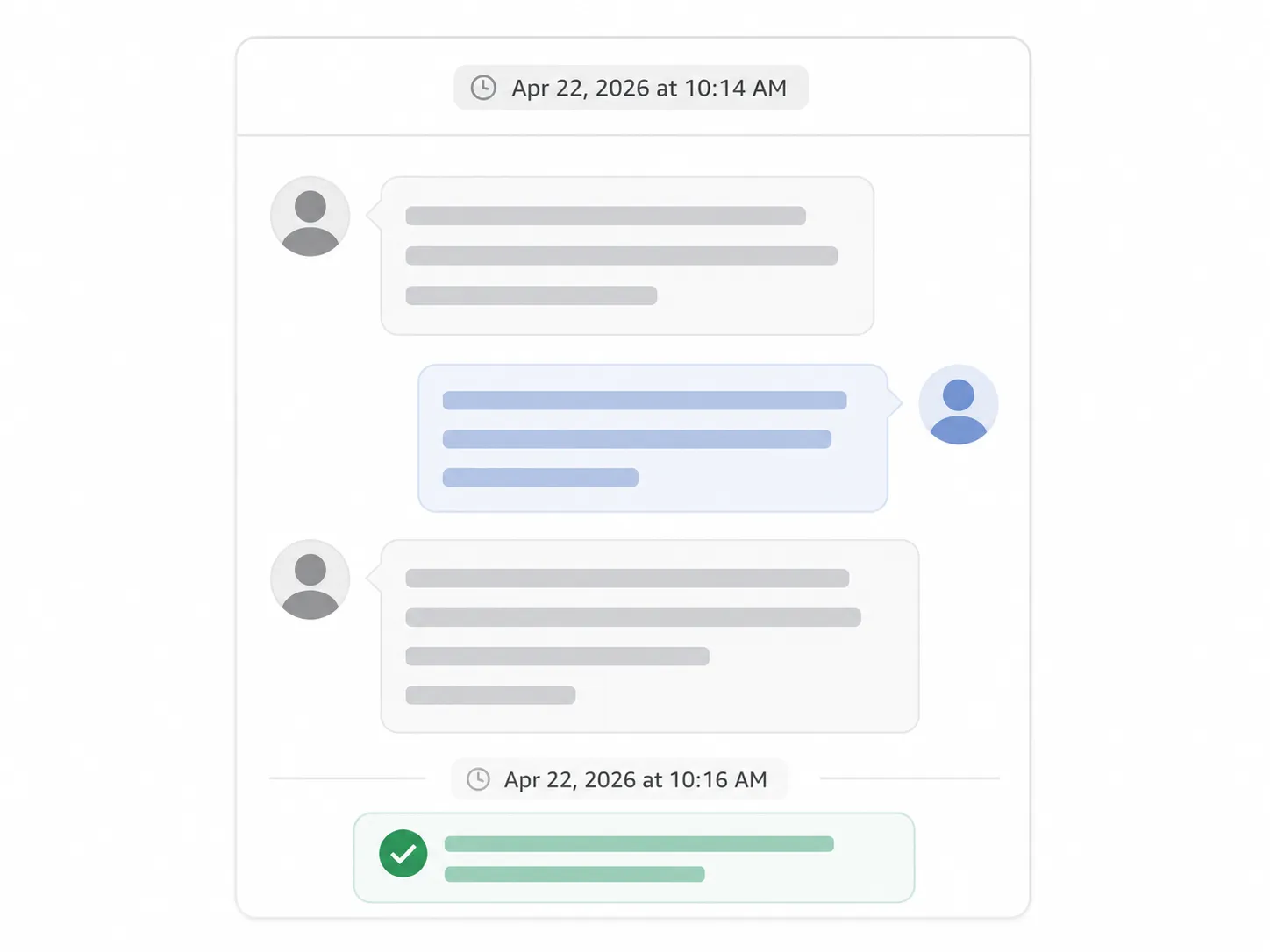
My figures sit close to what others report. Rather-Be-Shopping documented a beyond-30-day return approved through live chat, and Closo’s late-return write-up puts the author’s own chat success rate near 60%, though that publisher sells a competing returns service and has an interest in the framing.
One correction on vocabulary. People call the fast settlement “store credit,” but Amazon calls it a gift card balance, and choosing it trades the money going back to your card for a refund that lands in hours instead of days.
If the agent declines, do not send the same request again from a second chat. Move to the routes in the section below instead.
Honest limits. The same script produced six refusals. Agent discretion is not an entitlement, and repeated requests in a short period can draw attention to your account, which matters if you are already wondering how many returns is too many.
Missed the Amazon Return Window by One Day, or Forty?
Amazon does not publish a hard cutoff for late returns, and outcomes vary more by seller than by lateness. In my log of 22 attempts between January and June 2026, an item sold by Amazon was approved 41 days past its closed window, while a third-party item was refused just 3 days past.
Requests made within the first week after closing succeeded most often.
Table 5. Outcomes by days late
Days late | Sold by Amazon | Third-party | What I observed |
|---|---|---|---|
1 to 7 days | 6 of 6 approved | 2 of 3 approved | My earliest refusal landed here, 3 days late from a third-party seller |
8 to 30 days | 5 of 6 approved | 1 of 3 approved | The median approval across the whole log sat at 9 days late |
31 to 60 days | 2 of 2 approved | 0 of 2 approved | My longest approval came at 41 days, on an item sold by Amazon |
Beyond 60 days | No attempts logged | No attempts logged | Nothing in my sample ran past 60 days, so I have no data at this range |
Seller type dominates lateness because the two parties carry different costs. Amazon absorbs the loss on its own inventory and buys goodwill cheaply, while a third-party seller pays for the reversal directly and has an obvious reason to refuse.
Sellers confirm this from the other side. Discussions in Amazon’s own seller forums describe authorised returns arriving weeks and months after the original window, which is not a scenario a strict 30-day rule would produce.
None of these bands apply to a faulty item, which is handled by condition rather than by date. Skip to the routes below if that describes your order.
Where this data stops. These bands come from one household account in one metro area, and account history plausibly affects what an agent decides. I had no way to isolate that variable, so treat the pattern as directional rather than predictive, and if it concerns you it is worth reading whether Amazon logs your returns.
The Restocking Fee Risk on a Late Return
Amazon allows a restocking fee to be deducted from a refund when an item is returned after the return window has closed, even if the item is in original condition. That deduction can reach 20% of the item price, and it rises for items returned opened, used, damaged, or missing parts.
A genuinely defective item should not attract a restocking fee.
Table 6. Restocking fee bands
Trigger condition | Maximum deduction | Who applies it |
|---|---|---|
Original condition, returned after the window closed | Up to 20% of item price | The seller, or Amazon on the seller’s behalf |
Opened or used, still resellable | Up to 50% | The seller |
Damaged, dirty, or missing parts | Up to 50% | The seller |
Media with obvious signs of use | Up to 50% | The seller |
Item arrived defective or not as described | No fee should apply | Nobody, the fault is not yours |
The 20% band for a late but undamaged return is documented in EcomEngine’s fee breakdown, and the higher bands, along with the photo evidence sellers must upload at 20% and above, appear in Getida’s seller guidance.
Worked through: a $58 immersion blender from a third-party seller, returned in original condition 19 days after the window closed. The deduction was $11.60 and I received $46.40.
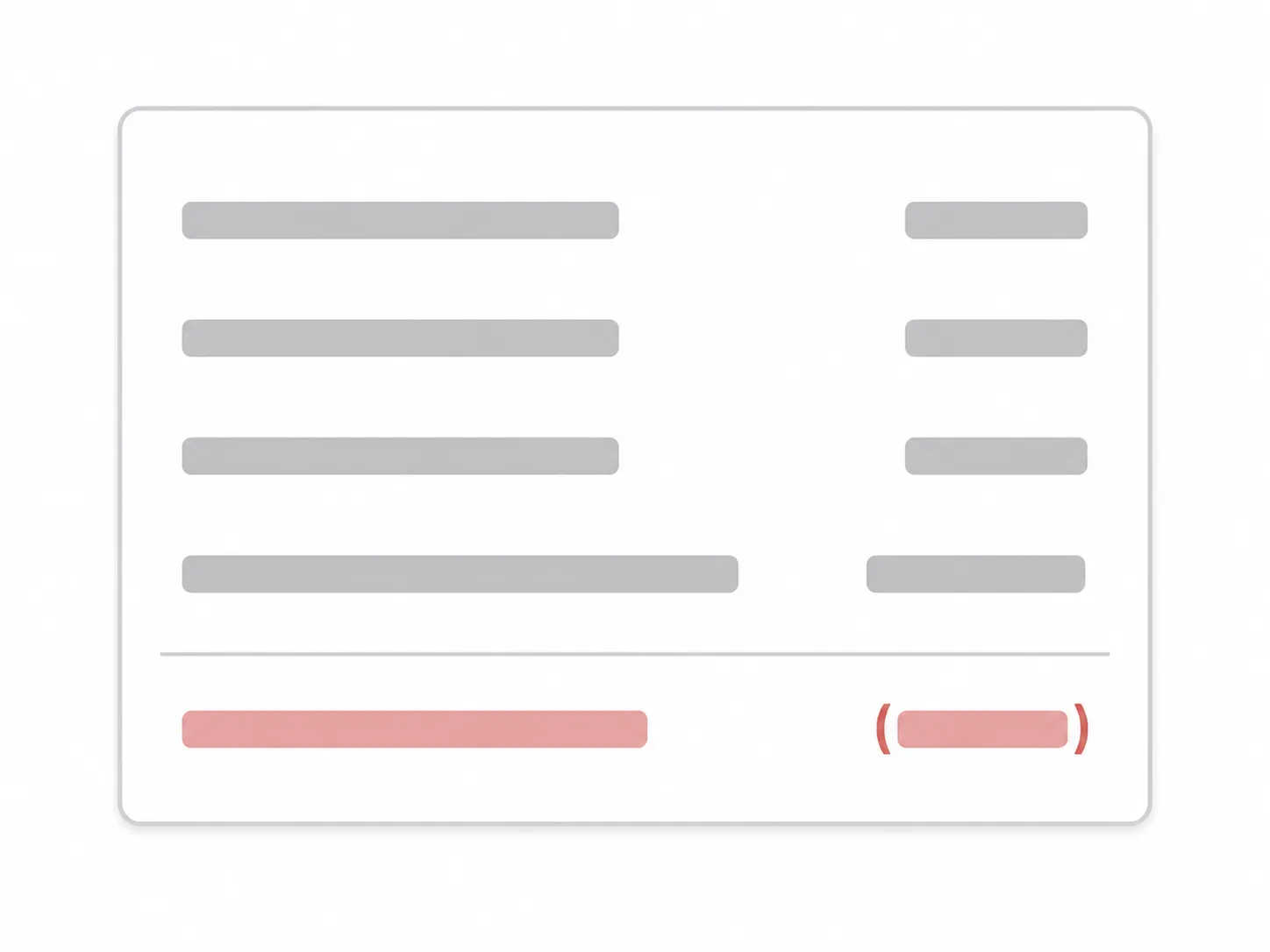
Fourteen of my sixteen approved returns refunded in full. Two came back short by exactly 20%, and both were third-party.
The fee is a lever, not an automatic charge, which is why two identical-looking situations produce different refunds. That also means you cannot know in advance whether yours will be applied.
This article covers the fee only as a consequence of taking the late route. For the full picture of when restocking fees apply across categories and how to avoid them, that is its own guide.
A number you cannot plan around. Two cases out of sixteen is a small base, and I have no way to predict which returns attract a deduction. Assume the worst case on anything above about $50 and treat a full refund as a good outcome rather than the default.
When the Window Doesn’t Matter at All
Amazon’s return window does not govern every refund route. A defective, damaged, or not-as-described item is handled through the problem-with-order path rather than the return path, an item sold and fulfilled by a third-party seller can go to an A-to-z Guarantee claim after the seller is contacted, and a card dispute remains available as a last resort.
Each of these runs on its own deadline, measured from a different starting point.
Report a problem. Use this when the item was never what the listing promised. Four of my 22 attempts went this way rather than through the return path, and all four resolved regardless of age, including one item 41 days past its window.
A-to-z Guarantee claim. This covers third-party sold-and-fulfilled orders only, and Amazon expects you to contact the seller first and give them a chance to fix it. If they refuse or go silent, Amazon investigates and refunds from the seller’s account.
Card dispute. This is the last resort, not the first move, and it belongs to your card issuer rather than to Amazon. Use it when both the seller and Amazon have refused and the item was materially not as described.
Table 7. Three mechanisms, three different clocks
Mechanism | What it covers | Deadline | Measured from | Used in this test |
|---|---|---|---|---|
Report a problem | Damaged, defective, or not as described | No fixed public window for the report itself | When you discover the fault | Yes, 4 times |
A-to-z Guarantee claim | Third-party sold and fulfilled orders | 90 days | The incident that gave rise to the claim | No, none filed |
Card dispute | Charges your issuer agrees to investigate | Set by your card network, commonly 60 to 120 days | The transaction or statement date | No, none filed |
The different starting points are the reason people miss these deadlines. Counting all three from the delivery date, which is the intuitive move, quietly shortens two of them.
For very low-value damaged items, ask before you ship. Amazon sometimes issues what shoppers call a returnless refund, refunding the money and telling you to keep the item, because the return shipping costs more than the product.
None of this is a legal right. Under US consumer-law rules, no federal statute compels a retailer to accept a non-defective return, and the protections that do exist cover defective goods, implied warranties, and state-level disclosure requirements instead.
Weigh the last resort carefully. A card dispute reverses money without Amazon’s agreement, and Amazon can treat that as adversarial. At the severe end of that spectrum sit accounts limited to digital orders, so use the issuer only after the other three routes have genuinely failed.
The 15-Day Rule That Catches People After Approval
Approving an Amazon return starts a second deadline. Once a return is authorised, Amazon states in its seller forums that the buyer has 15 days after the return window closes to get the item back, allowing for transit.
If the item is not shipped inside that period, the return label can expire and the refund does not process.
This is the failure that hurts most, because it arrives after you think you have won. The window governed whether you could ask, and the shipping period governs whether the authorised return actually completes.
Table 8. Approval to drop-off, from my log
Item | Approved | Dropped off | Days elapsed | Location | Refund |
|---|---|---|---|---|---|
Storage bins | 3 March 2026 | 14 March 2026 | 11 | UPS Store, Parma OH | Refunded 18 March |
Linen shirt | 22 April 2026 | 28 April 2026 | 6 | Kohl’s, Broadview Heights OH | Refunded 29 April |
Desk lamp | 11 May 2026 | 13 May 2026 | 2 | Whole Foods, Cleveland OH | Refunded 14 May |
Eleven days was my closest call. The label still scanned, but I would not run that margin again on anything I actually wanted the money back for.
Three habits close this failure mode for good:
Set the reminder on the delivery date, not the purchase date, because that is when the clock starts.
On a split order, note each shipment’s date separately.
Drop off in the same week the return is approved, not the same month.
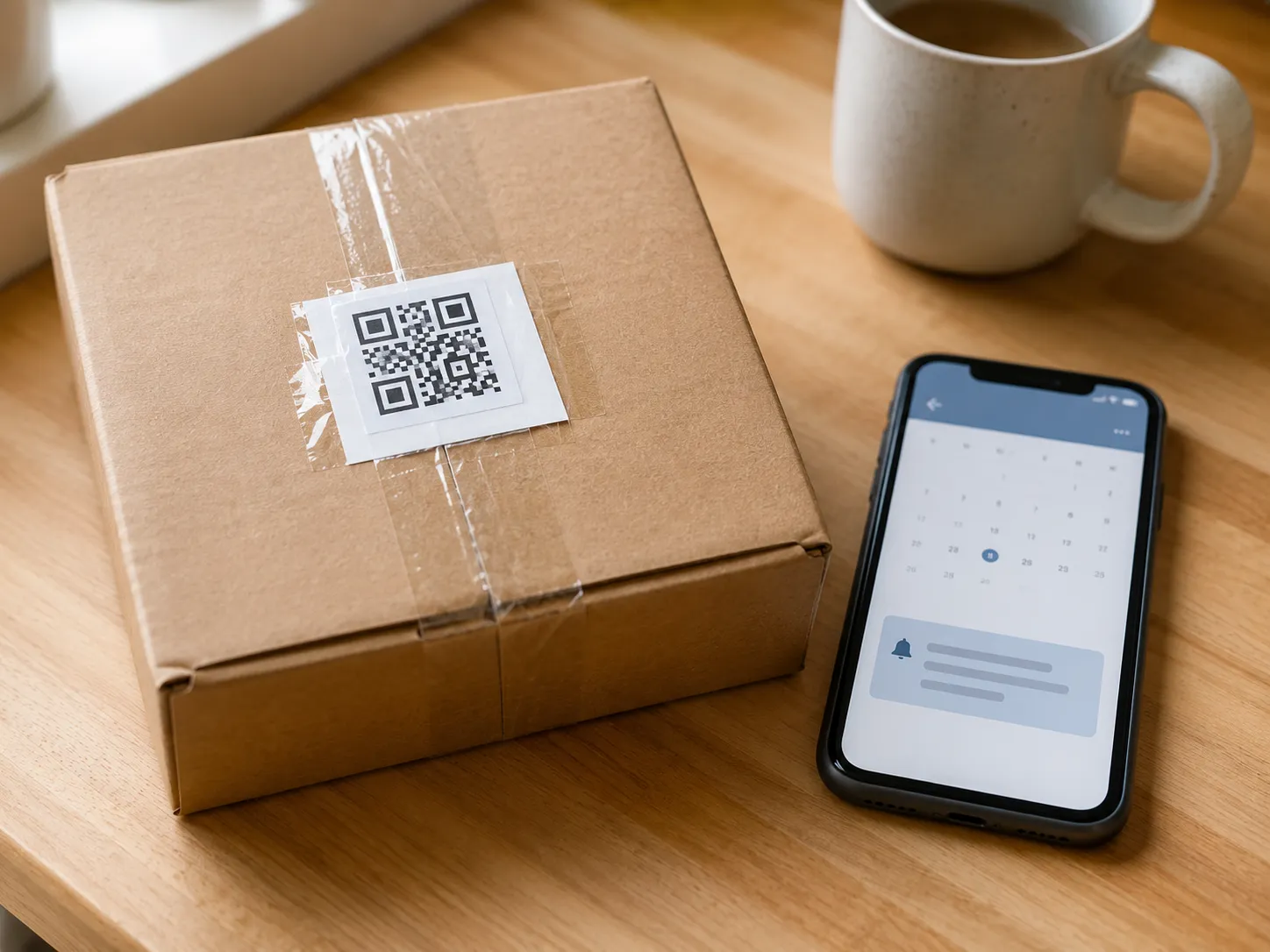
Where this figure comes from. The 15-day period is stated by Amazon in seller-facing forum guidance, not on the consumer returns policy page. Treat it as the operating rule rather than as published consumer policy, and confirm the expiry date printed on your own return label.
Amazon Return Window FAQs
What is Amazon’s return window?
Thirty days from delivery for most items sold and fulfilled by Amazon, with the item in original or unused condition. Registry purchases run far longer, Apple-branded items and some electronics run shorter, and Final Sale listings have no window.
Your order page shows the exact date for your purchase.
Can Amazon extend a return window?
Not automatically, but a customer-service agent can reopen a closed return on request. Across 18 requests using identical wording, 12 were approved, with far better odds on items sold and shipped by Amazon than on third-party listings.
Ask through chat, and ask soon after the window closes.
What happens if I miss the Amazon return window?
The Return or Replace button disappears and the automated system stops accepting the return. Four routes remain: ask an agent to reopen it, report a fault, file an A-to-z claim on a third-party order, or dispute the charge with your card issuer.
Which one fits depends on who sold the item.
Do late returns affect my Amazon account?
Twenty-two late-return requests across six months on my test account produced no warning, no restriction, and no visible change in how returns were handled. That is one account over half a year, so it says nothing about heavy or repeated use.
Amazon does monitor return behaviour.
Does the window restart if I exchange instead of return?
No. An exchange replaces the original item rather than resetting your clock, and the replacement carries its own separate return window from its own delivery date.
Treat the exchange as a new order for deadline purposes rather than an extension of the old one.
Can I return an Amazon item in a store without a window?
Only inside whatever window applies to that order. Drop-off partners including Kohl’s, Whole Foods, and Staples accept authorised returns box-free with a QR code, but they scan an authorisation Amazon already issued.
They cannot create one for a closed window.
Based on 22 logged late-return attempts on a single household account, 6 January to 30 June 2026. Methodology is set out near the top of this article.
The Bottom Line on a Closed Amazon Return Window
A closed Amazon return window is a routing problem rather than a lost refund. The 30-day rule is enforced by software and waived by people, and the variable that decided almost every one of my 22 attempts was not how late I was but who sold the item.
Sixteen of those attempts came back approved, including one at 41 days, while a third-party refusal landed at three days.
That reframe is worth more than any single tactic in this article. The reader who checks the seller before deciding whether to bother will spend their effort on the returns that are actually winnable, and will stop writing off money on the assumption that a missing button is a final answer.
So start with the date line on your order rather than the button, work out who sold the item, and pick the route that matches. Ask an agent for the ordinary change-of-mind case, report a problem when the item was faulty, escalate to a claim when a third-party seller stonewalls, and keep your card issuer in reserve.
Then set the reminder on your next delivery, because the cheapest version of this whole process is the one you never have to run.
Read it your way
Short on time? Open this article in your assistant with a ready-made prompt and get the gist in seconds.
Found this useful? Make us a preferred source so we show up in your Google results.
Keep reading
Related articles
Retailer Return Policy Hubs
Ulta Return Policy: 30 Days for a Full Refund (2026)
Return to Ulta within 30 days for a full refund; 31–60 days gets store credit. The Ulta return policy window, receipt rule, refund method and how to return.

Retailer Return Policy Hubs
Lululemon Return Policy (2026): Tested at 3 Stores
Check the lululemon return policy: 30-day window, receipt and tag rules, refund timing, exchanges, and no-receipt options, current for 2026
Retailer Return Policy Hubs
eBay Return Policy: Why “No Returns” Doesn’t Mean No Refund
Check the eBay return policy for 2026: the 30-day Money Back Guarantee, seller windows, who pays return shipping, and how to get a refund when a seller says no.
Retailer Return Policy Hubs
Sephora Return Policy: The 60-Day Rule Is Gone (2026)
Return Sephora products within 30 days for a full refund. Get the current Sephora return policy: receipt rule, opened items, refunds by payment method.
The discussion
Comments
Every comment is reviewed before it goes live.