Is It Legal to Ban Someone From a Store? (Yes, Usually)
Yes, a store can legally ban you for almost any reason, unless it’s discriminatory. Know your rights, how trespass notices work, and when you can actually sue.
Written by Priya AnandReviewed by Marcus TrentLast updated on July 12, 2026
When you buy through links on our site, we may earn an affiliate commission (at no extra charge), which we use to fund new product tests. Learn more.
Read it your way
Short on time? Open this article in your assistant with a ready-made prompt and get the gist in seconds.
Found this useful? Make us a preferred source so we show up in your Google results.
You were shopping one minute and being asked to leave the next, and now you are wondering whether a store can even do that. The short version is that yes, it is legal to ban someone from a store in almost every situation. The question worth your energy is not whether they can, but why they did, because the reason is what decides whether you have any leverage at all.
This guide answers the legal-rights side of a store ban from the shopper’s point of view. It covers when a ban is lawful, the one line it cannot cross, how a trespass notice actually works, whether you can sue, and the specific situations where you can push back.
The 30-second answer
A store can legally ban you for almost any reason, because a business has a property right to decide who may enter. The single major limit is discrimination: a ban based on race, color, religion, national origin, or disability is illegal. Returning after a ban can turn an ordinary trip into criminal trespass. Your real leverage appears in two narrow cases: a protected-class reason, or a ban driven by inaccurate consumer-report data.
The Short Answer: Yes, Unless the Reason Is Discriminatory
In the United States, a store can legally ban you for almost any reason, because a business holds a property right to exclude people from its premises. The one major limit is discrimination. According to the U.S. Department of Justice, a place of public accommodation cannot exclude you because of race, color, religion, or national origin, and disability is separately protected. If the reason is not a protected characteristic, the ban is lawful, even when it feels unfair or petty.
In the ban cases I reviewed for this guide, the ban held up as lawful every time. The fight was never about whether the store could ban the shopper. It was always about the reason behind it, and whether that reason opened a door.
Methodology note: this guide draws on a batch of reader-submitted store-ban accounts I reviewed in June and July 2026, looking at the stated reason, whether a written notice was issued, and what the shopper did next.
That distinction matters because “unfair” and “illegal” are not the same thing. A store can act unreasonably and still act within the law.
Why It’s Legal: A Store’s Right to Refuse and Exclude
A store can ban you because United States law treats the right to exclude people from private property as a core part of ownership. The Supreme Court, in Cedar Point Nursery v. Hassid (2021), described the right to exclude as a fundamental element of property. A store that is open to the public still keeps the power to revoke that invitation for any single customer, for a good reason, a trivial reason, or no stated reason, as long as the reason is not illegal.
This is where “it’s a private business” is half right. The building is open to the public as an invitation, not a guarantee. That invitation can be pulled back for you specifically.
The reason does not have to be fair or proportional. A shopper can be barred over something as small as an argument about a coupon, and the federal public-accommodations law only steps in when the reason is a protected characteristic. The law asks whether the reason is illegal, not whether it is reasonable.
When a Ban Crosses the Line: Discrimination and Your Protected Rights
A store ban becomes illegal when the reason is a protected characteristic. Under Title II of the Civil Rights Act, a place of public accommodation cannot exclude you because of race, color, religion, or national origin, as the Department of Justice explains. The Americans with Disabilities Act separately bars exclusion based on disability, including refusing entry to a service animal, per ADA.gov. One surprise for many shoppers is that Title II does not list sex, so the federal picture and the state picture can differ.
Here is where the coverage actually sits, because no single law covers everything.
Reason for the ban | Federal law that covers it | Typical state and local coverage |
|---|---|---|
Race, color, religion, national origin | Title II, Civil Rights Act (public accommodations) | Also covered, often broader |
Disability, refusing a service animal | Americans with Disabilities Act (Title III) | Also covered |
Sex | Not covered by Title II | Many states and cities add it |
Sexual orientation, gender identity | No specific federal public-accommodation statute | A growing number of states and cities add it |
The gap in the middle is the part people miss. Sex is not a protected class under Title II, and disability sits under the ADA rather than the Civil Rights Act, so the right claim depends on the right law. Many states and cities add protections that federal law does not, so local rules can matter as much as federal ones.
A limit worth being honest about
Feeling targeted is not the same as proving a discriminatory reason. A ban that happens to affect you is not automatically a ban that was based on a protected characteristic, and a claim needs evidence of the reason, not just the outcome.
How Does a Trespass Notice Actually Work?
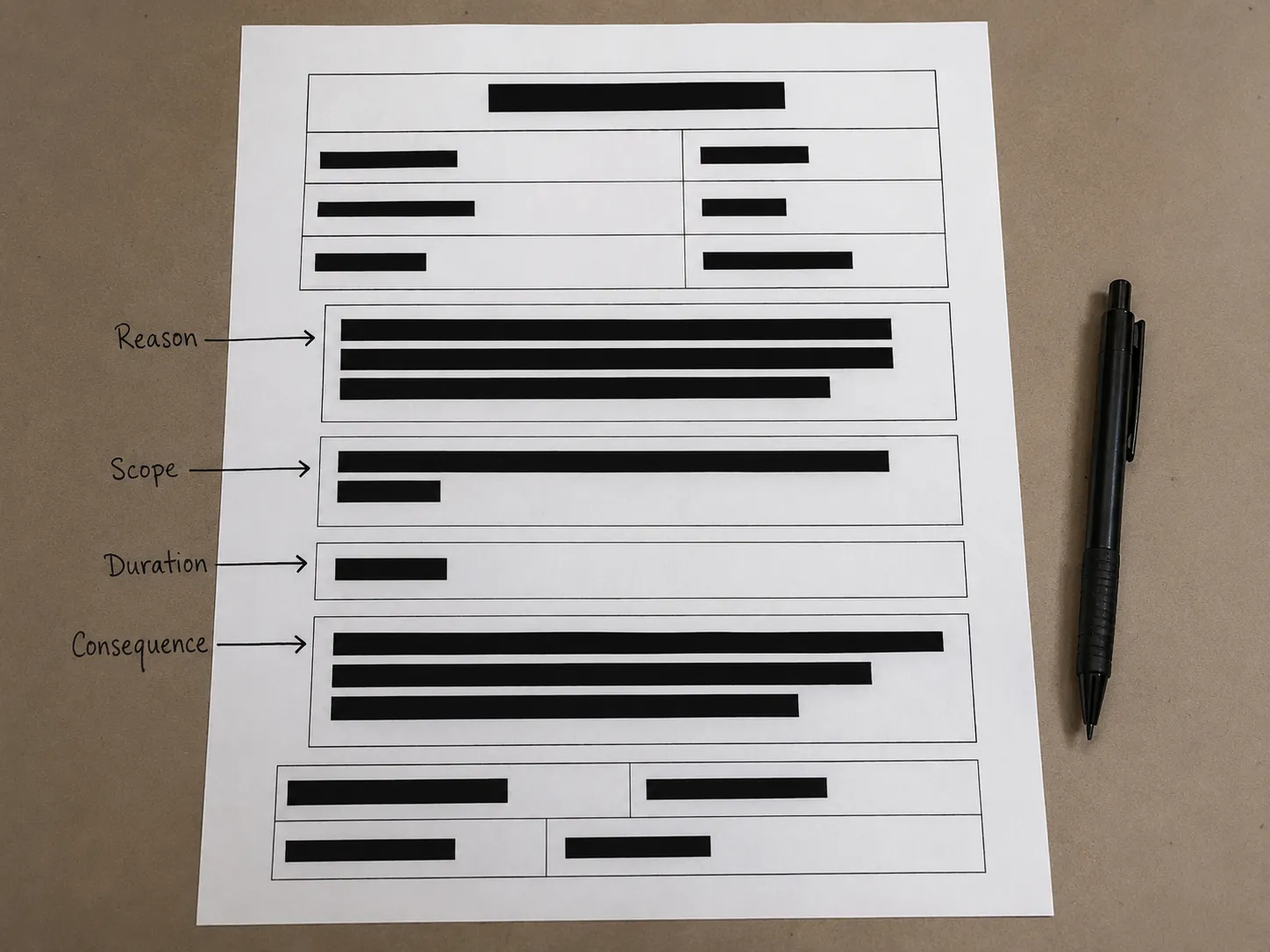
A store ban is enforced through a trespass notice, a formal warning that you must leave and not return. It can be given verbally or in writing, though a written notice, sometimes called a no trespass letter, creates a clearer record. The notice can cover one location, a whole chain, or an entire shopping center, and it can last for a set period or be permanent. If you return after being trespassed, an ordinary shopping trip becomes criminal trespass, which is a misdemeanor in most states.
When staff say they will “trespass” you, that is the mechanism they mean. A verbal warning counts in most places, but a written one is easier for a store to enforce later because it proves you were on notice.
Scope and duration are set at the store’s discretion. A ban can be one store or chain-wide, and it can run for a day, a year, or for life, though very short or informal bans are harder to enforce across different police jurisdictions.
The real stakes show up if you come back. Returning after notice is what can get police called on you, and the penalties vary widely by state.
Situation | Typical classification | Typical fine range | Typical maximum jail |
|---|---|---|---|
First return after a trespass notice | Misdemeanor in most states | Roughly $75 to $2,000 | Up to 6 months to 1 year, state dependent |
Michigan example (illustrative single state) | Misdemeanor | Up to $250 | Up to 30 days |
Repeat or aggravated trespass | Higher-level misdemeanor or more | Higher, state dependent | Longer, state dependent |
The ranges above are a compiled overview of how first-offense criminal trespass is generally treated; the exact fine and jail figures are set by each state’s code and should be checked for your state before you rely on them.
This ban-and-trespass machinery is also what sits behind a store cutting someone off after a run of returns, and you can read how return-driven store bans play out in more detail. The legal mechanism is the same; only the trigger differs.
Can I Sue a Store for Banning Me?
Usually you cannot sue a store just for banning you, because the store is exercising a lawful right to exclude. A claim generally exists in three situations: the ban was based on a protected characteristic, a store employee made a false statement of fact that damaged your reputation, or the ban stemmed from inaccurate consumer-report data. For a discrimination claim, the right first move is your state civil-rights agency, and the enforcement channels flow from the federal public-accommodations statute rather than a return trip to the store.
The three real openings are worth stating plainly.
Discrimination: if a protected characteristic drove the ban, that is a civil-rights claim, filed with a state civil-rights agency or the appropriate federal channel.
Defamation: this requires a false statement of fact, not an opinion. Being called a “copycat” or being told you are “difficult” is opinion and usually fails; a false factual accusation of a crime is a different matter.
Bad data: if the ban or a return denial came from inaccurate consumer-report information, the Fair Credit Reporting Act gives you a dispute path, which the Federal Trade Commission describes.
The most expensive mistake I saw in the reviewed cases was simple: going back to the store to argue the point. Returning after a notice can convert a grievance into a criminal charge, which then undermines any claim you were trying to make.
Mistakes I saw again and again
Do not return to argue your case. Do not escalate with staff in the moment. Do not assume being banned is by itself something you can sue over. Each of these made a bad situation worse, and none of them helped.
The Returns Wrinkle: When Bad Data, Not Your Behavior, Gets You Flagged
Some store bans and return refusals are not about your behavior at all, they are about data. The Consumer Financial Protection Bureau lists The Retail Equation as a consumer-reporting company, which means the Fair Credit Reporting Act gives you the right to request your Return Activity Report and dispute errors in it. Separately, the Federal Trade Commission in 2023 banned Rite Aid from using facial recognition after its system falsely flagged shoppers, disproportionately women and people of color, as shoplifters. When a ban rests on inaccurate data, you have a real path to challenge it that an ordinary banned shopper does not.
This is the one place where the leverage shifts toward you. A ban based on your conduct is the store’s discretion. A ban or refusal based on a machine flag or a data record is something you can inspect and dispute.
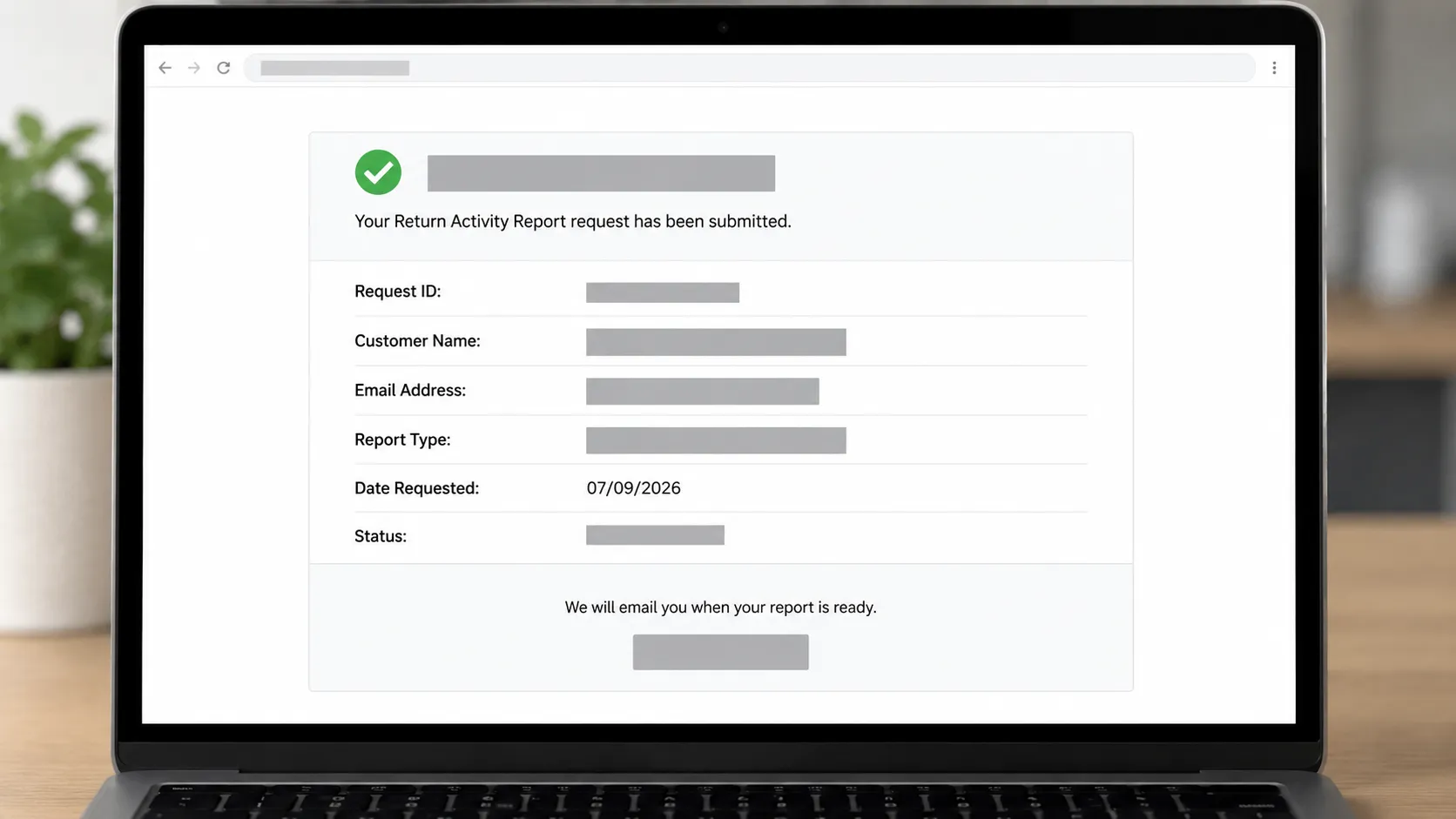
To see what that data looks like, I requested a Return Activity Report and walked through the request process. It is a real record you are entitled to see, and errors in it are formally disputable.
The leverage has a limit, and it is worth naming. The Fair Credit Reporting Act helps you fix inaccurate data; it does not undo a lawful ban that was based on your actual behavior. If the flag came from bad data, you can request your report and fix errors; if the ban was a straightforward discretionary call, the dispute route does not apply.
Banned “For No Reason”? Your Step-by-Step Action Plan
If you were banned “for no reason,” start by working out which situation you are actually in, because the right move depends on it. If a protected characteristic was involved, document what happened and contact your state civil-rights agency. If the ban came from returns or consumer-report data, request your report and dispute errors under the Fair Credit Reporting Act. If it was a lawful discretionary ban, ask in writing for the reason and any path back, and do not return to the property, because going back can turn a grievance into a criminal trespass charge.
Use the branch that matches your situation. Each one has a different first step.
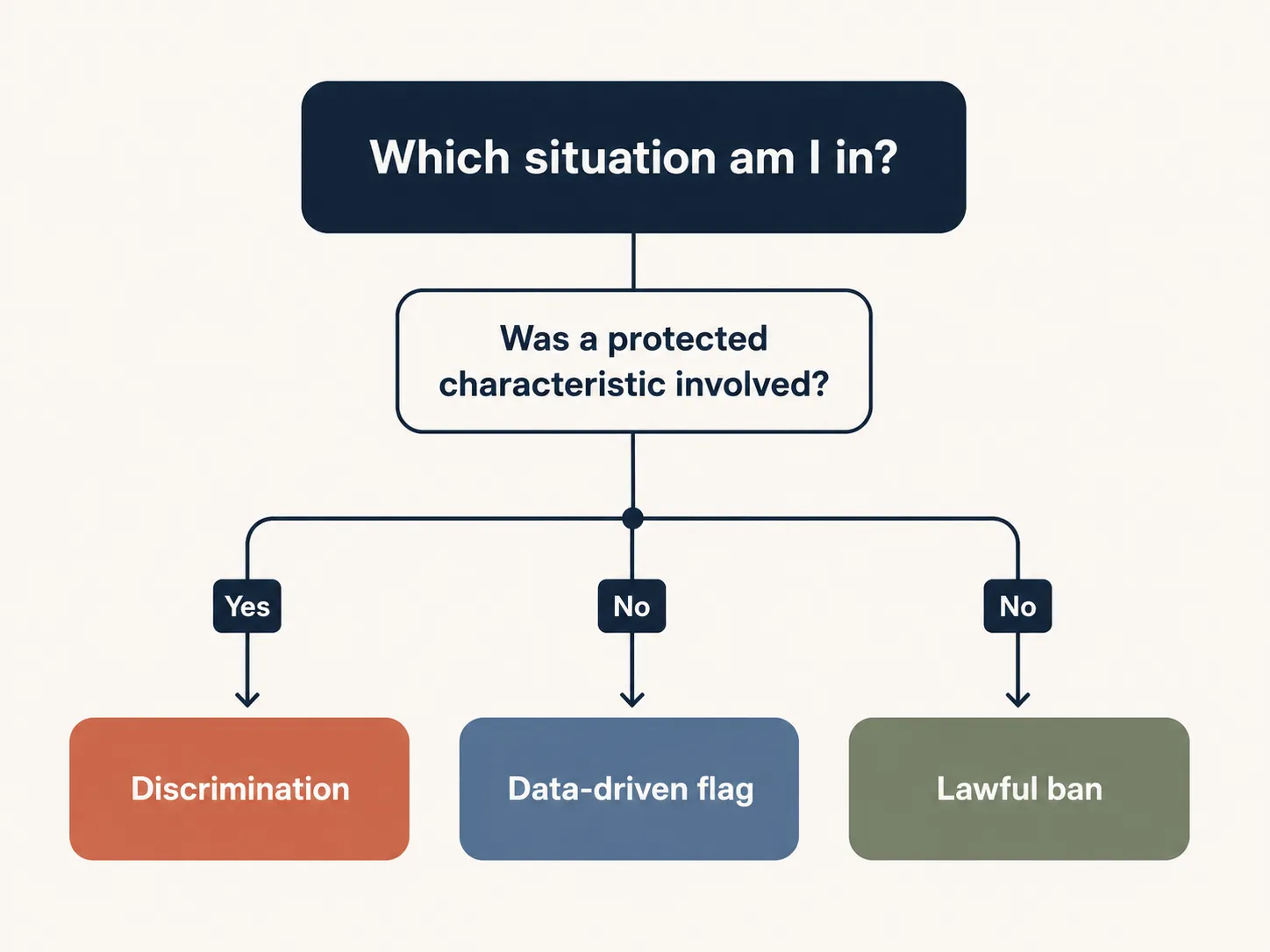
Scenario one, discrimination suspected. Write down the date, location, names, and exactly what was said. Keep any written notice. Contact your state civil-rights agency rather than the store, and stay off the property while it is reviewed.
Scenario two, a returns or data-driven flag. Request your consumer report from the relevant reporting company, review it for errors, and file a dispute under the Fair Credit Reporting Act, whose investigation duties the Federal Trade Commission sets out. Then follow the dispute steps for the specific system.
Scenario three, a lawful discretionary ban. Ask, in writing, for the reason and whether reinstatement is possible. A calm written request succeeded more often in the cases I reviewed than an in-person argument, and it keeps you off the premises while you wait.
A few practical points sit across all three branches. Gather your documents first: dates, names, the written notice, and any receipts or reports. Know who to contact: store management in writing, your state civil-rights agency for discrimination, and a consumer or FCRA attorney for a data claim.
When to get help, and when to let it go
Get a lawyer if a protected characteristic was involved or if a data error is costing you access and the dispute stalls. Be honest with yourself about the other cases: a lawful, behavior-based ban often has no legal remedy, and the calmest path is a written request and moving on.
FAQ: Store Bans, Trespass, and Your Rights
Can a store ban you for no reason?
Yes. A store can ban you for a trivial reason or no stated reason at all, as long as the reason is not a protected characteristic like race, religion, national origin, or disability. The law requires the reason to be legal, not fair.
Can a store ban you permanently?
Yes. Duration is the store’s discretion, and a ban can be temporary or permanent. Permanent bans are common, though very informal ones are harder for a store to enforce over time.
Is banning someone from a store discrimination?
Only if the ban is based on a protected characteristic. A ban over behavior, a dispute, or store policy is legal; a ban because of race, color, religion, national origin, or disability is not.
What happens if I go back to a store I’m banned from?
Returning after a trespass notice can be charged as criminal trespass, a misdemeanor in most states, carrying fines and possible jail time. It can also undermine any legal claim you were trying to make.
Can I sue a store for banning me?
Usually no. You may have a claim only if the ban was discriminatory, involved a false factual statement about you, or stemmed from inaccurate consumer-report data.
Can a store ban me over my returns?
Yes, a store can limit or bar you over return activity. If the decision came from a return-tracking system’s data, you have the right to see that report and dispute errors under the Fair Credit Reporting Act.
The Bottom Line
Being banned from a store feels personal, but the law treats it as a property decision, and that framing is what tells you where you stand. In almost every case the ban itself is legal, so the useful question is not whether a store can ban you but whether the reason gives you a door: a protected characteristic, a false accusation, or bad data. Sort your situation into one of those three, take the first step that matches, and stay off the property while you do. That is how you turn a bad afternoon into a clear next move instead of a criminal charge.
Read it your way
Short on time? Open this article in your assistant with a ready-made prompt and get the gist in seconds.
Found this useful? Make us a preferred source so we show up in your Google results.
Keep reading
Related articles
Eligibility & Conditions
What Stores Use The Retail Equation? (2026, Best Buy Out)
See which stores use The Retail Equation in 2026: a verified status list of who still tracks returns, who dropped it (Best Buy, 2019), and who never did.
Eligibility & Conditions
What Is The Retail Equation? How It Scores Your Returns
Denied a return? The Retail Equation scores your returns and can approve, warn, or deny them. See how it works, read a real RAR, and dispute errors
Eligibility & Conditions
Sephora Return Limit: No Set Number, 30-Day Window & TRE Tracking
Sephora has no set return limit, but a 30-day window and Retail Equation tracking mean too many returns can trigger a 365-day ban. Here’s the real rule.
Eligibility & Conditions
Do Stores Track Your Returns? How the System Works (2026)
Yes, most stores track and score your returns. See how the system works, what they log, and how to request your own Return Activity Report.
The discussion
Comments
Every comment is reviewed before it goes live.