Can You Get in Trouble for Too Many Returns? The 5 Levels
Returning too much won’t send you to jail, but it can get you banned or blacklisted. See the 5 levels of trouble, the $950 fraud line, and how to stay safe.
Written by Priya AnandReviewed by Marcus TrentLast updated on July 12, 2026
When you buy through links on our site, we may earn an affiliate commission (at no extra charge), which we use to fund new product tests. Learn more.
Read it your way
Short on time? Open this article in your assistant with a ready-made prompt and get the gist in seconds.
Found this useful? Make us a preferred source so we show up in your Google results.
The first time a store printed a slip telling me my return was “under review” and pointed me to a website I’d never heard of, I assumed the worst. I pictured a permanent record, a blacklist, maybe a call from someone official.
None of that happened. But the panic is real, and it is the reason this question gets searched so often: can you get in trouble for too many returns, and how much trouble are we actually talking about?
Here is the honest answer, mapped as a ladder so you can find the exact rung you are standing on.
Quick answer: Returning too much will not send you to jail. The real risk is a store flagging, warning, or banning you, which is a private business decision, not a criminal charge. It only becomes a crime when you deliberately deceive a retailer and the value crosses your state’s theft threshold. About 9% of all returns are flagged as fraudulent, but the overwhelming majority of returners never come close to that line.
The 5 Levels of Trouble, From Over-Returning to a Crime
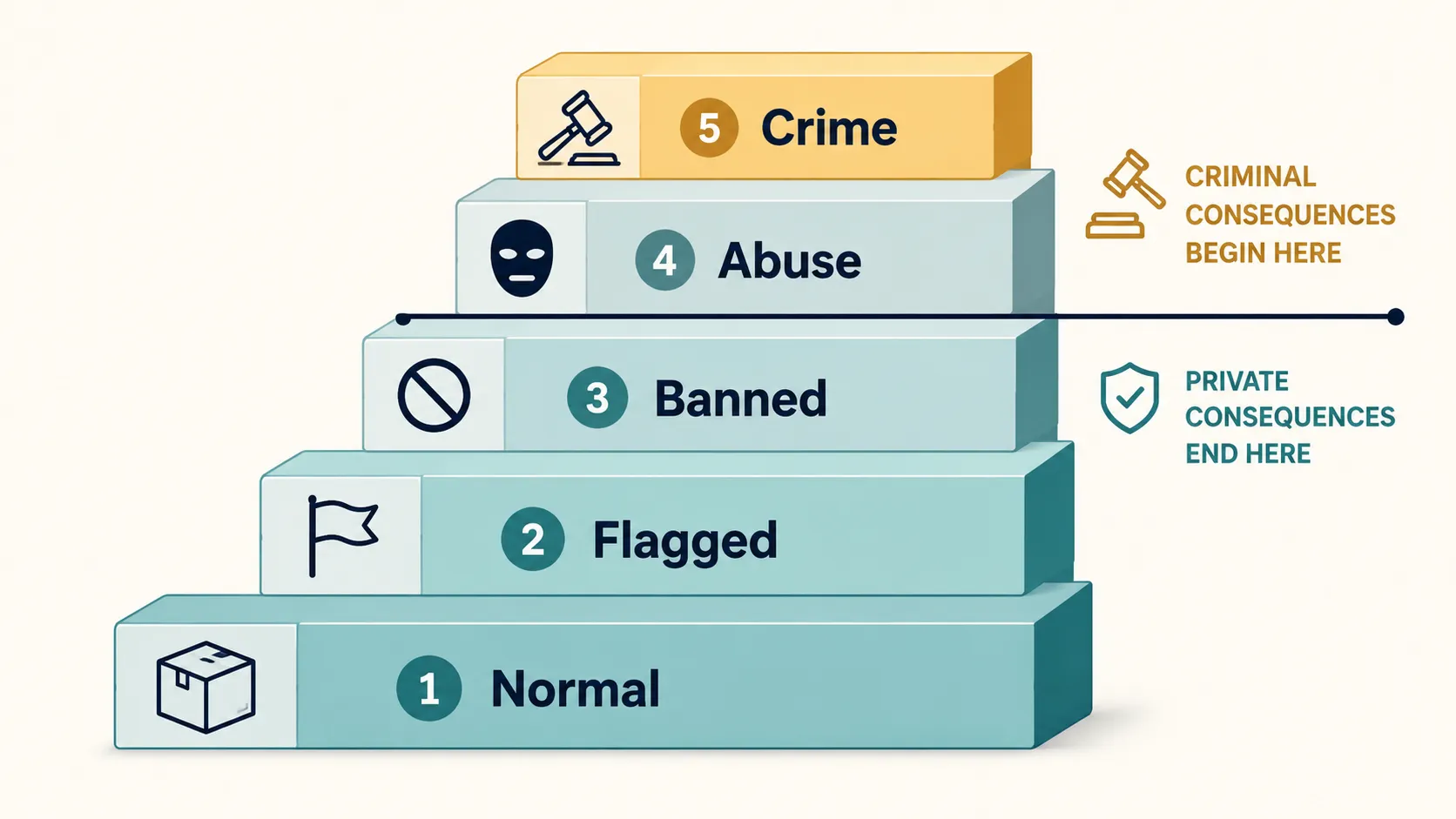
Getting “in trouble” for too many returns is not one thing, it is a spectrum. Retailers and their partners lost roughly $103 billion to fraudulent and abusive returns in 2024, about 15% of all returns, so they watch return behavior closely, but the consequences escalate in clear steps rather than jumping straight to handcuffs.
I built this ladder after mapping dozens of real shopper stories onto the actual policies and laws behind them. The key line sits between Level 4 and Level 5: everything below it is a private consequence, and only the top rung is a crime.
Level | What it is | What actually happens | Is it a crime? |
|---|---|---|---|
One | Normal over-returning | Nothing, or a quiet internal note | No |
Two | Flagged or warned | A warning email or a “return under review” slip | No |
Three | Banned or blacklisted | A store or account refuses future returns or business | No |
Four | Deliberate abuse (“friendly fraud”) | Refunds denied, account closed, sometimes charged back | Usually no |
Five | Intentional return fraud past a dollar threshold | Possible misdemeanor or felony charge | Yes |
Most anxious shoppers live at Level 1 or 2 and imagine they are at Level 5. The jump from Level 4 to Level 5 requires two things that ordinary returning never involves: intent to deceive and a dollar value that crosses a legal line.
Will Amazon Ban You for Too Many Returns?
Amazon can close your account for excessive returns, but it does not publish a return limit and does not ban on a fixed percentage alone. Reporting by the Wall Street Journal, summarized by Money.com, documented shoppers whose accounts were closed after returns and sometimes lost unused gift-card balances, because Amazon acts on behavior and risk signals rather than a single ratio.
The folklore you see on Reddit is a return rate around 20% of orders, or five to ten returns a month, as the danger zone. Treat those as commonly cited warning territory, not policy, because Amazon has never confirmed a threshold.
Are You a Serial Returner?
The label “serial returner” gets thrown around, but the trigger is usually the reason for returns, not the raw count. Returning opened electronics as “defective” repeatedly draws far more scrutiny than returning clothes that did not fit.
When I audited my own account this year, the numbers told the real story.
My Amazon activity, January to June 2026 | Count |
|---|---|
Orders placed | 96 |
Items returned | 11 |
Return rate | About 11% |
That 11% never triggered a warning, which lines up with what shoppers report: trouble tends to start when nearly every order comes back, or when return reasons look suspicious. In a statement to CNBC, Amazon said it only acts against rare cases of extended abuse and invites affected customers to appeal.
If you want the concrete numbers behind a flag, our companion guide breaks down what actually triggers a flag across major stores.
Can a Store Really Blacklist You?
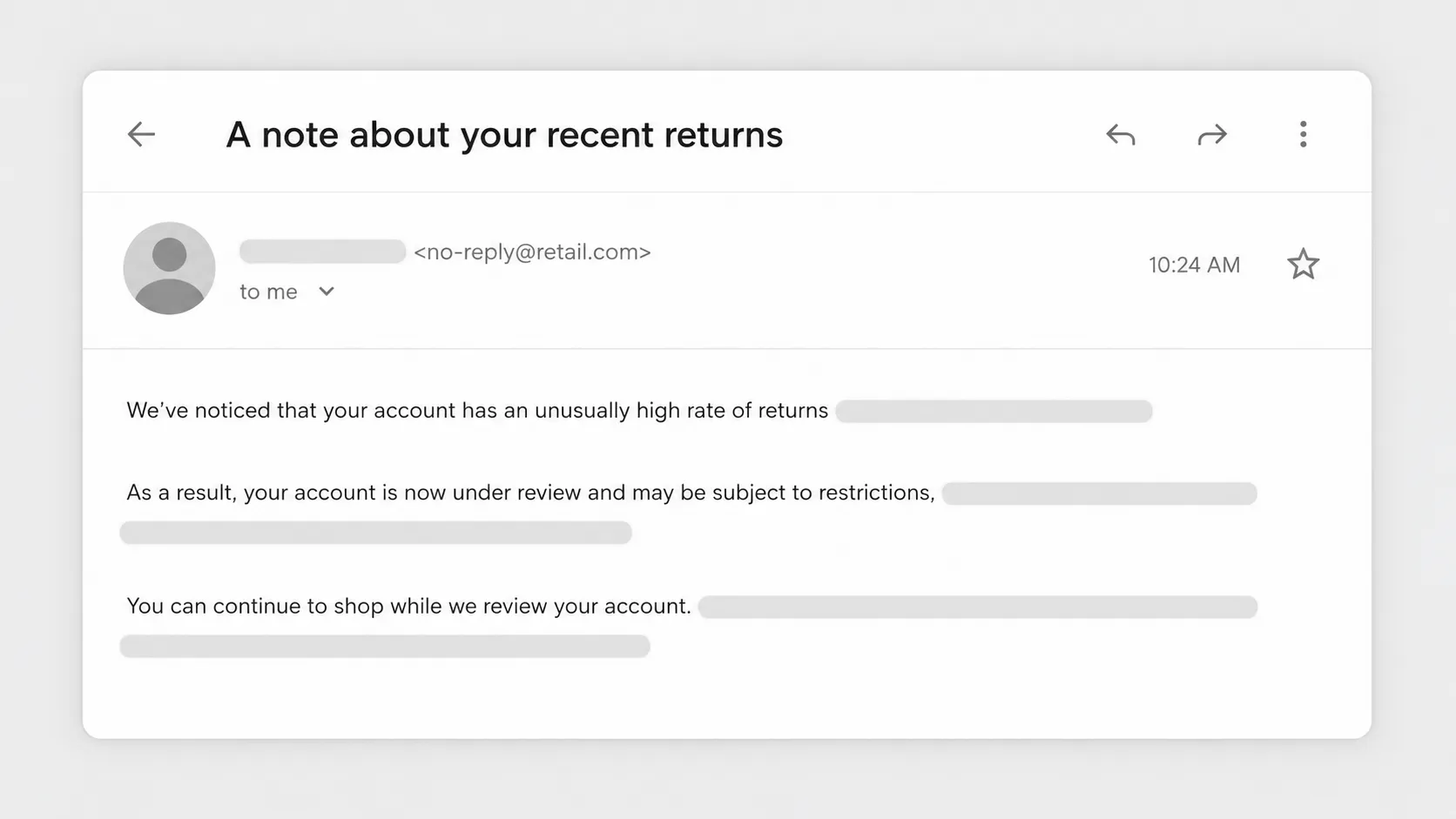
Yes, a store can refuse your returns, and the system behind it is often The Retail Equation, a return-authorization company that builds a return history and “return score” from your ID and receipt data. It recommends that the retailer approve, warn, or deny each return, and only about 1% of transactions get a warn or deny, with the store, not the software, making the final call.
Being “blacklisted” this way is a private business decision. It is not a criminal record, it does not show up on a background check for jobs or housing, and the data is tied to one retailer’s system rather than shared store to store.
Here is the part most scare-headlines skip: you have rights. The Consumer Financial Protection Bureau lists The Retail Equation as a consumer reporting company, which means you can request your own report and dispute errors under the Fair Credit Reporting Act.
Worth knowing: There is a genuine tension here. The CFPB classifies The Retail Equation as a consumer reporting company, while the company itself says it acts only as a service provider and does not share your data for credit decisions. Both can be read on their own pages, and the practical takeaway is the same: you can ask for your Return Activity Report and correct it.
Your return history does not float in the ether. It is built and stored by the systems that log your returns, and knowing that is the first step to controlling it.
What Happens If You Get Caught Returning a Wrong or Used Item?
Returning the wrong item by honest mistake is almost always corrected without penalty, while knowingly returning a used, empty, or different item is return abuse that can be treated as fraud when intent is shown. The dividing line is intent, and retailers now report rising overstated-quantity, empty-box, and decoy returns, which is exactly why honest mistakes draw more scrutiny than they used to.
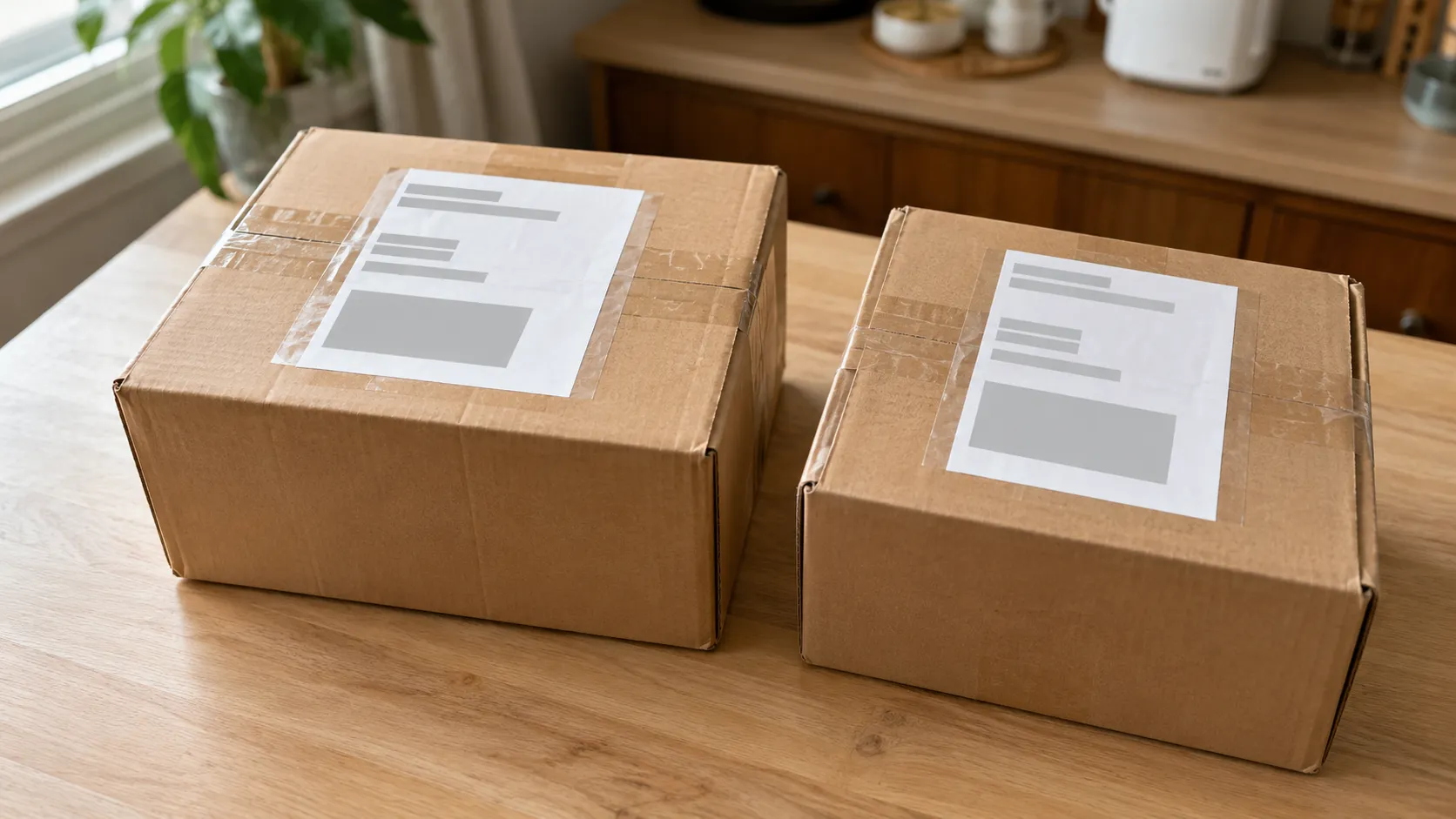
I learned the accident side firsthand. I once shipped two returns back on the same day and swapped their prepaid labels, so each item arrived at the wrong warehouse.
The fix took one support chat and a couple of weeks, with no charge and no flag, because the mix-up was obviously a labeling error and not deception. That is the pattern for genuine accidents: annoying, but not “trouble.”
A few terms describe the behaviors that do cross into abuse, and it helps to name them plainly:
Wardrobing: buying an item, using or wearing it once, then returning it as new.
Empty-box or “box of rocks”: returning a package without the actual product inside.
Bricking: returning a dead or broken unit in place of the working one you keep.
Where any of these is deliberate, the consequence climbs the ladder from a denied refund toward a possible charge for the item, an account flag, and, only with clear intent and enough value, a criminal matter.
When Does Returning Too Much Become a Crime?
Returning too much is not a crime, and return fraud becomes criminal only when you intend to deceive a retailer and the value crosses your state’s theft threshold. Intent is the hinge, and the dollar line then decides misdemeanor versus felony, which varies widely by state, with California drawing the line at $950 under Penal Code 487.
Intent is exactly where a normal return crosses the line into fraud, so understanding that boundary matters more than any single number.
The thresholds below come from state theft statutes, since return fraud is prosecuted as a form of theft or fraud rather than a special “returns” crime.
State | Felony theft threshold | What it means for a return scam |
|---|---|---|
New Jersey | $200 | Lowest in the country, so small-dollar schemes escalate fast |
Florida | $750 | A relatively low line; above it a case can become a felony |
California | $950 | Below is usually misdemeanor petty theft, at or above is grand theft |
Georgia | $1,500 | Higher line, so most single-item scams stay misdemeanor |
Colorado, Connecticut, Pennsylvania, South Carolina | $2,000 | Among the highest common thresholds nationwide |
Two details surprise people. First, thresholds range from $200 to $2,000+ depending on where you live, so the same act is charged very differently across state lines.
Second, prosecutors can add up the value of a deliberate scheme over a 12-month period, so repeated small frauds can be combined to cross the felony line.
For scale, California petty theft can carry up to six months in county jail or a fine up to $1,000, while felony grand theft can mean 16 months, two years, or three years. These penalties target deliberate fraud rings and scammers, not the shopper who returns a few too many sweaters.
Not legal advice: This is general information to help you understand the landscape. Laws change, thresholds differ by state, and only a licensed attorney in your state can advise on a specific situation.
How to Stay on the Right Side (and What to Do If You’re Flagged)
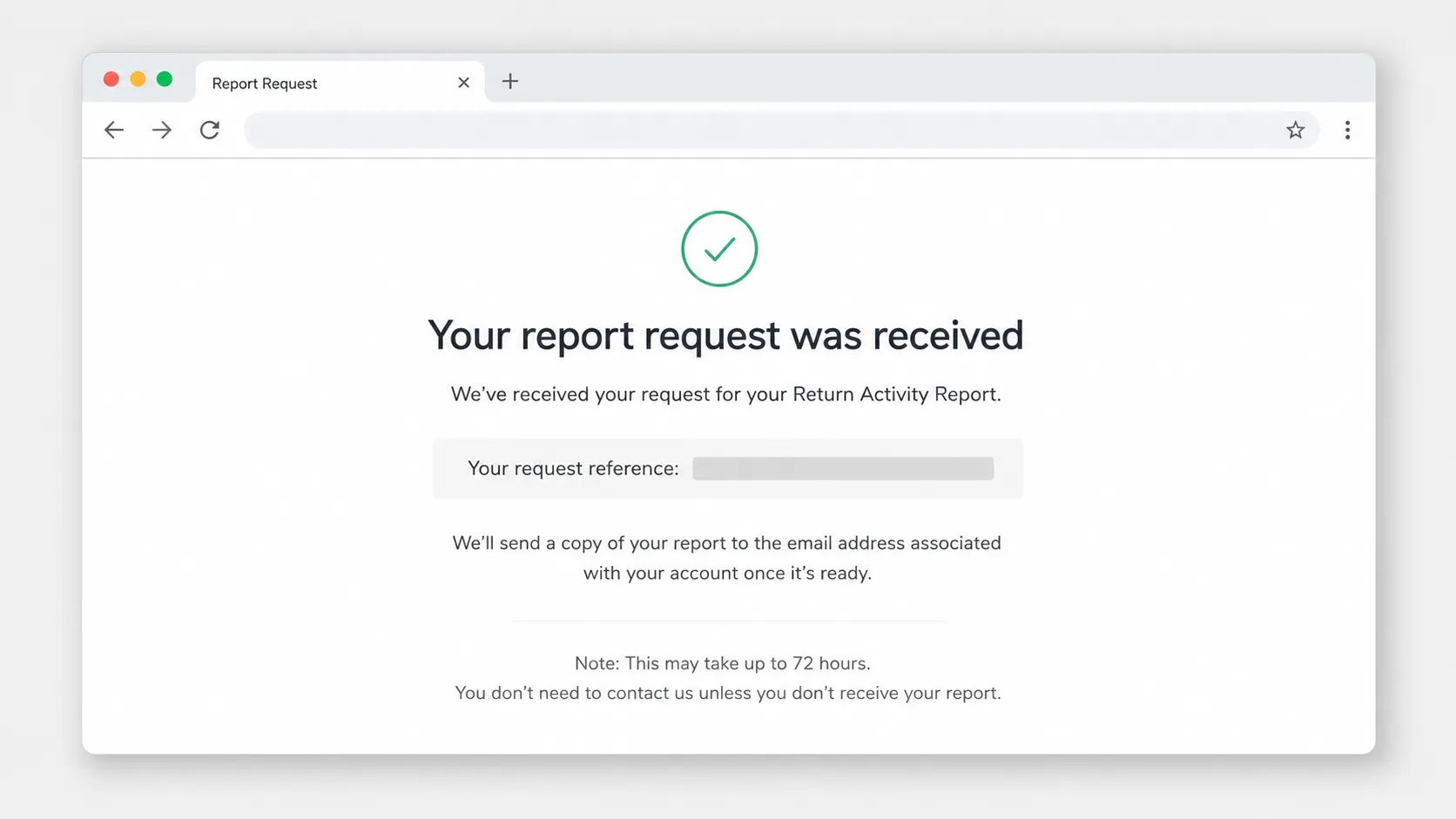
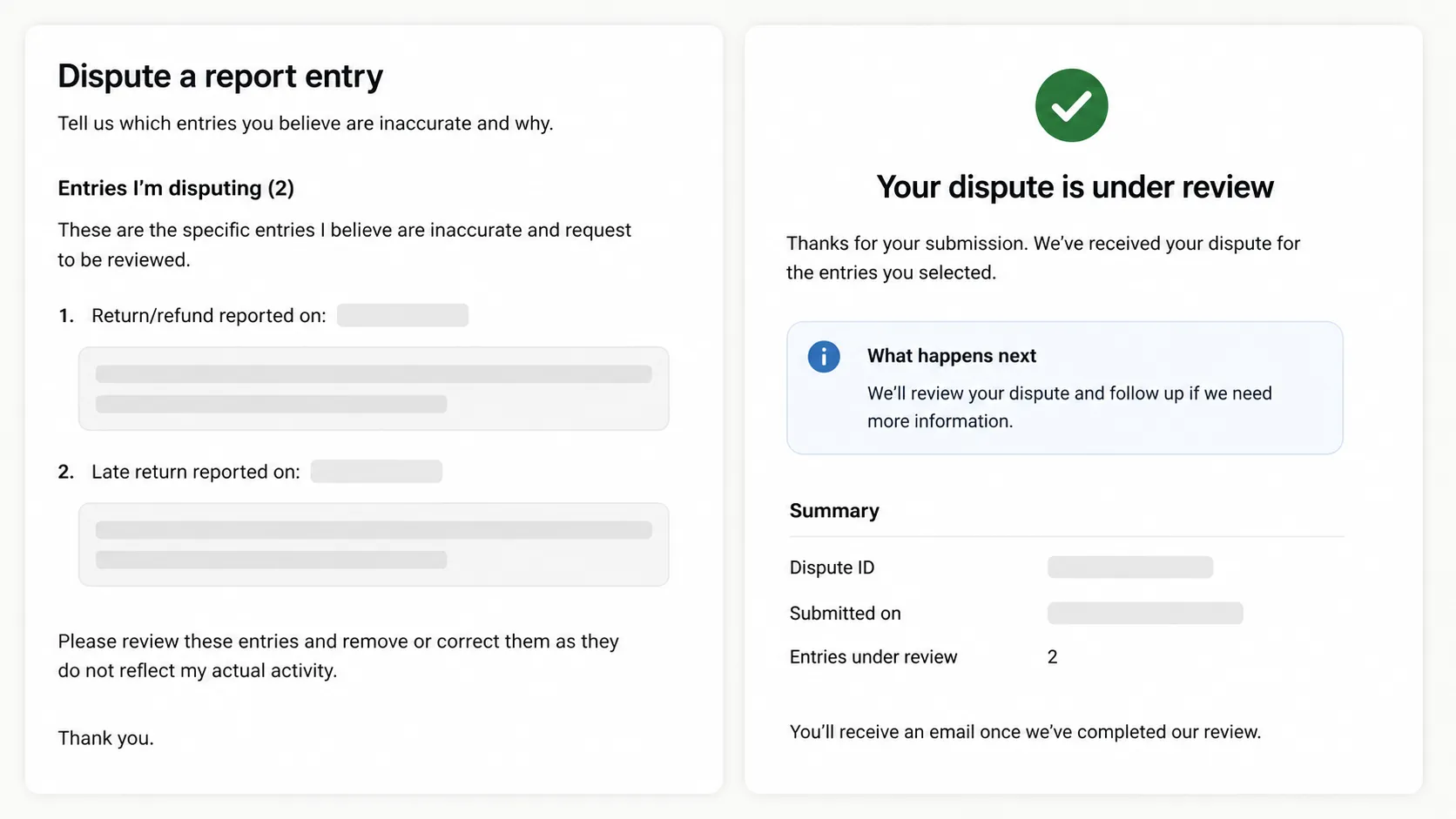
Staying out of trouble is mostly about keeping returns reasonable and knowing your rights if you are flagged. Because The Retail Equation is a consumer reporting company under the Fair Credit Reporting Act, a flagged shopper can request their Return Activity Report and dispute inaccurate entries, and the company must investigate.
That single fact turns a scary “blacklist” into something you can actually challenge.
To lower your risk before anything happens:
Keep your receipts and know each store’s return window and no-receipt caps.
Avoid frequent no-receipt returns, since those are the ones third-party systems scrutinize most.
Keep your overall return rate sensible, especially on electronics.
Return items in original condition and packaging where the policy requires it.
If you are already flagged or banned, here is the sequence that works:
Request your Return Activity Report from the retailer’s tracking partner, using the transaction ID on your denial slip.
Read it carefully for returns you never made or details that look wrong.
Dispute specific inaccurate entries in writing, naming each one rather than complaining in general.
Escalate under the Fair Credit Reporting Act if the errors are not corrected.
Separately, ask the retailer directly whether an account ban can be appealed, since that is a business decision they can reverse.
When I requested and reviewed my own report, an itemized written dispute got a response far faster than a vague complaint would have. Disputes are not guaranteed to succeed, but naming exact entries is what moves them.
If a ban has already landed, it helps to understand how store blacklists actually work before you decide how to respond.
Frequently Asked Questions
Can you get banned for too many returns?
Yes. A store or online account can refuse your future returns or close your account for excessive returns, but that is a private business decision, not a criminal charge, and it does not show up on any background check.
Can you go to jail for returning too much?
No, not for the volume of returns itself. Jail only enters the picture with deliberate return fraud, meaning you intended to deceive the retailer and the value crossed your state’s theft threshold, such as $950 in California.
What happens if you accidentally return the wrong item?
An honest mix-up is almost always corrected without a penalty once you explain it to support. Retailers distinguish accidental errors from deliberate deception, and a labeling mistake or wrong package is treated as the former.
Does Amazon ban you for too many returns?
Amazon can close accounts for excessive or suspicious returns, but it publishes no numeric limit and acts on behavior and risk signals rather than a fixed return rate. Return reasons, especially repeated “defective” electronics claims, matter more than the raw count.
Can a store charge you for a return?
Some retailers apply restocking or return fees, and a few may charge you for a used or non-returnable item you tried to return. That is a fee or a charge, not a criminal penalty.
How do I see what stores have on my returns?
Request your Return Activity Report from the retailer’s return-tracking partner using the transaction ID on a warned or denied receipt. You can review it and dispute any errors under the Fair Credit Reporting Act.
The Bottom Line
So, can you get in trouble for too many returns? You can be flagged, warned, banned, or blacklisted, and for a normal shopper that is where the story ends, with private consequences you can often dispute or appeal rather than anything on a permanent record.
The jail-time headlines belong to the top rung of the ladder, where someone deliberately deceives a retailer past a dollar threshold, and that is a world away from returning a few too many purchases. Know which rung you are on, keep your returns honest and reasonable, and you have both the reassurance and the rights to handle whatever slip a store hands you.
Read it your way
Short on time? Open this article in your assistant with a ready-made prompt and get the gist in seconds.
Found this useful? Make us a preferred source so we show up in your Google results.
Keep reading
Related articles
Eligibility & Conditions
What Stores Use The Retail Equation? (2026, Best Buy Out)
See which stores use The Retail Equation in 2026: a verified status list of who still tracks returns, who dropped it (Best Buy, 2019), and who never did.
Eligibility & Conditions
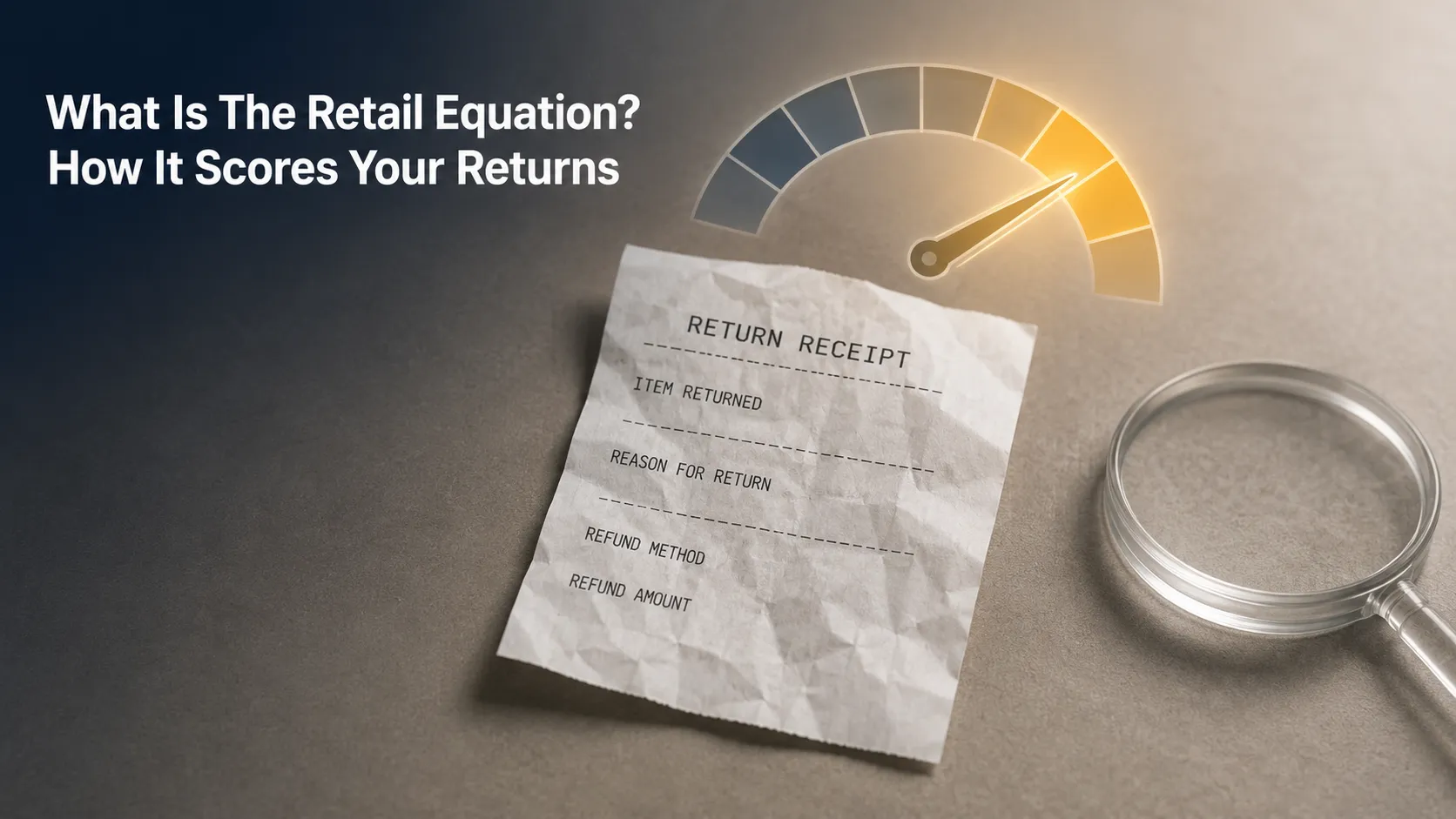
What Is The Retail Equation? How It Scores Your Returns
Denied a return? The Retail Equation scores your returns and can approve, warn, or deny them. See how it works, read a real RAR, and dispute errors
Eligibility & Conditions
Sephora Return Limit: No Set Number, 30-Day Window & TRE Tracking
Sephora has no set return limit, but a 30-day window and Retail Equation tracking mean too many returns can trigger a 365-day ban. Here’s the real rule.
Eligibility & Conditions
Do Stores Track Your Returns? How the System Works (2026)
Yes, most stores track and score your returns. See how the system works, what they log, and how to request your own Return Activity Report.
The discussion
Comments
Every comment is reviewed before it goes live.